-
-
1
-
2
-
3
-
4
-
5
-
6
Inspiration
Misplacing an everyday object is often part of a larger continuity problem. A plan changes, someone leaves without updating what they need, and later a Search begins under stress.
Hardware trackers solve one object at a time. Generic assistants can be helpful, but they may also sound more certain than the available evidence allows.
LostLoop explores a different idea: an AI recovery companion that can reason about the next useful step without ever pretending to know what physically happened.
ChatGPT plans the next move. You own reality.
What it does
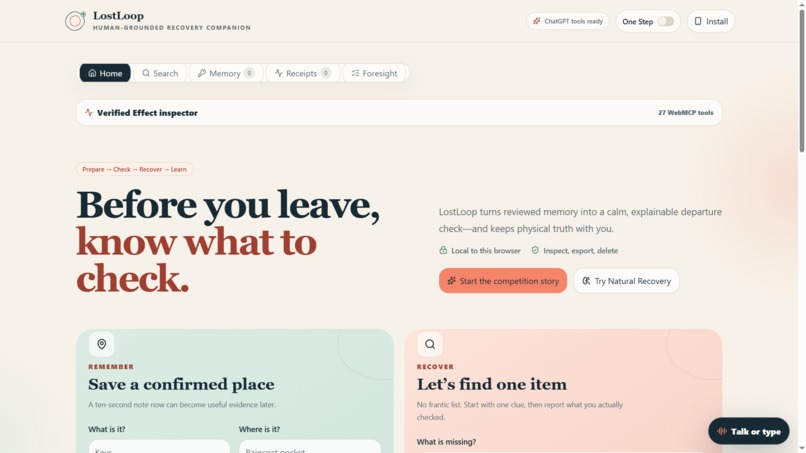
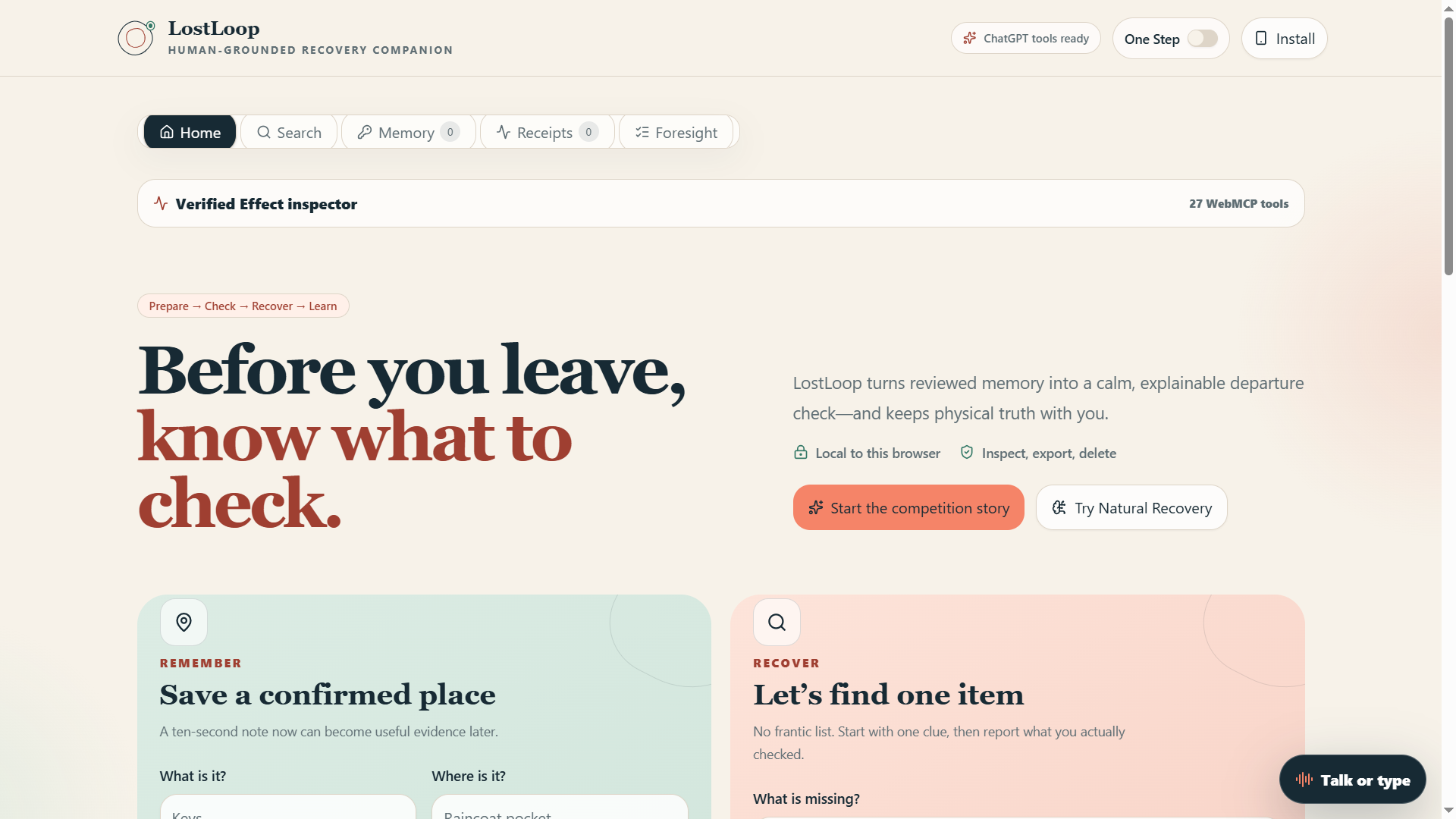
LostLoop is a private, local-first Human- Companion built around a strict separation between AI planning and human-confirmed reality.
The complete loop is:
- Remember a human-confirmed place.
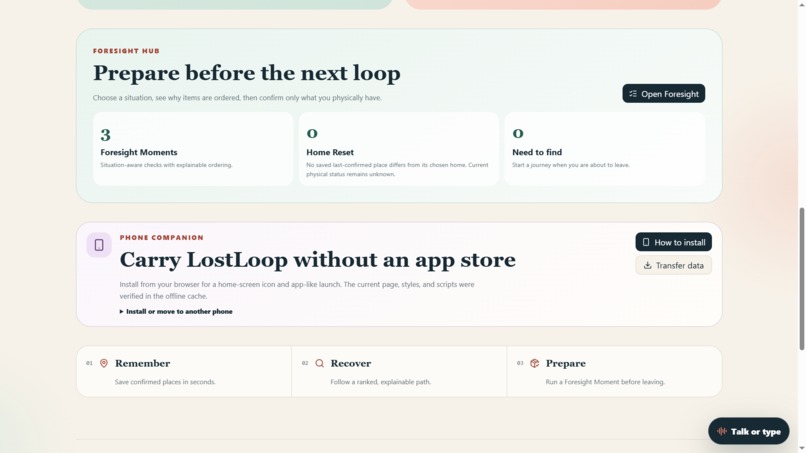
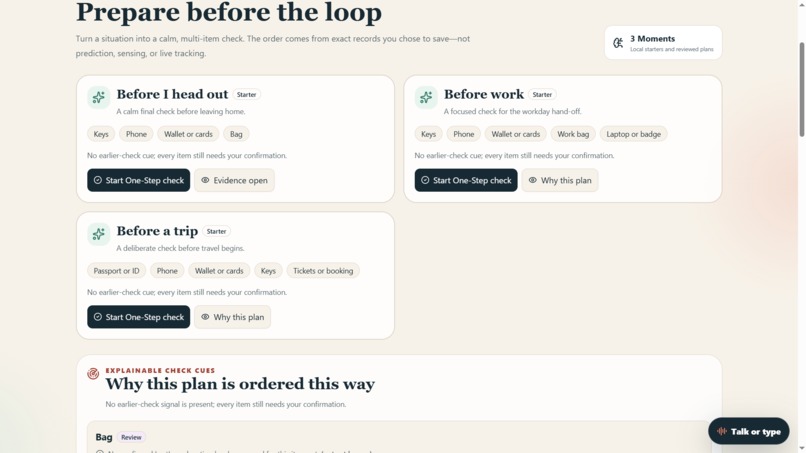
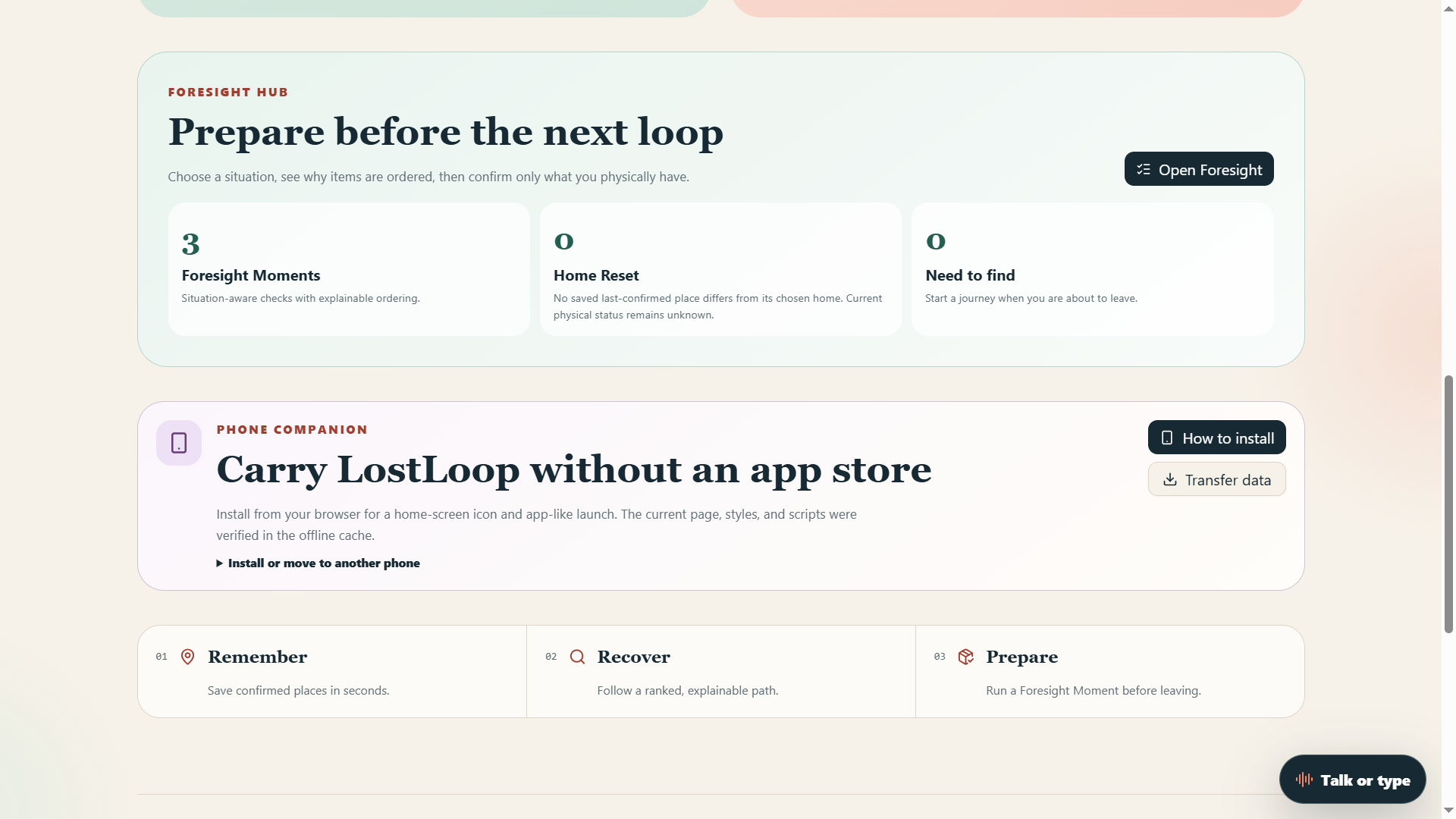
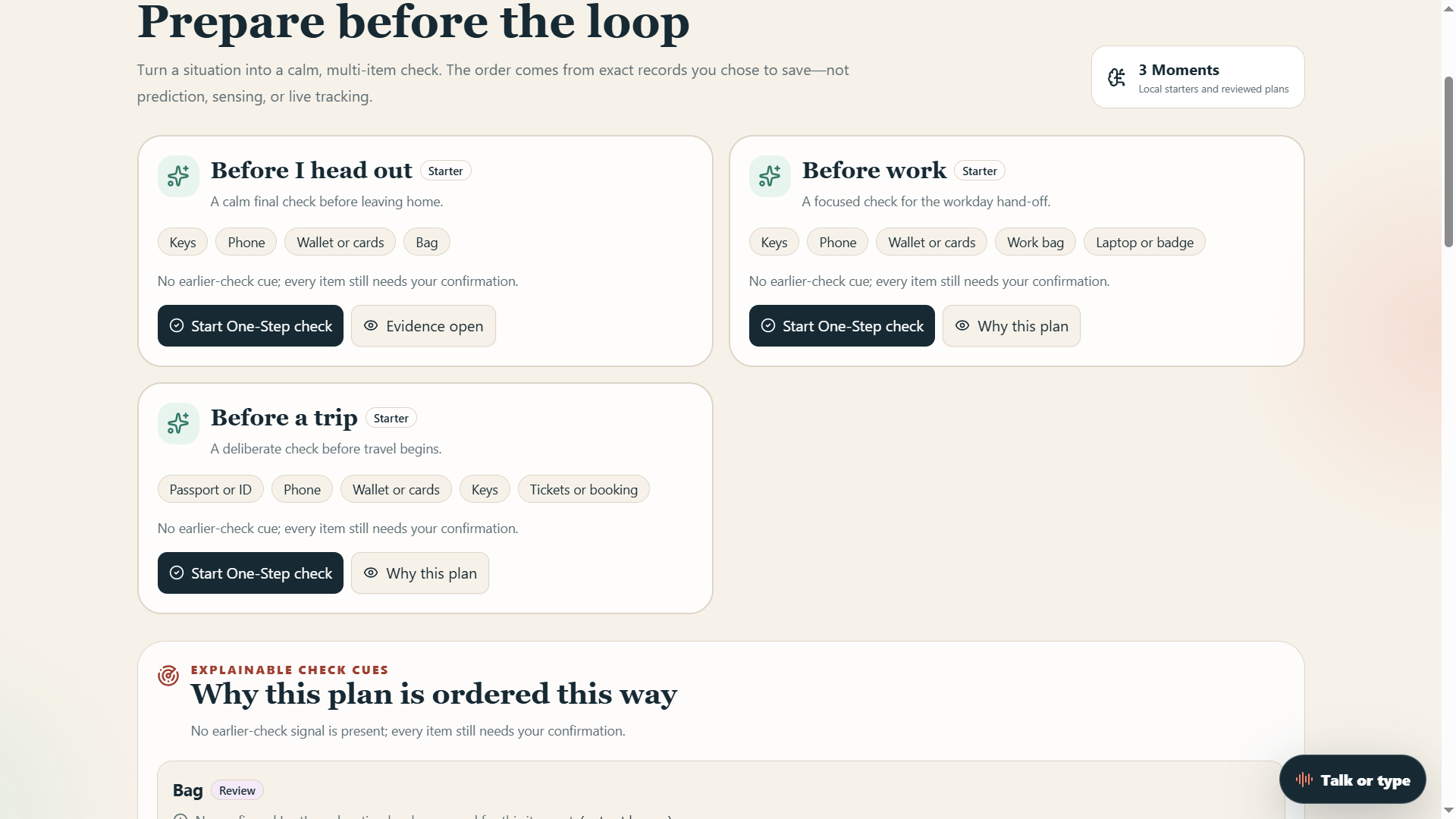
- Prepare reusable Foresight Moments and Ready Journeys.
- Adapt a journey through a reviewable Plan Shift.
- Recover through explainable Search, Rewind, and the Living Home Canvas.
- Confirm every physical report and possession state separately.
- Learn personal place language only after explicit human approval.
For example, ChatGPT can read the current LostLoop state through WebMCP and stage a change to a saved journey. LostLoop shows the exact Kept / Added / Removed diff, but staging the proposal changes no physical fact. The person alone can apply or discard it.
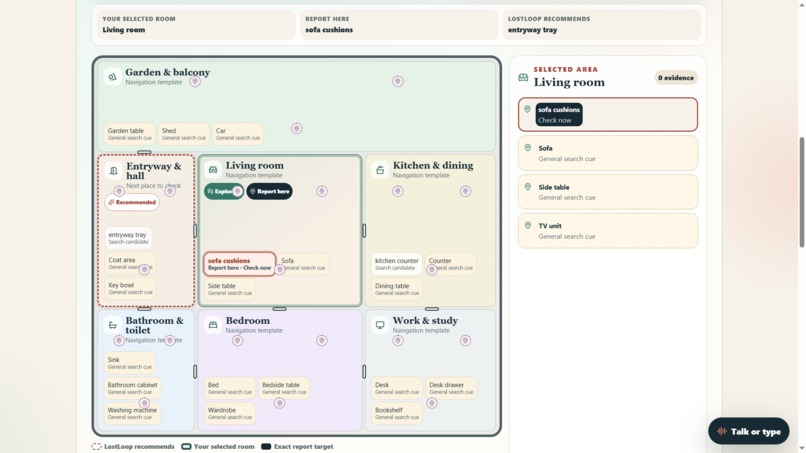
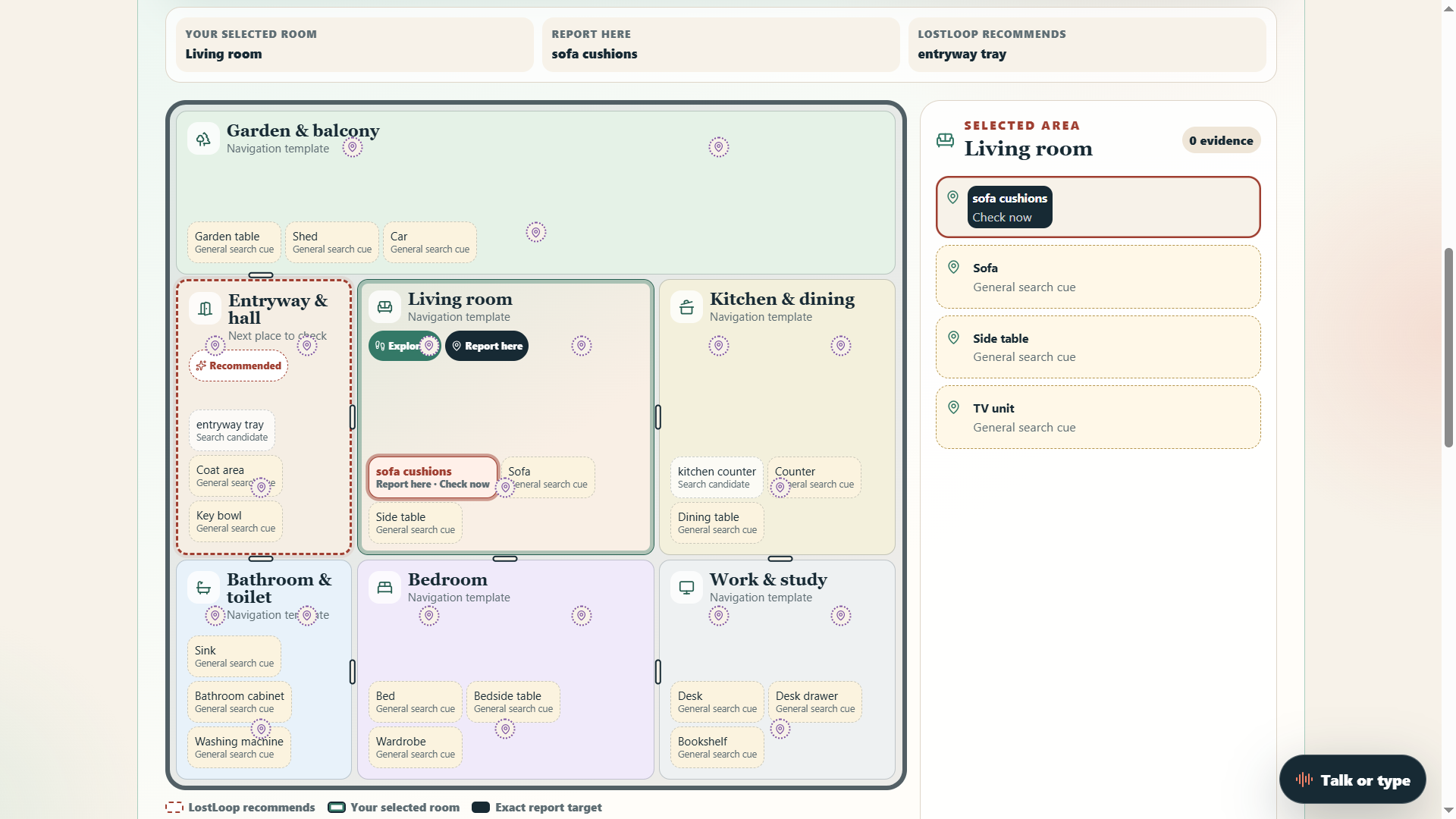
During Search, LostLoop keeps three things separate: what the evidence recommends, which room the person has selected, and which exact place is eligible for a report.
A statement such as “I checked the bathroom” is not automatically converted into a physical fact. LostLoop first asks for an exact visible landmark and any missing outcome, then presents the normal confirmation boundary.
The system also supports natural personal language such as “my little table”, but teaching that phrase changes language only — never memory evidence or physical truth.
Why WebMCP
WebMCP is the core interaction layer rather than an add-on.
LostLoop exposes exactly 27 closed-schema WebMCP tools through document.modelContext.registerTool(...).
ChatGPT can read the live browser-local workspace, understand which actions are structurally possible, and stage bounded proposals against exact revisions.
The tools are intentionally asymmetric:
- read tools are pure;
- proposal tools are revision-bound and inert;
- physical facts require explicit human confirmation;
- there is no agent-side approval path.
LostLoop exposes a versioned Action Graph describing allowed and blocked operations, their revision bindings, human gates, and truth effects.
Every WebMCP call also passes through a common Verified Effect runtime contract. The result includes a bounded receipt showing the before/after revision, observed changes, human gate, replay status, and next legal read.
The in-app Judge Inspector displays actual session receipts while explicitly describing them as application-level verification rather than a cryptographic audit.
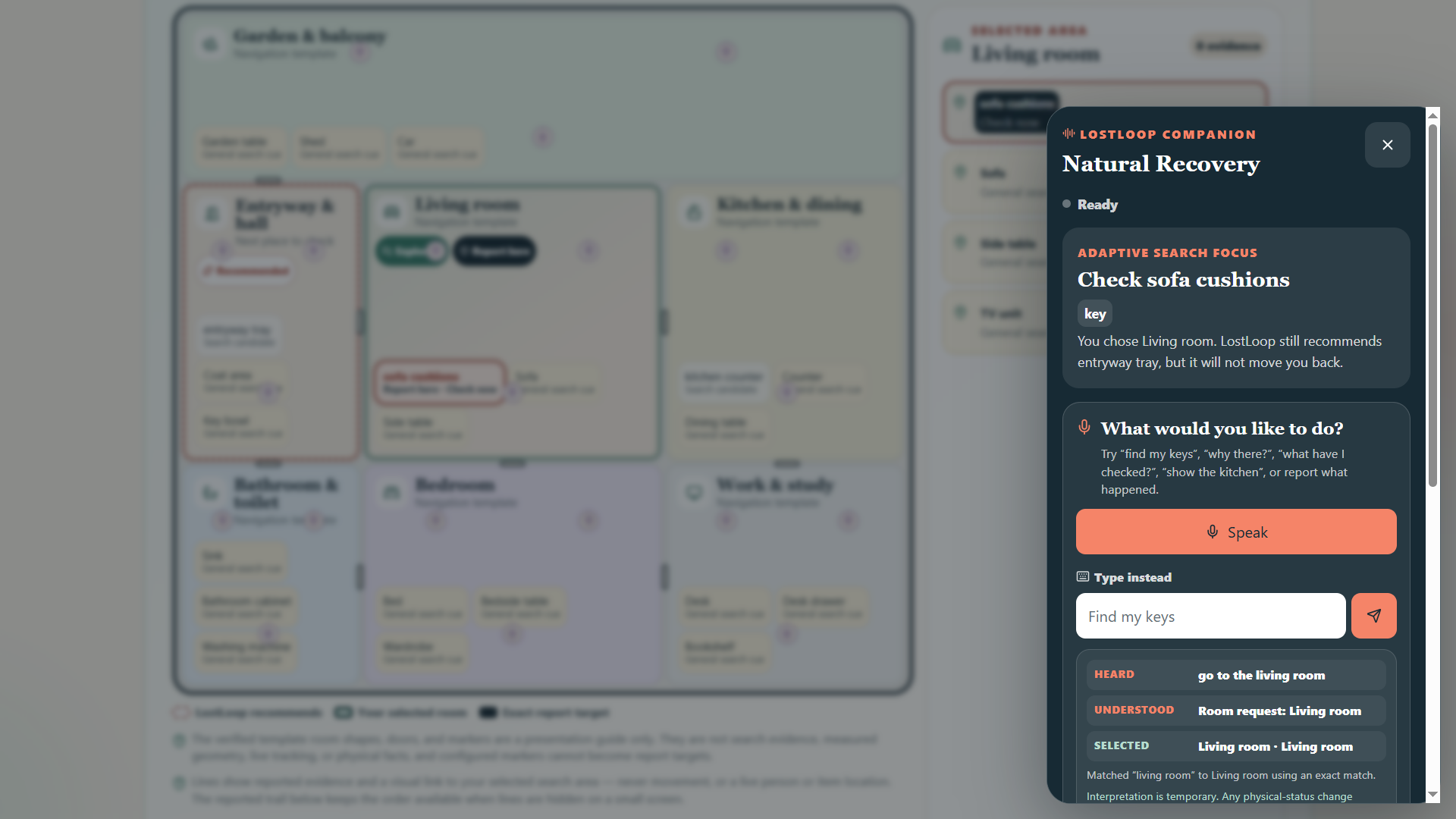
Natural Recovery without invented certainty
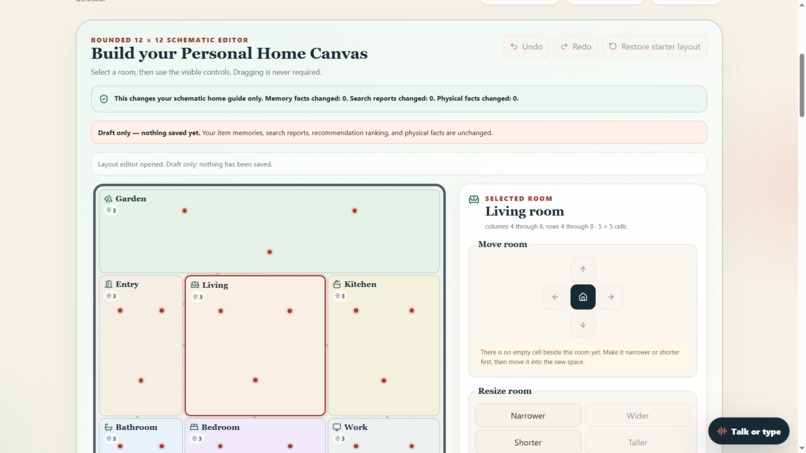
The Living Home Canvas provides a familiar room-and-landmark interface for recovery.
It is intentionally not a tracking system. It does not use GPS, indoor positioning, cameras, Bluetooth, or inferred person/object locations.
The WebMCP projection makes this boundary machine-readable:
tracking: falsecurrentPersonLocation: nullcurrentItemLocation: null
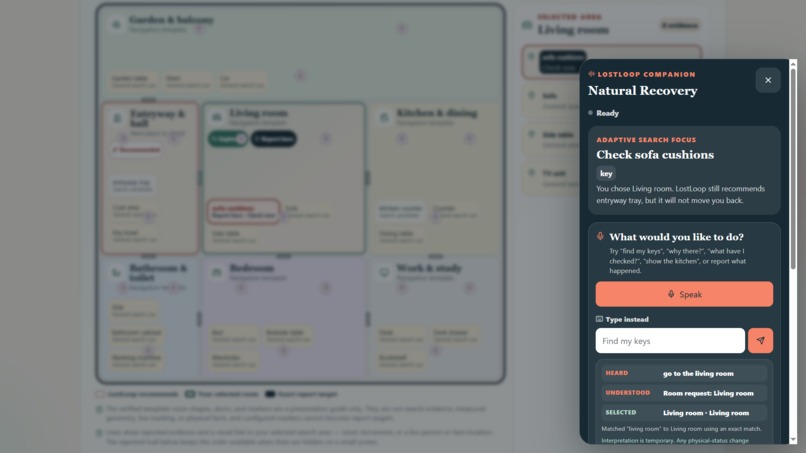
Natural language is resolved only against bounded visible candidates.
Exact spatial relations such as under, inside, or behind require a visible anchor. Ambiguous near / next-to / beside language becomes a visible choice rather than invented geometry.
The interface exposes Heard → Understood → Selected, making language interpretation inspectable instead of silently guessing.
Human Truth
One of the most important LostLoop rules is:
Found ≠ possession.
Finding an item does not automatically mean the person has it with them.
Search completion and possession are separate human-confirmed states. This prevents the assistant from collapsing a real-world observation into a stronger claim than the person actually made.
The same principle applies throughout the product: AI can suggest, organize, rank, explain, and stage — but the human owns the facts.
Privacy and safety
LostLoop is local-first.
There is no account system, analytics backend, automatic cloud sync, GPS tracking, stored microphone recording, stored transcript, or user-data backend.
Personal place phrases and custom home layouts remain local and exportable. Private text is redacted from collaboration receipts and inspection summaries.
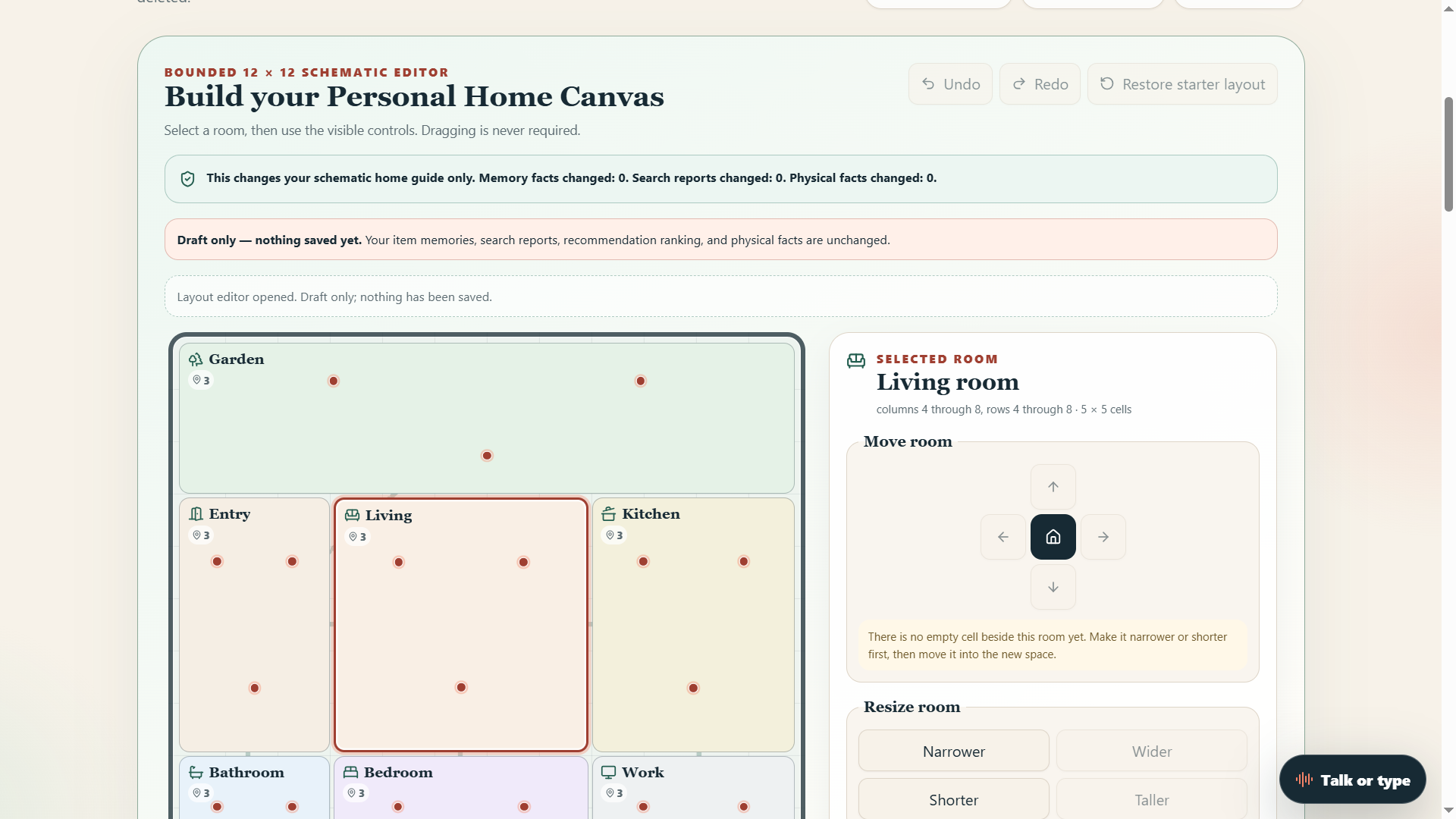
The Personal Home Canvas is a bounded schematic editor, not architectural CAD or an AI-generated location model. It is explicitly marked as not to scale and never claims where a person or object currently is.
How im built it
LostLoop 14.0 uses:
- React 19
- TypeScript
- Vite / Vinext
- Cloudflare Workers
- browser-native PWA capabilities
- local browser storage
- Web Speech input/output
- WebMCP
The application uses a deterministic state-transition engine with strict schema validation, revision-checked writes, bounded inputs, explicit migrations, and fail-closed WebMCP contracts.
The final competition release contains exactly 27 WebMCP tools.
Challenges
The hardest problem was not adding more AI capability. It was deciding what the AI must not be allowed to claim.
Natural language is messy. People say things like “I checked there”, “go back to the table”, or “try beside the bed”. A normal conversational system may resolve these confidently, but LostLoop has to preserve uncertainty whenever the evidence is incomplete.
That required closed candidate sets, revision binding, explicit confirmation gates, deterministic semantic framing, and careful separation between navigation, suggestions, observations, and physical facts.
Another challenge was keeping the same interaction useful through voice, typing, touch, WebMCP, desktop, and mobile without creating hidden state transitions.
Accomplishments
The final 14.0 release passed the complete release gate with:
- 355 tests passed
- 0 failed
- 0 skipped
- zero production runtime audit vulnerabilities
- a verified 27-tool WebMCP contract
- deterministic language and dialogue regression suites
- clean fresh-extraction build verification
The public competition build is deployed independently and can be tested without access to the development workspace.
What I have learned
The most valuable lesson was that useful agentic software does not require giving an agent unlimited authority.
A system can become more capable by making its boundaries clearer.
WebMCP made it possible to give ChatGPT structured access to the live application while preserving a strict distinction between:
what the agent can understand, what it can propose, and what only the human can make true.
What's next
The competition version intentionally focuses on one complete and inspectable recovery contract.
Future directions could include household sharing, optional cloud synchronization, broader multilingual voice support, additional accessibility modes, and richer personal home presentation — while preserving the same human-confirmed truth boundary.
Built With
- chatgpt
- cloudflare
- localstorage
- node.js
- pwa
- react
- typescript
- vite
- webmcp
- webspeechapi

Log in or sign up for Devpost to join the conversation.