Project title
Lost in Preparation
Challenge track
Track 1: Traditional Knowledge Mining
Inspiration
In the 1970s, Tu Youyou's team kept failing to get antimalarial activity from sweet wormwood. Then a 4th-century text by Ge Hong pointed them away from heat. A low-temperature extraction then yielded artemisinin, and a Nobel Prize in 2015. The plant had been right all along; the preparation had not.
That made us ask how often modern studies of traditional remedies test the plant the way the recipe actually prepared it: cold infusion or decoction, wine or water, fresh juice or dried powder, strained or not. And when they don't, can we even tell?
Problem statement
Traditional remedies are recipes: a plant, a solvent, heat or none, a plant part, fresh or dried material, strained or not. Each choice changes which compounds end up in the preparation. Modern pharmacology usually tests a plant as a standard solvent extract, and rarely reports enough about the preparation to tell whether a traditional remedy was ever tested the way it was made. Artemisinin shows what is at stake: the activity was found only once researchers followed a 4th-century text's preparation and avoided heat. Promising leads may be dismissed, or never examined, because the preparation was lost between the recipe and the lab.
What it does
Lost in Preparation is a pipeline and a website that:
- Reads historical herbals (Culpeper 1652 and 1850, and Pliny's Natural History as translated by Bostock and Riley) and extracts structured recipes. Every field is backed by a verbatim quote from the source, so a failed quote check rejects the recipe.
- Resolves historical plant names to accepted species (World Flora Online), with candidates, confidence and flags for disputed names.
- Looks up the known compounds for each species (LOTUS via Wikidata, standardised with RDKit).
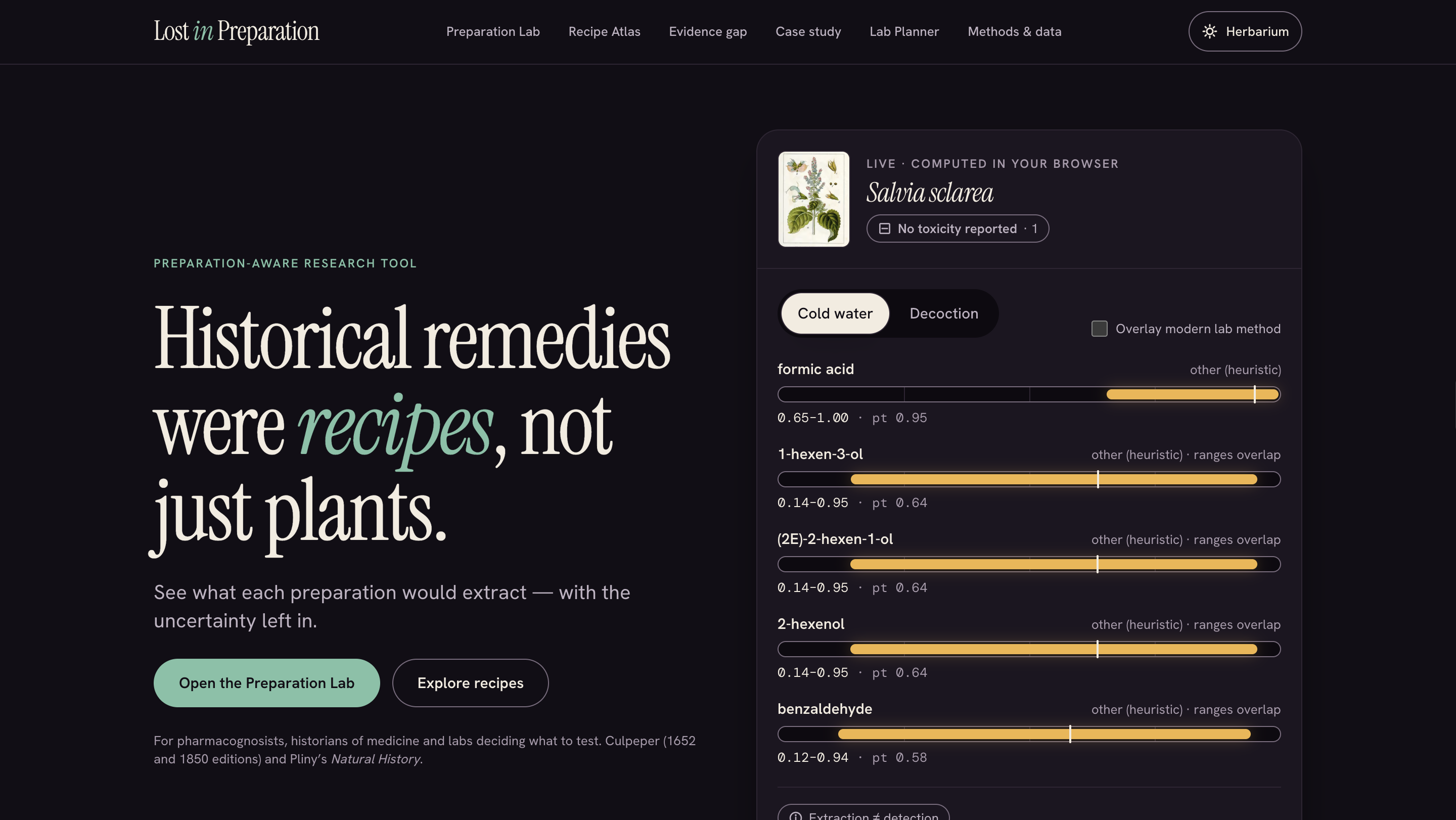
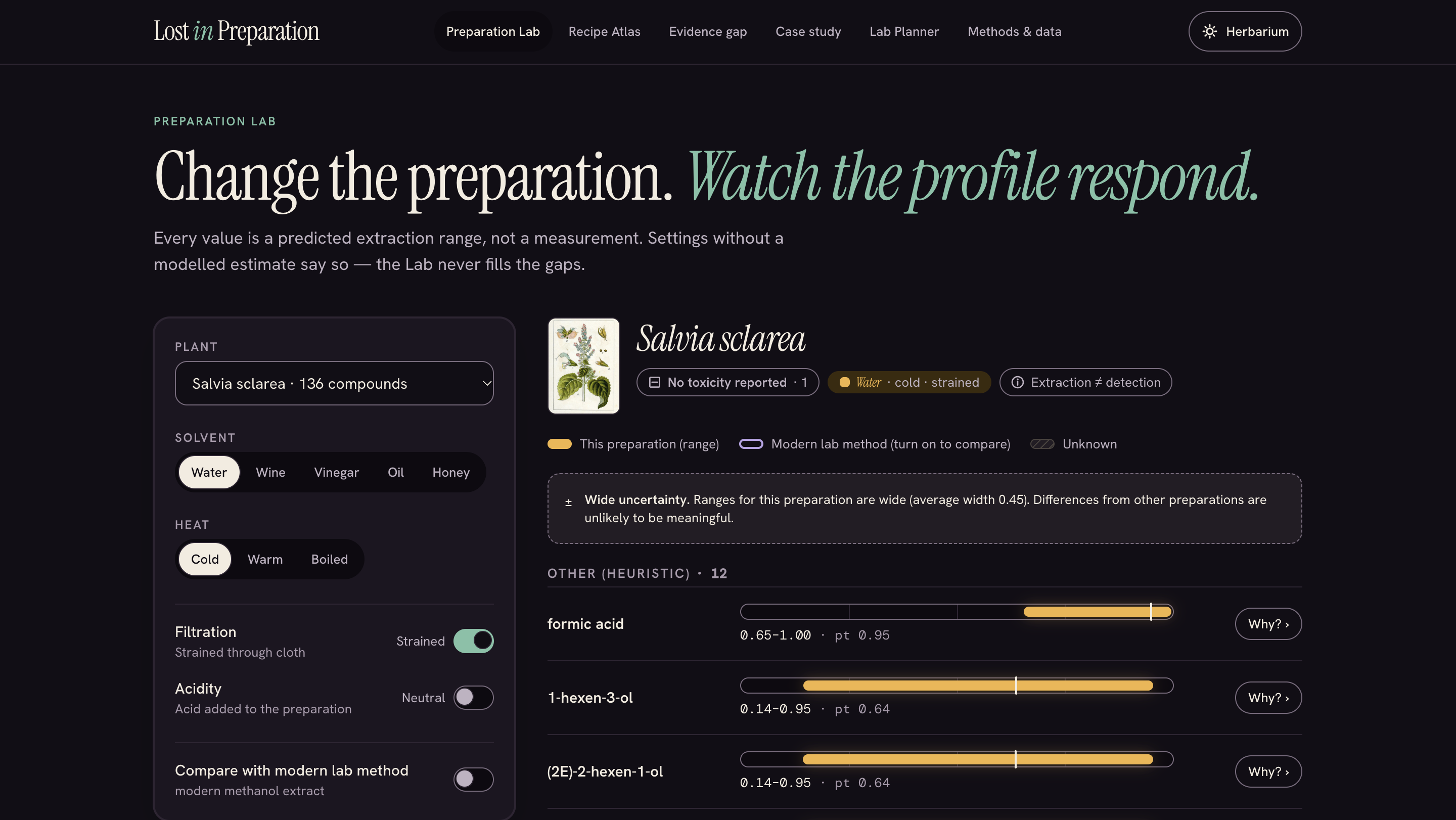
- Models what each preparation delivers chemically. Solvent, heat, filtration and acidity are separate factors with Monte Carlo uncertainty ranges, and the artemisinin case serves as a sanity check.
- Audits the modern literature. For each plant and historical use, it records how modern studies prepared the plant, under a protocol fixed before any study was retrieved.
- Ranks hypotheses worth re-testing: plant–use pairs never tested the way they were made, ranked only on gaps that hold across the uncertainty range. It then picks a re-test panel by exact optimisation and benchmarks classical and simulated-quantum (QAOA) solvers against that optimum.
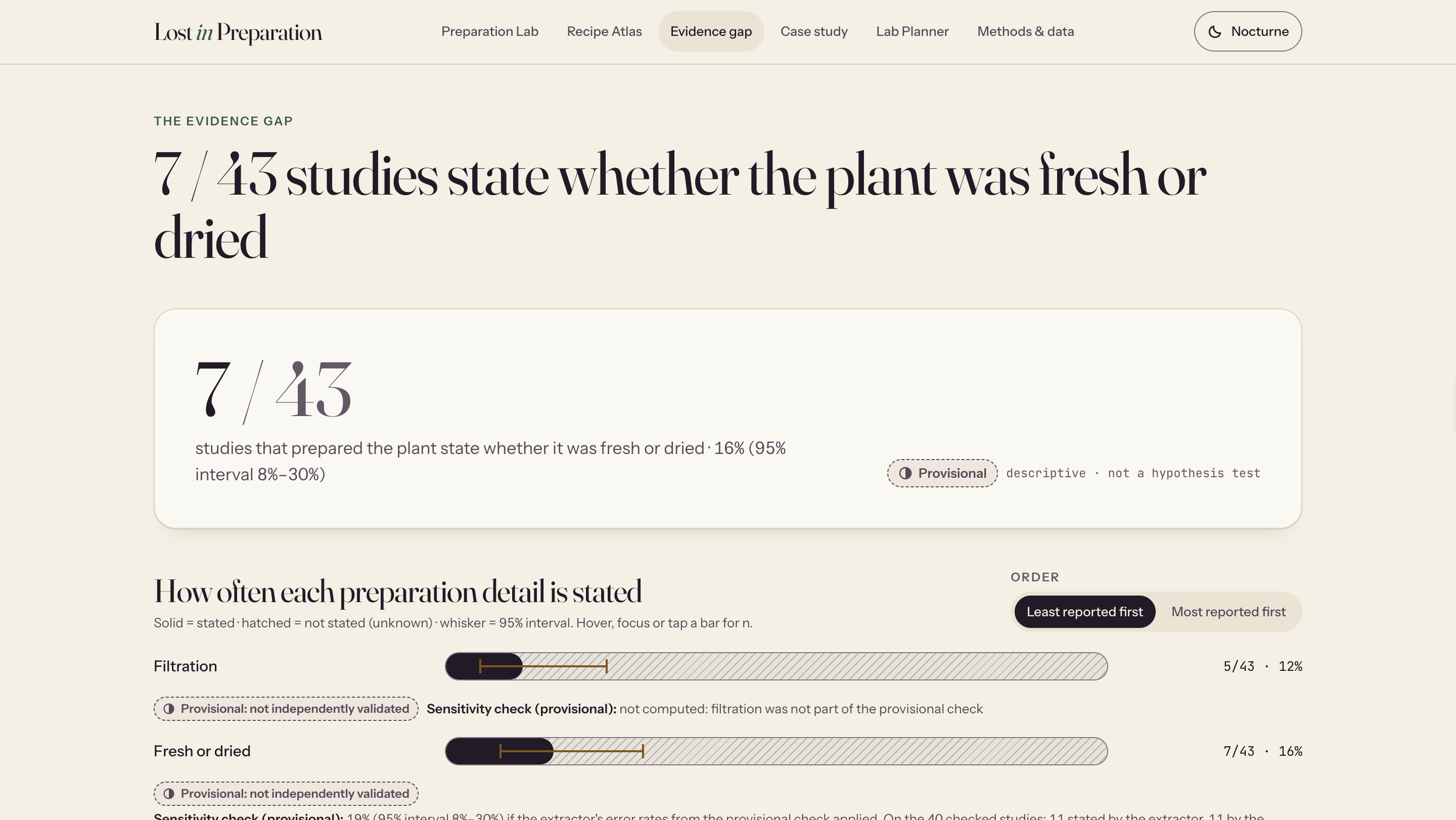
Headline finding: a reporting gap. Among 43 modern studies that prepared the plant material, the share stating each preparation variable was:
- heat: 26% (95% CI 15–40%);
- fresh or dried: 16% (8–30%);
- filtration: 12% (5–24%);
- all five variables: 0% (0–8%).
Only 2.3% (95% CI 1.1–5.0%) of screened articles compared two preparations of the same plant material. So it is usually impossible to tell whether a remedy was ever tested the way it was made.
The website lets anyone explore all of this:
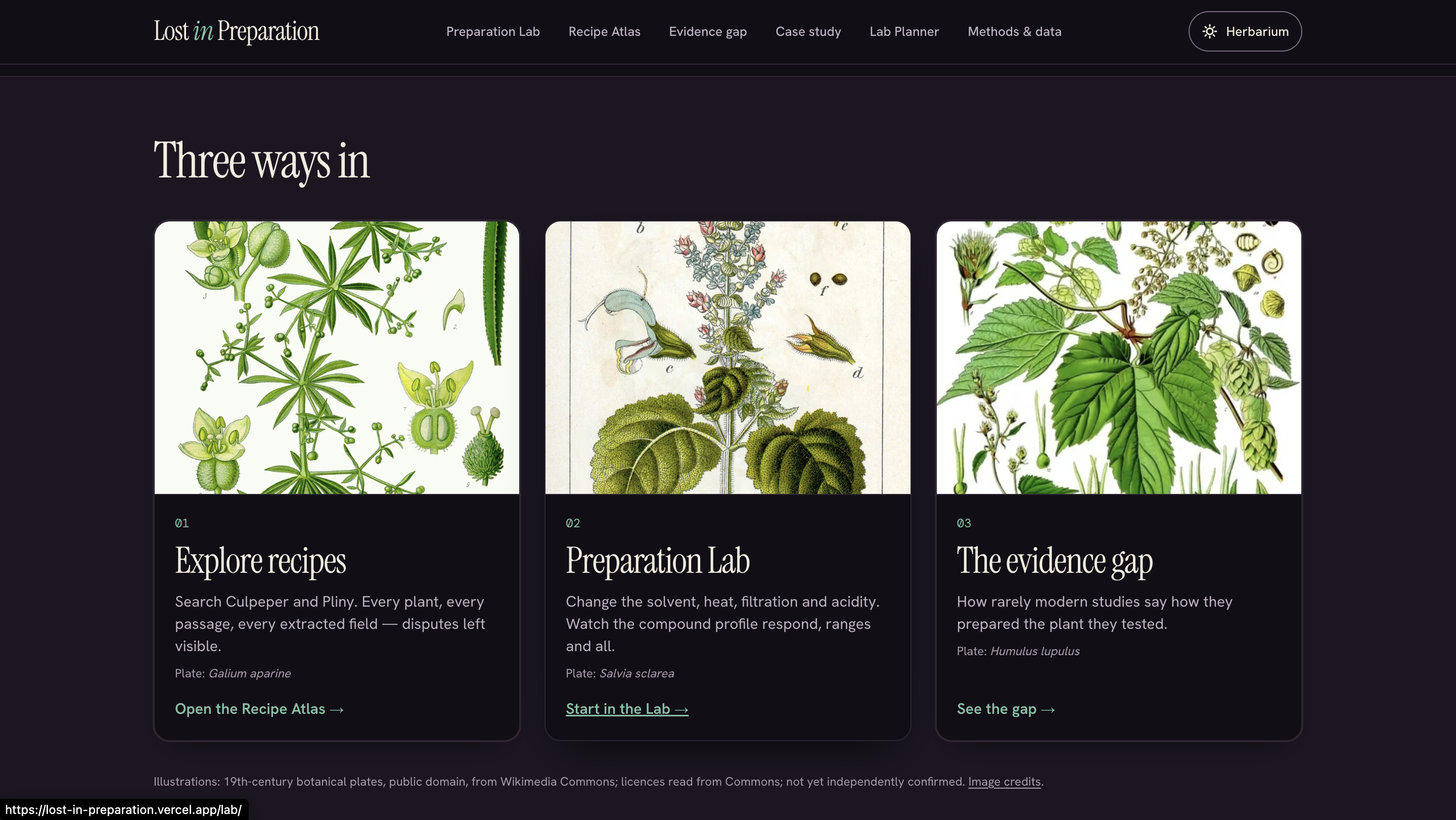
- Preparation Lab: switch solvent, heat and straining and watch the predicted compound profile change. It runs live in the browser, and every setting is a shareable URL.
- Recipe Atlas: 631 recipe pages, each with its source quotes.
- Evidence gap: the reporting-gap figures above.
- Liquorice case study.
- Lab Planner: the suggested re-test panel.
- Impact & ethics: who can use the outputs, a proposed preparation reporting checklist, the terms for traditional knowledge, and the plan beyond the hackathon.
It never claims a remedy works or is safe. Its output is hypotheses worth re-testing, each with a cited toxicity entry.
Results
- Headline: a reporting gap (descriptive; n and 95% Wilson intervals). Of 43 modern studies that prepared the plant material, the share stating heat was 26% (15–40%), fresh or dried 16% (8–30%), filtration 12% (5–24%), and all five details 0% (0–8%). Only 2.3% (1.1–5.0%) of 257 article screenings compared two preparations of the same plant material.
- Fidelity audit (supporting, small n). Pre-registered v2: 0 of 11 units with a known status were faithful to the historical preparation (32 unknown). Audit v1 had a design flaw; it is reported as it stands, and v2 was pre-registered before it ran.
- Hypotheses worth re-testing. 3 plant–use pairs never tested the way they were made, ranked only on gaps that hold across the uncertainty range. The top one, Glycyrrhiza glabra (liquorice) for liver diseases, changed after a logged extraction correction (median gap 0.20 → 0.42).
- Re-test panel. An 8-experiment panel chosen by exact optimisation of a QUBO (robust gap + coverage − redundancy), toxic species excluded, under a pre-registered rule.
- Quantum benchmark. QAOA (penalty and XY mixers, simulated) against the exact optimum. Mean probability of sampling the optimum, as a multiple of a random feasible panel: 2.7× / 1.5× / 0.7× at 8 / 12 / 16 candidates in v2, and up to 5.0× / 4.8× / 2.2× in the pre-registered v3 (cost rescaling, INTERP to p = 5, CVaR). Simulated annealing found the optimum on every run. At 0.5% two-qubit error, P(optimum) fell from 0.19 to 0.02. No quantum advantage is claimed.
- Quantum chemistry. GFN2-xTB logP against 150 measured compounds: mean absolute error 1.51, against 0.66 for RDKit's Crippen logP, so the model uses RDKit.
- Preparation model. 18/18 essential-oil rows agree with it; water preparations remain unvalidated (too few studies reported a compound as absent).
- Prototype. A live website (see Links): Preparation Lab, Recipe Atlas (631 recipe pages), evidence gap, liquorice case study, ranked hypotheses, Lab Planner with the quantum benchmark, Methods & data, Impact & ethics.
Impact and ethics
- Drug discovery: the Lab Planner gives natural-product labs a short re-test panel, each plant prepared as the recipe said, with toxic species excluded. Artemisinin is the reference case.
- Journals and reviewers: the headline finding implies a five-item preparation reporting checklist (solvent, plant part, heat, fresh or dried, filtration), plus a sixth: when a study evaluates a traditional use, test at least one preparation made the traditional way. It costs authors a few lines of methods text and makes a negative result interpretable.
- Public health: people take plants as teas, decoctions, tinctures and oils, not lab extracts. The Lab shows how far a preparation's predicted profile differs, compounds of concern included. It gives no guidance on preparing or taking any plant.
- Conservation of knowledge: plant-use databases usually drop the preparation. Here every recipe field is tied to a verbatim quote, so the how is kept with the what.
- Ethics: we used only published, public-domain texts, so no living community's knowledge was taken without consent. Extending the method to living traditions would follow the CARE Principles, free, prior and informed consent through a community partnership, and Nagoya Protocol access and benefit-sharing terms. The community would decide what is published, not us.
- Feasibility: World Flora Online and LOTUS are global, the static site costs nothing to run, and the pipeline reruns from a fresh clone with no API keys. The bottleneck to scaling is expertise in historical plant names, not computing.
How we built it
- Pipeline (Python 3.11): a versioned data contract (Pydantic → JSON Schema → generated TypeScript and Zod types), with TEI/EEBO and Gutenberg ingestion and pinned SHA-256 checksums. Compound handling uses RDKit, with GFN2-xTB as a cross-check against experimental logP. The modern-methods audit is coded by rules from a versioned lexicon, and each check was pre-registered before its data was collected.
- Recipe extraction: written by Claude (
claude-opus-5-5) in a Claude Code session, following a frozen prompt (v3). Every record passes the same verbatim-quote validator, and failures are logged rather than repaired. The model, the prompt version and the date are recorded on each record. - Optimisation (Phase 8): the re-test panel is a QUBO (robust gap + coverage − redundancy), solved exactly. Greedy, simulated annealing and QAOA (penalty and XY mixers, simulated in Qiskit Aer with a noise sweep) are benchmarked against the exact optimum. No quantum advantage is claimed.
- Website: Next.js static export (TypeScript strict, Tailwind). The M4 preparation model is ported to TypeScript and runs in a Web Worker, and the build fails unless it reproduces every published Python estimate exactly. Every data file is checked against the contract schemas when the site builds.
- Quality gates: 306 Python tests; type-check, lint, Vitest, Playwright and axe in both themes on desktop and at 390 px; and Lighthouse. A fresh-clone reproducibility script reruns the pipeline with no API keys and network access refused.
Challenges we ran into
- Our first audit protocol had a design flaw. Its solvent rule made every non-water recipe unmatchable, so v1 measured our protocol rather than the field. We kept v1 frozen and reported it, then pre-registered a v2 re-analysis instead of quietly fixing it.
- Historical plant names are slippery. Pliny's 19th-century translation often uses disputed identifications, so Pliny is marked lower confidence throughout, and a genus "false friends" audit checks the names.
- Validating the preparation model honestly. It agrees with 18/18 essential-oil rows, but water preparations remain unvalidated: we found too few literature rows that reported a compound as absent. We say so on the site rather than overstating it.
- Avoiding circular evaluation. The same AI wrote the extraction guidelines and the silver set, so we refuse to score extraction against that set. It will be scored only against a human gold annotation.
- A real correction mid-project. An extraction error changed the top hypothesis (liquorice, median gap 0.20 → 0.42). We logged the correction and turned it into a public case study.
Accomplishments that we're proud of
- A quantified, reproducible reporting gap, with n and 95% CIs for every figure.
- Every recipe field traces to a verbatim quote from a public-domain source.
- A browser engine with exact parity to the Python model, enforced as a build gate.
- Pre-registration, frozen protocols and published failures (audit v1, the inconclusive v3 check) rather than only the results that worked.
- A clear validation status for each result: human-validated, validated against external data, AI-assisted check (provisional), or human validation pending.
What we learned
- Whether a remedy "doesn't work" in a modern study often can't be judged, because the study never says how the plant was prepared.
- AI-assisted extraction is powerful, but only trustworthy when every claim can be checked mechanically against its source text.
- Quantum optimisation is fun to benchmark, but on problems this size an exact solver is the honest baseline.
Data sources and attribution
Historical texts (all ingested only after their licence was checked):
- Nicholas Culpeper, The English Physitian (London, 1652): EEBO-TCP A35365, CC0 1.0.
- Nicholas Culpeper, The Complete Herbal (London: Thomas Kelly, 1850): Project Gutenberg #49513, public domain in the USA.
- Pliny the Elder, Natural History, tr. John Bostock and H. T. Riley (Bohn, 1856), vols 4 and 5: Project Gutenberg #61113 and #60688, public domain in the USA.
Databases and services:
- World Flora Online (name matching; CC0) and the GBIF Backbone Taxonomy (CC BY 4.0, doi:10.15468/39omei).
- LOTUS natural-product occurrences via Wikidata (CC0); PubChem (structures); Crossref metadata (CC0).
- Europe PMC / PubMed / PMC Open Access for the modern-methods audit: only identifiers, titles, MeSH terms and short attributed quotes from openly licensed articles are in the repository; abstracts and article texts are not.
- SangsterLogP dataset: Cirino, T., Sangster, J., Charochkina, L., & Tetko, I. (2026). Zenodo, https://doi.org/10.5281/zenodo.19387552, CC BY 4.0 (logP validation).
- European Medicines Agency HMPC monographs and public statements (one attributed sentence per species, for the toxicity entries).
- Wikipedia (CC BY-SA 4.0) and Lewis & Short, A Latin Dictionary (PerseusDL, CC BY-SA 4.0), for drafted name identifications (provisional).
- Botanical plates: 18th- and 19th-century illustrations whose Wikimedia Commons pages state public domain, credited one by one on the site's Credits page.
- Software: xtb 6.7.1 (LGPL-3.0), RDKit, Qiskit and Qiskit Aer; fonts under the SIL Open Font License.
The full register, article by article, is docs/DATA_LICENCES.md. Our code is MIT and our derived data CC BY 4.0, with third-party quotations keeping their own licences.
Limitations and assumptions
- Extraction is not detection. The model predicts the fraction of a compound a preparation extracts; studies report whether it was detected, which also depends on how much the plant contains. LOTUS has no abundance data, so the two cannot be fully separated.
- The preparation model is a hypothesis generator, not a validated predictor. It is best supported for essential-oil compounds and unvalidated for water preparations, and its ranges are wide once descriptor error is included.
- Human validation is still pending. The recipe extraction, the audit coding, the name identifications and the toxicity entries have automated or AI-assisted checks only; AI-assisted checks are labelled provisional and never counted as validation.
- Small numbers. The reporting gap rests on 43 studies and the fidelity audit on 11 known units; we report intervals rather than field-wide rates.
- Source confidence. Pliny's 19th-century translation often uses disputed plant names, so Pliny-derived results are marked lower confidence. Only single-plant recipes enter the headline analysis.
- Rule-based audit coding. "Stated" means the rule-based extractor coded a value from a versioned lexicon; abstracts report less than methods sections.
- Quantum results are simulations on small instances (noise-free statevector, plus a parametric noise model), not runs on quantum hardware.
- Scope of knowledge. Only published, public-domain European texts were used; no living community's knowledge was collected.
- No medical claims. The outputs are hypotheses worth re-testing; nothing on the site is guidance on preparing or taking any plant.
What's next
- Complete the pending human validations: a gold annotation of 50 passages, a hand-check of 40 studies, 30 scholarly name identifications, and review of the toxicity entries.
- Add more herbals and more languages (Latin, Arabic and Chinese materia medica).
- Validate the preparation model for water preparations with paired lab measurements.
- Partner with a lab to run the top re-test panel, with each plant prepared as the recipe said.
- Propose a short "preparation reporting" checklist for ethnopharmacology journals.
Links
- Code: https://github.com/DurgaPritam/Lost-in-Preparation
- Live site: https://lost-in-preparation.vercel.app
- Video: https://youtu.be/Qh62AWzp0jU?si=i6_FbM5XZJSBt7jF
Built With
- axe-core
- claude
- claude-code
- lighthouse
- lotus
- next.js
- pandas
- playwright
- pulp
- pydantic
- python
- qiskit
- qiskit-aer
- rdkit
- react
- tailwind-css
- typescript
- vercel
- vitest
- web-workers
- wikidata
- world-flora-online
- xtb
- zod
