Inspiration
Every RPG I have ever played had the same problem. The world forgot me.
I could burn a village and return three hours later to find the innkeeper cheerfully offering me a room. I could betray an ally and meet them again with no memory of what happened. The story moved forward but the world never changed.
I wanted to build the opposite of that. A game where every choice leaves a mark. Where the enemy you spared comes back. Where the promise you broke haunts you. Where the world is not a backdrop but a living thing that remembers.
LoreForge is what happens when you give an AI Dungeon Master a perfect memory and tell it never to forget.
What it does
LoreForge is a solo text-based dark fantasy RPG where an AI Dungeon Master runs a fully adaptive campaign for a single player.
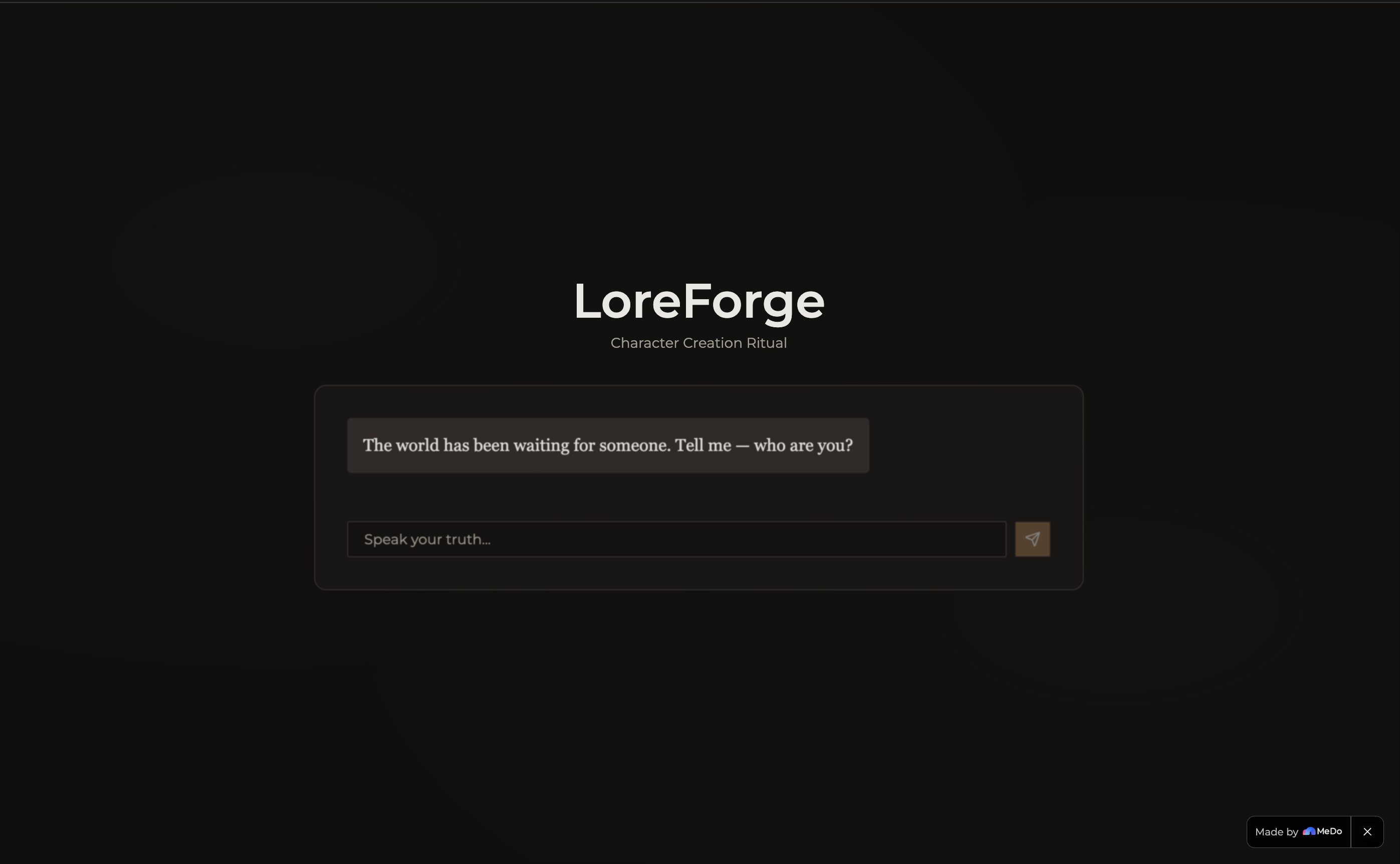
You create your character through natural conversation. No forms. No stat sheets. The AI asks who you are and extracts everything it needs from how you answer. Your character's hidden stat profile is derived from your words:
$$S_{profile} = f(strength_{narrative},\ cunning_{narrative},\ empathy_{narrative},\ darkness_{narrative})$$
where each dimension is inferred from the language and choices made during the creation conversation rather than assigned by number.
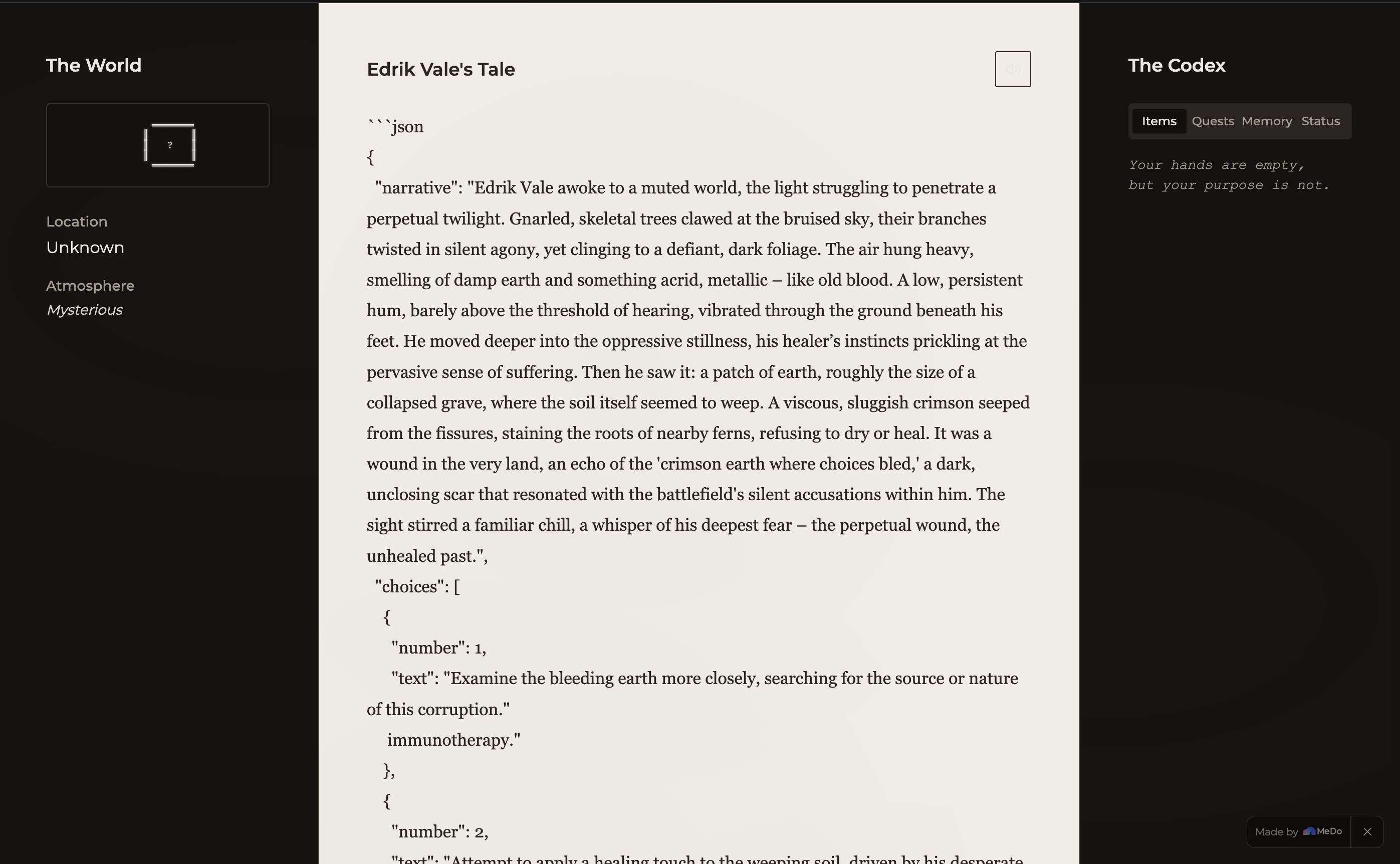
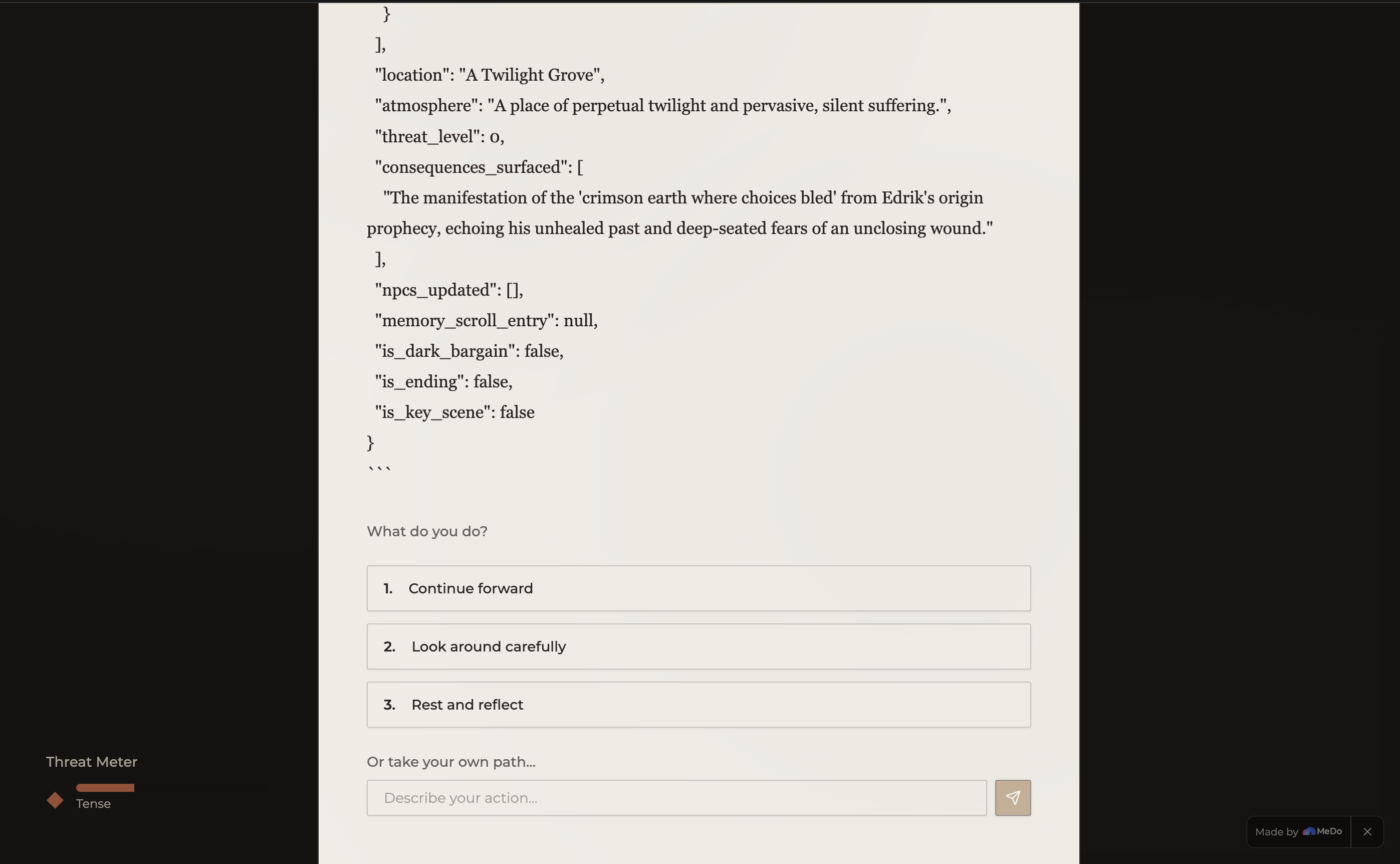
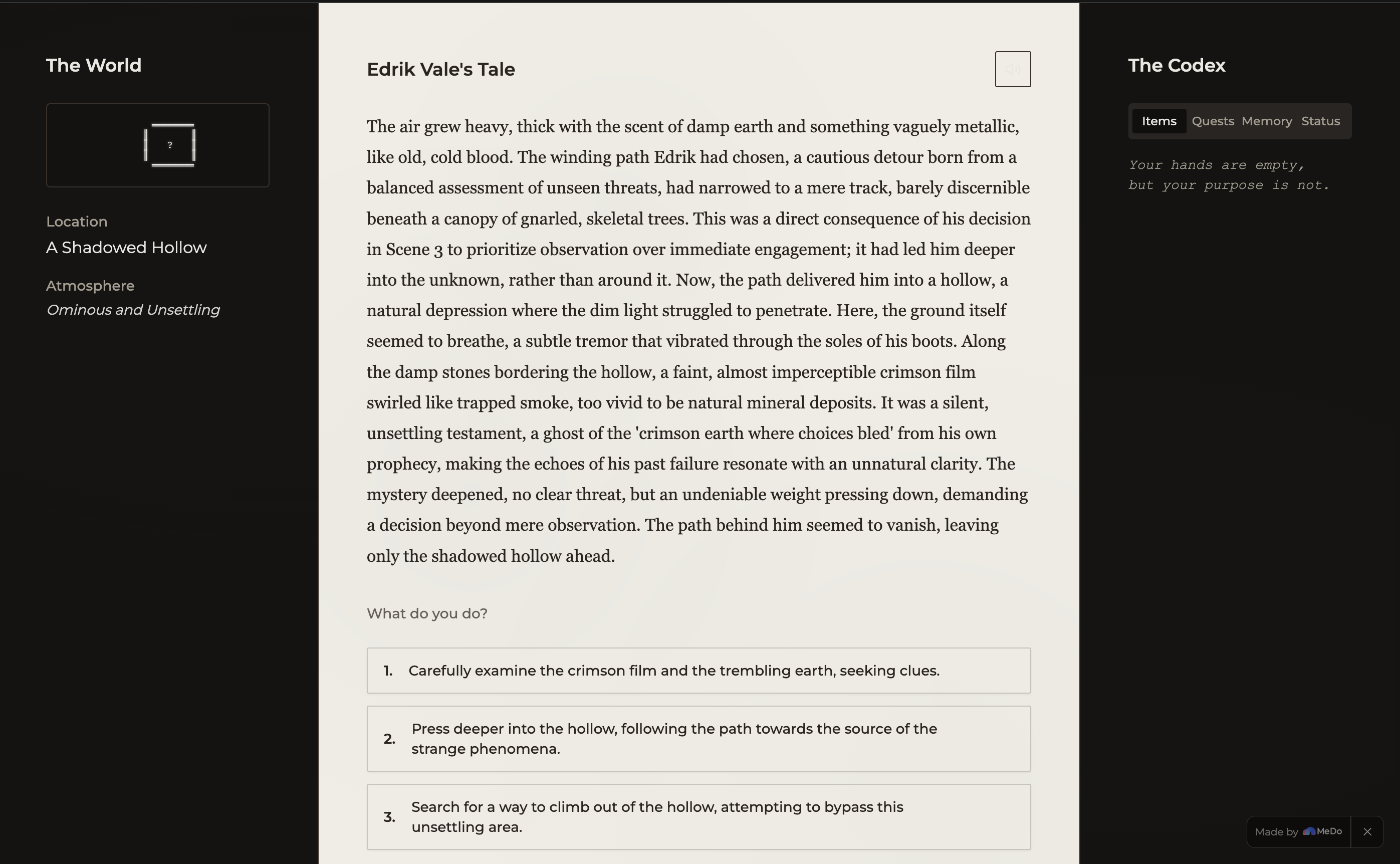
The game runs across three panels. The left panel shows an ASCII art scene illustration that updates with each new location. The centre panel carries the story — AI-narrated literary prose, three numbered choices, and a free-form input field for players who want to act outside the options. The right panel holds the Codex: your inventory, quest log, a Memory Scroll showing your five most consequential choices, and your Wounds and Blessings.
The Mandatory Decision History Query System is the engine underneath everything. Before generating every single scene, the AI queries the complete stored decision history to check what should surface as consequence right now. Spared enemies reappear. Broken promises are remembered. The world reacts to who you have been, not just who you are in this moment.
At critical story moments, a Dark Bargain triggers. A shadowy overlay appears. An entity offers you something. The cost is always narrative — a memory, a relationship, a piece of who you are. Your answer is permanent and woven into everything that follows.
When your character dies, the game does not end. A new character begins in the same world, years later. Your previous character exists as a grave, a legend, a carved warning on a wall.
How we built it
Built entirely using MeDo through conversational prompting in five turns.
Turn 1 built the character creation conversational flow — the AI greeting, the extraction logic for all six character elements, the hidden stat profile generation, and the ASCII portrait and Origin Prophecy output.
Turn 2 built the three-panel main game layout with the narrative engine, the three-choice system, the free-form input handling, and the Dark Bargain overlay with its shadowy visual effect.
Turn 3 implemented the Mandatory Decision History Query System — the most technically critical feature. Every scene generation now begins with a full lookup of stored decision history before prose is written.
Turn 4 added the Codex panel population, the Reputation Web hidden tracking system, the Prophecy Thread hook weaving, and session persistence with the "Previously..." recap.
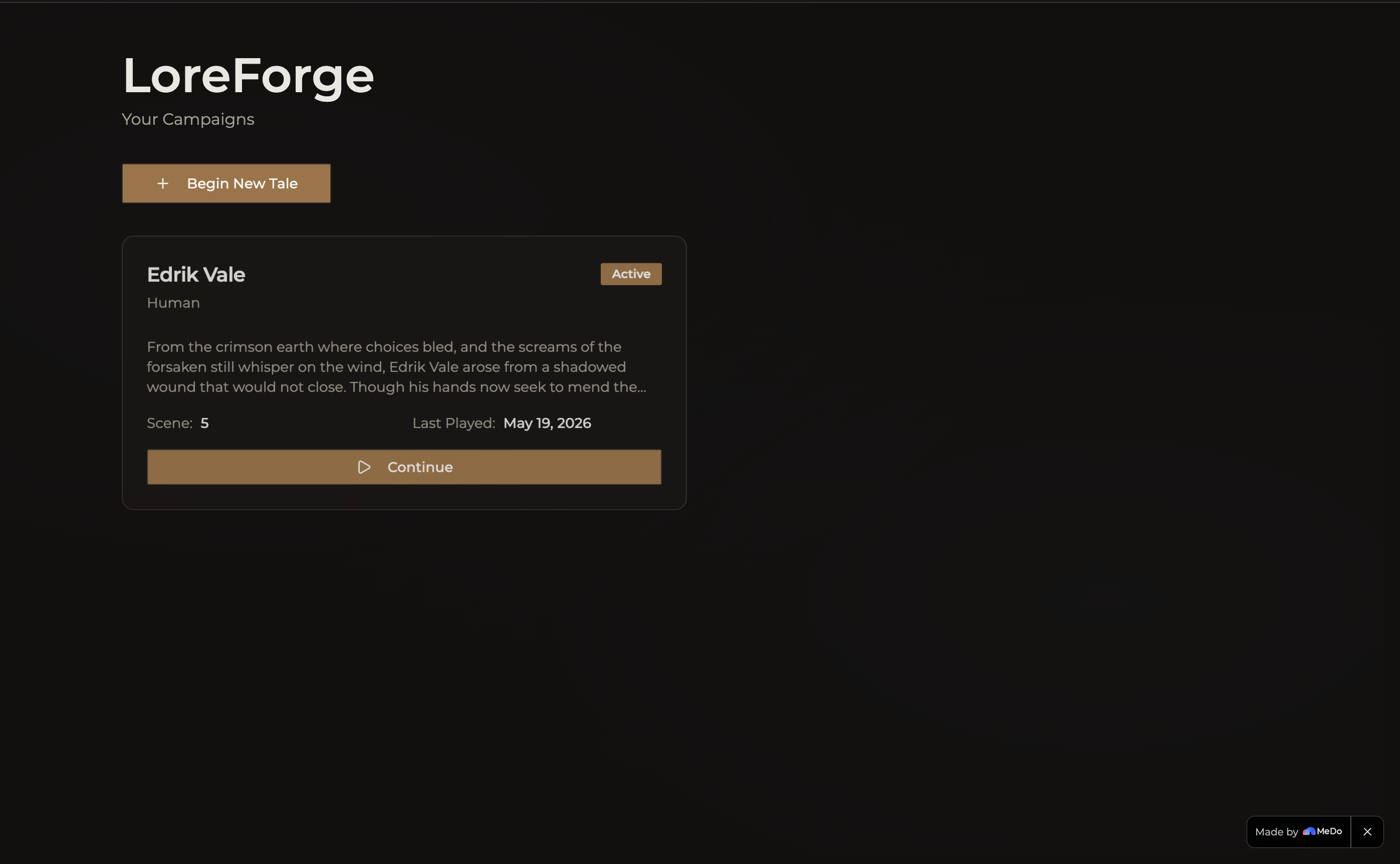
Turn 5 built the Campaign Archive page, the Death and Legacy system, and the PDF export that compiles completed campaigns into a formatted novella.
The LLM plugin powers all narrative generation. The Text-to-Speech plugin handles audio output. The Kling Image Generation plugin generates character portraits and scene illustrations.
Total build time: approximately 4 hours.
Challenges we ran into
The mandatory history query was the hardest engineering problem. LLMs naturally want to generate forward. Forcing a lookup backward through every stored decision before writing each new scene required a strict system prompt architecture. The solution was treating the decision history as a required context block prepended to every generation call rather than an optional reference.
Prose quality vs. game clarity. Literary prose and game instruction fight each other. "You see a door" is clear. "The threshold yawns before you like a held breath" is atmospheric but ambiguous. Finding the register where the DM voice is both beautiful and navigable took several prompt iterations.
The Dark Bargain tone. Early versions were either too theatrical (players felt manipulated) or too flat (the moment lost its weight). The fix was making the entity's offer feel like it genuinely understood the player's specific situation rather than delivering a generic temptation.
Death transition pacing. Moving from one character's death to a new character beginning in the same world without breaking immersion required careful narrative bridging. The world-state needed to carry forward while the player felt the weight of the transition rather than a simple reset.
Accomplishments that we're proud of
The Mandatory Decision History Query System is the feature we are most proud of. It is the difference between a chatbot that plays pretend and a world that actually remembers. Every consequential choice is stored, indexed, and checked before every scene. The math behind the urgency of resurfacing a past choice is:
$$R_{consequence} = \frac{I_{original} \times T_{elapsed}}{D_{narrative}}$$
where $I_{original}$ is the impact weight of the original choice, $T_{elapsed}$ is sessions since the choice was made, and $D_{narrative}$ is narrative distance from the original context. High scores surface as active consequences in the current scene.
The Death and Legacy system is the second feature we are proud of. Most games treat death as failure. LoreForge treats it as continuation. Your grave in the world your previous character shaped is one of the most emotionally resonant moments the game produces.
What we learned
Memory is the soul of a good story. The technical challenge and the narrative challenge were the same challenge. Making the AI remember is what makes the world feel real. Every other feature in LoreForge exists to serve this one principle.
Constraint produces character. No stats. No dice rolls. No menus. Every constraint we removed forced the writing to carry more weight. The game is better because it has less game in it.
The player creates the best content. The Prophecy Thread, the Dark Bargain, the Legacy system — the most powerful moments in playtesting were not the ones we wrote. They were the ones that emerged from specific player choices colliding with the consequence engine.
What's next for LoreForge
- Multiplayer legacy mode where two players play in the same world in different eras, their choices becoming each other's history
- Voice narration with character-specific voice profiles for DM narration and NPC dialogue
- Visual scene generation expanding the Kling integration to produce full illustrated scenes for key narrative moments
- Campaign sharing allowing players to export their world seed so others can play in a world shaped by someone else's choices
- Reputation Web visualizer making the hidden NPC relationship map visible as an optional overlay for players who want to see the politics they have created
Built With
- apis
- css
- deploy
- generation
- html
- image
- javascript
- kling
- llm
- localstorage
- medo
- node.js
- plugin
- react
- rest
- text-to-speech

Log in or sign up for Devpost to join the conversation.