-
-
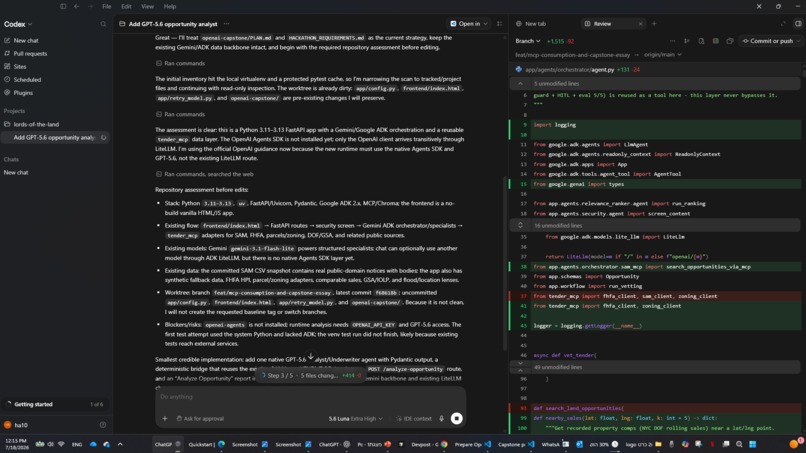
planing
-
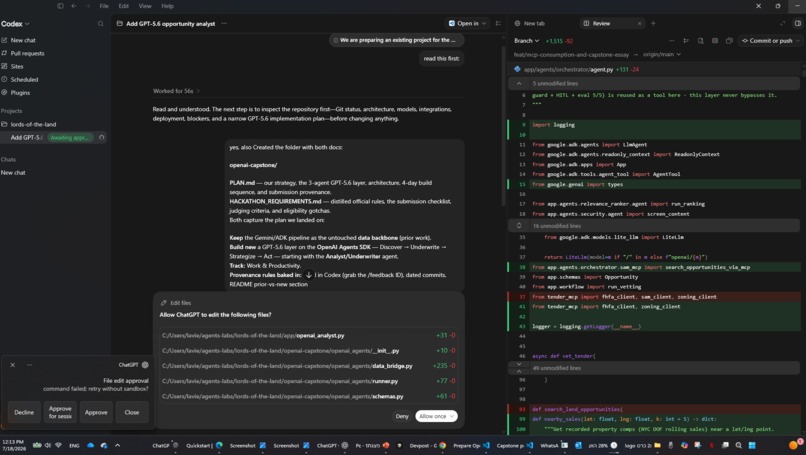
first go
-

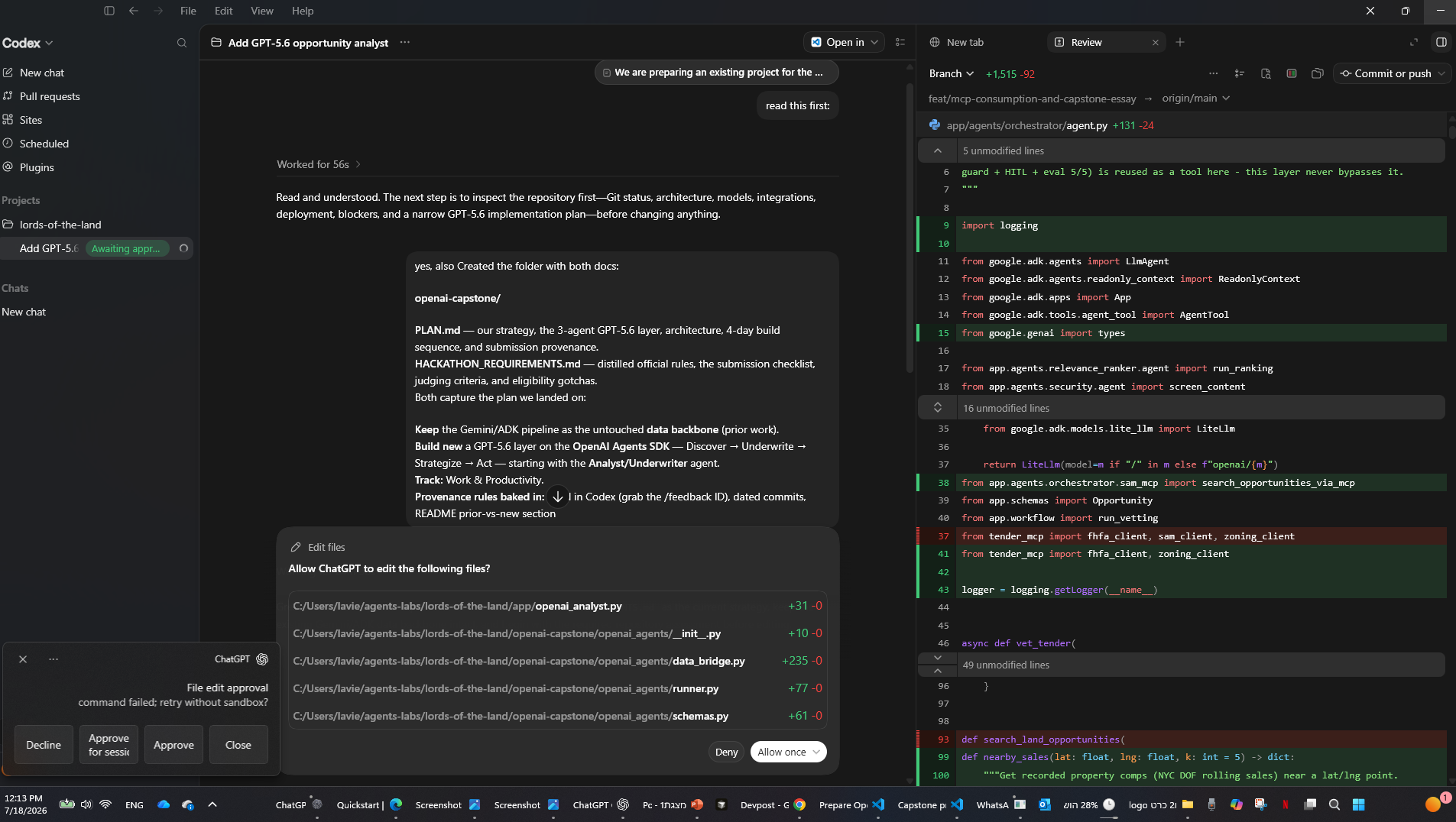
codex errors handaling
-
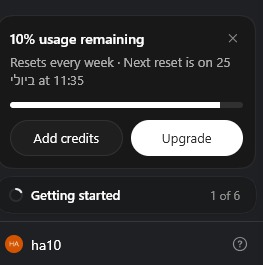
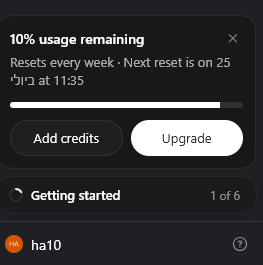
codex token run out
-
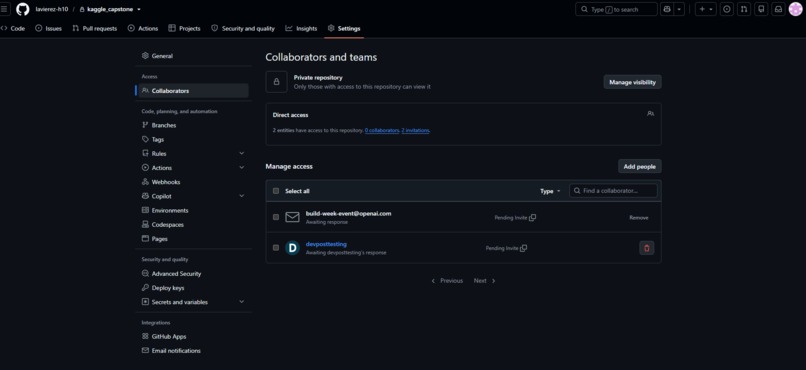
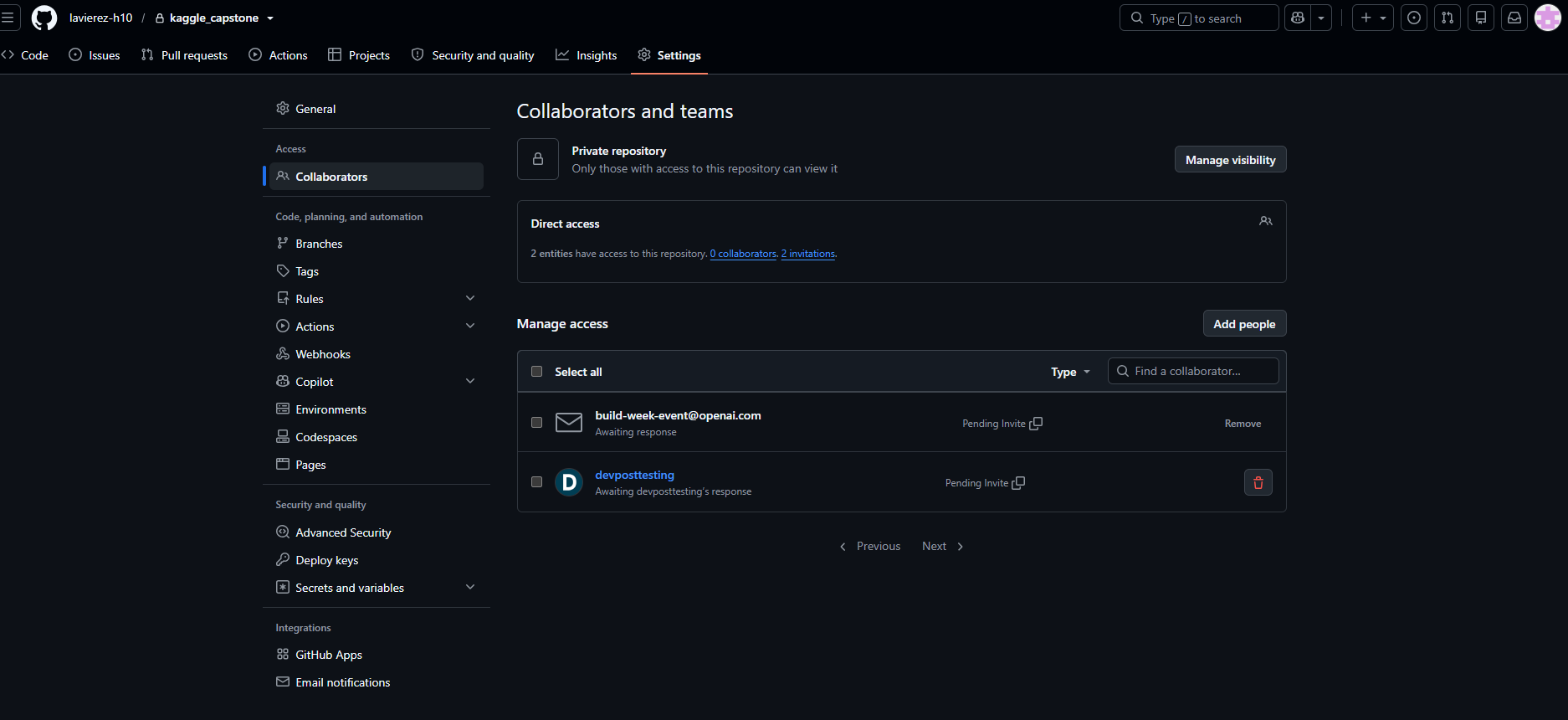
added judges on git repo
-
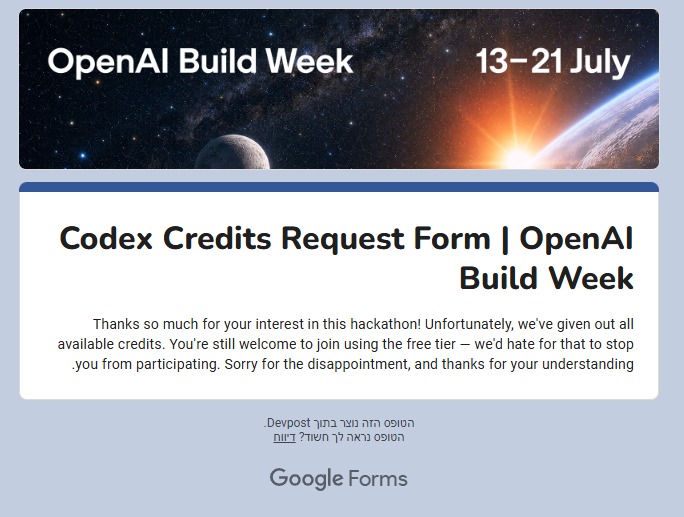
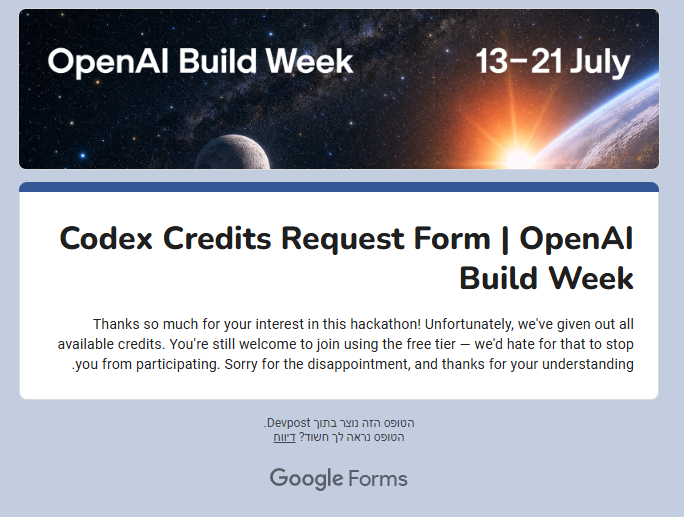
missed the token option
-
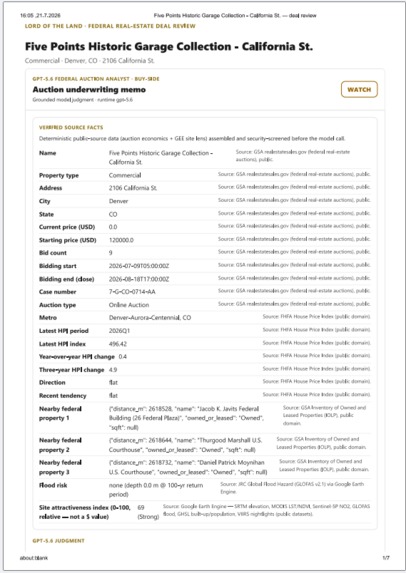
report first page
-
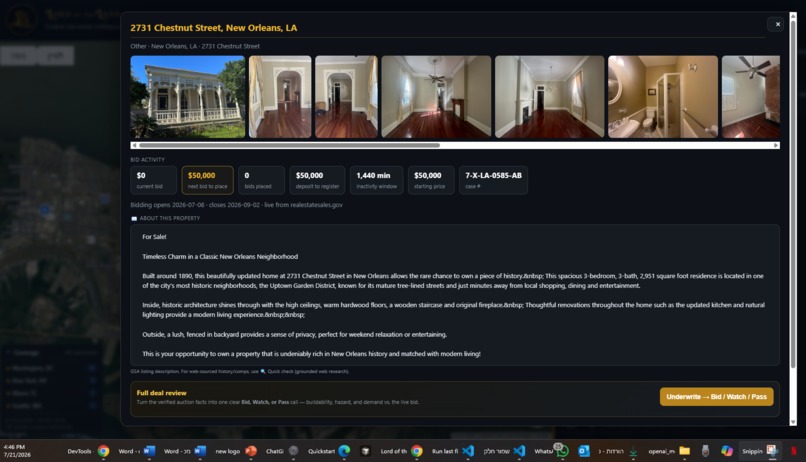
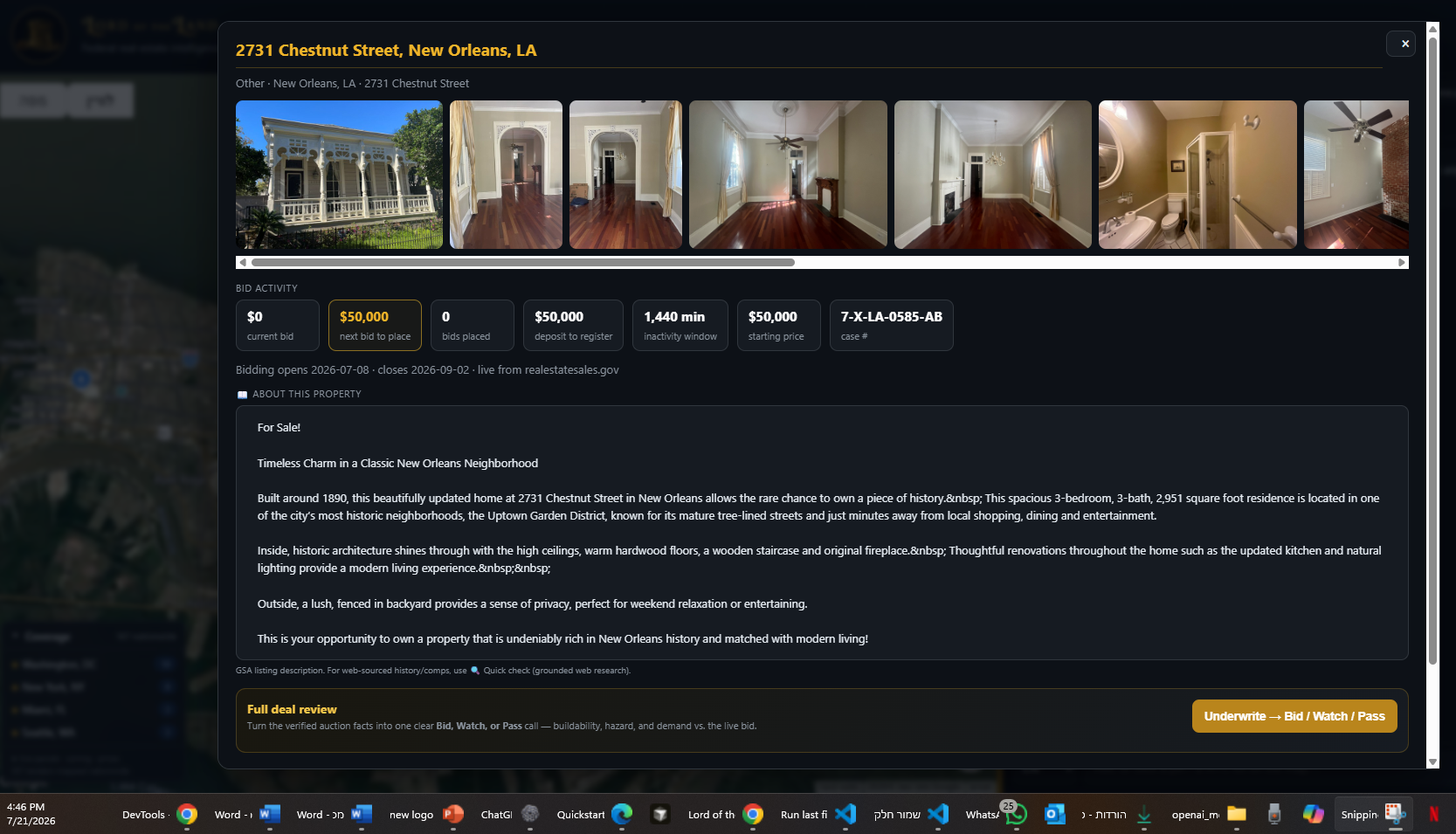
property for sale open to bids
-
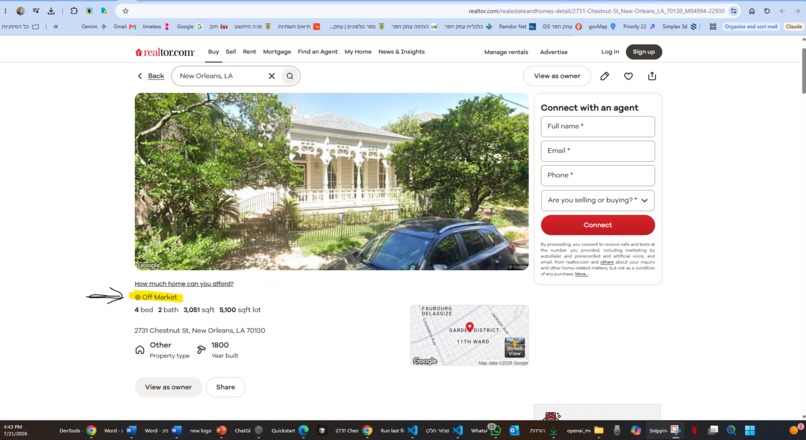
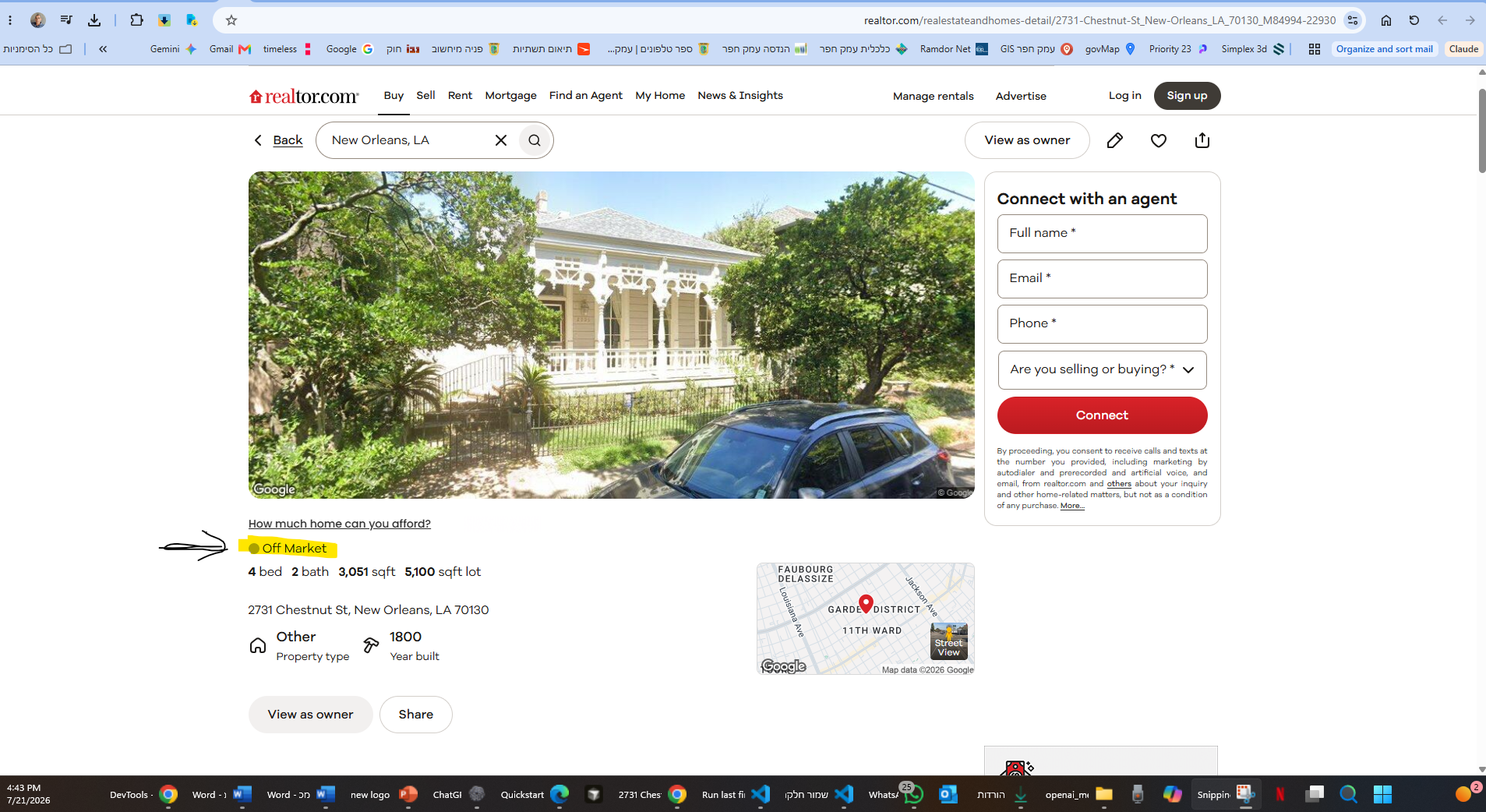
same property we have listed "off market" on other web sites
-
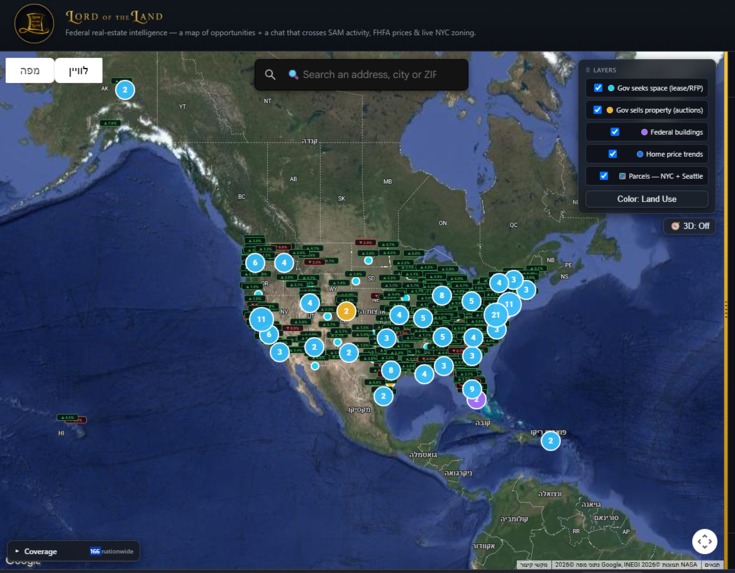
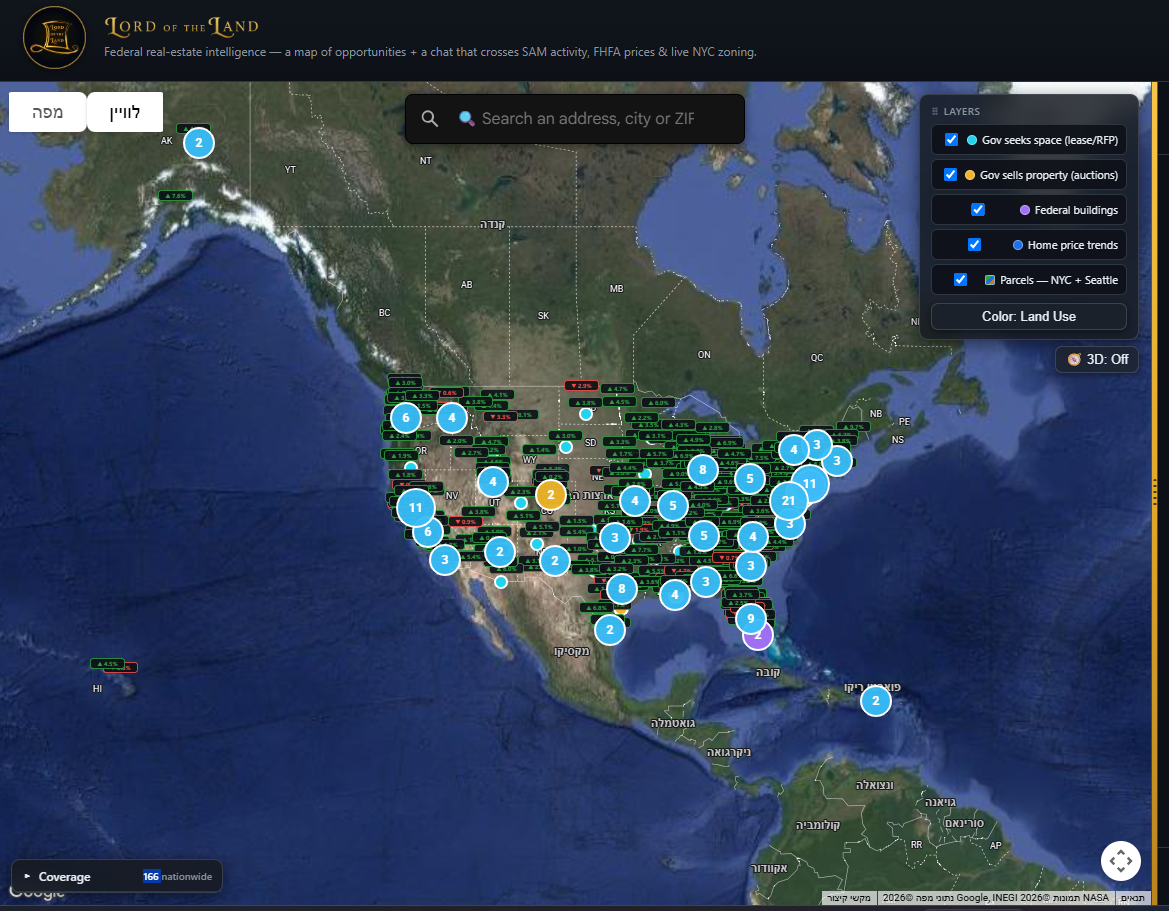
us gov tenderes on map
-
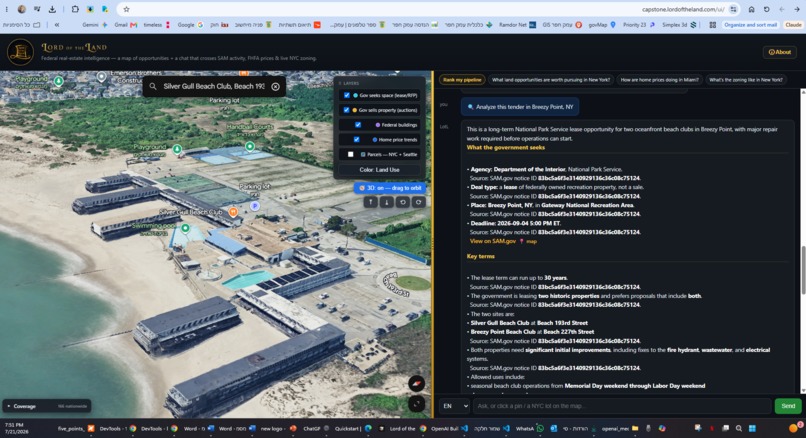
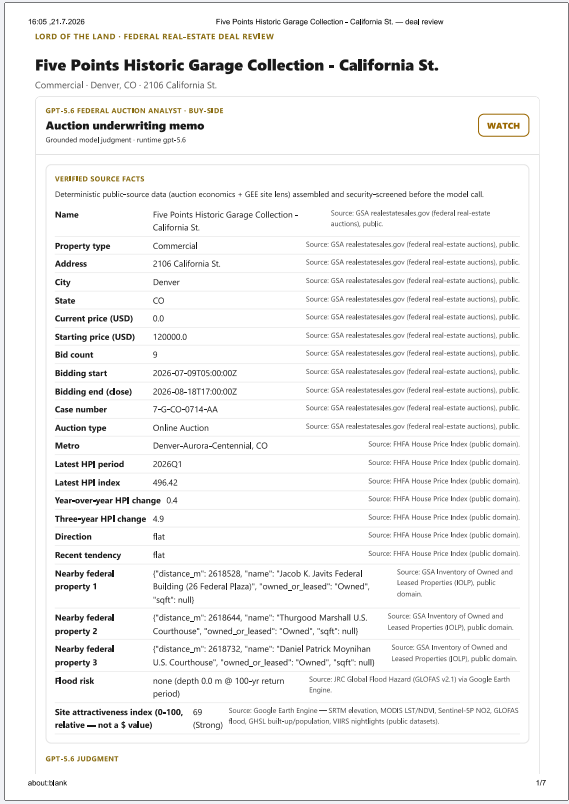
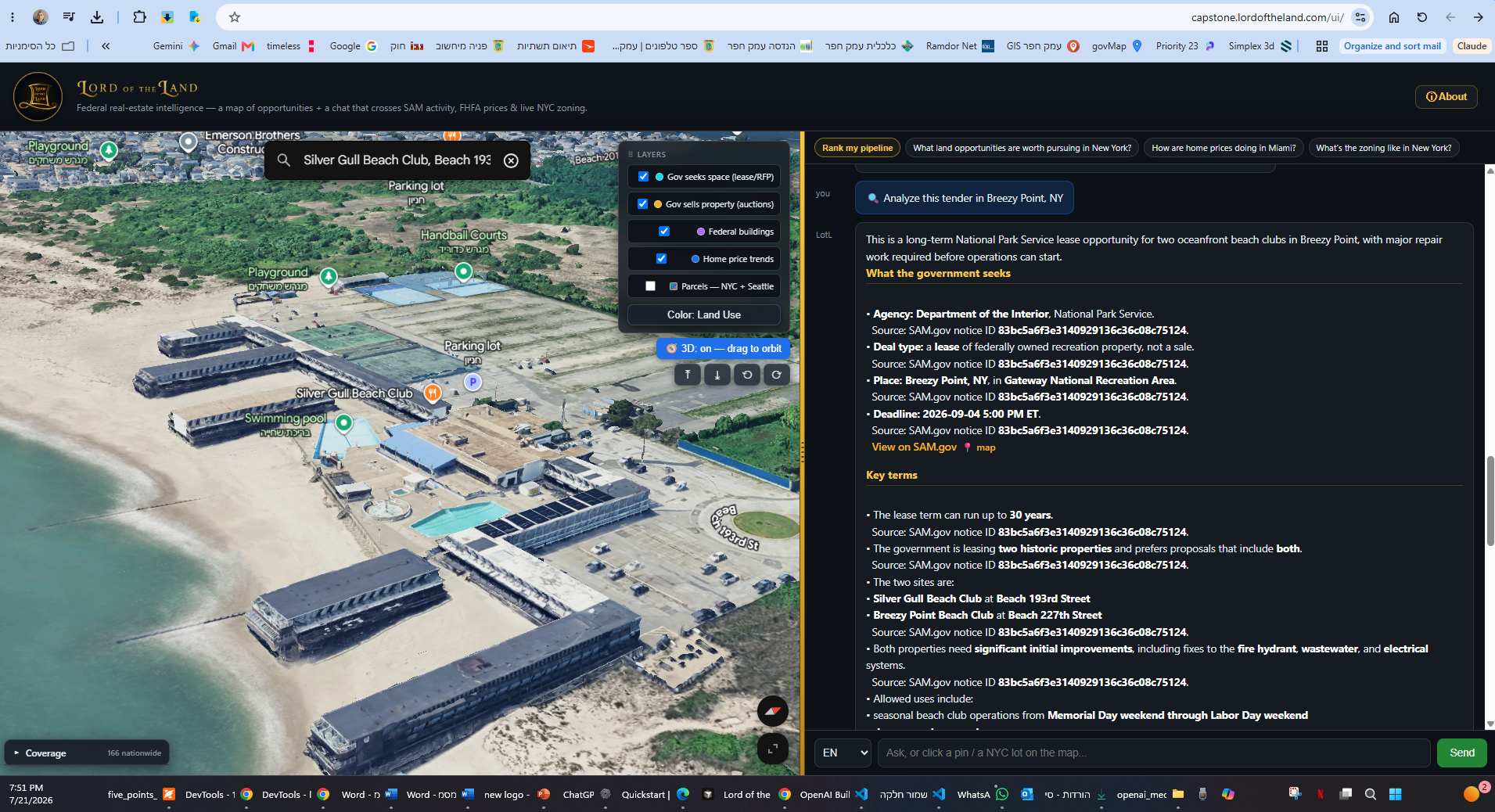
tender ai analysis

Inspiration
For the last year Im vibe-coding my dream app (www.lordoftheland.com) a single place to bring planning and real-estate data together. It started in Israel, then followed me to Greece, and later to the US and Spain, growing city by city as I added places I liked that had real-estate potential.
The problem I kept hitting is fragmentation. A buyer, investor, appraiser, broker, attorney, or developer often has to search across many government and city websites just to understand one property. Federal listings, parcel data, zoning rules, market trends, maps, and planning documents live in separate systems, in different formats, and each demands professional knowledge to interpret.
Lord of the Land was inspired by a simple question: What if you could get it all in one place, as one package? That was the personal project.
When the Kaggle / Google AI course came along last month, I wanted a sharper problem to build an agent around — and asked what value I could add on top of the data. What a real-estate investor really wants is the best-value deals and the properties still under the radar, out of the wide public eye. That question is where the SAM.gov idea came up: a quiet corner of government tenders — the government selling property, or seeking space to lease — that's fully public yet hard to read at human speed. So I built on it as a Google ADK agent that gathers SAM data from different sources, so anyone hunting a federal real-estate opportunity can reach the relevant facts, risks, and opportunities from one intelligent interface.
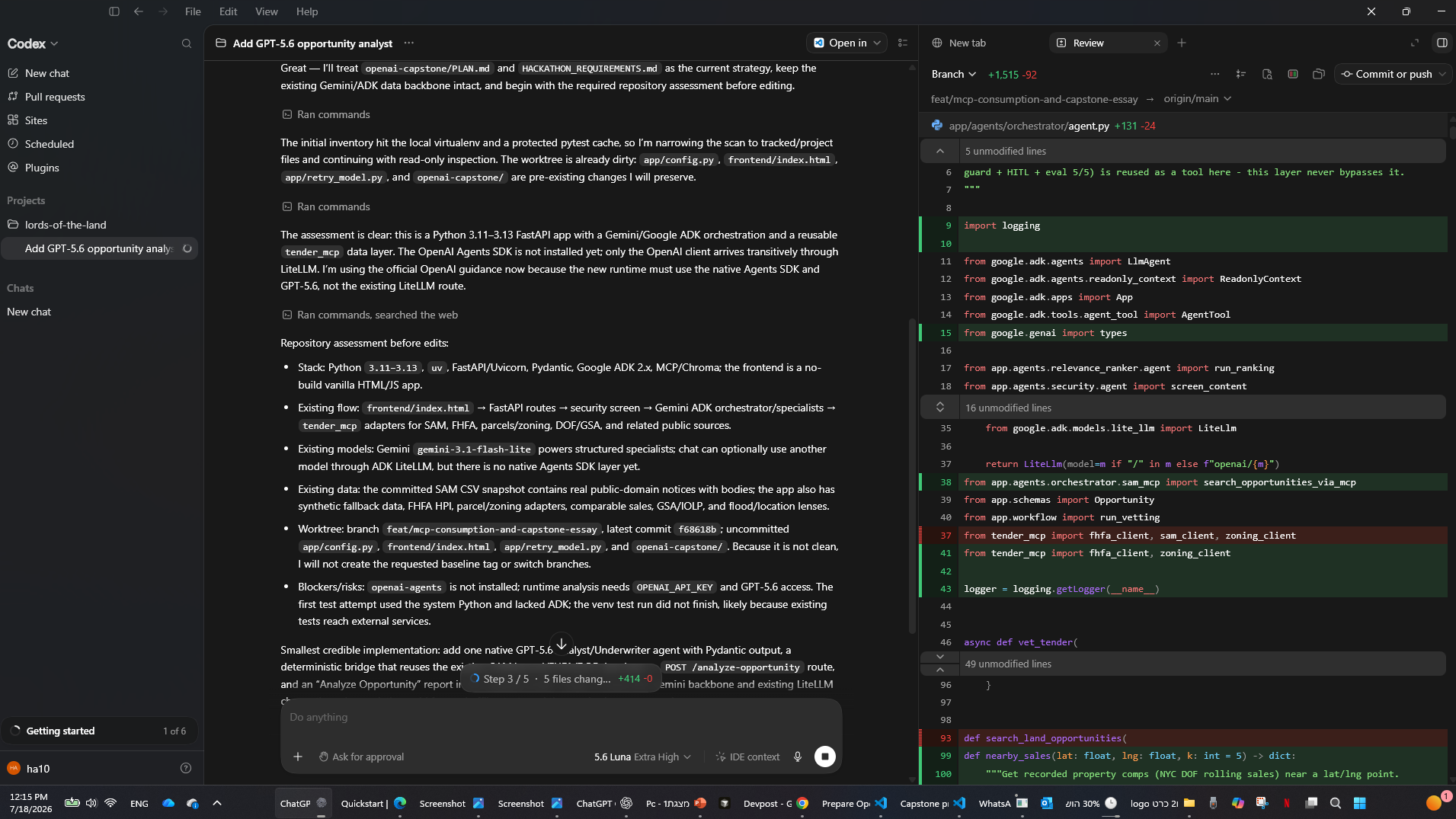
For the OPEN AI BUILD WEEK I took the base app I already had and used Codex with GPT-5.6 to build a more powerful tool on top of it: three GPT-5.6 agents that process the data, read the documents, and answer the user's questions - combining professional real-estate knowledge with AI, public data, mapping, and automated analysis, layered on the existing Google ADK backbone.
Its purpose isn't to replace professional judgment — it's to make the first stage of tender due diligence faster, clearer, and more accessible and even fun.
What It Does
Lord of the Land is an AI-powered federal real-estate intelligence platform. The application brings together several types of public information and cross check them, such as:
- Federal real-estate opportunities
- Government property sales and leasing requirements
- Parcel and location data
- Zoning and planning information
- Housing-market indicators
- Interactive map layers
- GEE (google earth engine) data layers for real estate data analysis
- AI-assisted search and analysis
Users can explore opportunities on a map, review available property information, and ask questions about locations, market conditions, zoning, and government real-estate activity.
For OpenAI Build Week, we are extending the existing platform with a new feature:
GPT-5.6 Federal Opportunity Analyst
The new workflow allows a user to select a federal real-estate opportunity and request a structured due-diligence analysis.
The analyst is designed to:
- Summarize the opportunity.
- Review the available property and location information.
- Add zoning and market context where data is available - 4 cities are wired.
- Identify risks, missing information, and important assumptions.
- Recommend practical next steps.
- Produce a clear Pursue, Review, or Skip assessment.
- Show the sources used and distinguish source facts from AI interpretation.
When information is unavailable, the system is instructed to state that clearly rather than inventing an answer.
How We (me and my AI coding agent) Built It
In thw Google & Kaggle AI Agents Capstone project —i started the Google ADK multi-agent system with an LLM layer on top (gpt 5 mini). That gave me the initial architecture, public-data integrations, map interface, and deployed application.
During this OPEN AI BUILD WEEK, the existing application got meaningfully extended using Codex and GPT-5.6. Codex is being used to:
- Inspect and understand the existing codebase
- Design the new opportunity-analysis workflow
- Connect GPT-5.6 to existing property and market data tools
- Build structured model outputs
- Create backend endpoints and user-interface components
- Add validation, error handling, and tests
- Document the architecture and deployment process
- Separate pre-existing work from the new Build Week implementation
The project uses a deliberate human-and-agent collaboration model. Codex accelerates implementation, debugging, testing, and documentation. Human expertise defines the professional logic: which facts matter, how uncertainty should be presented, what constitutes a meaningful real-estate risk, and how recommendations should be communicated responsibly. and finish up with cloud
Challenges
The most time killing and annoying was building the interface through an AI coding agent was harder than it sounds. The agent writes the map layers, the pins, and the buttons — but it can't see the result, and I often struggled to put into words what felt wrong. Getting pins to show correctly on the map, naming the buttons so the action was obvious (Quick check vs Full deal review), making the 3D↔2D toggle behave, and giving honest progress feedback each took a loop of render → look → describe → fix, which was sometimes genuinely exhausting. But along the way I started to understand the code a little myself — both the Python and the index.html — enough to make small changes on my own: text sizes, element colors, spacing, nudging things left and right, and starting to recognize functions and what they do. That turned the process from pure back-and-forth into something I could begin to steer directly.
Another main challenges was data fragmentation. Different government and municipal sources use different identifiers, geographic structures, schemas, update cycles, and access methods. Some locations have detailed parcel and zoning information, while others provide only limited data. downloading for each supported city the zooning files and proces them, embading, chunks and load to chroma vector stor for RAG pipeline to serve both user and agents.
A second challenge was avoiding false certainty. Real-estate analysis often involves incomplete records, outdated documents, jurisdiction-specific rules, and facts that require professional verification. The product therefore needs to distinguish between:
- Verified source data
- AI interpretation
- Professional assumptions
- Missing information
- Issues requiring further investigation
Another challenge was extending an existing product within a short hackathon period. Instead of rebuilding the entire platform, i focused on one complete and useful workflow that demonstrates how GPT-5.6 and Codex can transform disconnected public data into an actionable decision-support experience.
What have i Learned
I learned that the greatest value of AI in real estate is not simply generating text.
The real value comes from combining:
- Reliable data retrieval
- Tool use
- Structured reasoning
- Clear source attribution
- Domain expertise
- Honest handling of uncertainty
- gis data, rest api, post gis - finding sources and wire them
We also learned that an effective coding agent is most powerful when it works within clear product boundaries. Codex accelerated the engineering process, but the quality of the result depended on precise requirements, continuous testing, and professional decisions about the user experience.
Most importantly, i learned that complex real-estate information can become significantly more understandable without oversimplifying it.
What’s Next
The next stage is to expand the analyst into a broader land due-diligence system that can support additional jurisdictions, planning documents, valuation indicators, environmental constraints, infrastructure information, and transaction data. Implement GSA Public Buildings Service Pricing Desk Guide as a pricing-methodology grounding source.
Our long-term vision is to create an intelligent layer for land and real-estate decisions worldwide:
One location, one interface, and a clear explanation of the facts, risks, and potential.


Log in or sign up for Devpost to join the conversation.