-
-
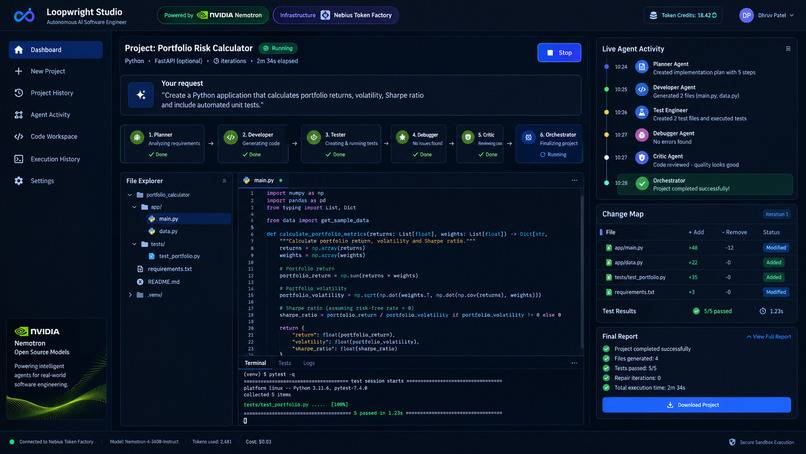
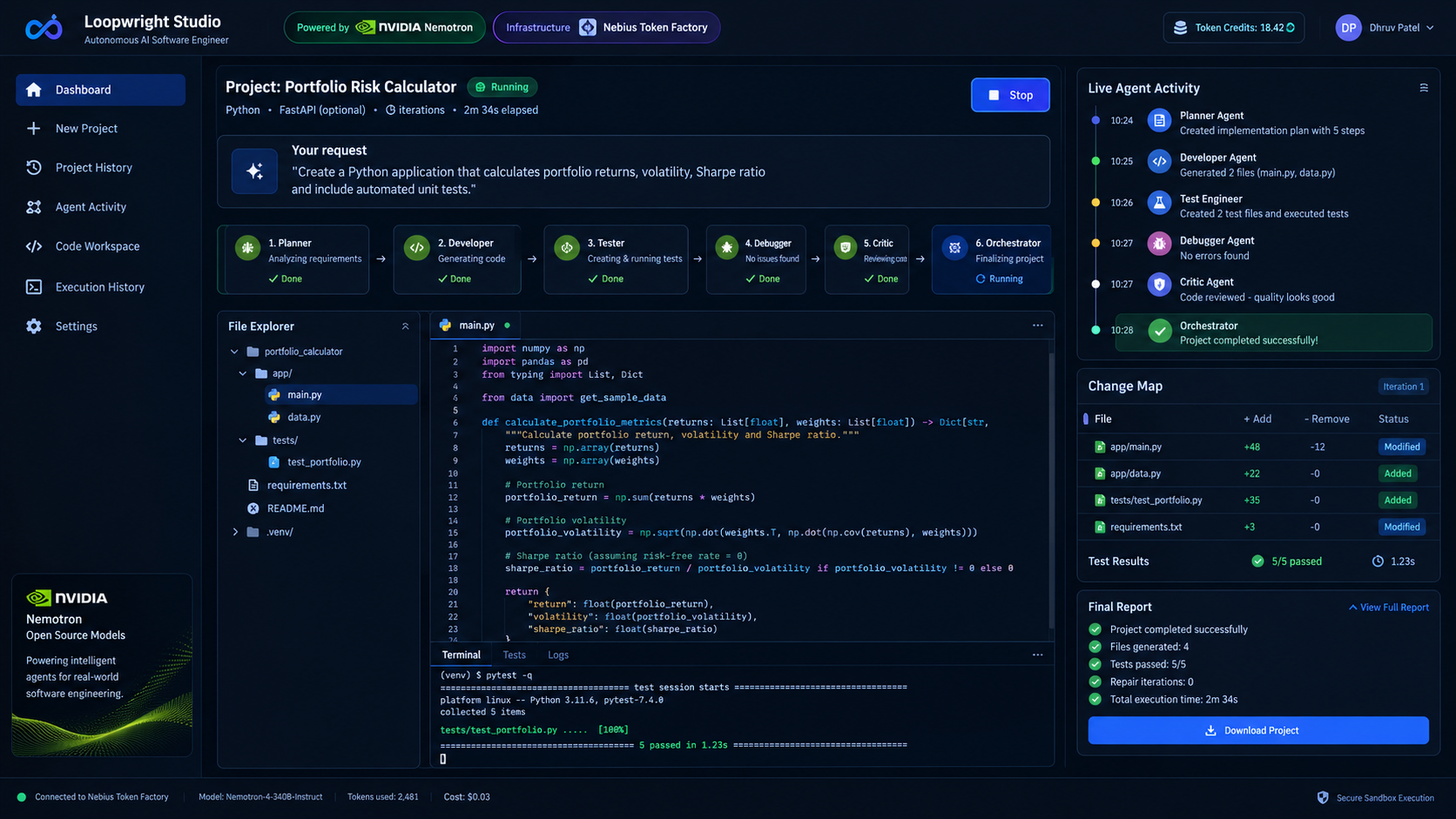
Loopwright Studio's real-time AI engineering dashboard, powered by NVIDIA Nemotron and Nebius Token Factotory.
Loopwright Studio
From Prompt to Production, Autonomously.
What it does
Loopwright Studio is an autonomous AI software engineering platform designed to transform how software is built, tested, debugged, and delivered.
Traditional AI coding assistants primarily generate code snippets or suggest solutions. However, developers still need to manually integrate code, execute programs, identify errors, write tests, and repeatedly fix broken implementations.
Loopwright Studio aims to automate this entire engineering lifecycle through a coordinated team of specialized AI agents powered by NVIDIA Nemotron and Nebius infrastructure. The platform transforms a natural-language software request into an iterative development workflow. Core capabilities:
- Intelligent Planning: Understands user requirements and converts them into structured engineering tasks.
- Autonomous Development: Generates application code and manages project files.
- Automated Testing: Creates and executes tests to validate generated software.
- Intelligent Debugging: Analyzes execution errors, identifies potential root causes, and proposes targeted fixes.
- Self-Healing Development: Iteratively repairs code and reruns tests until success or an execution limit is reached.
- Real-Time Monitoring: Displays agent activities, execution logs, errors, and progress.
- Change Map: Tracks file modifications, additions, deletions, test results, and repair iterations.
- Final Delivery: Provides a development report, test results, and generated project files.
Our ultimate objective is to move beyond AI-assisted coding and create an autonomous engineering environment capable of delivering working software.
How we built it
We designed Loopwright Studio around a multi-agent architecture where specialized agents collaborate through a central orchestration system.
AI and Infrastructure
- Nebius Token Factory: Provides access to hosted AI inference infrastructure.
- NVIDIA Nemotron: Serves as the primary open-source model for reasoning, planning, and software engineering tasks.
- Multi-Agent Architecture: Separates planning, development, testing, debugging, and quality review into specialized responsibilities.
Technology Stack
- Frontend: Next.js, TypeScript, Tailwind CSS, and modern UI components.
- Backend: Python and FastAPI.
- AI Integration: Nebius Token Factory API and NVIDIA Nemotron.
- Code Editor: Monaco Editor.
- Communication: REST APIs and real-time event streaming.
- Storage: SQLite/PostgreSQL.
- Execution: An isolated sandbox execution backend.
Agent Workflow
- The Planner Agent analyzes the development request.
- The Developer Agent generates the required implementation.
- The Test Engineer creates and executes automated tests.
- The Debugger Agent analyzes failures.
- The Developer Agent applies targeted repairs.
- The Critic Agent reviews the results.
- The Orchestrator coordinates iterations and determines completion.
The system records execution events and code changes to provide transparency into the development process.
The architecture is designed to support controlled execution, configurable iteration limits, error recovery, and persistent project history.
Challenges we ran into
Building an autonomous software engineering system introduced several significant technical challenges.
1. Agent Coordination
Making multiple specialized agents collaborate reliably was challenging. Each agent needed structured inputs, predictable outputs, and a shared understanding of the development task.
2. Reliable Code Execution
Generating code is relatively straightforward compared with executing untrusted generated code safely. We needed to consider execution isolation, resource limits, timeouts, and access restrictions.
3. Automatic Error Recovery
An AI-generated solution can introduce additional bugs while attempting to repair existing ones. We focused on targeted debugging, test-driven verification, and bounded repair iterations.
4. Real-Time Observability
Displaying genuine agent activity, terminal output, code changes, and execution results required a reliable communication layer between the backend and frontend.
5. Model Integration
Integrating NVIDIA Nemotron through Nebius required attention to API compatibility, model identifiers, authentication, response formats, and inference reliability.
6. Limited Development Time
Working within a hackathon deadline required prioritizing a functional end-to-end development cycle over unnecessary features and visual complexity.
Accomplishments that we're proud of
- Designed an autonomous multi-agent software engineering architecture.
- Developed a workflow connecting planning, code generation, testing, debugging, and repair.
- Created an iterative development approach that uses actual test outcomes to guide improvements.
- Designed a Change Map to make code modifications and repair iterations transparent.
- Built a foundation for real-time agent activity monitoring.
- Focused on reproducibility and measurable execution results rather than simply presenting AI-generated code.
- Established an architecture designed to integrate NVIDIA Nemotron through Nebius infrastructure.
Our biggest accomplishment is the vision of transforming an AI coding assistant into an autonomous software engineering system.
What we learned
This project taught us that building autonomous AI systems involves much more than connecting a language model to a user interface.
We learned:
- How to design and coordinate specialized AI agents.
- How to structure reliable agent communication and orchestration.
- Why generated code must be validated through actual execution.
- How automated testing can serve as feedback for AI-driven development.
- Why sandbox security is essential when executing AI-generated code.
- How to design observable and reproducible AI workflows.
- How infrastructure, inference latency, and model reliability influence autonomous systems.
Most importantly, we learned that true AI autonomy requires a continuous feedback loop between reasoning, execution, evaluation, and improvement.
What's next for Loopwright Studio
We envision Loopwright Studio evolving into a complete autonomous software engineering workspace.
Our future roadmap includes:
1. Advanced Multi-Agent Intelligence
Enable agents to collaborate on larger projects, independently manage subtasks, and coordinate complex software development workflows.
2. Secure Cloud Sandboxes
Introduce stronger isolated execution environments with configurable CPU, memory, network, and execution-time restrictions.
3. Full-Stack Application Generation
Allow users to generate complete applications, including frontend interfaces, backend services, databases, APIs, and deployment configurations.
4. GitHub Integration
Enable repository analysis, automated commits, branch management, pull request generation, and code review.
5. Continuous Development
Allow projects to resume previous development sessions, preserve engineering context, and continue working from existing codebases.
6. Advanced Quality Intelligence
Introduce security analysis, performance optimization, code quality scoring, dependency vulnerability checks, and intelligent refactoring.
7. Enterprise Collaboration
Support team workspaces, developer approval workflows, role-based access, and collaborative agent execution.
8. Autonomous Deployment
Enable verified applications to move from development and testing toward controlled cloud deployment.
Our Vision
We believe the next generation of software development will be built around intelligent systems that can understand requirements, execute engineering tasks, learn from failures, and continuously improve their output.
Loopwright Studio is our step toward that future.
We are not building another AI coding assistant. We are building an autonomous engineering partner.
Loopwright Studio — From Prompt to Production, Autonomously.
Built With
- ai-code-generation
- ai-debugging
- automated-testing
- autonomous-ai-agents
- code-execution-sandbox
- docker
- fastapi
- large-language-models-(llms)
- monaco-editor
- multi-agent-ai
- nebius-token-factory
- next.js
- nvidia-nemotron
- postgresql
- python
- react
- rest-api
- server-sent-events-(sse)
- sqlite
- tailwind-css
- typescript
- websockets

Log in or sign up for Devpost to join the conversation.