Inspiration
The idea for LoopProof started with a simple question: how do we know whether collected e-waste is actually being recycled?
Collecting waste is only the first step. It still needs to reach a processing facility, go through the right process, and have evidence to support the final claim. We wanted to build a system that makes these stages visible instead of treating collection as proof of successful recycling.
That led us to one principle that guides the entire project: collected does not mean recycled.
What it does
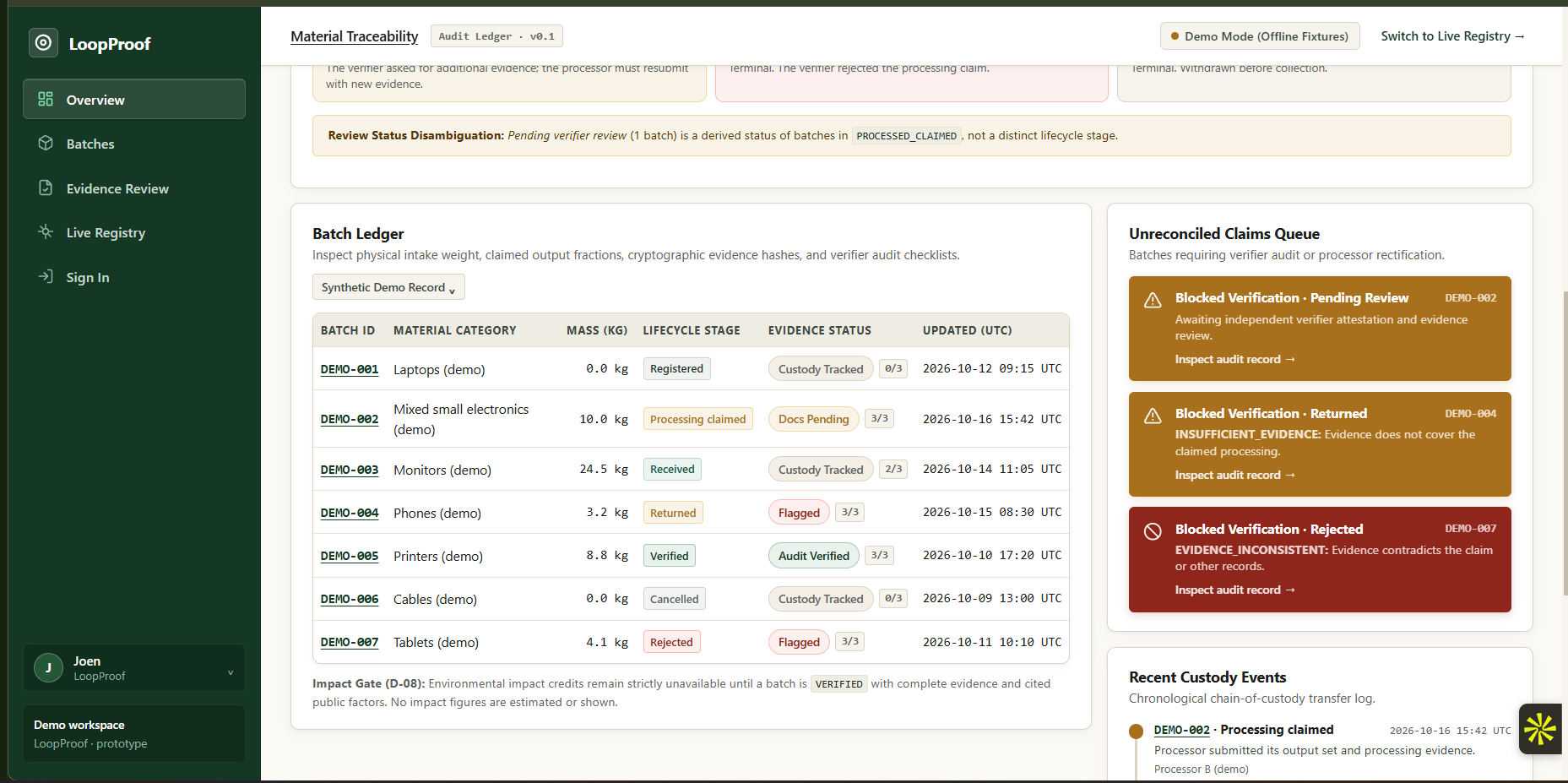
LoopProof is an e-waste traceability platform designed to track a batch from registration and collection through facility receipt, processing claims, and independent verification.
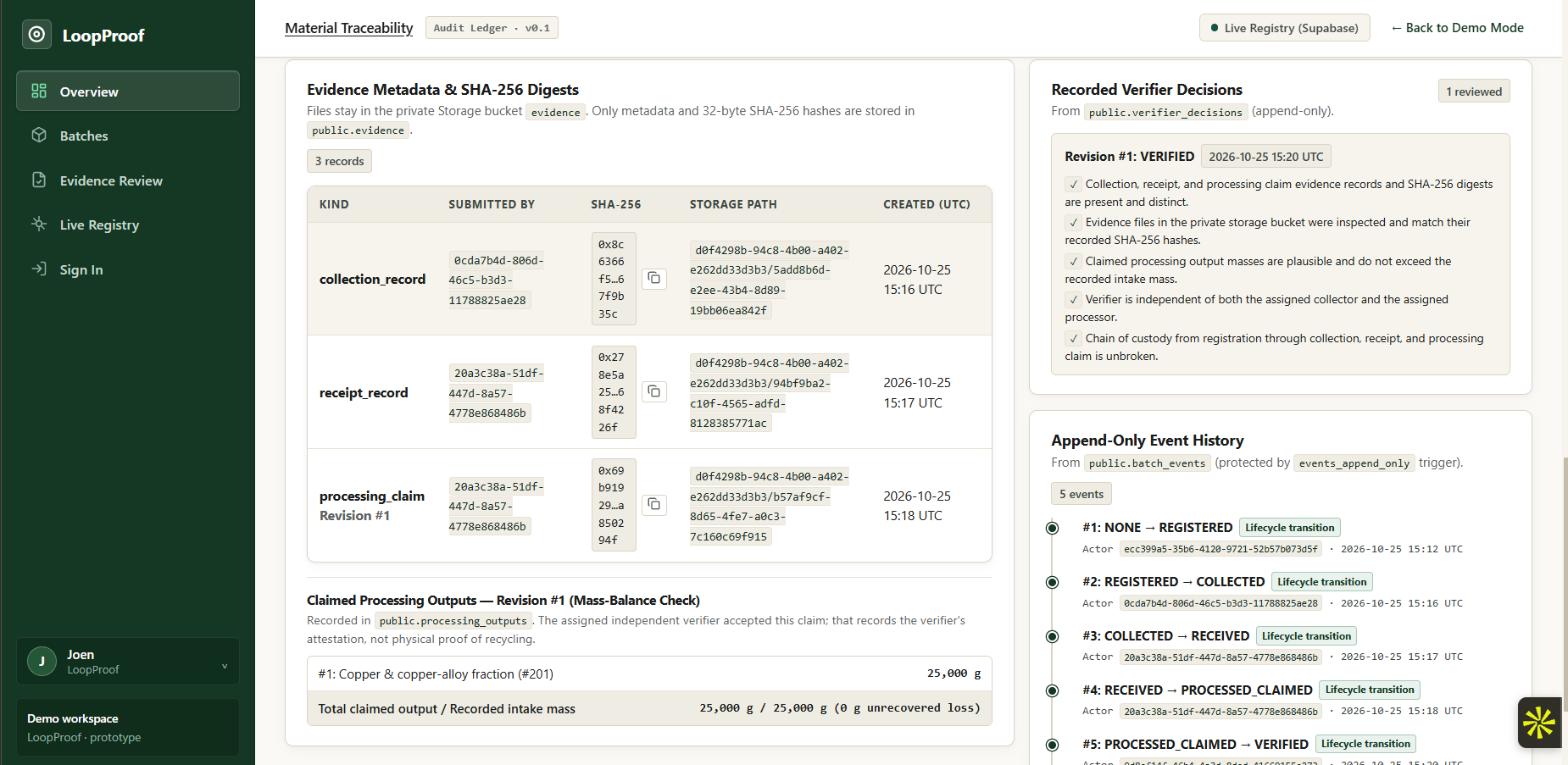
It records lifecycle events, keeps evidence metadata with SHA-256 hashes, supports role-based actions, and checks reported output mass against the original intake. This helps distinguish between a processing claim and an outcome that has passed the required verification process.
The idea is to make the status of every batch easier to understand and make unsupported environmental claims harder to overlook.
How we built it
We built the web application using Next.js, React, and TypeScript. The live workflow uses Supabase for authentication, database operations, access control, and lifecycle actions. We also developed Solidity smart contracts and tested them locally.
One important design decision was to keep evidence files separate from their hashes. A hash can help identify whether a file has changed, but it cannot prove that the information inside the file is true or that recycling physically took place.
The current web workflow records lifecycle actions in Supabase. The Solidity contracts have been tested locally but have not been deployed to a public testnet.
Challenges we ran into
One of our biggest challenges was designing the lifecycle so that collection, receipt, processing, and verification could not be treated as the same thing. Each stage represents a different claim and needs the appropriate evidence.
We also worked on mass-balance validation. For example, when the reported output matches the original intake, the system should not incorrectly flag the batch for a mass discrepancy.
Another challenge was being honest about what technology can prove. A database entry or blockchain record can help preserve a record of an action, but it does not automatically prove that the real-world activity happened.
Accomplishments that we're proud of
We're proud to have built a working web prototype that brings the main stages of e-waste traceability into one workflow.
The project combines role-based access, lifecycle tracking, evidence hashes, mass-balance checks, and a separate verification stage. We also built a Solidity test suite and added automated tests for the web application.
Most importantly, we designed LoopProof around a clear rule: a batch should not be treated as verified recycling simply because someone has marked it as processed.
What we learned
Building LoopProof taught us that trustworthy sustainability reporting requires more than a dashboard or a blockchain. It depends on good workflow design, appropriate evidence, access controls, independent review, and clear rules about when a claim can be accepted.
We also learned to be careful with environmental impact reporting. Even when a batch has supporting records, the system must distinguish between what has been recorded, what has been verified, and what can reasonably be claimed about its environmental benefit.
What's next for LoopProof — Evidence-Gated E-Waste Traceability
The next step is to strengthen the verification workflow, improve the public batch-tracking experience, and test the system more thoroughly with realistic scenarios.
We also want to explore a public testnet deployment of the Solidity contracts and connect the on-chain records with the live application, while keeping sensitive evidence files private.
In the longer term, we would like to work with e-waste collectors, processing facilities, and independent verifiers to understand what evidence is practical to collect and how the system could support real supply chains.
LoopProof is currently a prototype. Its sample batches and development test records are synthetic, and the project has not undergone an independent security audit. Our goal is to keep improving it while preserving the principle that inspired it: make the evidence visible, and never claim more than the evidence supports.
Built With
- contracts
- copy
- ethereum
- next.js
- postgresql
- react
- smart
- solidity
- supabase
- typescript
- web3

Log in or sign up for Devpost to join the conversation.