-
-
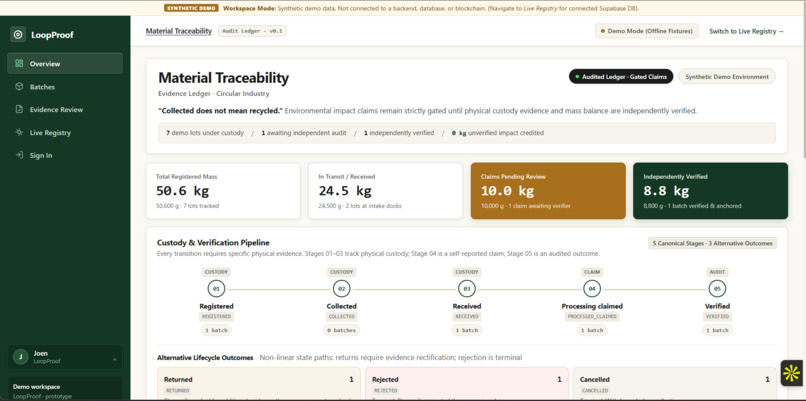
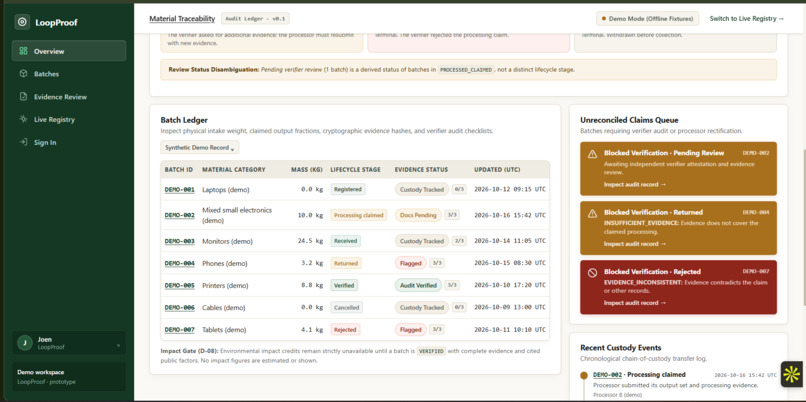
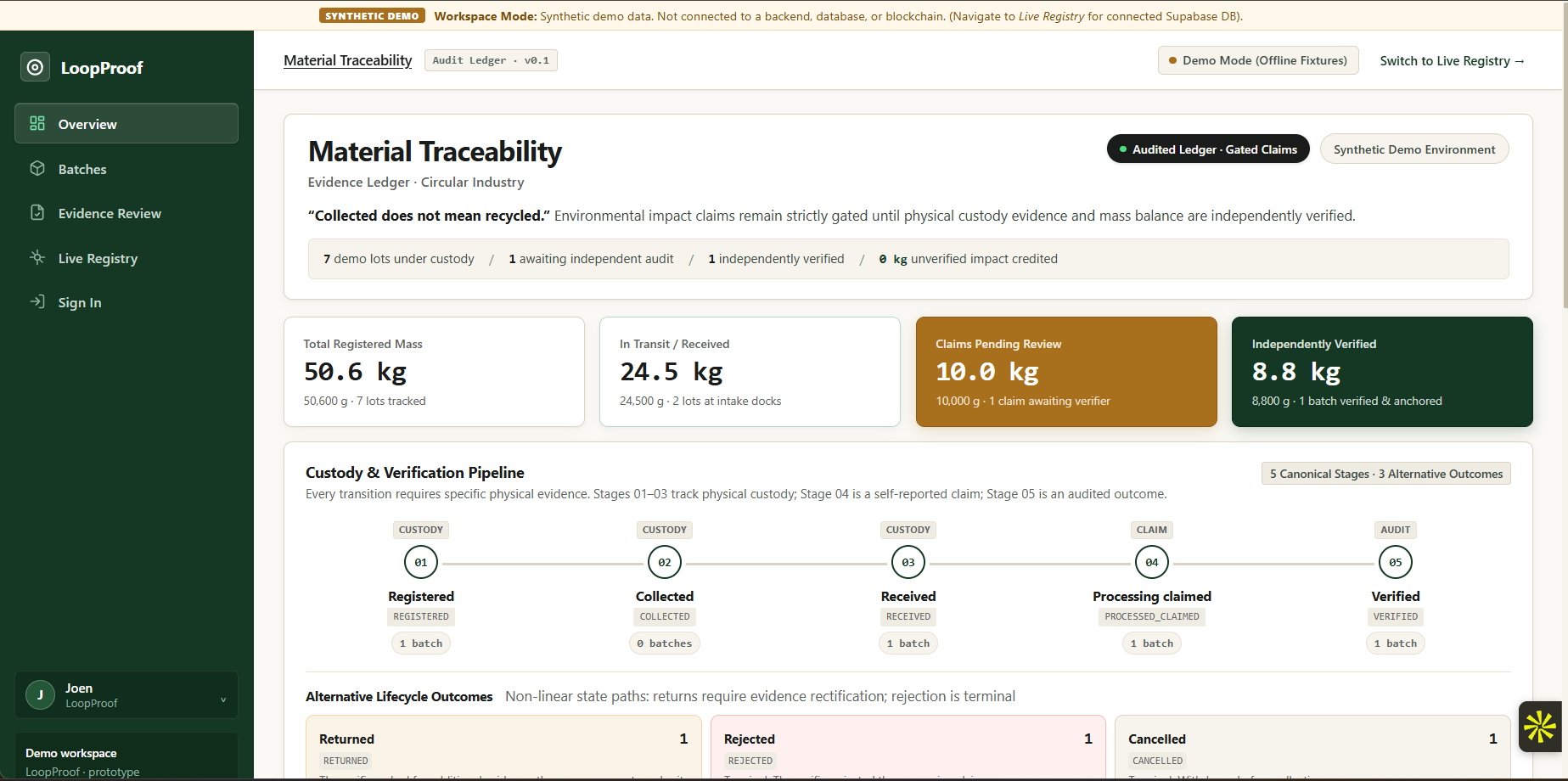
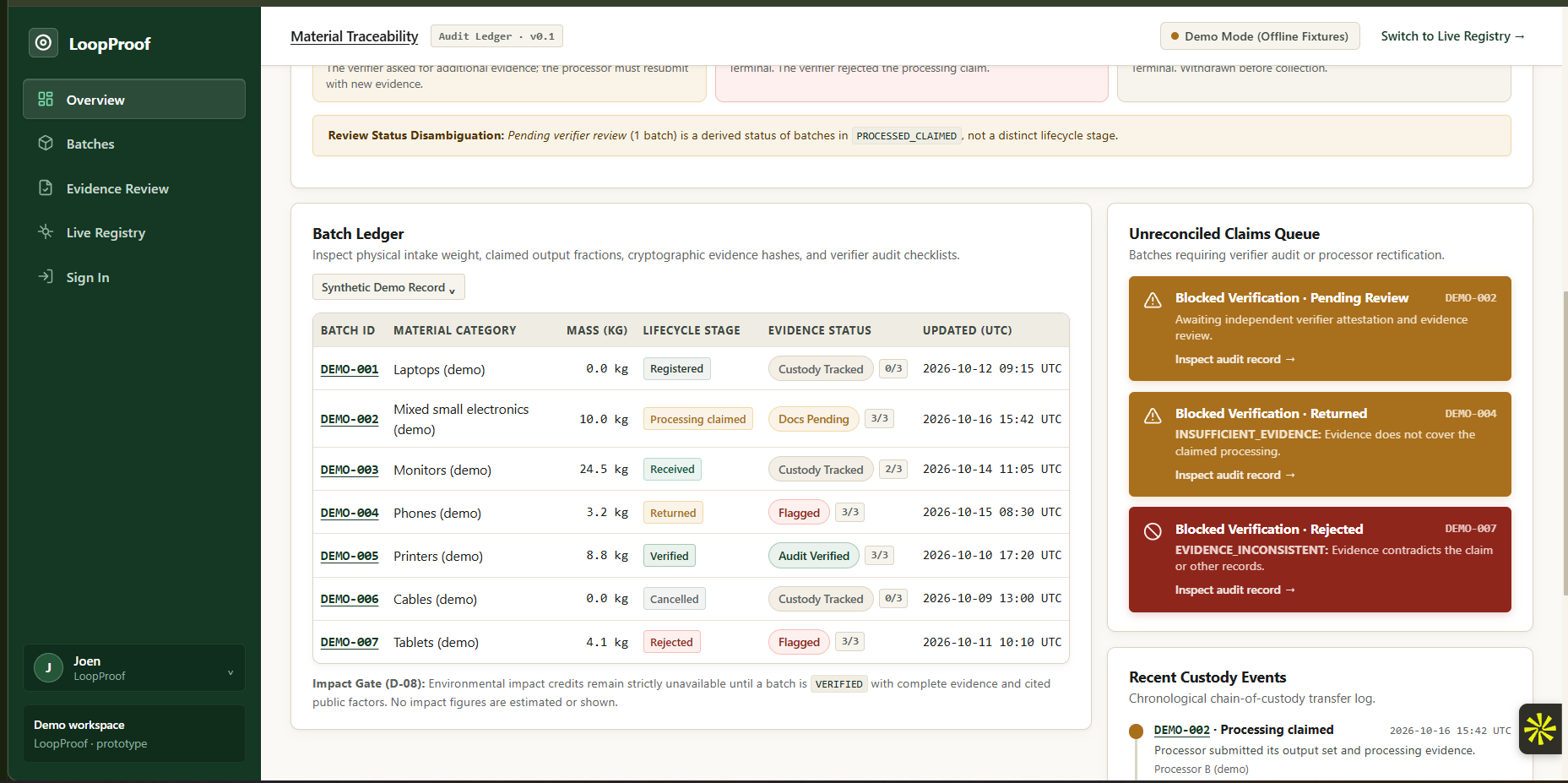
LoopProof’s material traceability dashboard tracks e-waste batches, lifecycle states, and evidence-backed processing claims.
-
-
Inspiration
Electronic waste is one of the world's growing environmental challenges, but collecting e-waste is not the same as ensuring it is responsibly processed. Between collection points, transporters, and recycling facilities, records can become fragmented, claims can be difficult to verify, and reported environmental impact can be hard to trust.
We built LoopProof around one simple principle: Collected does not mean recycled.
We wanted to explore how evidence-driven workflows and blockchain technology could make e-waste traceability more transparent, accountable, and auditable.
What It Does
LoopProof is an AI-assisted, blockchain-backed e-waste traceability prototype designed to track material batches through their lifecycle while distinguishing reported activity from verified outcomes.
Its core approach focuses on:
- Batch traceability: Associate collection and processing records with a consistent batch reference.
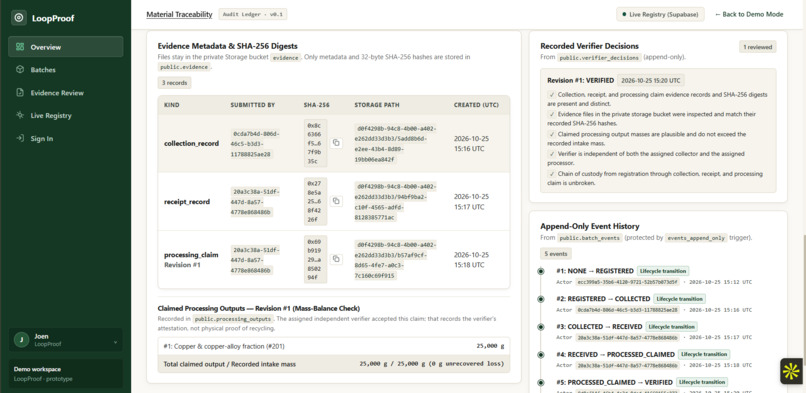
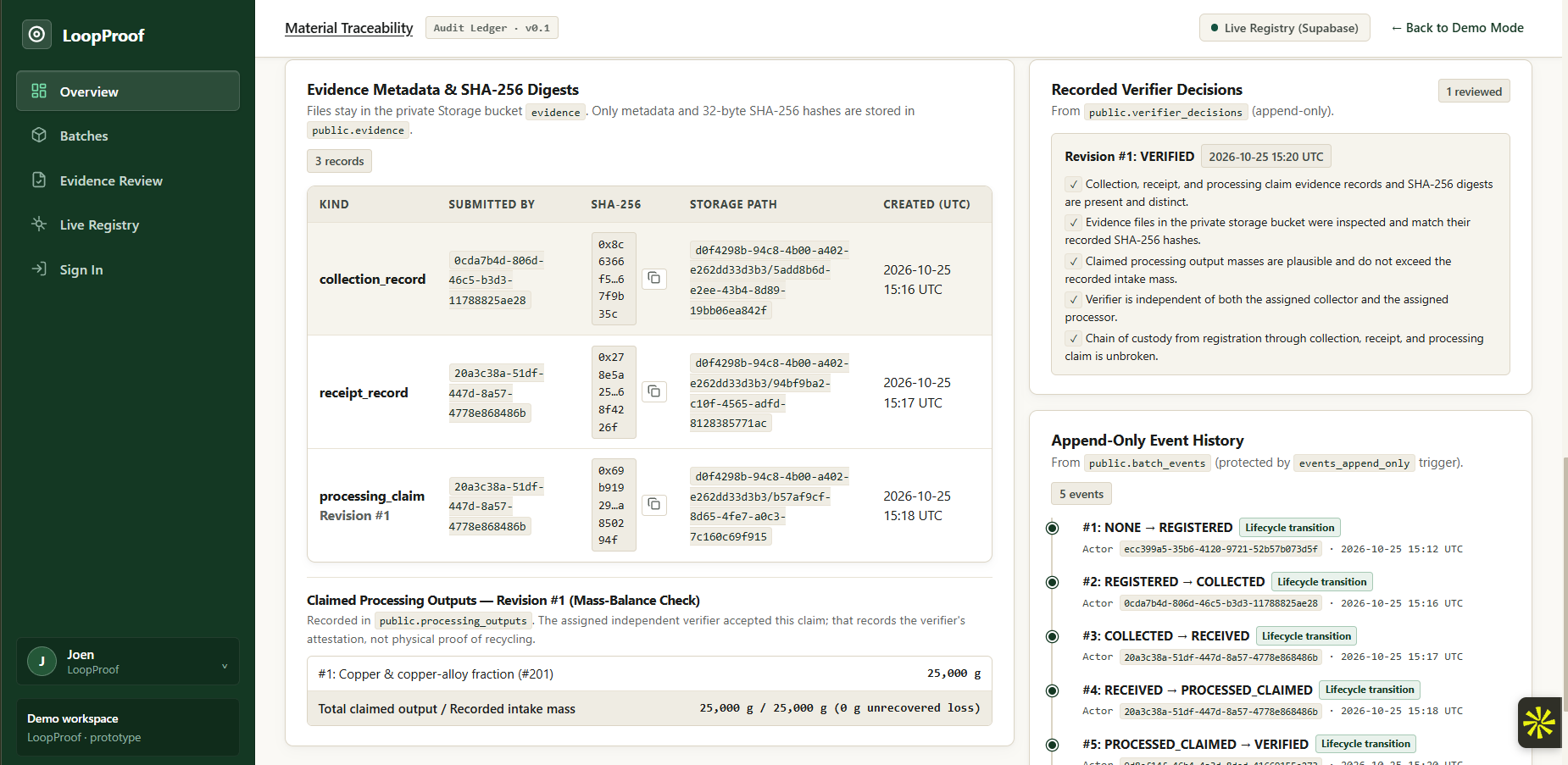
- Evidence-backed claims: Attach supporting evidence to lifecycle events and processing claims.
- Evidence integrity: Detect duplicate evidence artifacts and reduce the risk of reusing the same evidence across claims.
- Verification-aware lifecycle: Distinguish collection, receipt, processing claims, and verified outcomes rather than treating them as interchangeable.
- Transparent impact reporting: Present environmental impact information in a way that can be evaluated against the underlying records and methodology.
How We Built It
We developed LoopProof as a web-based prototype supported by a smart-contract registry architecture.
The implementation includes a frontend dashboard for batch and evidence workflows, Solidity smart contracts for lifecycle registry logic, and a development and testing environment using Hardhat.
We designed the lifecycle around explicit state transitions and evidence requirements. The aim is to ensure that a processing claim is not automatically treated as a verified outcome merely because a batch has been collected or a file has been uploaded.
The project also includes contract tests and documentation covering lifecycle rules, design decisions, and test planning.
Implementation note: The current smart-contract registry runs in a local Hardhat development environment and is not yet deployed to a public blockchain testnet. The prototype's demonstration data is synthetic and is not presented as evidence of real-world recycling events.
Challenges We Faced
One of the biggest challenges was deciding what each lifecycle event should actually prove. Collection, receipt, processing, and verification represent different claims and must not be conflated.
Another challenge was designing evidence handling so that duplicate artifacts and unsupported claims could be identified without making the workflow unnecessarily complicated.
We also had to balance a clear user experience with the need to make lifecycle status, evidence records, and verification boundaries explicit.
What We Learned
Building LoopProof reinforced that blockchain alone does not guarantee trustworthy data. A ledger can preserve records, but the quality of those records still depends on evidence, validation, identity controls, and independent review.
We learned to treat verification as a distinct step, document lifecycle rules explicitly, and distinguish a technical prototype from a production-ready traceability system.
What's Next
Our next steps include deploying the registry to a supported public testnet, strengthening and validating role separation and verifier independence, expanding adversarial contract tests, and improving evidence validation.
We also want to develop more rigorous environmental impact calculations, with transparent assumptions and auditable data sources, and eventually evaluate the workflow with real e-waste collection and processing partners.
Our Vision
LoopProof aims to make e-waste traceability more evidence-driven and accountable.
Because responsible recycling should be supported by evidence—not just a claim that a batch was collected.
Built With
- blockchain
- contracts
- development
- e-waste
- hardhat
- javascript
- management
- smart
- solidity
- sustainability
- web

Log in or sign up for Devpost to join the conversation.