LoopLocal Turn everyday waste into local resources. Theme: Eco-Friendly & Sustainability Interdisciplinary themes: Logistics & Supply Chain, Social Impact & Community Innovation
Elevator Pitch LoopLocal is a community-based surplus redistribution system that helps campuses, cafés, offices, hostels, and small businesses redirect usable food and everyday resources to nearby people and organizations instead of sending them to waste.
Rather than treating surplus as a disposal problem, LoopLocal treats it as a local logistics problem: identify what will become surplus, match it with a nearby need, and coordinate a predictable pickup before it becomes waste.
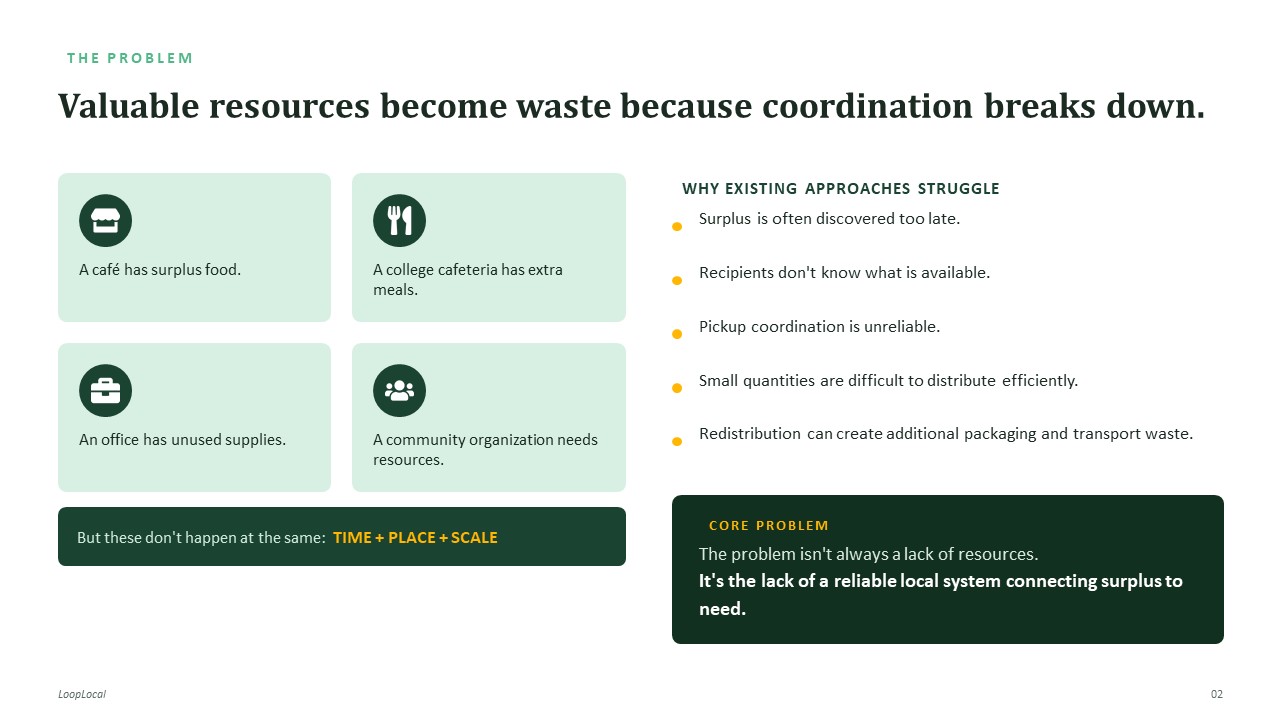
- The Problem Every day, organizations end up with resources that still have value but are difficult to redistribute efficiently.
A café may have unsold food near closing time. A college cafeteria may have excess prepared food. An office may have unopened supplies it no longer needs. A hostel may have reusable containers or materials sitting unused.
The problem is not always a lack of resources.
It is often a lack of coordination, timing, trust, and logistics.
Current approaches can be fragmented:
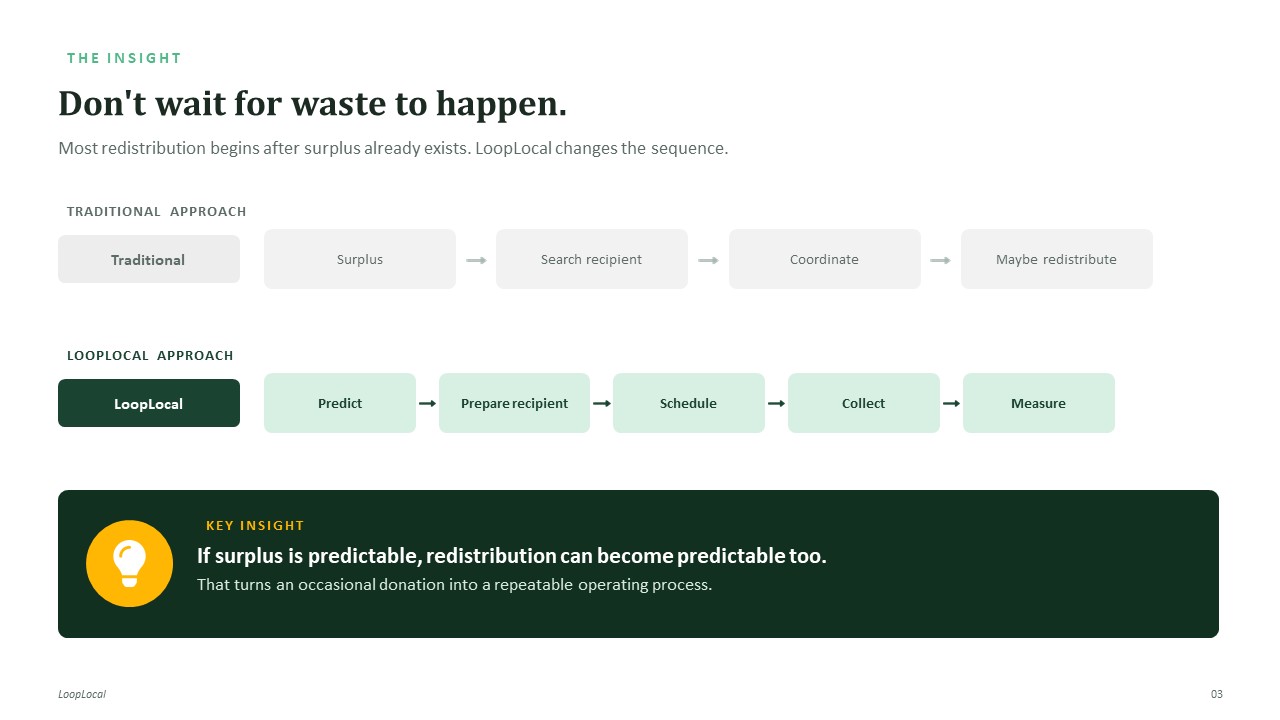
Surplus is discovered too late.
Potential recipients may not know it exists.
Pickup is difficult to coordinate.
Small quantities are not attractive to conventional logistics systems.
Repeated redistribution can create additional packaging waste.
Organizations may be unwilling to participate if the process is complicated.
As a result, something that could still be useful can become waste simply because the right person is not connected to it at the right time.
- Our Solution LoopLocal creates a simple local resource loop:
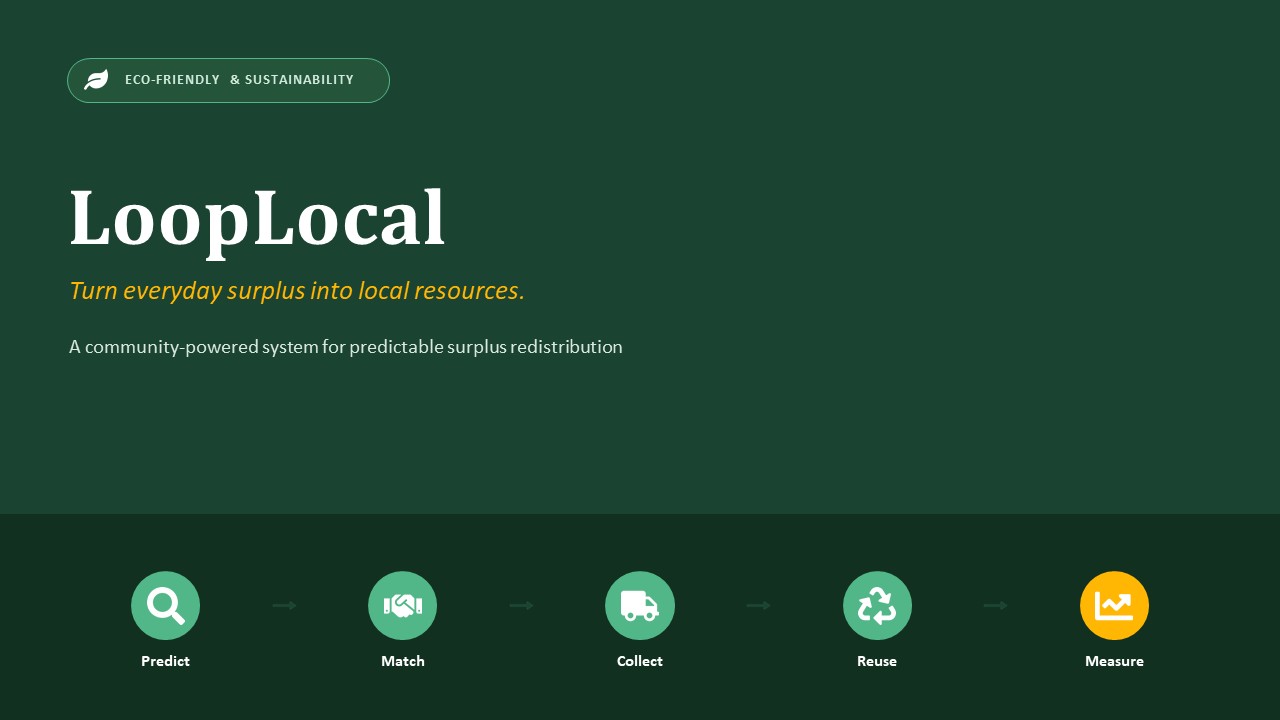
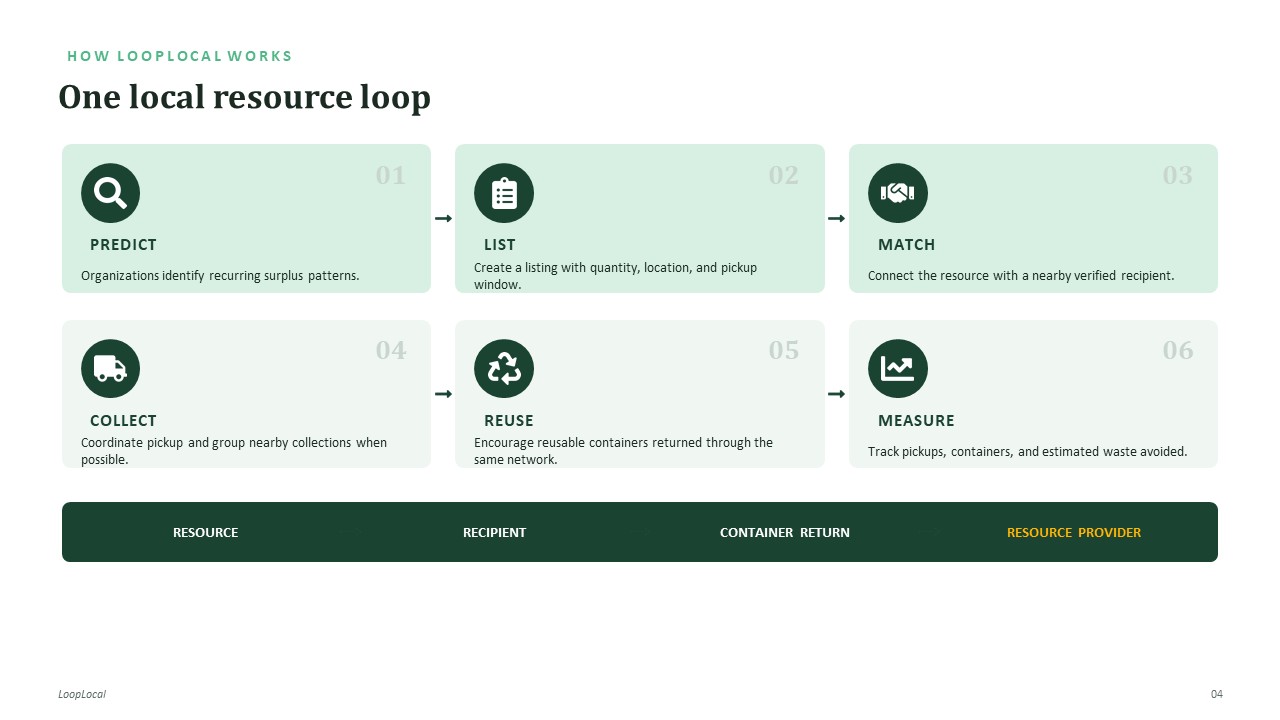
Predict → List → Match → Collect → Reuse → Measure
A participating organization identifies resources that are likely to become surplus.
Instead of waiting until the last moment, the organization can announce an upcoming surplus window.
LoopLocal then matches the resource with nearby verified recipients and groups compatible pickups into practical time windows.
The system also encourages reusable containers and recurring pickup routes so that redistribution itself does not create unnecessary waste.
Example A college cafeteria expects 25 surplus meal portions at 8:30 PM.
Instead of waiting until 8:30 PM and asking:
"Who wants this?"
the cafeteria posts:
25 meals likely available — pickup 8:30–9:00 PM
Nearby registered recipients can reserve quantities.
The system creates a pickup plan.
The cafeteria knows exactly where the surplus is going.
The recipient knows when to arrive.
The result is a predictable local loop instead of last-minute disposal.
- How It Works Step 1 — Predict Organizations record recurring surplus patterns.
Example:
Monday: approximately 15 portions
Friday: approximately 30 portions
Event days: approximately 50 portions
This allows future surplus to be anticipated rather than discovered at the last minute.
Step 2 — List The organization creates a simple surplus listing:
Resource type
Quantity
Available time
Pickup location
Basic safety/handling information
Packaging type
Step 3 — Match LoopLocal identifies suitable nearby recipients based on:
Distance
Quantity
Availability
Pickup window
Recipient requirements
Step 4 — Collect Recipients receive a defined pickup window rather than an indefinite request.
Multiple nearby pickups can be grouped into one route.
Step 5 — Reuse Where appropriate, reusable containers are returned through the same local network.
This creates a second loop:
Resource → Recipient → Container return → Resource provider
Step 6 — Measure Organizations receive simple impact metrics such as:
Resources redistributed
Estimated waste avoided
Number of successful pickups
Reusable containers circulated
Recurring surplus patterns
- What Makes LoopLocal Different? LoopLocal is not primarily a marketplace.
It is a local redistribution infrastructure model.
Most simple redistribution concepts focus on finding someone who wants surplus.
LoopLocal focuses on the harder question:
How do we make redistribution predictable enough to happen repeatedly?
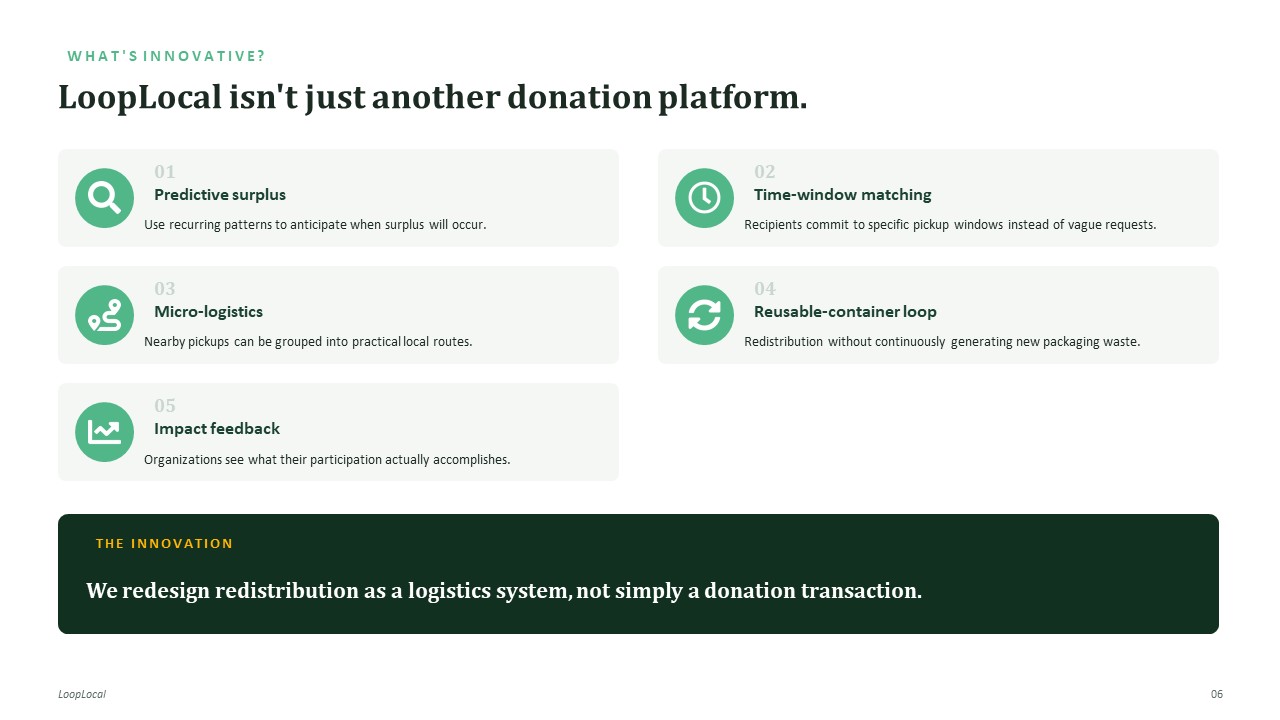
The concept combines five elements:
Predictive surplus Organizations learn when and where surplus is likely to occur.
Time-window matching Recipients reserve resources within specific pickup windows.
Micro-logistics Nearby pickups can be grouped rather than handled independently.
Reusable-container circulation Redistribution does not need to rely entirely on disposable packaging.
Impact feedback Participants can see whether their recurring participation is actually reducing waste.
Target Users Supply-side users College cafeterias
Restaurants and cafés
Hostels
Corporate cafeterias
Bakeries
Event organizers
Small retailers
Recipient-side users Community organizations
Student groups
Shelters
Local charities
Community kitchens
Other verified organizations
Individuals, where appropriate and legally permissible
Network users Student volunteers
Community coordinators
Local delivery partners
Campus sustainability teams
- Example User Journey Before LoopLocal Cafeteria → Surplus → No immediate recipient → Disposal
With LoopLocal Cafeteria → Predict surplus → Publish pickup window → Match recipient → Scheduled collection → Reusable container returned → Impact recorded
The objective is to turn an unpredictable waste event into a repeatable operational process.
- Innovation The central innovation is the shift from surplus donation to surplus logistics.
Instead of asking:
"Can somebody use this?"
LoopLocal asks:
"Can we design a system in which the right recipient is already prepared to collect it?"
This changes redistribution from an occasional charitable action into a repeatable local operating model.
The concept can also expand beyond food.
The same framework could eventually support:
Unused educational materials
Event supplies
Packaging materials
Office supplies
Reusable containers
Certain surplus retail goods
The fundamental principle remains the same:
Keep useful resources circulating locally for as long as possible.
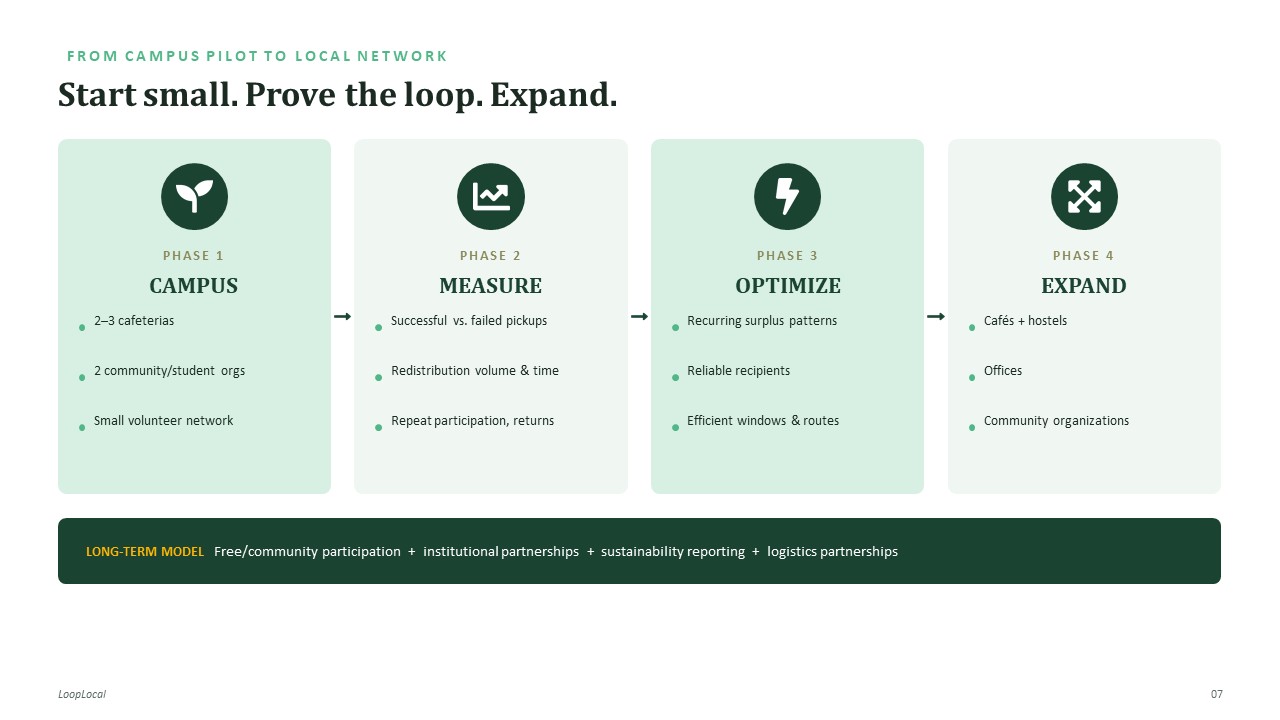
- Implementation Plan Phase 1 — Campus Pilot Start with one college campus.
Participants:
2–3 cafeterias
2 student/community organizations
A small volunteer pickup team
The first version can operate using simple forms, spreadsheets, messaging, and physical collection points.
No sophisticated software is required for the pilot.
Phase 2 — Measure Track:
Number of surplus listings
Successful pickups
Failed pickups
Average pickup time
Quantity redistributed
Container returns
Repeat participation
The objective is to discover where the process breaks.
Phase 3 — Optimize Use the collected information to identify:
Frequent surplus locations
Frequent pickup windows
Reliable recipients
Efficient routes
Reusable-container requirements
Phase 4 — Expand After proving the model on one campus, connect nearby:
cafés
hostels
offices
community organizations
This creates a local resource network.
- Resources Required The initial pilot requires surprisingly little infrastructure.
People One campus/community coordinator
Participating organizations
Verified recipient organizations
Volunteer pickup team
Physical resources Reusable containers where appropriate
Clearly marked collection points
Basic weighing/measurement equipment
Digital resources The pilot can initially use:
Online forms
Spreadsheet/database
Messaging
Simple dashboards
A dedicated application could be developed later if the operating model proves effective.
- Potential Challenges Food safety Not every surplus item should be redistributed.
LoopLocal would therefore require clear eligibility and handling rules, with participating organizations responsible for complying with applicable food-safety requirements.
Missed pickups A recipient who reserves resources but fails to collect them can cause another waste event.
The system therefore needs confirmation, reminders, reliability tracking, and eventually recipient reliability scores.
Transportation cost Individual deliveries could make redistribution inefficient.
LoopLocal addresses this through pickup windows and grouped local routes rather than treating every listing as an independent delivery.
Trust Organizations need confidence that recipients are legitimate.
The pilot would therefore use verified participating organizations and controlled community networks.
Scaling A system that works for one campus may not automatically work for an entire city.
The model should therefore expand geographically in stages rather than attempting to solve the entire city at once.
- Business / Sustainability Model LoopLocal can operate initially as a social-impact pilot.
Long-term possibilities include:
Free community tier Small organizations can participate without a subscription.
Institutional partnerships Universities, municipalities, businesses, and sustainability programs can sponsor local networks.
Enterprise sustainability plans Larger organizations can receive detailed reporting on their redistribution activity.
Logistics partnerships Local logistics providers can participate in scheduled micro-routes.
The objective is to make the core redistribution network accessible while creating sustainable funding for coordination and infrastructure.
- Expected Impact LoopLocal aims to produce impact at three levels.
Environmental Reduce avoidable resource waste.
Increase reuse.
Reduce unnecessary disposal.
Encourage reusable packaging systems.
Social Make usable resources available to organizations that need them.
Strengthen local community networks.
Create opportunities for student/community participation.
Operational Give organizations a predictable process for handling surplus.
Reduce last-minute coordination.
Create data about recurring surplus patterns.
Improve local collection efficiency.
- Success Metrics The pilot would measure:
Metric What it tells us Resources listed Network participation Resources successfully redistributed Actual utilization Failed pickups Reliability problems Average pickup time Operational efficiency Repeat participants Long-term adoption Containers returned Circularity Estimated waste avoided Environmental impact Cost per successful redistribution Economic feasibility
The first objective is not to maximize the number of users.
It is to prove that a small local network can repeatedly move surplus from where it exists to where it is useful.
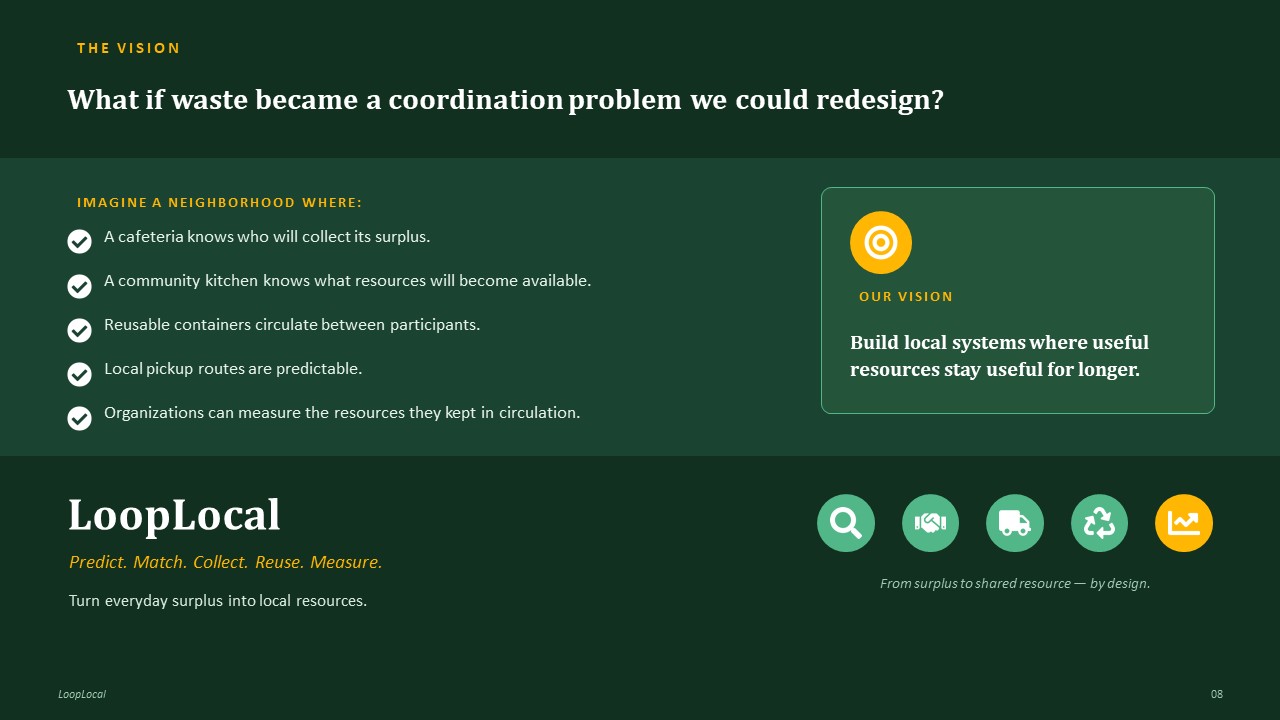
- Future Vision Imagine a neighborhood where surplus does not automatically mean waste.
A bakery knows which community organization collects its end-of-day surplus.
A college cafeteria knows its recurring pickup window.
A community kitchen knows what resources are likely to become available.
Reusable containers circulate between participating organizations.
Local volunteers and logistics partners handle predictable routes.
Instead of thousands of isolated acts of disposal and donation, the community operates one connected resource loop.
That is the future LoopLocal is designed to explore.
- Why Now? Waste is often discussed as a production problem.
LoopLocal approaches it as a coordination problem.
We do not necessarily need to create more resources.
We need better systems for keeping existing resources useful.
The concept therefore combines sustainability, logistics, community participation, and operational design into one framework.
- Prototype / Demonstration The prototype can demonstrate one complete scenario:
Scenario College cafeteria
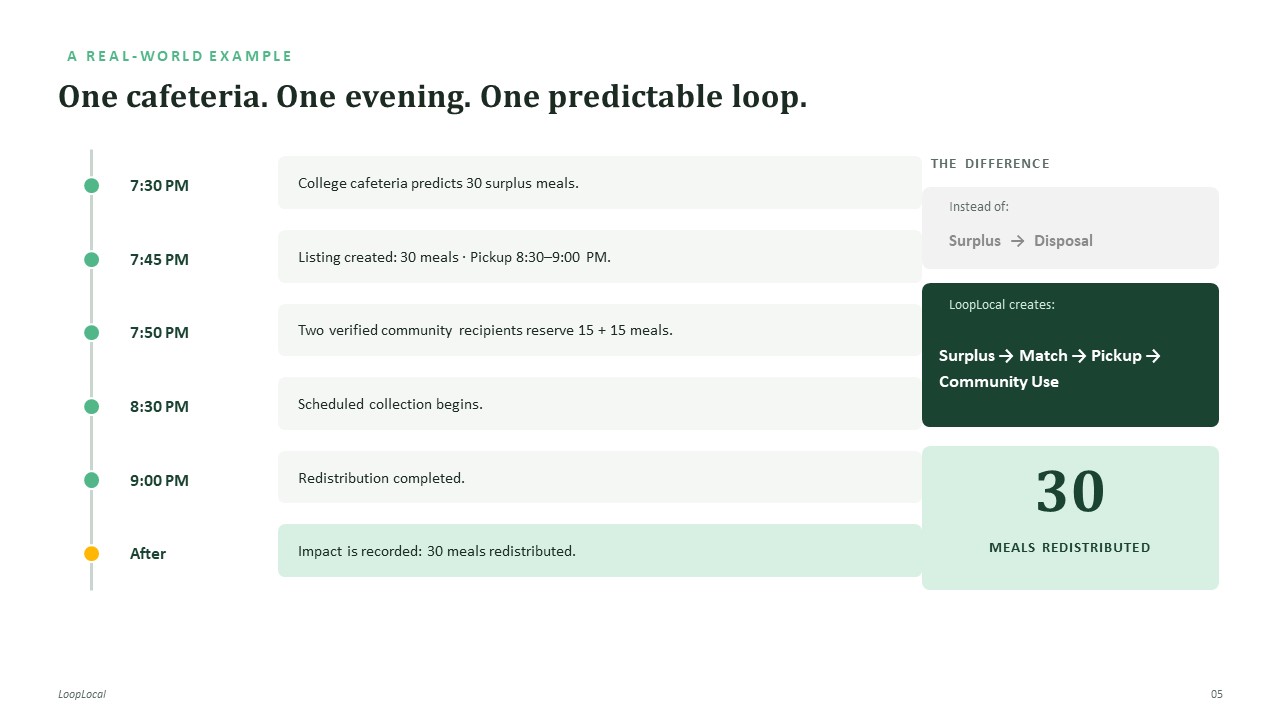
At 7:30 PM:
30 meals expected to remain.
At 7:45 PM:
Surplus listing created.
At 7:50 PM:
Two verified community recipients reserve 15 meals each.
At 8:00 PM:
Pickup window confirmed.
At 8:30 PM:
Collection completed.
At 9:00 PM:
Redistribution recorded.
The prototype should visually show this journey from prediction to completed redistribution.
One-Sentence Summary LoopLocal turns local surplus from a last-minute disposal problem into a predictable, coordinated resource-sharing network.
Project Story The problem Useful resources become waste because supply and demand are disconnected in time and space.
The insight The missing ingredient is often not another donation platform—it is reliable local coordination.
The solution LoopLocal predicts recurring surplus, matches it with verified nearby recipients, coordinates pickup windows, encourages reusable containers, and measures the resulting impact.
The vision Build local systems where useful resources stay in circulation instead of becoming waste.
Built With
- and
- canva
- figma
- google-docs
- google-sheets
- no-code
- prototype
- qr-codes

Log in or sign up for Devpost to join the conversation.