-
-
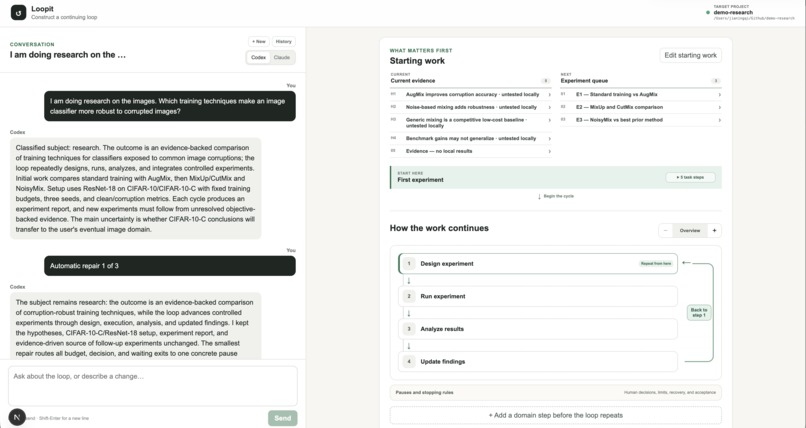
loopit interface
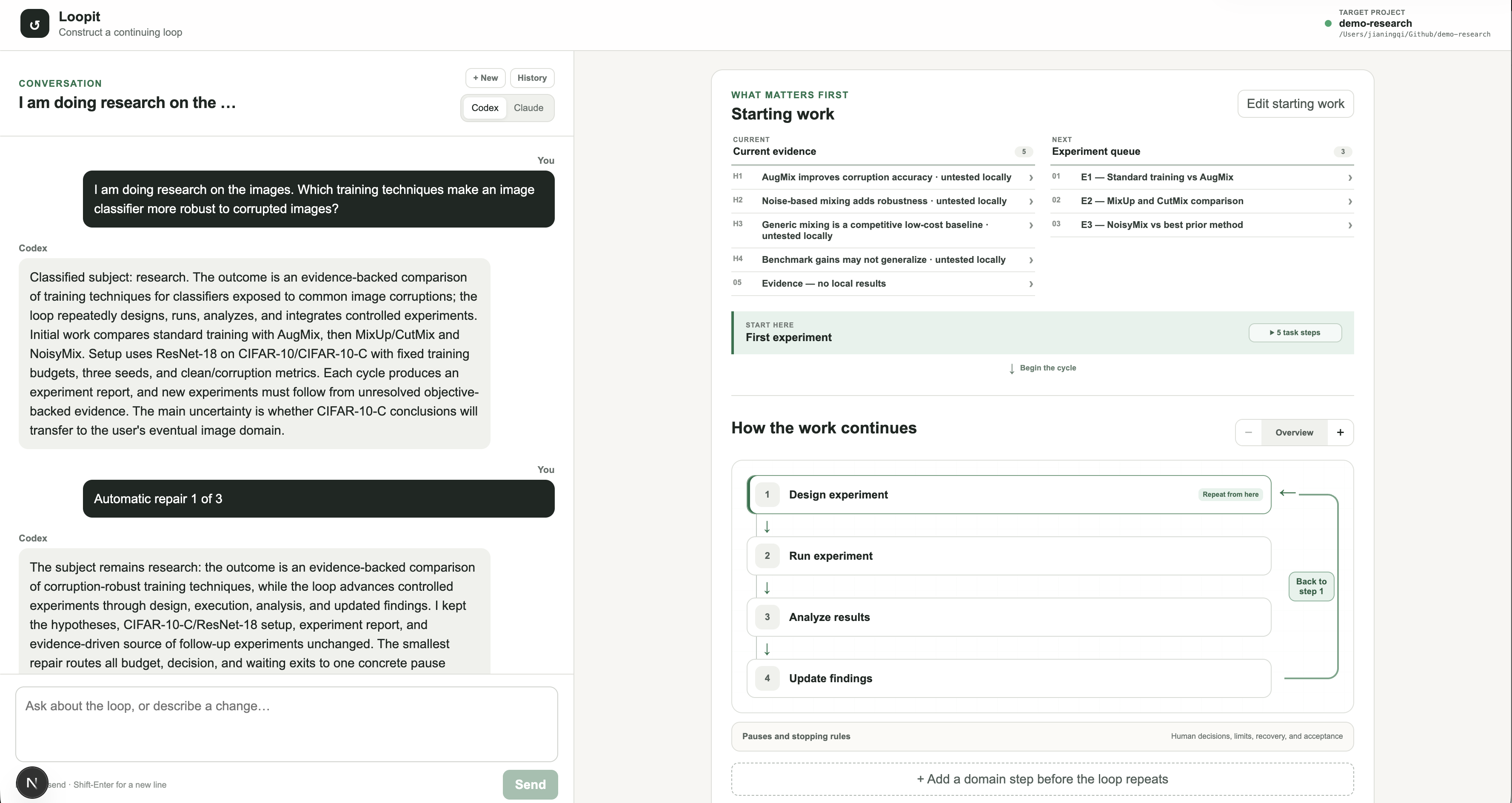
Inspiration
Loopit started as a research tool I built for myself. Traditional coding agents often work for a short period, stop, and ask for the next instruction. I wanted an agent that could continue making progress without constant supervision. The resulting loop harness ran autonomously for more than 70 hours and significantly accelerated my research. Then I found many people who are using codex or claude code do not work with loops. They ask the agent to work on something, then wait 15 min after it complete, then continue to ask the next question. That made me wonder: could the same approach help other people automate their own work? Could they delegate their work to codex for 24 hours rather than give instructions every 15 min?
What it does
Loopit turns a goal into a repeatable, autonomous workflow. Users can define a process, specify how each iteration should work, and test whether the loop can continue reliably. At the end of each iteration, Loopit returns the agent to a well-defined state so it can evaluate the result, decide what comes next, and begin another cycle. Instead of stopping after a single task, the agent keeps progressing without requiring continuous human supervision.
How we built it
I built a web interface around Codex that runs directly on the user’s local machine. Codex handled much of the implementation, allowing me to focus on the product design, workflow model, and experience of creating reliable loops.
Challenges we ran into
The biggest challenge was making loops easy to understand. Most users do not naturally describe their work as loops or states. The product needed to turn a simple goal into a workflow that could repeat reliably. A loop needs clear goals, completion criteria, and a reliable way to determine the next action. Early versions exposed too much of this complexity through technical language. We also faced a very literal hardware challenge: water was spilled on my computer during development, so the project briefly paused while the machine dried out.
Accomplishments that we're proud of
We built a working interface and harness that helps users create and run autonomous workflows—even when they are unfamiliar with the concept of an agent loop. I am especially proud that the UI makes an abstract technical idea feel approachable. It guides users from an initial goal to a workflow that can be tested, refined, and run continuously.
What we learned
Users do not naturally think in terms like “loop state,” “iteration,” or other internal jargon. They think about the outcome they want and the work required to reach it. That taught us to design around the user’s language: goals, progress, results, and next steps. The underlying system can remain sophisticated, but the experience should feel clear and familiar.
What's next for loopit
Next, we plan to build a more capable runtime with stronger reliability, recovery, observability, and control for long-running workflows. We also want to support more automation types and make it easier for anyone to turn a recurring process into a dependable autonomous loop.
Built With
- codex

Log in or sign up for Devpost to join the conversation.