-
-
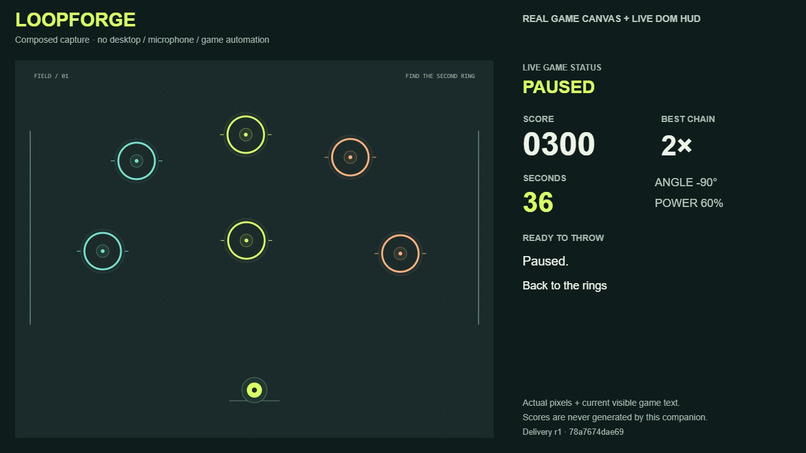
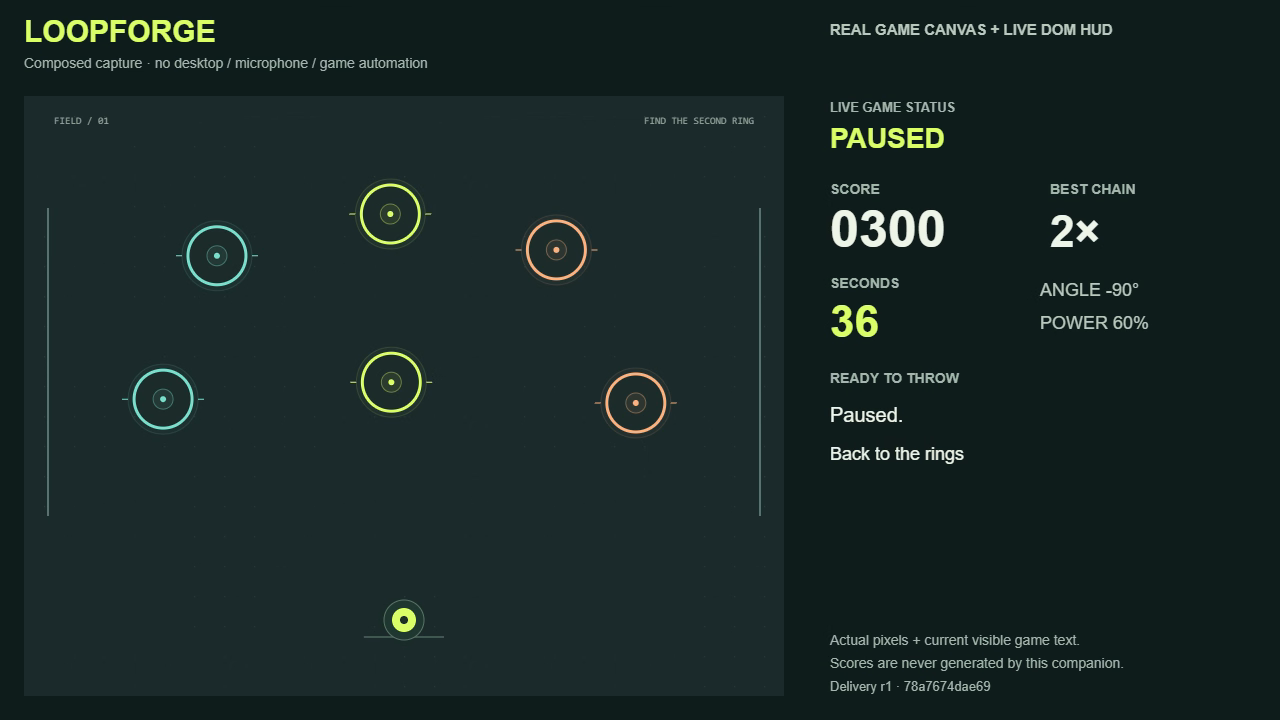
Actual game canvas and live HUD after a 300-point two-ring chain (paused).
Inspiration
A booth visit is brief. LOOPFORGE gives that moment a clear challenge: launch a ball, catch a moving ring, then reach another ring before the ball falls. A 45-second round provides a score to chase and a quick reset. Untimed practice gives players room to explore the same mechanics before starting the clock.
What it does
Players adjust angle and power to send a projectile through moving rings. Each different ring caught during one flight extends the chain; center hits and wall banks add points. The dotted aiming guide follows the same motion rules as the ball. Visible sliders and a Launch shot button support keyboard-operated play. Pause, resume, a timed result screen and One more round complete the loop, with no account or player uploads required.
How it was built
The JavaScript engine uses small fixed simulation steps, gravity and damped wall bounces. Swept-distance checks catch intersections between frames, while per-shot ring tracking prevents duplicate points. Scoring, aiming preview, timing and reset share the same engine. Geometric Canvas 2D artwork and optional synthesized Web Audio sounds keep the game self-contained, without third-party runtime libraries or borrowed game assets.
Development tools and roles
IntelliJ IDEA 2026.3 contributed source formatting and before-and-after inspections across seven files. Its findings led to clearer optional-parameter handling, a more descriptive DOM helper and removal of an unused export. CC HSIEH directed the project; OpenAI Codex developed the concept, implementation, code-based visuals and sounds, tests and documentation, and operated the visible browser controls for the recorded demonstration.
Demonstration and next steps
The 87.5-second English-captioned video shows the real game: a two-ring throw worth 300 points, pause and resume, a miss, the natural result and a reset. It uses actual game pixels and visible score text, with waiting trimmed and a held reset frame disclosed. The next steps are real-player booth trials and a separate-screen local leaderboard. The current game and its runtime source are available under MIT.
Built With
- canvas-2d
- css
- html
- intellij-idea
- javascript
- node.js
- openai-codex
- web-audio
