-
-
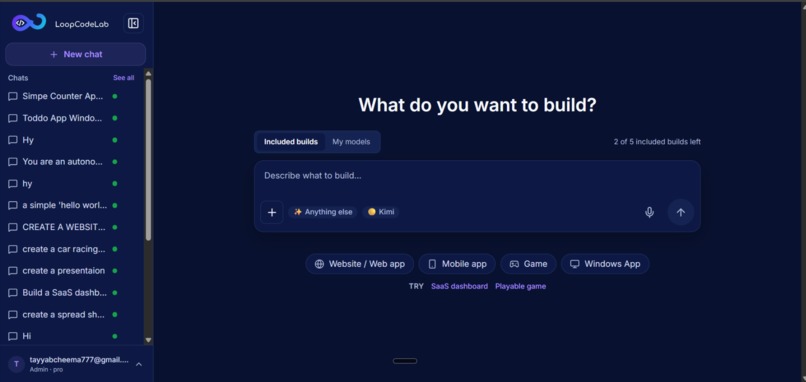
Idea Refine stage
-
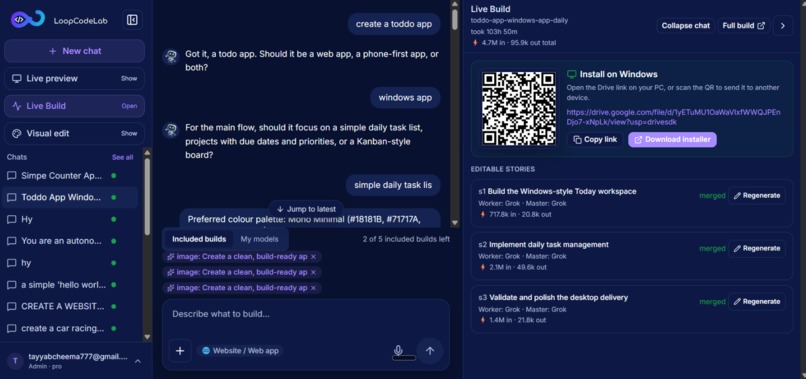
Product Stage
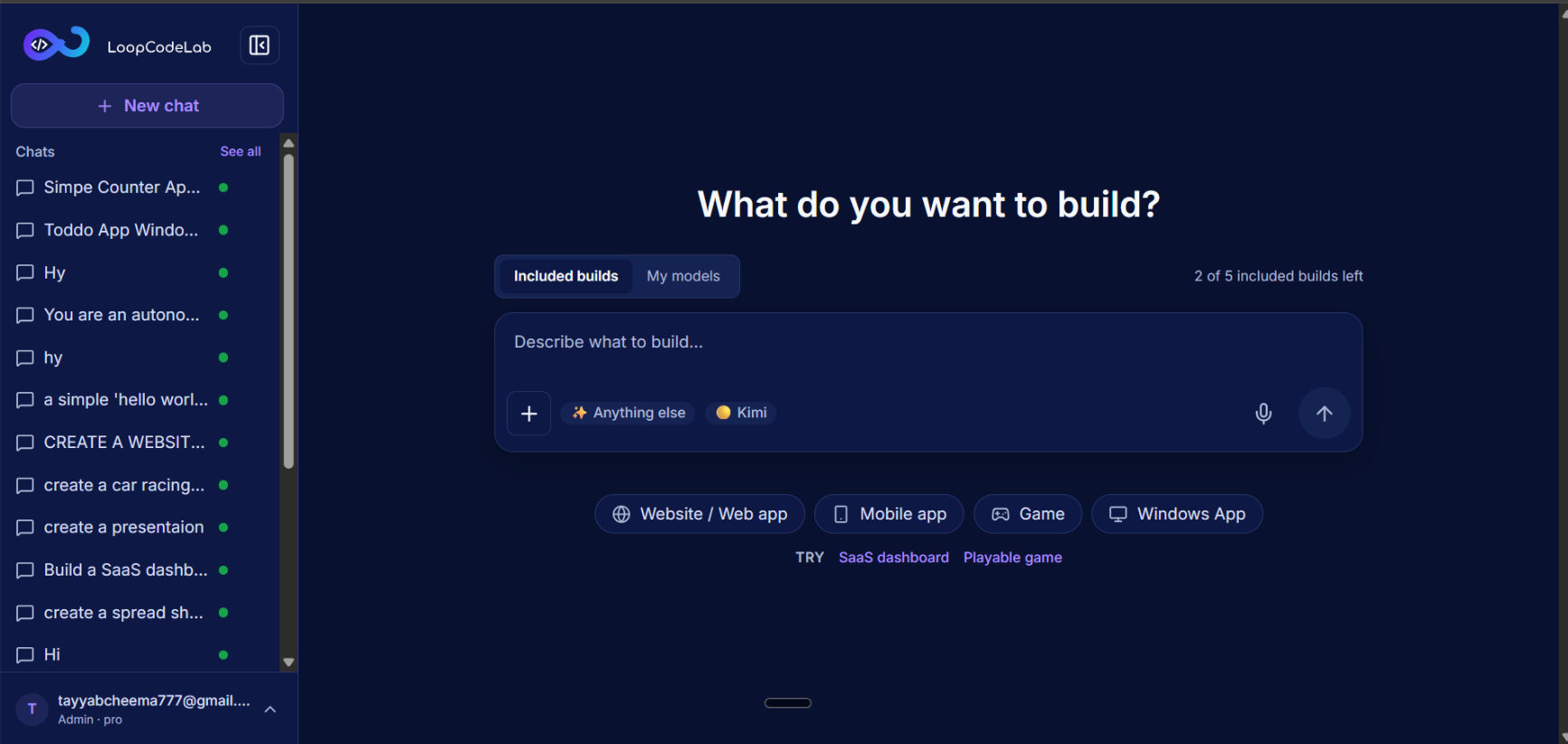
LoopCodeLab: Building Software with an Engineering Team
Inspiration
In May 2026, I was travelling and realised a gap in how I worked. AI coding tools are powerful, but they assume you are at your desk or tethered to a single interface. Most work like solitary assistants: you submit a task and wait whilst one agent orchestrates the entire flow—planning, implementation, testing, review. You must remain present to supervise.
I wanted something different. What if agents could work autonomously whilst I travelled, visible through a persistent terminal I could check whenever I connected? What if multiple specialists coordinated in parallel with clear boundaries and review gates, resembling how engineering teams actually build software?
That gap became LoopCodeLab. It is a self-hosted platform where you describe a project in plain language and a coordinated team of AI agents plans, builds, reviews, and iterates together. Agents work autonomously on isolated branches. You observe through a persistent web terminal. The name reflects the cycle: Learn → Build → Review → Repeat.
What it does
LoopCodeLab has two core parts. A persistent web terminal connects to real tmux sessions so you can monitor autonomous agents and interact from anywhere, regardless of network stability. Ralph, an autonomous orchestrator, transforms a project description into a Git-tracked codebase without requiring your constant attention.
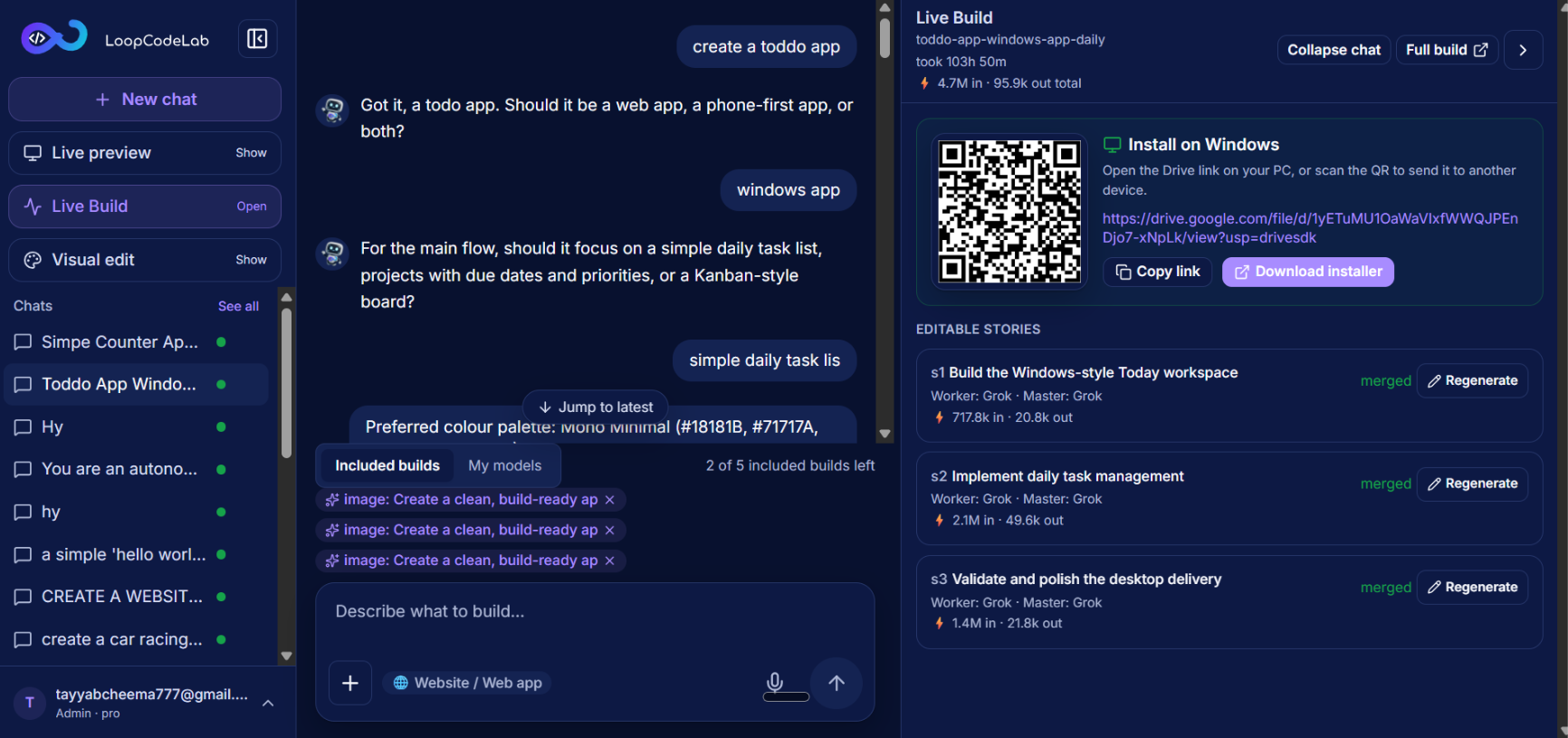
When you submit an idea, the system converts your prompt into an implementation plan and breaks it into focused development stories. Each story gets assigned to an available AI agent working inside an isolated Git branch and worktree. Compatible tasks run in parallel. A supervising agent reviews each agent's changes before they reach main. If something fails, the system detects it, retries within bounds, or reassigns the work. Approved changes merge automatically.
You bring your own AI credentials and choose from supported providers: Claude Code, Codex, Qwen. LoopCodeLab runs on your infrastructure, so project files, credentials, build history, and learned preferences stay under your control. Agents work whilst you are offline. You observe progress through the terminal whenever you reconnect.
How I built it
The backend uses Node.js, Express, and WebSockets. The browser terminal is built with xterm.js; node-pty and tmux bridge the web interface to persistent terminal sessions on the host.
The product layer combines React, Vite, and Tailwind CSS. It includes a project dashboard, guided build workflows, live progress tracking, terminal access, build previews, credential settings, MCP server configuration, and project history.
The orchestration engine coordinates the full lifecycle. Each worker receives a bounded task and operates within its own Git worktree. A reviewing agent examines the result before merge. This makes Git an active part of coordination, not merely a storage layer.
I also implemented a no-cost stub mode so the orchestration flow can be tested without consuming AI credits.
Challenges I faced
Coordinating parallel agents. Agents modify shared files, make conflicting assumptions about architecture, or complete tasks in unexpected sequences. I gave every task its own Git branch and worktree. This isolation prevents collisions and allows the supervising agent to review changes before they reach main.
Recovering from failures. AI agents stall, produce incomplete work, or fail partway through. The system needs to detect these situations without halting the entire build or losing progress on unrelated work. I built in monitoring, bounded retries, explicit failure states, and agent reassignment.
Maintaining consistency across long builds. Multi-stage builds accumulate drift as different agents make different architectural decisions. LoopCodeLab maintains a shared project logbook. Important decisions and review outcomes get recorded so later workers inherit the same constraints instead of rediscovering them.
Making autonomous work observable. Each planner, worker, and reviewer runs in a genuine tmux session. Users can watch agents work through the web terminal, inspect their branches, and review the Git history. This makes every significant action inspectable.
Supporting different AI tools. Coding CLIs have different command syntax, authentication schemes, capabilities, and failure behaviours. I built an abstraction layer that routes tasks across multiple providers whilst keeping provider-specific logic separate from the main orchestration.
What I learned
Successful multi-agent development depends less on adding more agents and more on creating clear boundaries between them.
Small, well-scoped tasks produce better agent results than vague, sprawling ones. Git worktrees are effective as an isolation mechanism for parallel AI development. Review agents need explicit acceptance criteria to make consistent decisions. Retries must be bounded and observable. Persistent project memory prevents architectural drift. Users will not trust autonomous systems until they have visibility and control.
Provider independence makes an AI platform more resilient and accessible. You are not locked into one vendor's capabilities or pricing model.
I gained experience with WebSockets, PTY automation, tmux coordination, Git worktrees, agent routing, React application architecture, and failure recovery in long-running workflows.
Accomplishments
LoopCodeLab orchestrates end-to-end software builds using real development primitives: actual terminal processes, real Git branches and worktrees, parallel AI coding agents, automated review and merging, persistent sessions, bring-your-own-credentials architecture, and a complete self-hosted web interface.
One project idea becomes a structured, reviewed, and Git-tracked implementation.
What's next
The roadmap includes additional AI coding providers, smarter task dependency detection, improved cost and token tracking, stronger automated testing gates, visual comparison and UI-review agents, collaborative team workspaces, container-based execution isolation, reusable community skills and workflows, and more deployment and artifact-delivery targets.
The goal is a practical, open platform where anyone can turn an idea into working software whilst retaining ownership, transparency, and control.
Built With
- codex
- javascript
- tmux


Log in or sign up for Devpost to join the conversation.