-
-

Loop pogo
-
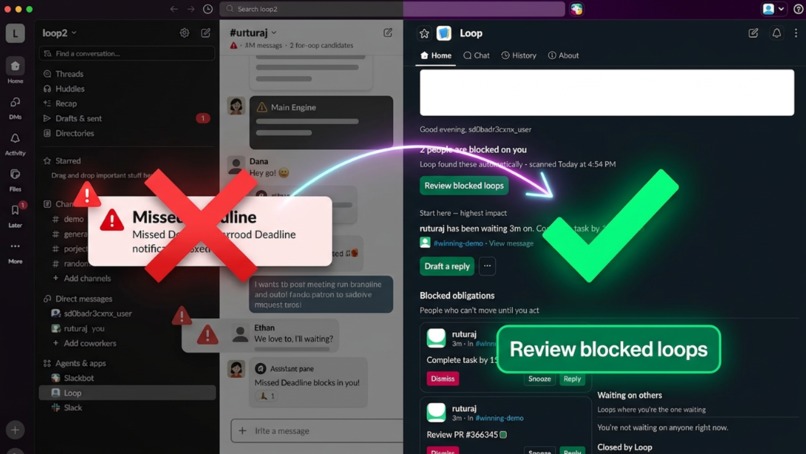
Loop handles you dependecies and work priorities
-
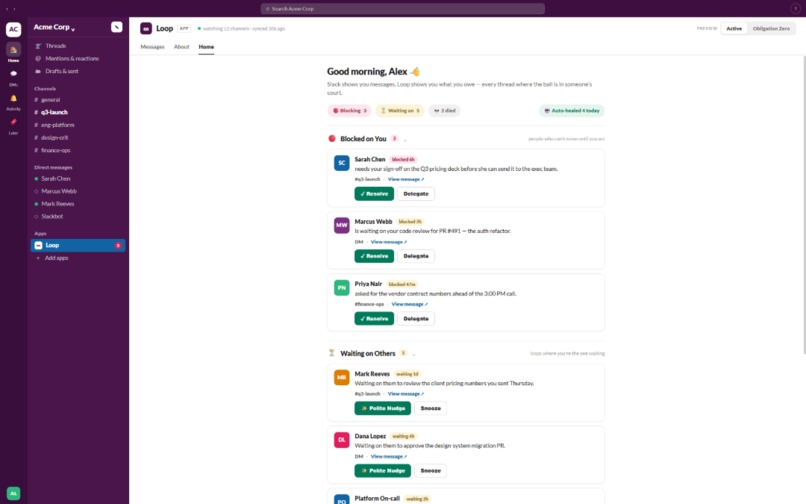
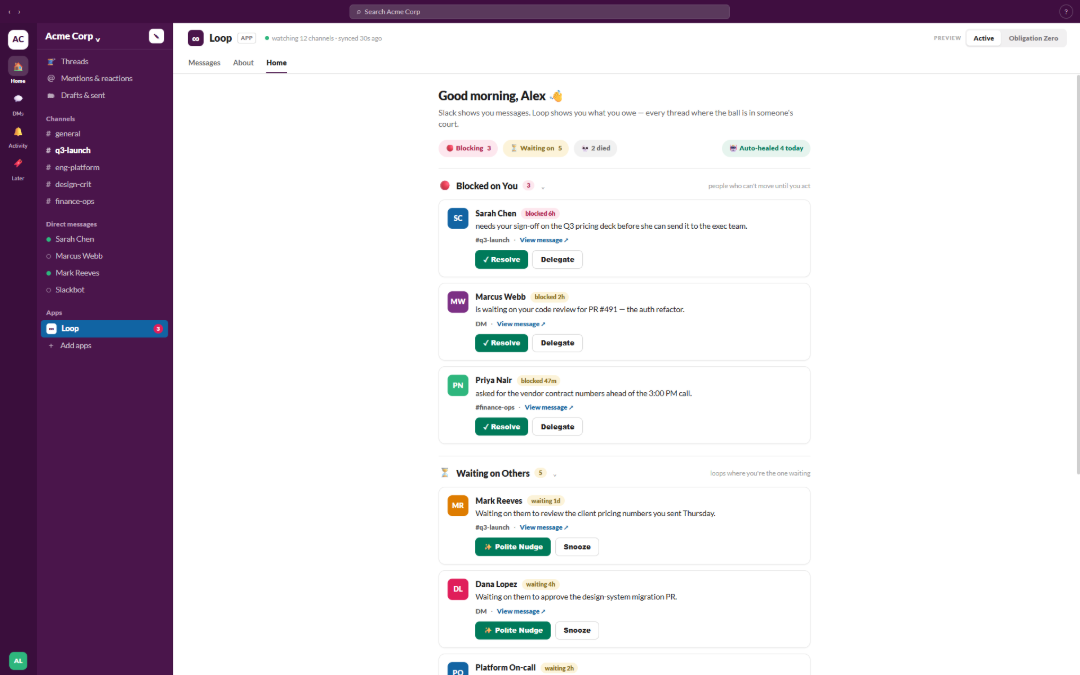
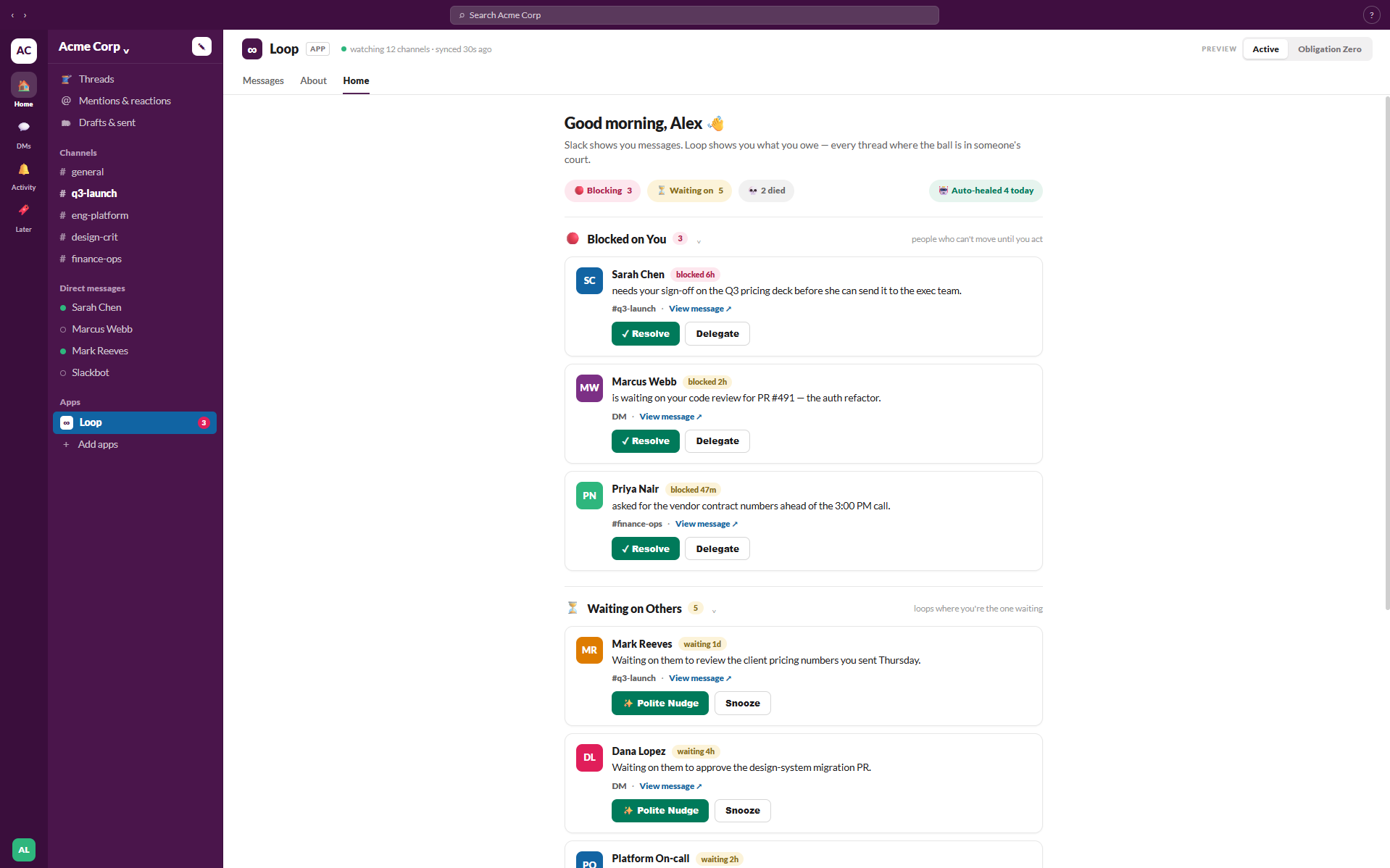
Homepage
-
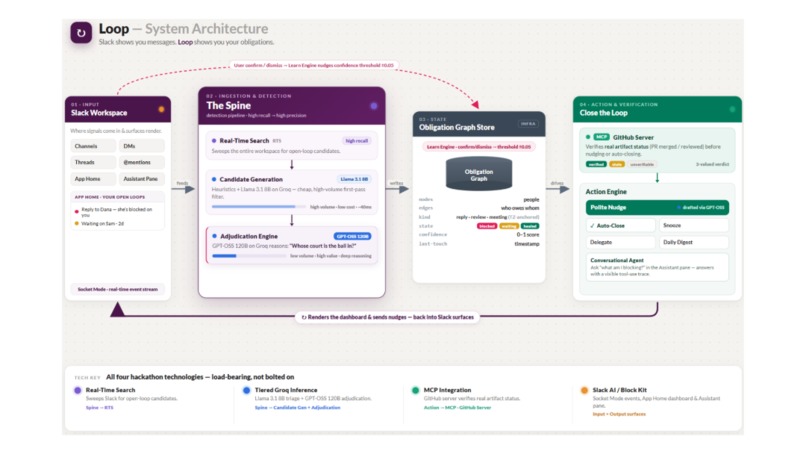
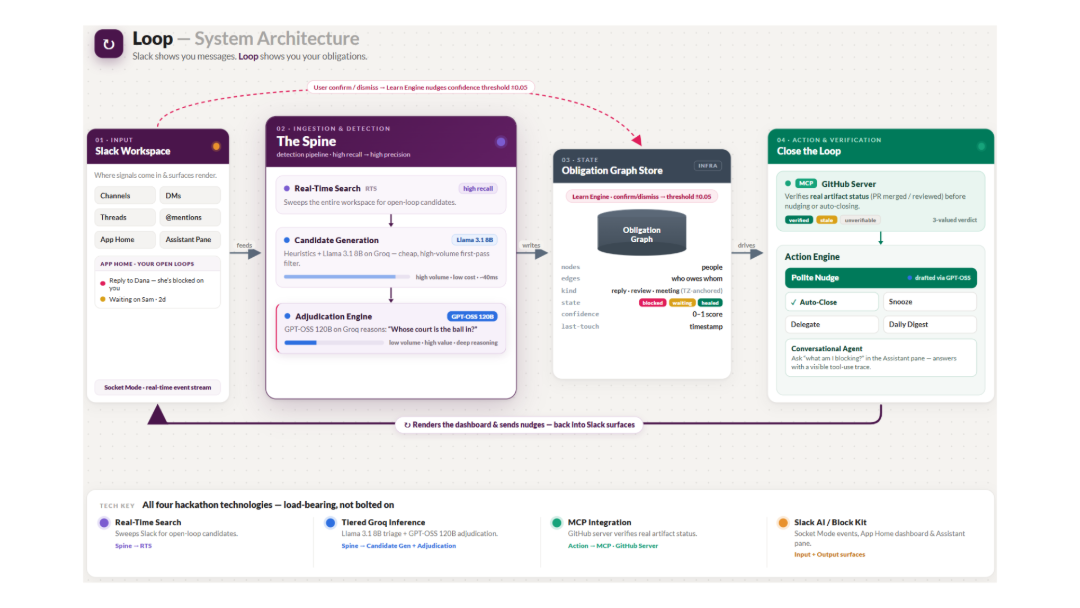
System arcitecture
-
-
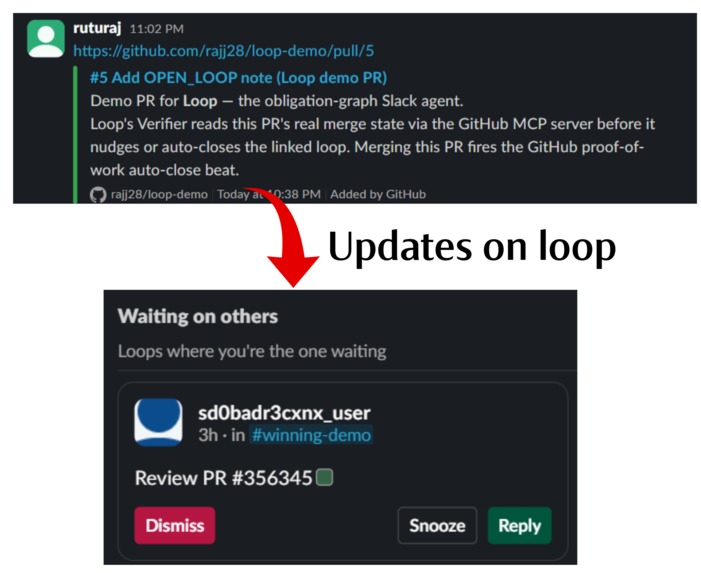
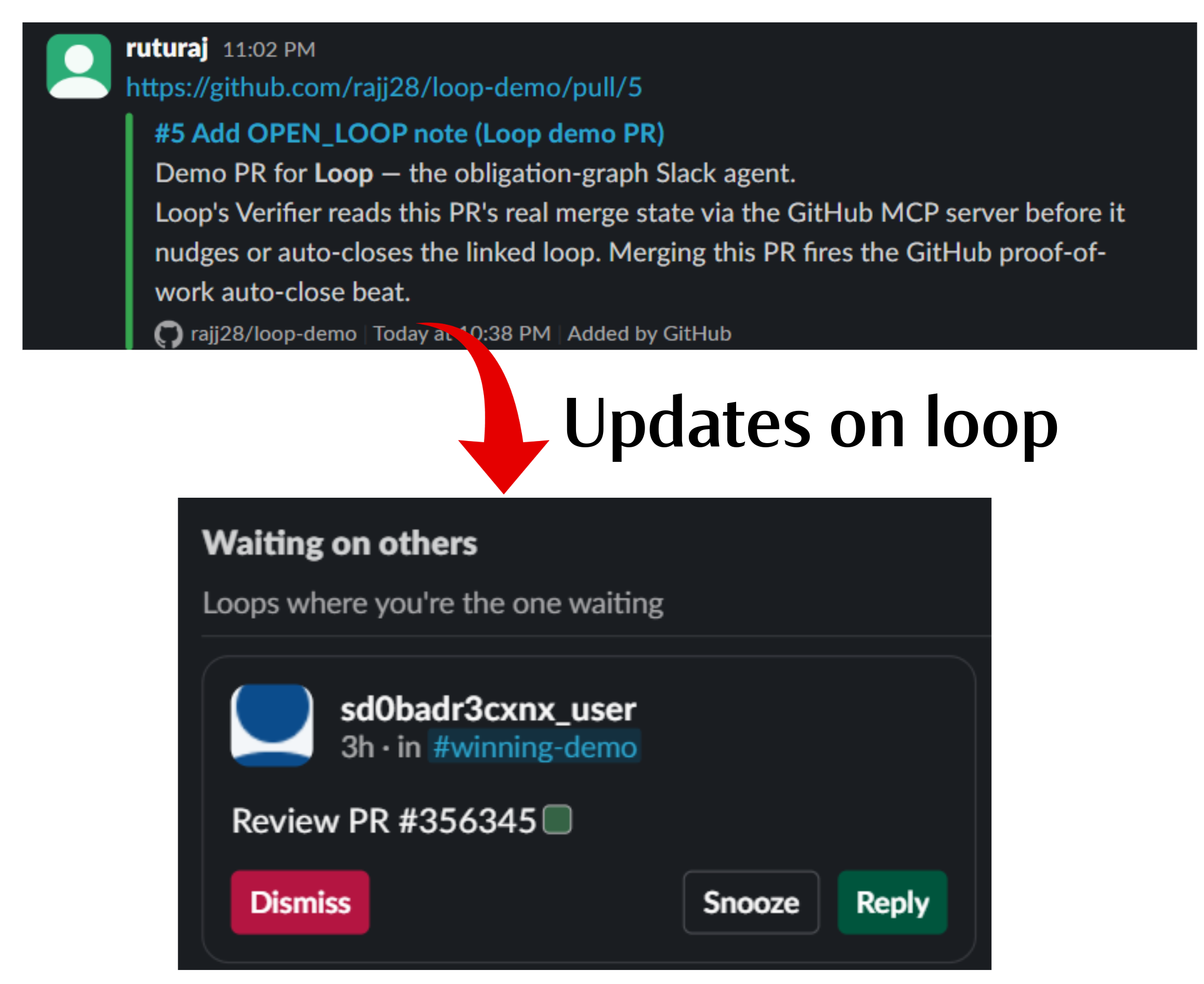
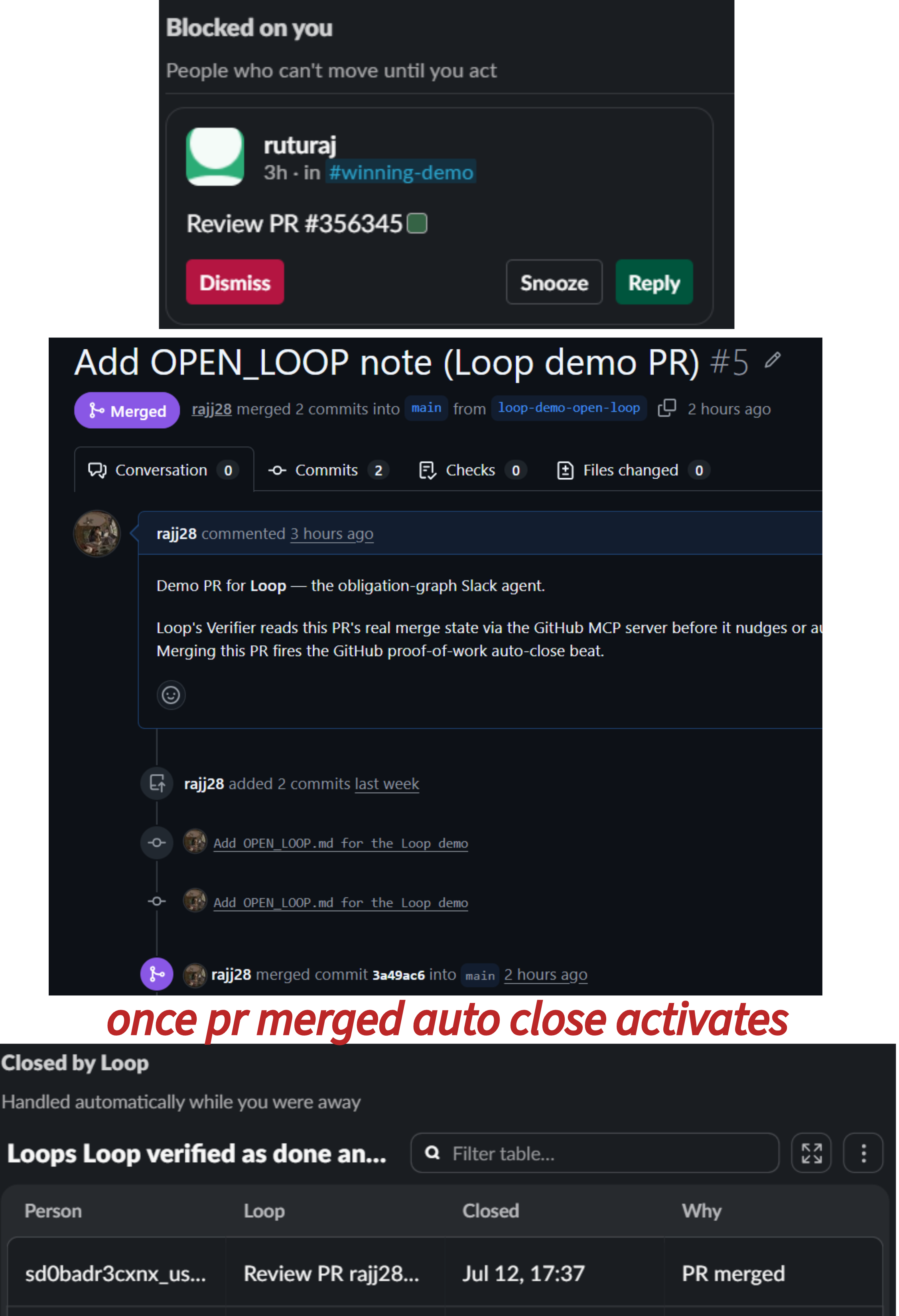
proof based loop detect and clearance
-
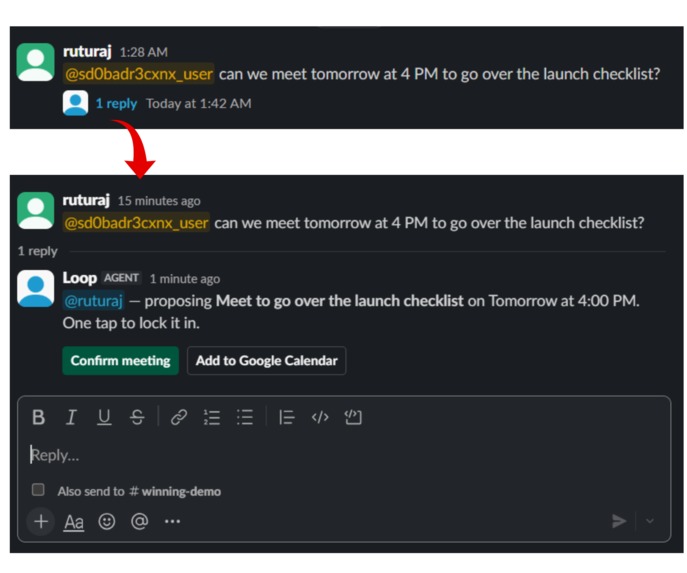
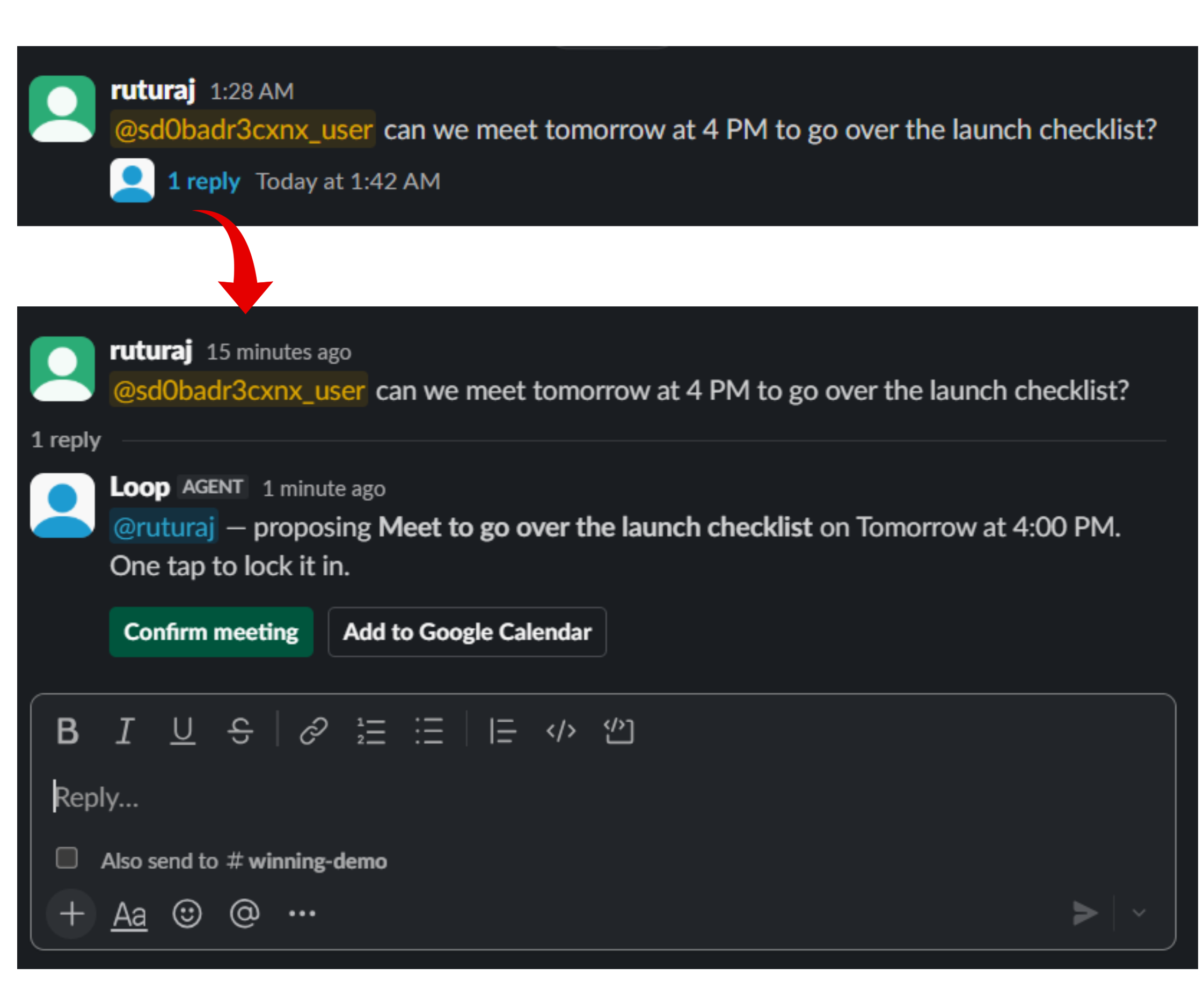
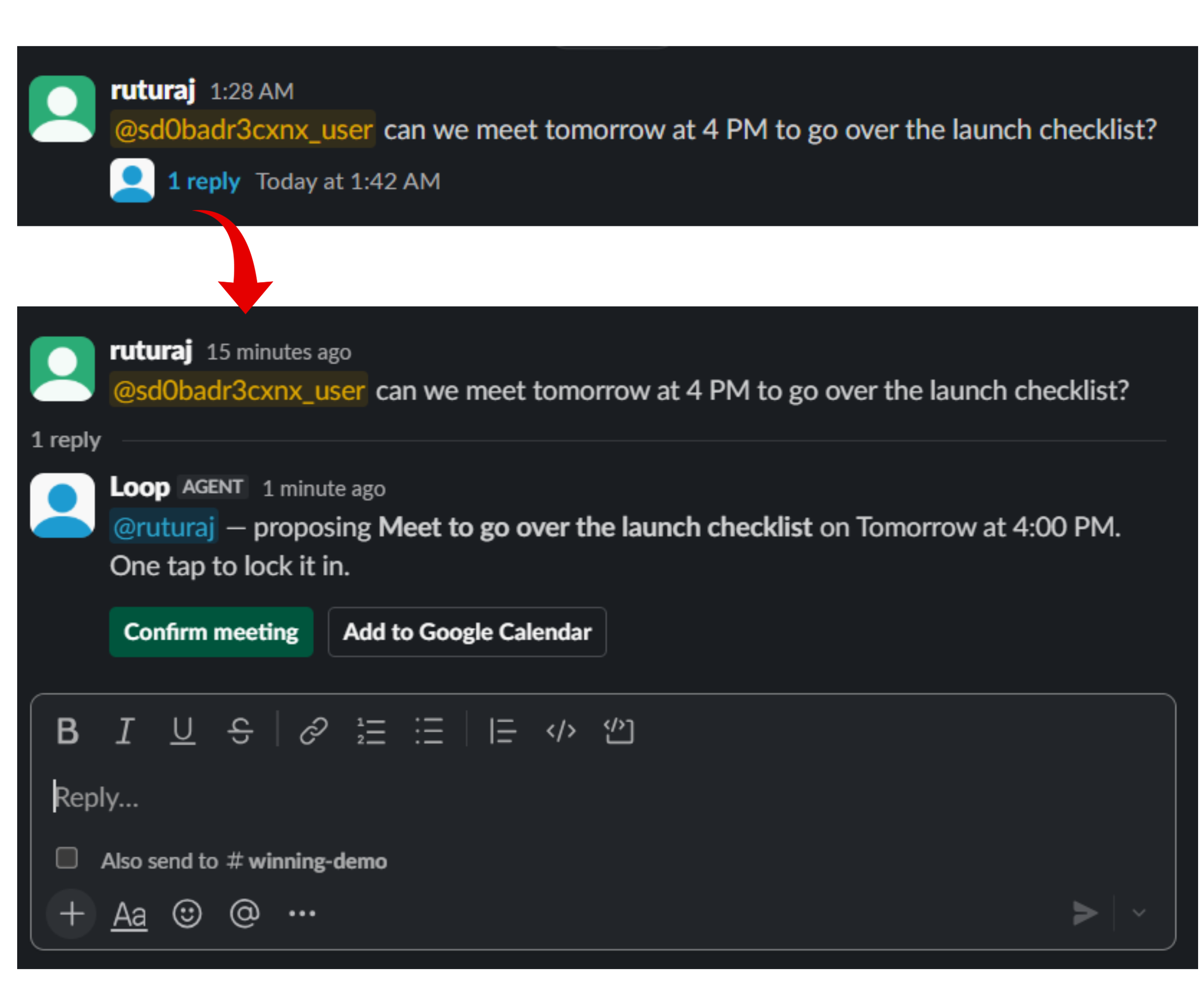
Auto meeting handler , detects meetings in chat and send confirmation in thread
-
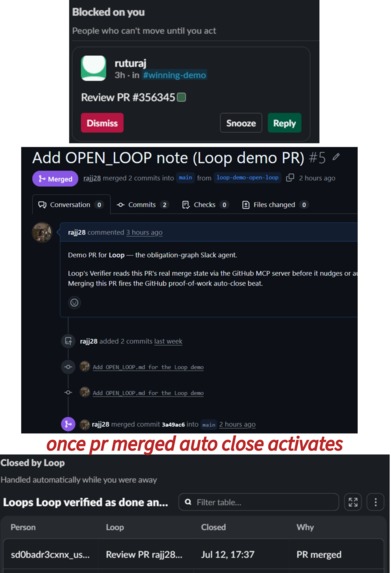
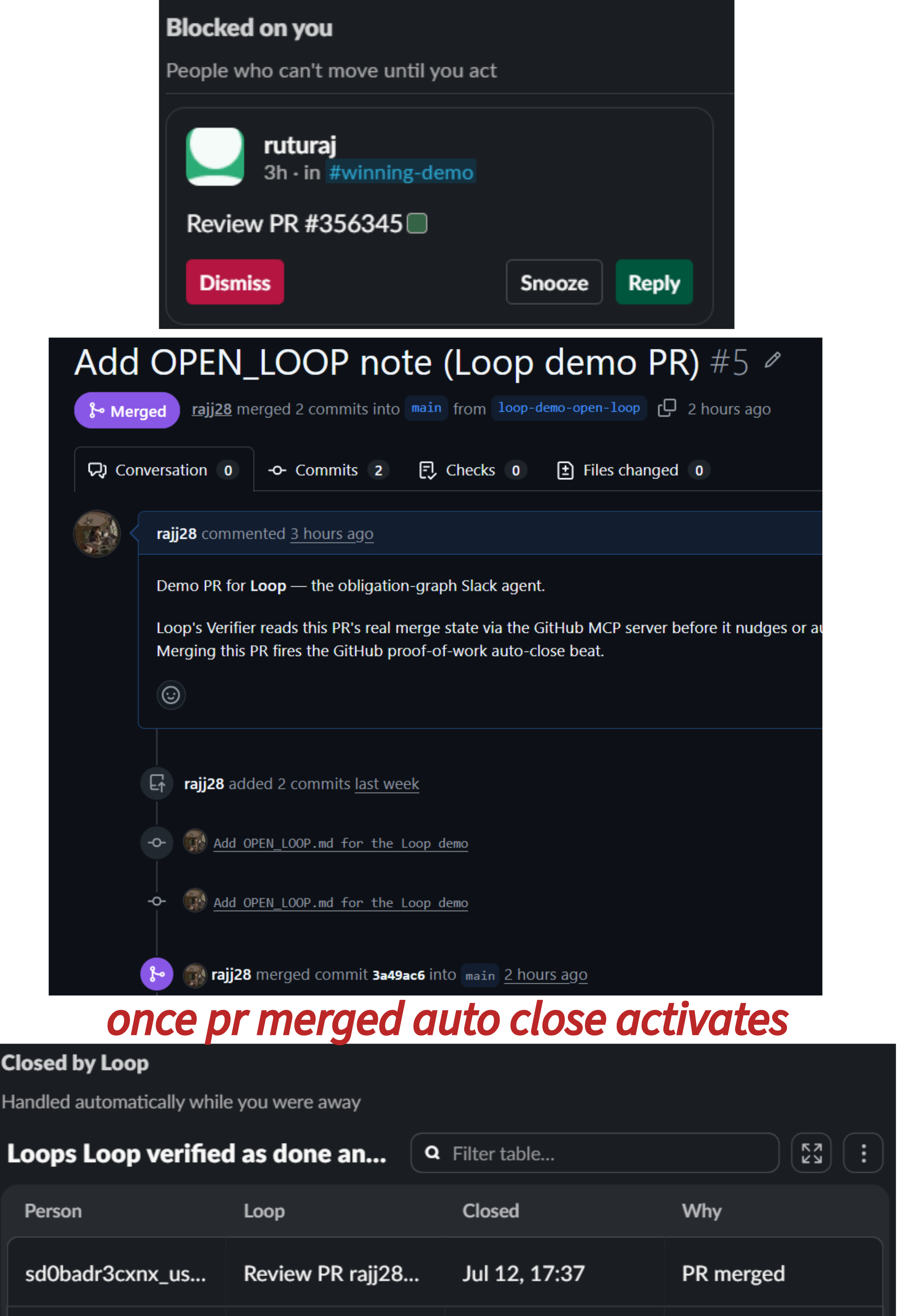
Auto heal at its best

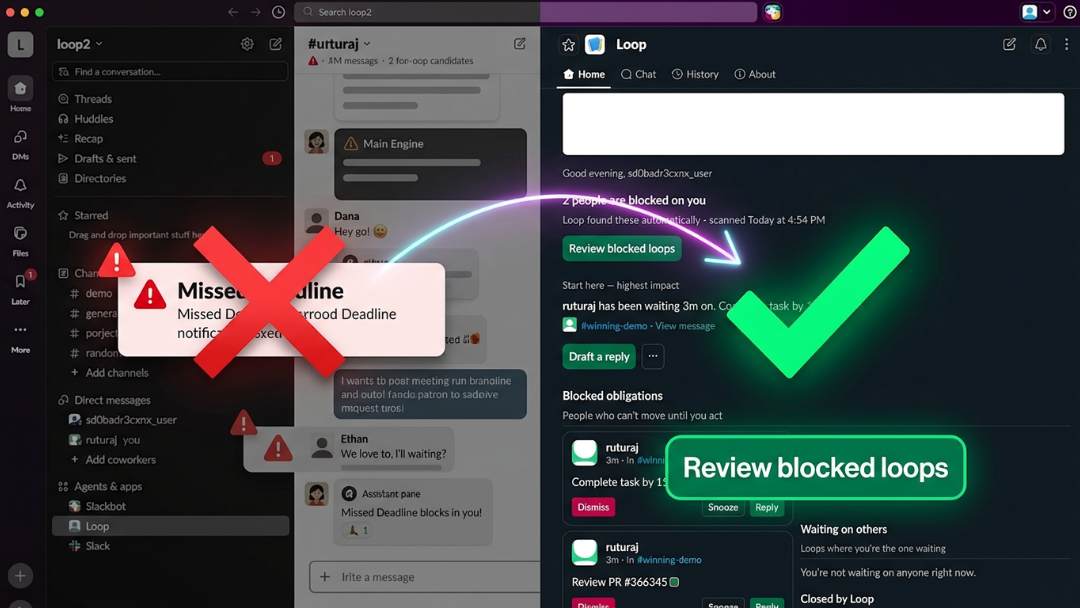
Inspiration
Every day, thousands of dependencies are created inside team conversations. Someone asks a question. Someone promises a code review. Someone proposes a meeting. And not a single one of them is tracked. They sink under a flood of new messages, and the cost is always the same: confusion, dropped handoffs, and missed deadlines.
Task managers don't fix this, because nobody files a ticket for "I'll get back to you by Thursday." The promise lives only in the conversation — so that's where the agent has to live too. We built Loop around one idea: your team doesn't have a communication problem, it has an open-loop problem.
What it does
Loop is a Slack AI agent that maintains a live obligation graph: every open loop where someone is blocked on you, or you are waiting on someone, auto-detected from plain conversation with no forms, no commands, and no manual marking.
- Detects commitments in real time. "Can you review my PR?" / "I'll send it by Friday" / "Can we meet tomorrow at 4?" each become a tracked obligation with parties, a summary, and a deadline.
- Verifies against reality before acting. PR-review loops are grounded in actual GitHub state via the GitHub MCP server. Loop never nudges anyone about work that's already merged — it checks first.
- Heals loops autonomously. When the PR merges, Loop closes the loop itself and files it in the Auto-Healed feed. Nobody clicked anything.
- Understands meetings. Proposed times are extracted in the author's own timezone and turned into scheduled obligations with a one-click prefilled calendar event — no OAuth required.
- Acts as you, with consent. Loop drafts polite nudges in your voice and sends them as you — but only ever after a one-tap confirmation. Snooze, delegate, and a daily digest round out the actions.
- Talks back. Ask the Assistant pane "what am I waiting on?" and an LLM planner composes a plan over Loop's real tools, executes it, and shows you the full tool-use trace.
- Learns. Every Confirm or Dismiss tunes a surfacing threshold, so Loop gets sharper every day about what your team actually cares about. Dismissed loops never resurface.
The signature reveal on the dashboard: "N people are blocked on you right now and you don't know it."
Feature spotlight — Meetings, both sides of the loop
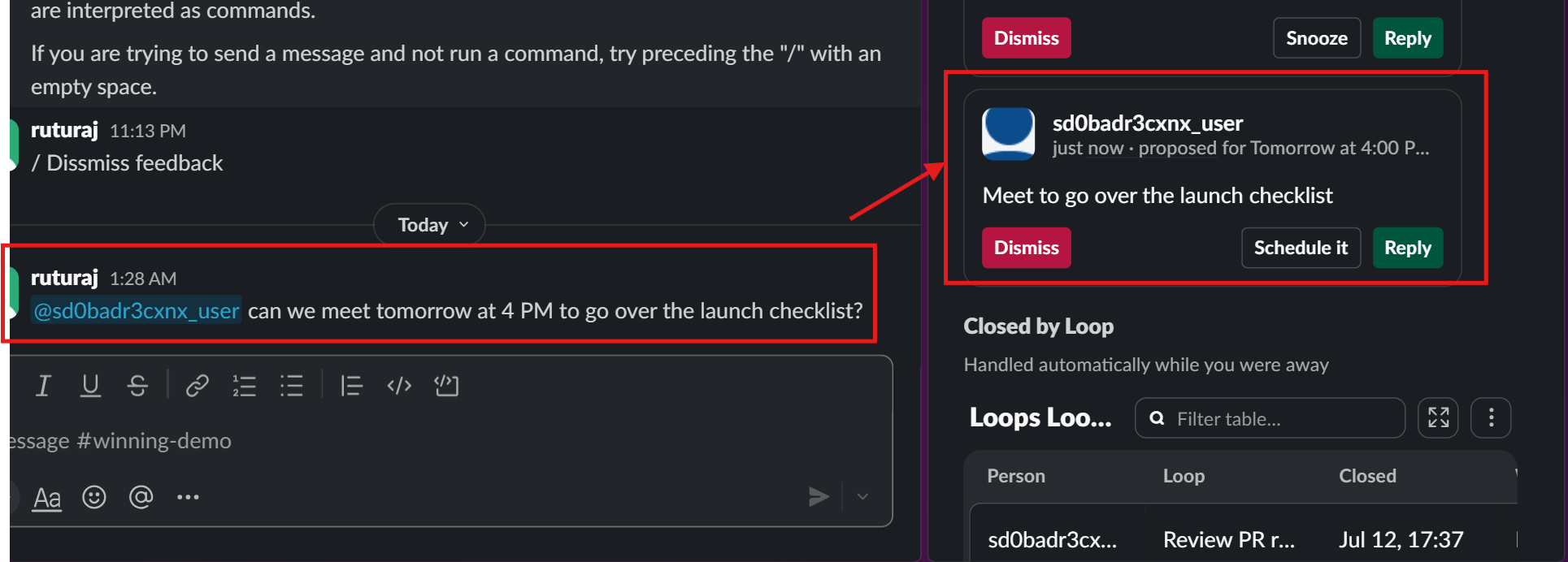
Sender side — the ask. One plain sentence in chat ("can we meet tomorrow at 4 PM?") is all it takes: Loop extracts the proposed time on the author's own clock and the meeting appears on the dashboard with a Schedule It action.
Receiver side — one tap to lock it in. Loop proposes the meeting right in the thread where it was suggested: Confirm meeting heals the loop; Add to Google Calendar creates the prefilled event — no OAuth, no timezone math, no back and forth.
Feature spotlight — Auto-heal, end to end
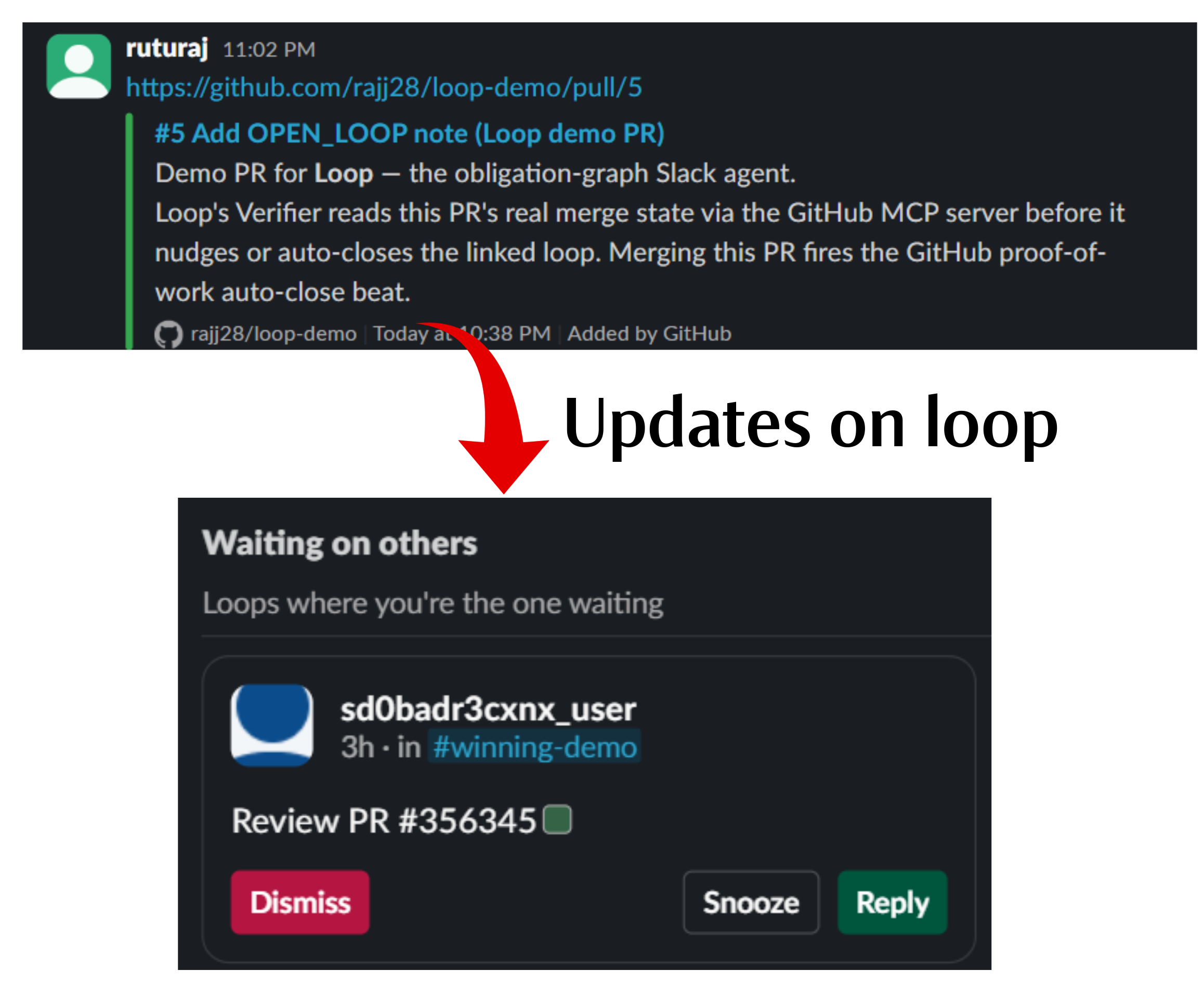
The ask becomes a grounded loop. A review request with a PR link is detected, adjudicated, and stamped with the real GitHub artifact — the dashboard now shows exactly who is waiting on whom.
The PR merges — and Loop closes the loop itself. The Verifier reads the real merge state through the GitHub MCP server and heals the loop autonomously: "Closed by Loop — PR merged." Nobody clicked anything in Slack.
How we built it
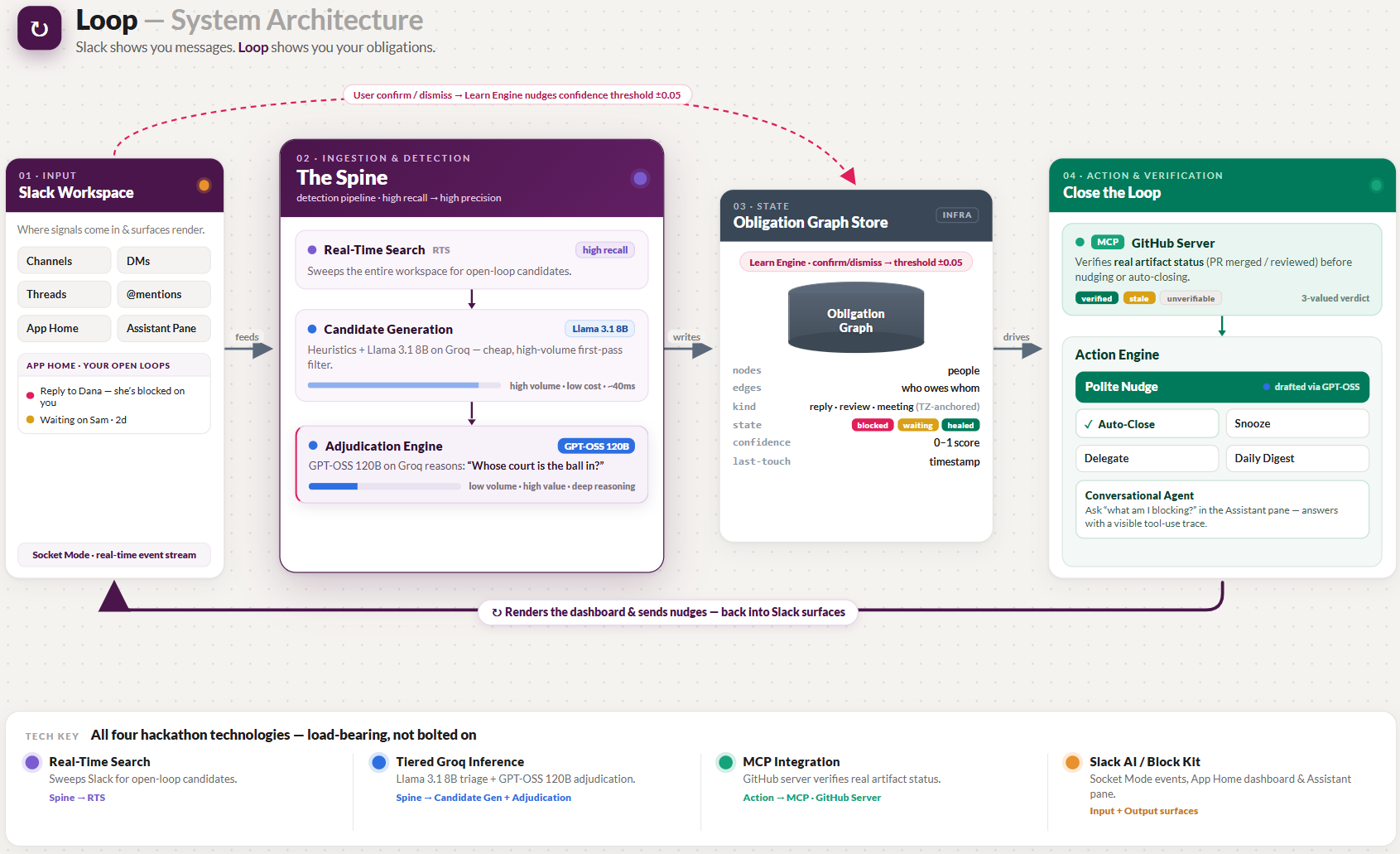
Loop is five cooperating agents around one SQLite obligation graph:
- Watcher (Perceive) — a fast-tier LLM classifier sweeps live message events plus Slack's Real-Time Search (
assistant.search.context) for high-recall open-loop candidates. - Adjudicator (Reason) — a smart-tier model decides who owes what to whom and by when, extracts meeting times anchored to the author's Slack timezone, and stamps GitHub artifact references parsed from free text.
- Verifier (Verify) — grounds PR-referencing loops in real GitHub state through the GitHub MCP server, returning RESOLVED / UNRESOLVED / UNVERIFIED before any nudge or auto-close is allowed to fire.
- Action Agent (Act) — renders the App Home command center in Block Kit, drafts and sends nudges as the user behind a confirmation gate, auto-closes verified-merged loops, and delivers the daily digest.
- Learn Engine (Learn) — records Confirm/Dismiss feedback and tunes the surfacing threshold in bounded, clamped steps.
A sixth surface, the Conversational Agent, fronts everything in the Slack Assistant pane with a ReAct-style planner that composes the other agents as tools at runtime — and degrades gracefully to a deterministic parser if planning fails, so a bad plan never blocks the user.
The stack: Python, Slack Bolt over Socket Mode (no public endpoint needed), SQLite for the graph, a two-tier LLM setup on Groq (an 8B model for cheap high-recall filtering, a 120B model for precise adjudication), APScheduler for sweeps and digests, and the GitHub MCP server for proof-of-work verification. A single pure is_surfaced predicate is the one source of truth for "is this shown?" across every surface, and the core invariants are enforced by property-based tests (Hypothesis, 100+ examples per property).
Challenges we ran into
- Announcements are not obligations. Early prompts happily turned "we will have a meeting at 4pm" into a loop. Teaching the Adjudicator the difference between an announcement and a proposal that awaits confirmation — and requiring two distinct parties, with an explicit self-loop guard — was prompt-engineering trench warfare.
- Timezones. "Tomorrow at 4 PM" means nothing in UTC. We anchor spoken times to the author's Slack
tz_offsetat adjudication time, then convert to UTC for storage. - The feedback loop feeding itself. Loop's own posts were being detected as new open loops. The Watcher now drops bot-authored candidates before they ever reach the Adjudicator.
- Trusting an agent to act. Auto-close only fires on verified GitHub state; transport failures return UNVERIFIED and safely block action. Anything sent as the user sits behind an explicit confirmation. Autonomy is earned per-action, not assumed.
- Slack rate limits. Real-Time Search throttles aggressively, so live event-driven detection carries the experience while sweeps retry politely in the background.
What we learned
The hard part of an autonomous agent is not intelligence — it's restraint. Loop's most important lines of code are the discard guards, the verification gate, and the confirmation tap: every path where the agent chooses not to act. Grounding LLM judgments in external proof (real GitHub state) turned out to be the difference between a demo and something you'd actually let post as you.
What's next for Loop
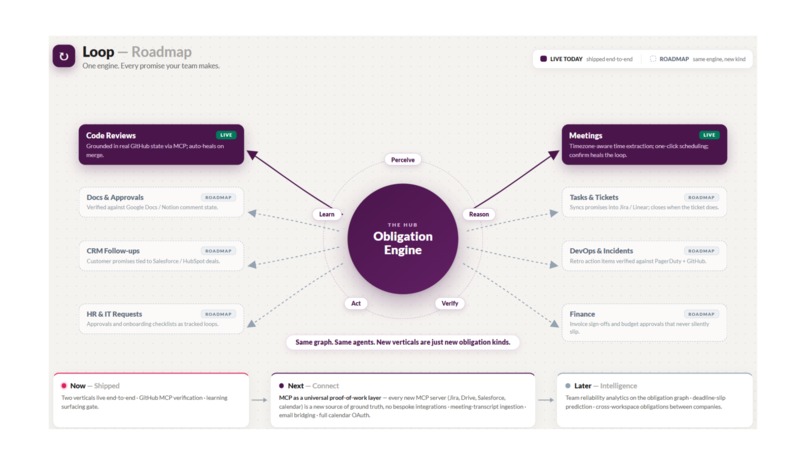
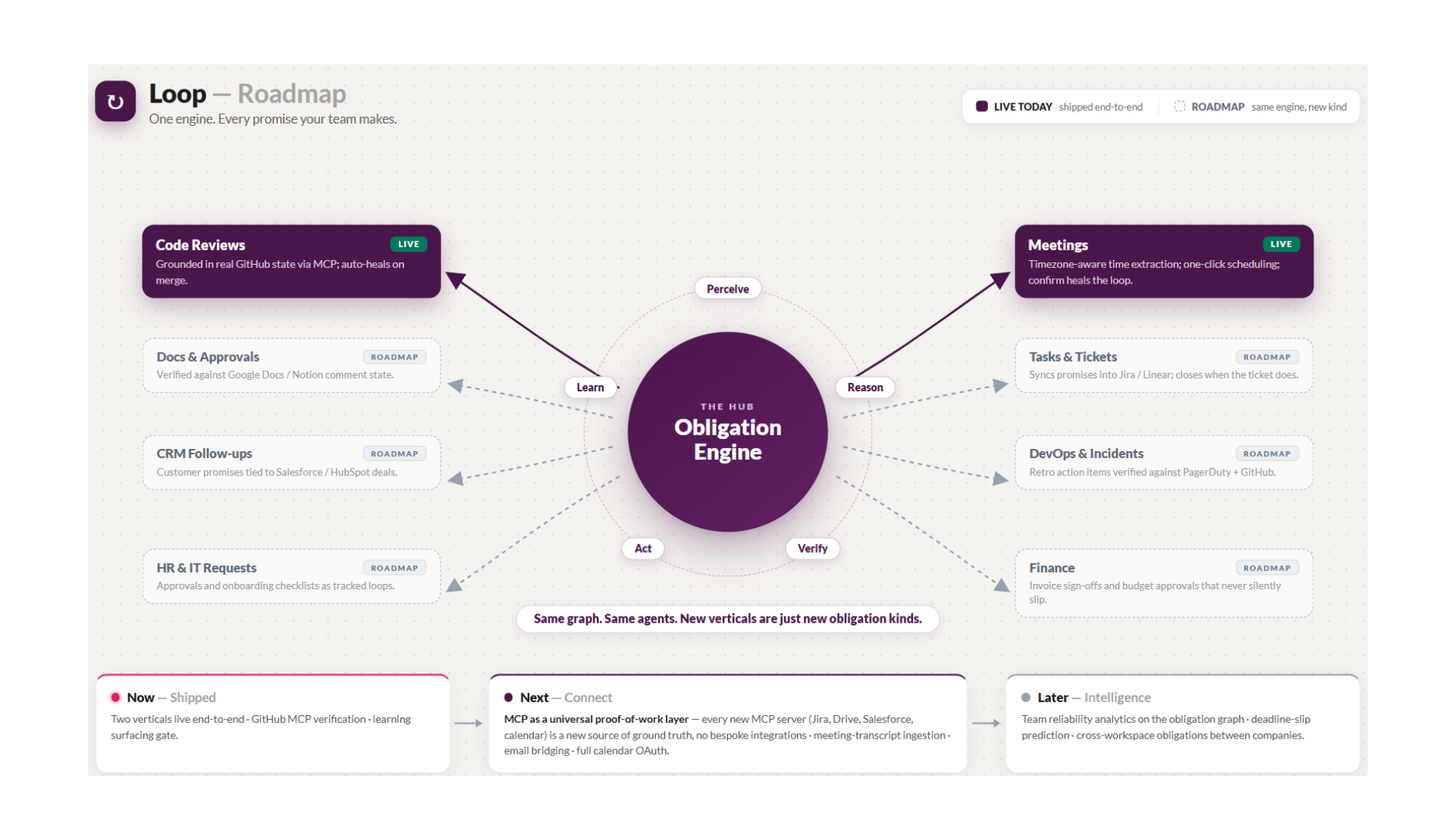
The obligation graph is deliberately general: a meeting is just an obligation of kind meeting, and a code review is an obligation with a GitHub artifact. Every new vertical is just a new obligation kind on the same engine — same Watcher, same Adjudicator, same Verifier, same Learn loop. That makes the roadmap wide:
New verticals on the same engine
- Docs and approvals — "can you review the design doc?" becomes a loop verified against Google Docs / Notion comment state, healing itself when the review lands.
- Tasks and tickets — promises like "I'll pick that up" sync into Jira or Linear, and the loop closes when the ticket does.
- HR and IT requests — leave approvals, access requests, onboarding checklists: loops between an employee and a system of record.
- Finance — invoice sign-offs and budget approvals with deadlines that never silently pass.
- CRM follow-ups — "I'll send the proposal by Friday" becomes a loop tied to a Salesforce or HubSpot deal, so no customer promise is ever dropped.
- DevOps and incidents — post-incident action items from the retro thread, verified against PagerDuty and GitHub until every follow-up actually ships.
Deeper connections
- MCP as a universal proof-of-work layer. The Verifier already speaks MCP; every new MCP server (Jira, Google Drive, Salesforce, calendar) is a new source of ground truth Loop can verify against — no bespoke integrations, just plug in another system of record.
- Meeting transcripts. Commitments made out loud in Zoom or Meet calls flow into the same graph via transcript ingestion — the promise made in a meeting finally has the same accountability as one typed in Slack.
- Email bridging. Half of a team's obligations cross the Slack boundary into Gmail or Outlook; Loop can track the loop across both.
- Full calendar OAuth — one-click scheduling that creates the real event and auto-confirms the meeting loop end to end.
Intelligence on top of the graph
- Team reliability analytics — the obligation graph is a dataset no other tool has: where loops pile up, which handoffs break, average time-to-close by team. A dashboard of organizational follow-through.
- Deadline risk prediction — with enough closed loops, Loop can flag "this promise will probably slip" before it does.
- Cross-workspace federation — obligations that span companies (agency and client, vendor and buyer) tracked on both sides.
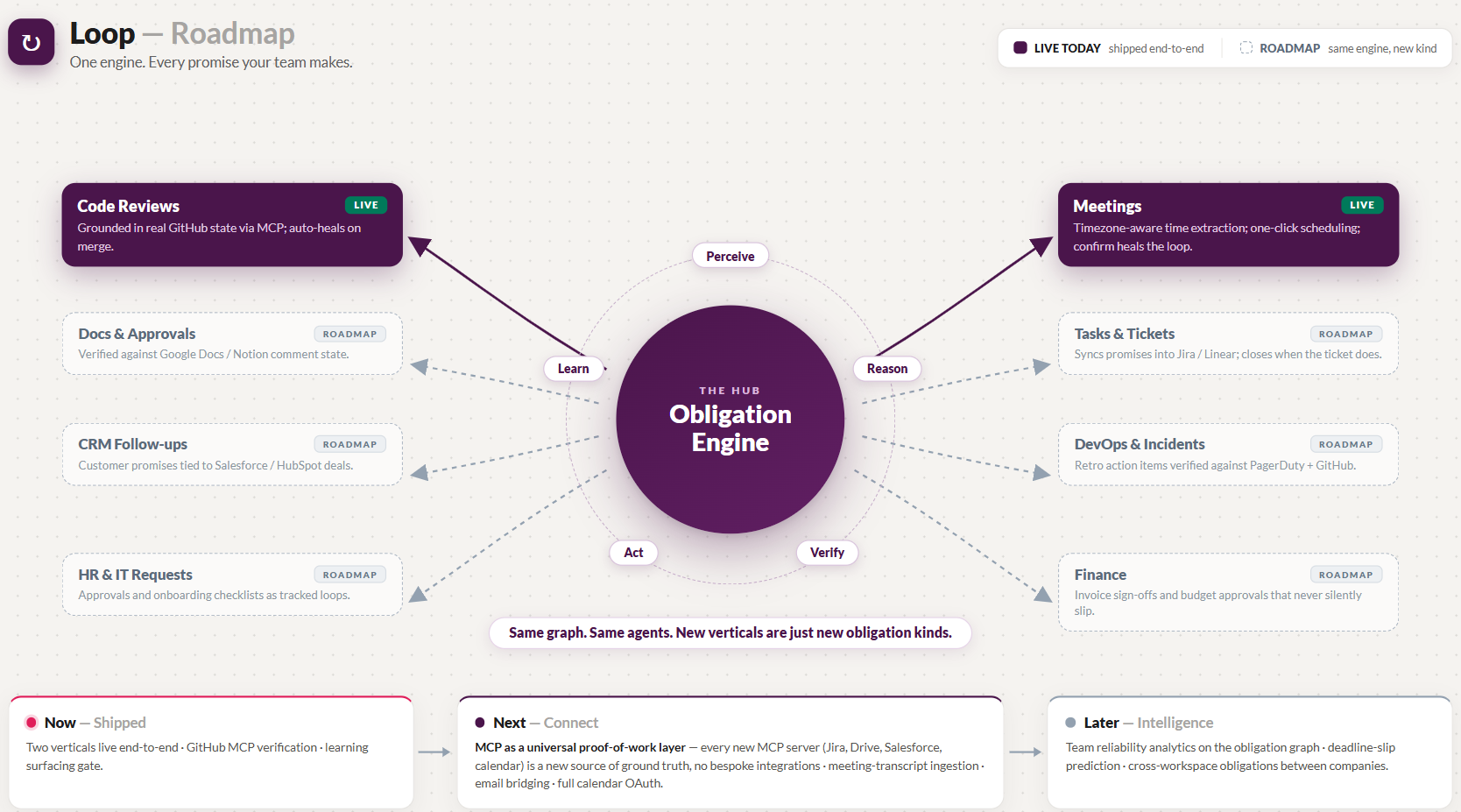
One engine, every promise your team makes — wherever it's made.
Built With
- apscheduler
- block-kit
- github-api
- github-mcp
- google-calendar
- gpt-oss
- groq
- hypothesis
- llama-3.1
- llm
- mcp
- multi-agent
- pytest
- python
- real-time-search
- slack
- slack-ai-assistant
- slack-bolt
- socket-mode
- sqlite

Log in or sign up for Devpost to join the conversation.