Inspiration
I've played tower defense games for years — Bloons, Kingdom Rush, Plants vs Zombies — and noticed every one of them treats a leaked enemy the same way: you lose some HP, the enemy disappears, and you go back to placing towers. The cost of failure is paid once. I wanted to design a TD where failure compounds — where the enemy you let through doesn't just hurt you, it comes back stronger and brings a friend. That's Loop Guard. The Death Spiral mechanic asks: "what if the threat you generate is your own underperformance, not an external script?"
What it does
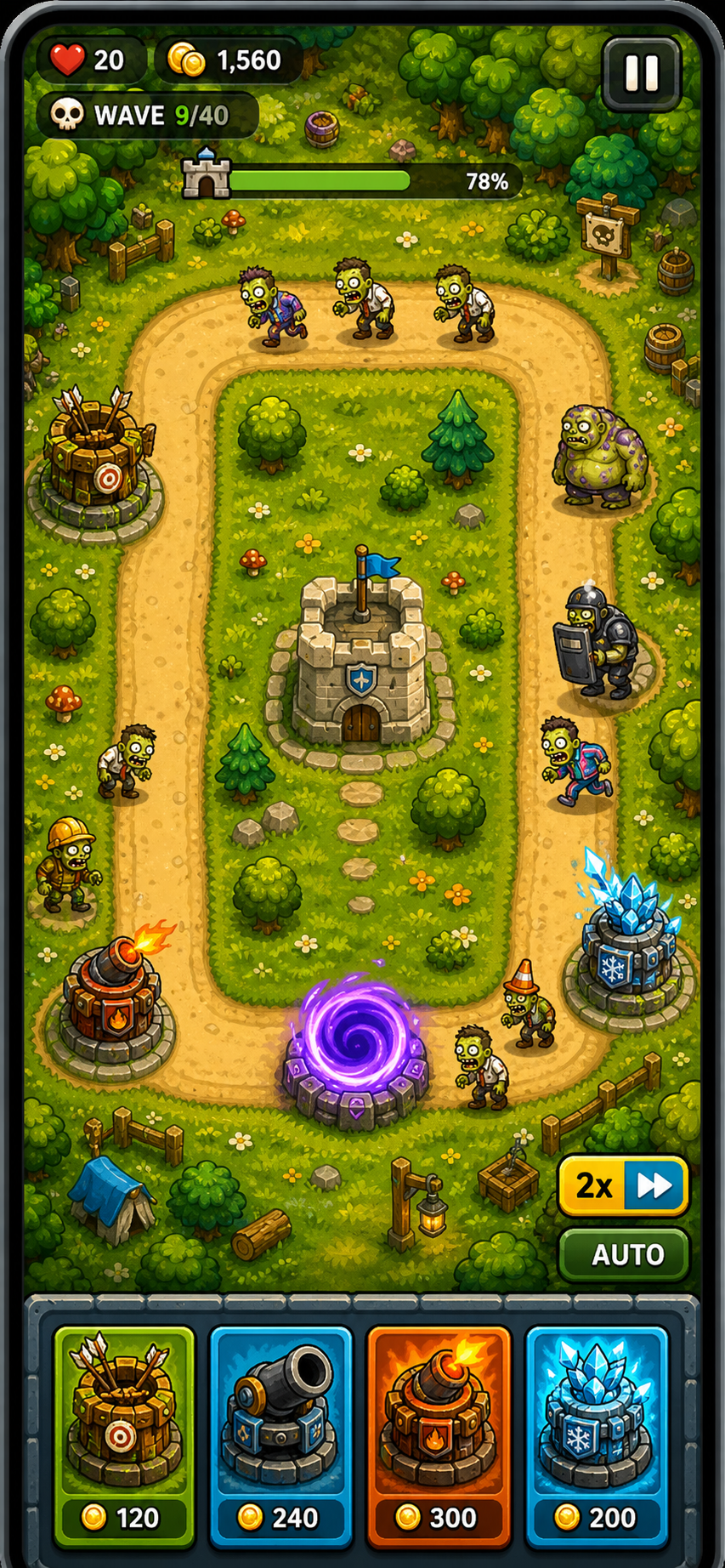
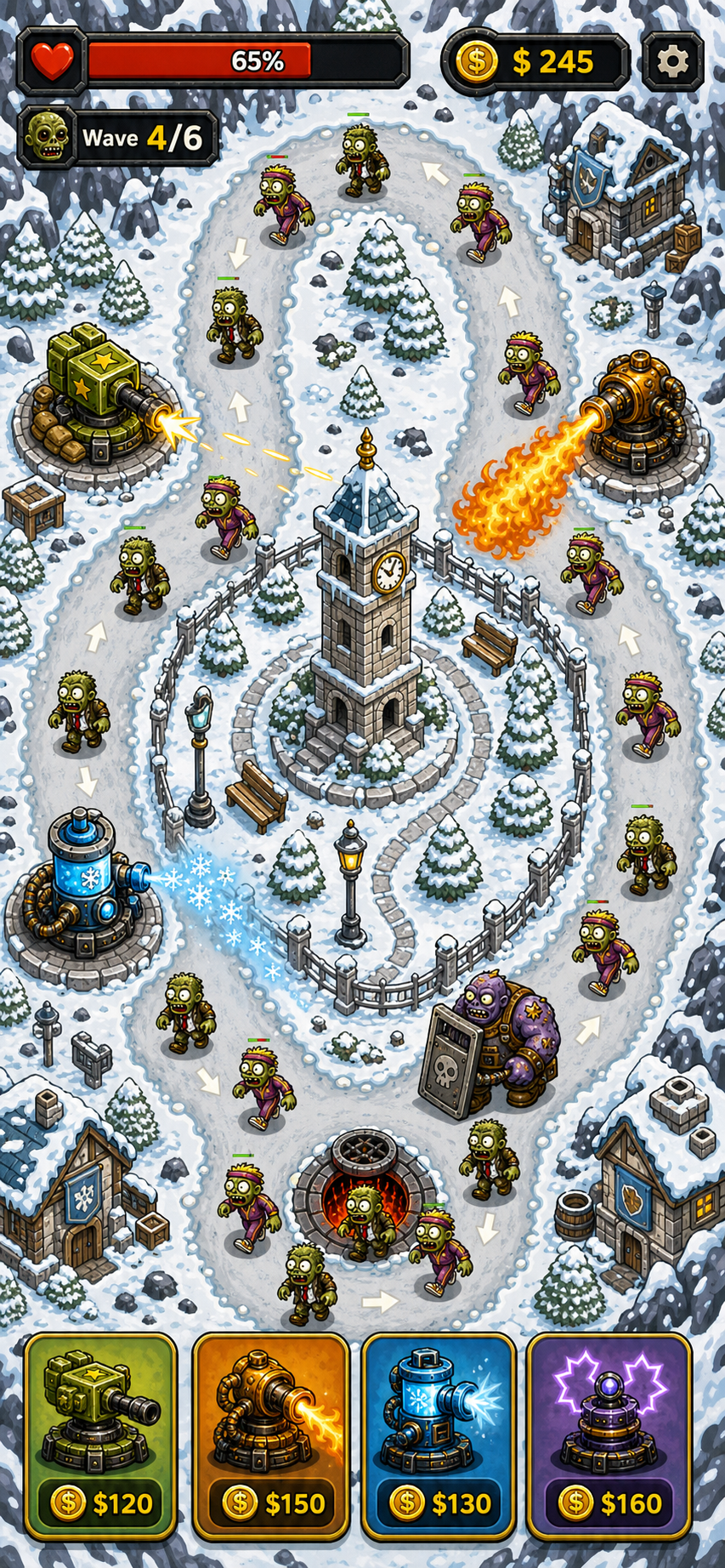
Loop Guard is a mobile tower defense built around a closed-loop map. Enemies emerge from a Portal at the top, walk one full lap, and if you let them survive, they re-enter the Portal — you lose stage health, the enemy re-emerges with upgraded stats and a higher gold bounty (the risk/reward kicker), and a basic duplicate of the original spawns alongside it. Every leak is felt twice: as damage, and as a new spawn. Two campaigns (Forest at midday, Desert at dusk), 5 levels each, with a hero (Cmdr. Cassia Reyes), an equipment gacha, talent tree, and tower upgrade/evolution system layered on top.
How we built it
This is a design submission, so "build" meant the documentation stack plus interactive prototypes to test the feel. I started with a concept backlog of TD twists, then prototyped two finalists in HTML — a Self-Upgrading Loop TD and a Rewind TD — to validate which mechanic actually rewarded skill instead of just punishing. Loop Guard won. I then drafted the four required artifacts (GDD, Player Journey Map, Visual Concept Package, Production Plan) and iterated each ~10 times, using the prototypes as the canonical source of truth whenever a tuning question came up.
Challenges we ran into
The hardest design problem was making the Death Spiral feel productive instead of punishing. Early on the cascade felt like the game was kicking you while you were down. The fix was twofold: cap the cascade at +1 duplicate per lap (no compounding within a single re-entry) and have the upgraded survivor drop more gold when finally killed — so a survivor is tougher but more valuable. The second challenge was scope discipline. The MVP grew faster than the timeline could absorb until I forced Leaderboards and Daily Seed out of MVP into Section 6, which made the Production Plan honest.
Accomplishments that we're proud of
The four artifacts feel like one game. Every system the GDD names appears in the Player Journey Map within the first 15 minutes, every system has a phase in the Production Plan, every system has a visual treatment in the Concept Package. The Death Spiral is a USP I can defend in one sentence. And the HTML prototype actually feels the rhythm of dread and relief that the GDD describes — which means the design isn't only on paper.
What we learned
A USP has to be teachable in 90 seconds of play, not 90 lines of design doc. That's why the Player Journey Map flags 1:30 as the make-or-break beat. I also learned that cutting features is harder than adding them — and that the cuts make the design clearer, not weaker. And on mobile, color carries more of the design load than UI layout: the palette decisions on Visual Concept slide 2 ended up doing more work than the wireframes.
What's next for Loop Guard
The full version layers content expansion (more towers, heroes, maps, enemies, equipment) on top of long-term retention systems (Event Mode, PvP, Battle Pass, Daily/Weekly Quests, Achievements, Leaderboards, Daily Seed). Immediate next step: build a first playable in Meta Horizon Worlds Mobile and put it in front of real players to validate that the Death Spiral lands at 1:30 the way the Player Journey Map predicts.
Built With
- metaai
- metahorizon
- typescript


Log in or sign up for Devpost to join the conversation.