-
-
Loop - AI Second Brain
Inspiration
First-generation and working college students don't fail because they're not smart — they fail because modern student life is fragmented across too many channels. A deadline lives in Canvas. A rescheduled meeting lives in a group chat. A financial aid reminder lives in an email. A call from mom lives in a text. No tool connects all of it — and no human brain can hold all of it clearly.
The user: undergraduate students juggling coursework, jobs, and family obligations, who experience chronic cognitive overload from scattered, unstructured information.
The constraint: they can't afford to miss a deadline or misread a priority — but they have no reliable way to surface what actually matters right now.
What Loop Does
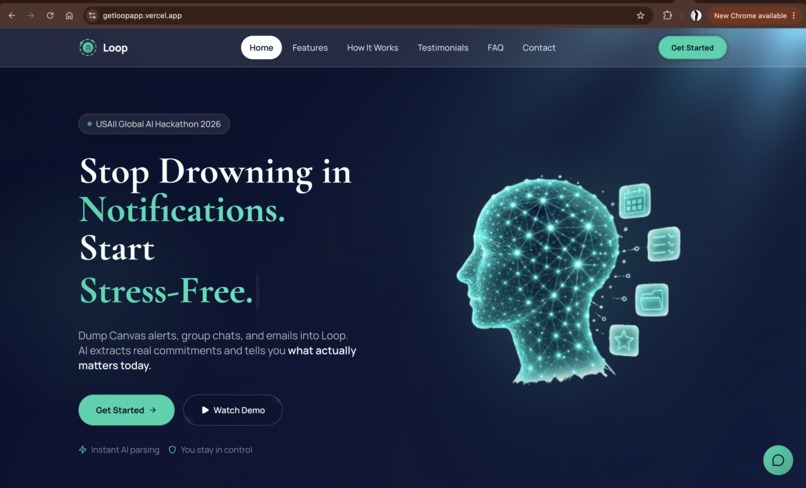
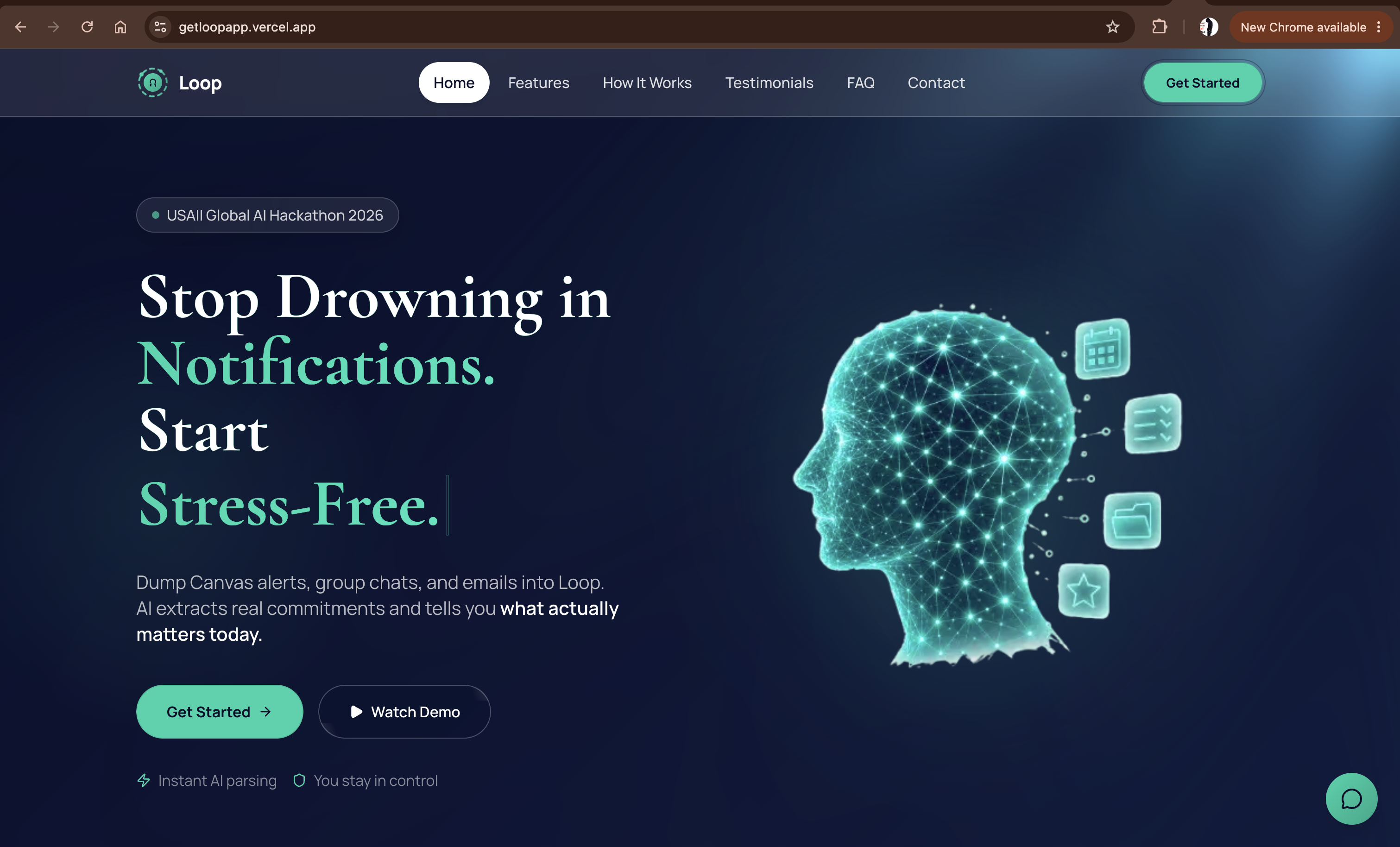
Loop is an AI second brain. Students dump everything overwhelming them — typed text, copy-pasted messages, screenshots of group chats and emails — into one place. GPT-4o parses the chaos and extracts every commitment, deadline, and decision into a structured, prioritized list. Each item shows exactly what the AI found and why it scored it that way — so the student stays in control.
One core rule drives every design decision: Loop never takes action on the student's behalf. It surfaces and organizes. The student decides everything.
How We Built It
- Next.js 14 (App Router) + React + TypeScript
- Firebase Auth (email/password + Google Sign-In) + Firestore for per-user data persistence
- OpenAI GPT-4o — text parsing, conversational AI assistant, daily briefing generation
- OpenAI Vision API (via GPT-4o multimodal) — screenshot and image parsing
- Streaming responses via OpenAI SSE + ReadableStream
- Tailwind CSS + shadcn/ui — responsive UI down to 375px
- Deployed on Vercel
Challenges We Ran Into
Making unstructured input reliably parseable was the core engineering challenge. A student pasting a chaotic group chat screenshot produces wildly variable output without careful prompt engineering. We solved this by enforcing a strict JSON output schema requiring every extracted item to include a source_snippet (the exact text that triggered the extraction) and a confidence score — so students can always verify the AI's reasoning rather than just trusting it blindly.
Streaming responses required careful state management — rendering GPT-4o tokens progressively via ReadableStream without UI flicker took several iterations to get right.
Accomplishments We're Proud Of
- The core loop actually works end-to-end: dump chaos, get structured priorities with evidence, in real time
- Responsible AI is built into the product — not bolted on. Every parsed item shows its source. The AI never acts. Disclaimers are visible on every surface
- Judge/evaluator demo mode with rich realistic mock data so anyone can experience the full product instantly without creating an account
- A streaming AI assistant grounded in the student's own captured items — contextual, not generic
- 78/78 unit tests passing; production build clean
What We Learned
The most important design constraint we set was also the hardest to maintain: "Loop never does things for you." Every time a feature felt powerful, we asked — is this helping the student think more clearly, or is it replacing their judgment? The former builds trust. The latter builds dependency. That question shaped every decision from the priority scoring logic to the AI assistant system prompt.
What's next for Loop — AI Second Brain for Students
- Semantic search using stored embeddings (infrastructure already built)
- Voice input via Whisper API
- University licensing — student success offices as B2B customers (retention tool for at-risk students)
- Google Calendar integration for auto-blocking focus time
Built With
- firebase
- gpt-4o
- javascript
- next.js
- openai
- react
- shadcn-ui
- tailwindcss
- typescript
- vercel


Log in or sign up for Devpost to join the conversation.