Inspiration
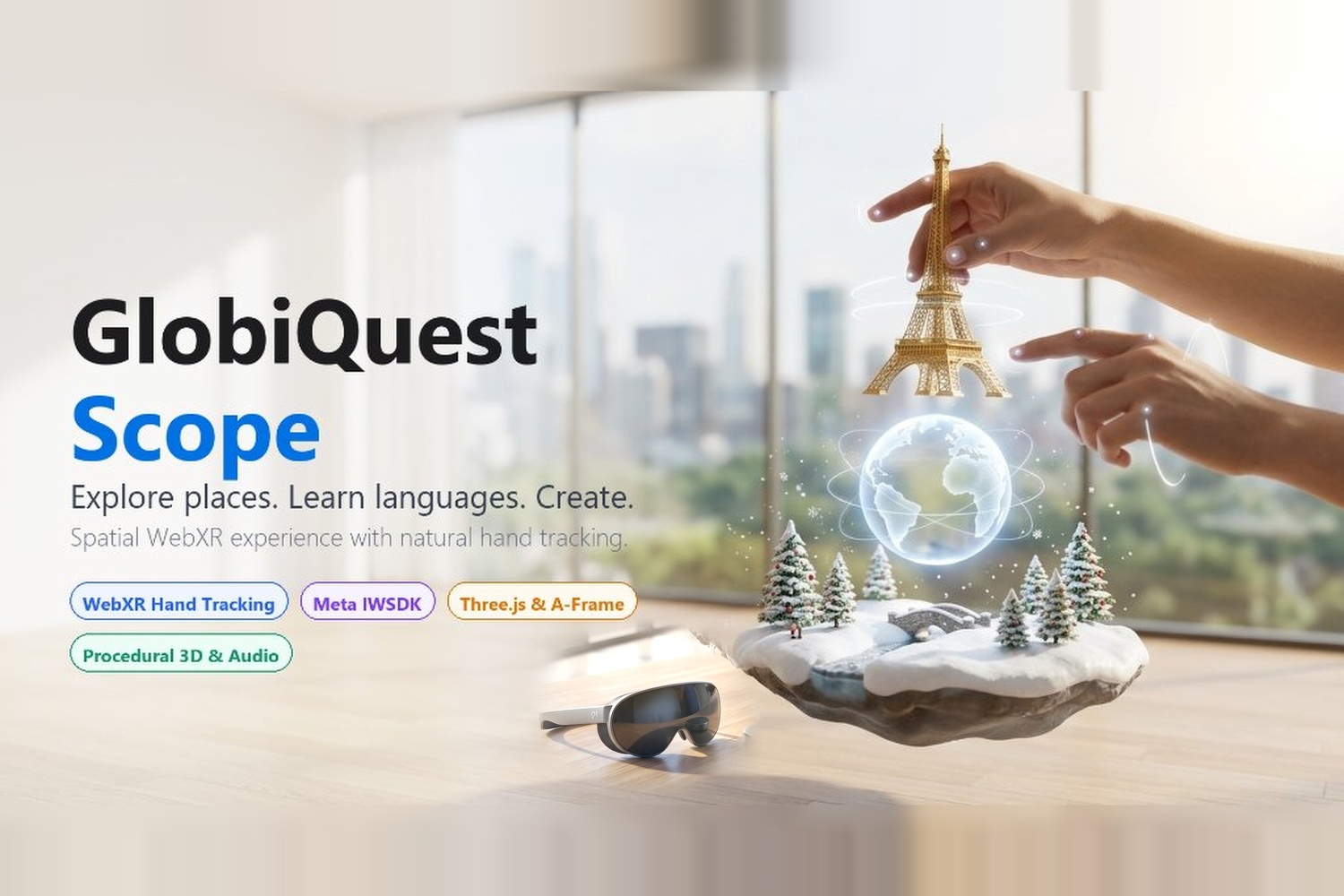
What if I could reach toward a globe, pull out a place, and discover something about it?
The possibilities of Meta VR Glasses Spatial WebXR Experience led me to build my first interaction around that single question: a pinch stretches the globe’s surface, revealing a country-inspired miniature. I wanted that tactile moment of physical wonder to open the door to deeper discovery—a magnified closer look, cultural storytelling, spoken language, and creative play. That idea became GlobiQuest Scope.
What It Does
GlobiQuest Scope is an immersive spatial experience set on a floating low poly island, blending geography, language learning, audio synthesis, and procedural creativity.
Tactile Globe & Real-Time Deformation: Using natural hand tracking or controllers, you can freely rotate the globe or pinch and pull its surface outward, dynamically deforming mesh vertices in real time to reveal detailed country miniatures. Secondary Camera Inspection Lens: A floating handheld lens renders an offscreen secondary camera to inspect objects up close, calculating real-time viewing rays to determine exact geographic coordinates and estimated terrain elevations. Cultural Exploration & Spoken Guide: Select regional landmarks to reveal curated photography, historical descriptions, and source credits, accompanied by an animated virtual assistant that narrates destination stories. Multilingual "Words" Lab: Features 24 vocabulary entries across five languages, complete with native typography, romanized transliteration, definitions, and spoken audio powered by the Web Speech API. Dynamic Environments & Audio Synthesis: Switch seamlessly between Sunny, Rainy, and Snowy spatial atmospheres with particle systems. Explore five musical instruments (Guitar, Piano, Bells, Drums, Flute) featuring procedural acoustic synthesis, such as damped plucked-string modeling. Parachute Pop Mini-Game: A spatial hand-tracking target game where floating parachutes trigger physics particles, haptic/sound cues, and live scoring. 3D Art Studio: A spatial drawing suite where drawn strokes transform into 3D procedural characters. Bring to Life animates sketches with an expressive face, while Loop to Jelly converts rough lines into a smiling pastel creature with full undo, clear, and cancellation controls. Spatial Ergonomics: Movable, resizable glassmorphism panels ensure crystal-clear text readability anywhere in the physical room.
How I Built It
I engineered GlobiQuest Scope entirely on open web standards to run natively in browser based mixed reality without external app installations:
Meta Immersive Web SDK (IWSDK): Powers native XR session lifecycle management, low-latency hand-tracking joint sampling, and hardware-accelerated mixed reality features. Three.js & A-Frame: Handles procedural scene graphs, custom vertex deformation shaders on the globe, spatial audio nodes, and the secondary offscreen render targets for the inspection lens. Web Speech API: Delivers real-time, browser-native speech synthesis for multilingual pronunciation and virtual assistant narration. Procedural Geometry & Audio: All miniature characters, morphing jelly meshes, and musical chord progressions (damped plucked-string synthesis) are synthesized locally on-device. Universal Interaction Layer: Built with a unified input abstraction supporting simultaneous hand gestures (pinch, grab, pull), Meta Quest Touch controllers, head-directed gaze (look-and-hold), and desktop fallback controls.
Challenges I Ran Into Ergonomics & Spatial Predictability: Mixed reality interfaces fail when panels drift out of reach or occlude the field of view. I spent significant time calibrating billboard constraints, comfortable font sizes, and gaze-adaptive panel positioning. Hand-Tracking Reliability & Debouncing: Hand gestures can easily trigger accidental double-clicks or false positives. I engineered input debouncing and raycast hit filtering so that raycasting identifies intended surfaces without bleeding clicks into occluded background panels. Procedural Stroke Cancellation: In the Art Studio, users needed a smooth "Cancel" action. I had to ensure the drawing engine reliably aborted in-progress spline interpolation without leaving orphan vertices or spawning premature character animations. Coordinating IWSDK with WebXR Frameworks: Bridging the Meta Immersive Web SDK's native input sampling pipeline with A-Frame’s entity-component lifecycle required precise frame-loop synchronization to prevent frame drops or tracking jitter.
Accomplishments I'm Proud Of A Tactile "Magic Moment": Creating an elastic globe where pulling a country miniature feels genuinely physical, surprising, and delightful in mixed reality. Zero-Install WebXR Experience: Delivering console-quality 3D deformation, secondary camera rendering, and procedural audio directly inside the browser at a locked 72–90 FPS on Meta Quest. Deep Multimodal Engagement: Unifying geography, multilingual linguistics, generative 3D sculpting, and live instrument playing into one cohesive spatial interface as a solo developer. Universal Accessibility: Seamless fallback between natural hand tracking, controllers, and look-and-hold gaze selection makes the experience intuitive for every user.
What I Learned Spatial Usability Is Immersion: A visually stunning 3D asset means nothing if interaction is frustrating. Clear visual confirmation (activation rings, hover pulses), predictable depth placement, and reliable gesture limits are what make an XR experience feel truly magical. Physical Prototyping Beats Simulators: While browser simulators are valuable for rapid code iteration, true ergonomic validation, testing arm fatigue, pinch comfort, and visual scalecan only be perfected through extensive testing on the physical headset.
What's Next for GlobiQuest Scope Shared Spatial Co-Presence: Multi-user WebXR sessions enabling collaborative exploration, cooperative 3D creation, and real-time cultural discovery in a shared mixed-reality space. AI-Powered Adaptive Virtual Guide: Integrating real-time conversational voice intelligence to support dynamic, open-ended dialogues about regional histories, landmarks, and dialects. Creator Miniature Sandbox: Expanding procedural tools to let users sculpt, customize, and pin their own 3D architectural landmarks and regional wonders directly onto the globe. Next-Gen Wearables & Passthrough: Optimizing hand-tracking fiducials and depth-aware occlusion for upcoming lightweight AR glasses and mixed reality headsets.
Built With
- a-frame
- canvas-api
- css3
- html5
- javascript
- meta-iwsdk
- open-meteo
- three.js
- web-audio-api
- web-speech-api
- webxr

