-
-
This image is a hero banner for Loom, presenting the app as a premium intentional matchmaking platform.
-
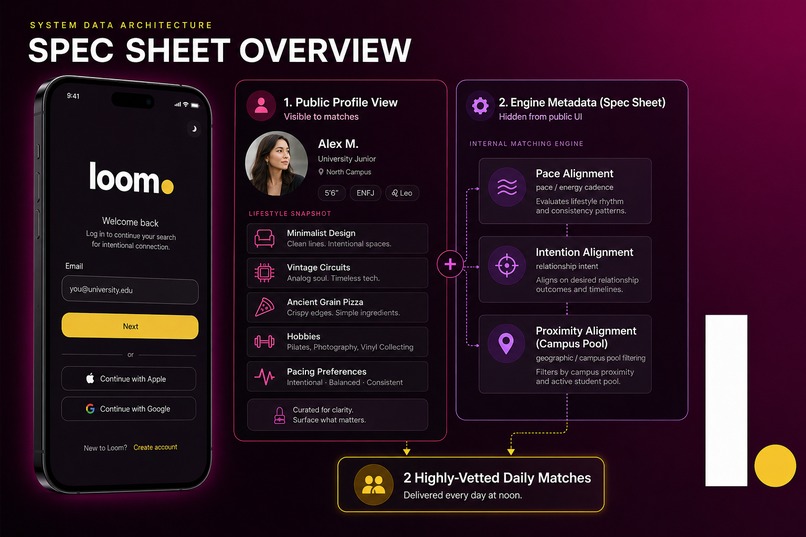
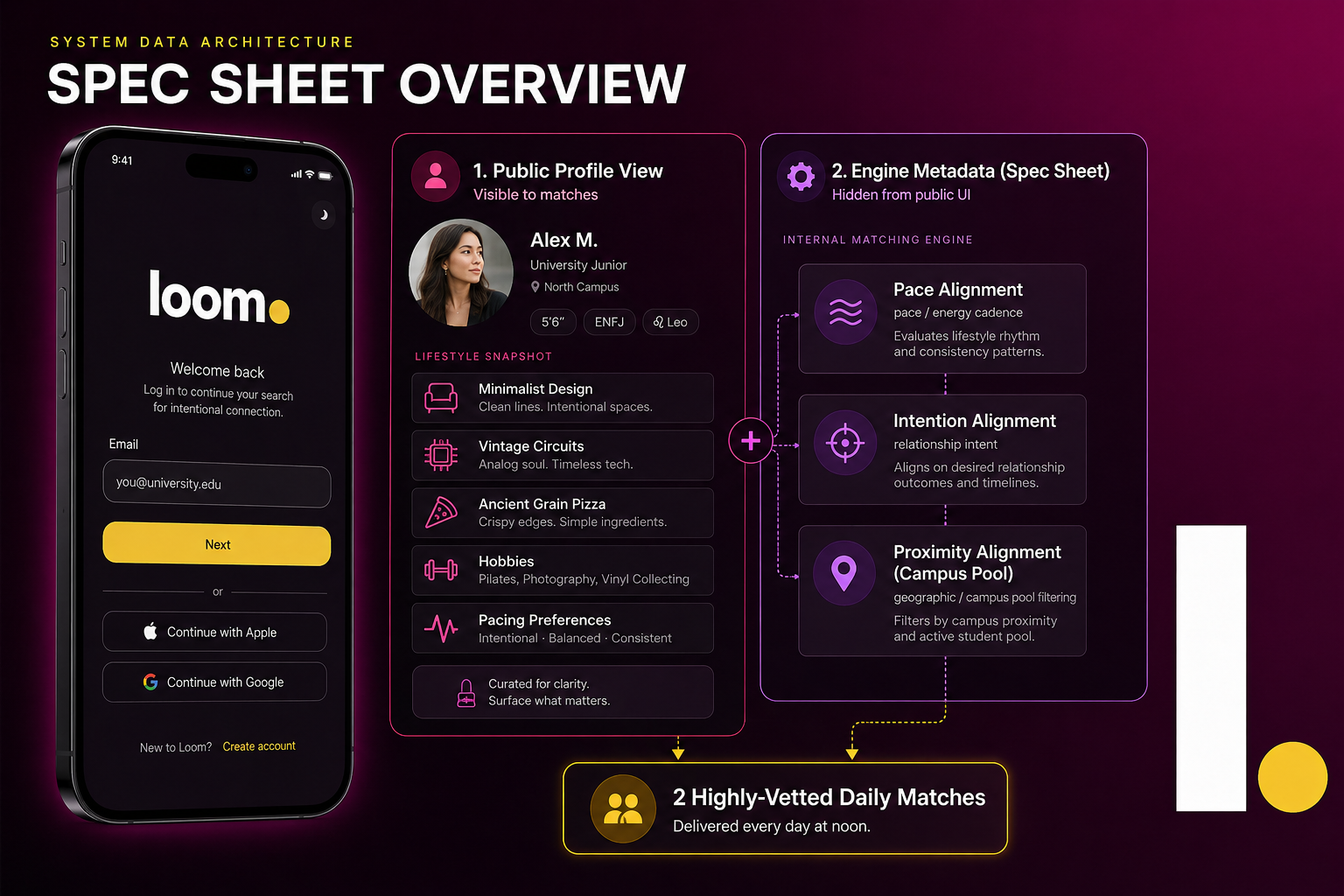
Loom’s spec sheet showing how public profile data and hidden matching metadata power two vetted daily matches.
-

This is Loom’s future app icon, designed for the mobile version planned after the web app.

Loom
Inspiration
We are currently seeing a total collapse in dating app trust. Gen Z is facing massive app fatigue because the current tools treat human connection like an endless e-commerce queue. The 'infinite scroll' has moved from a feature to a burden. We realized the current market optimizes for volume and time in app instead of intentional alignment.
Our inspiration for Loom was to replace the aimless bio scroll with a structured alignment sync. By artificially constraining the supply to a limited daily drop, we force intentionality. Loom replaces the distractions of endless browsing with a focus on alignment logic, where the system acts as a technical gatekeeper for compatibility.
How We Built It
Loom was built as a high fidelity web application using Tailwind CSS for our signature neon noir minimalist aesthetic. As a team of MIS students focused on vibe coding, we acted as product leads and system architects while leveraging Lovable to handle the heavy lifting of the React component architecture. This approach allowed us to focus on the product strategy and the complex data flow instead of getting bogged down in boilerplate code.
We integrated the Gemma 4 reasoning model through the Google Cloud Gemini API to handle the actual matching logic. Our architecture is divided into two distinct data structures:
The Identity Spec: This captures baseline parameters like name and gender to initialize the digital signature.
Engine Metadata: Quantitative data labeled for the AI's eyes only. This is strictly hidden from the public UI to allow the system to calculate alignment in the background without creating superficial filtering traps.
The heart of the app is the Alignment Spec engine. It processes pace and intention data through the LLM to provide a tactical compatibility summary for every match.
Challenges We Faced
The biggest hurdle was AI state orchestration. Transitioning from a generic UI to a system where Gemma 4 correctly interprets baseline specs required a very specific data schema. We had to ensure the user’s identity remained persistent from the initial Identity Spec in step one all the way to the final Spec Sheet in step four.
Managing the GCP infrastructure under a tight hackathon deadline was high pressure. We monitored API traffic and quotas in the Google Cloud Console for project 296912188132 while debugging server functions to ensure the engine sync stayed stable. As vibecoders, the challenge was ensuring the AI understood the system requirements as clearly as a human developer would during those final 3:00 AM refactors.
What We Learned
We learned that in consumer software, artificial friction is a feature, not a bug. Introducing a 4-step Spec Sheet onboarding actually improved user trust because it signaled that the system was performing a complex, intentional calculation rather than just serving up random profiles.
We also learned that visual hierarchy is the foundation of product trust. Using monospaced terminal typography for specs and glowing borders for interactive elements helped move the prototype from a standard dating app to a sophisticated matching system. It proved that aesthetic choices directly influence how users perceive the "intelligence" of an underlying engine.
What Is Next for Loom
Our immediate priority is migrating from our current local-state prototype to a persistent backend infrastructure. This will allow us to move beyond session-based demos and securely store user "Baseline Specs" in a centralized database to execute matching logic at scale.
We also plan to utilize the Gemini 2.5 Flash Image model to generate a Visual Signature. This will be a unique, abstract data aura based on a user's specific specs that serves as their primary public identifier. Finally, we intend to scale our Gemma 4 integration to handle distinct "Campus Pools," allowing the alignment logic to adapt to the unique micro-communities of specific universities like UWB.
Built With
- css
- javascript
- lovable
- lucide
- react
- tailwind-css
- typescript

Log in or sign up for Devpost to join the conversation.