-
-
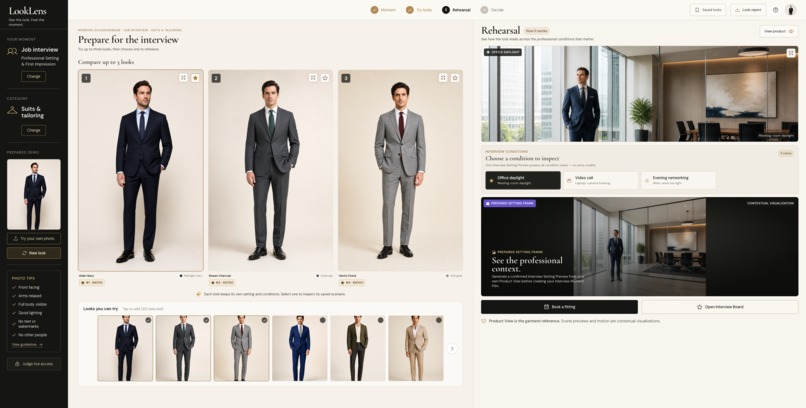
Job interview - male
-
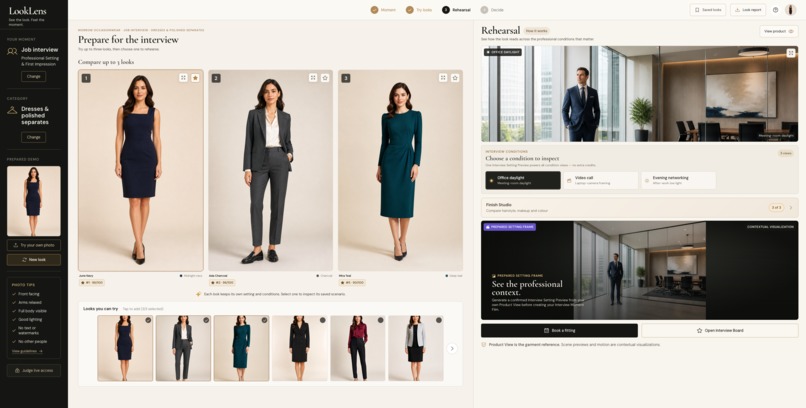
Job interview - female
-
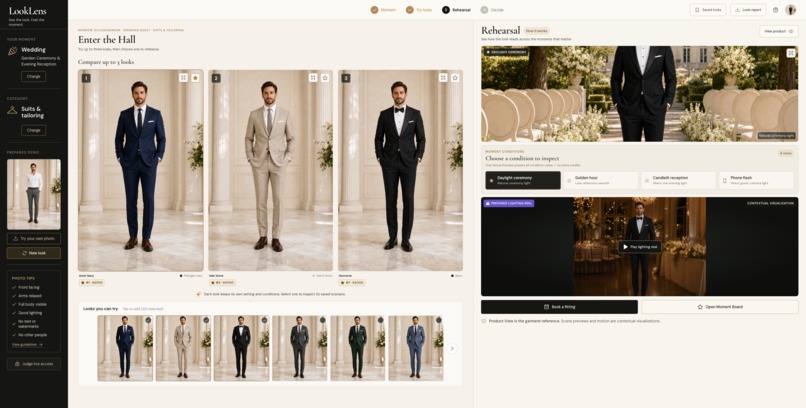
Wedding - male
-
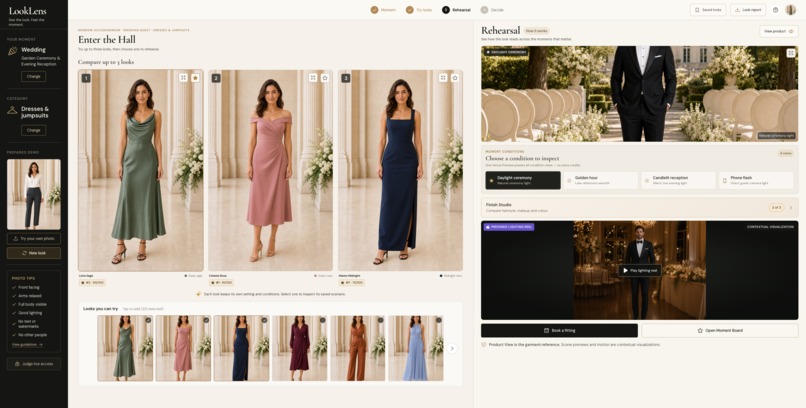
Wedding - female
-
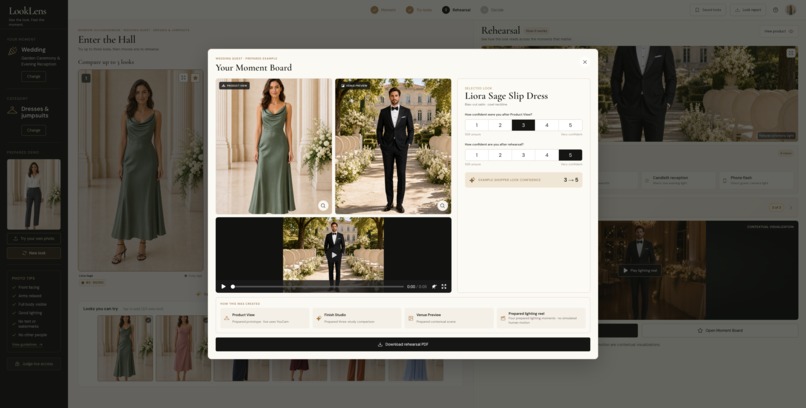
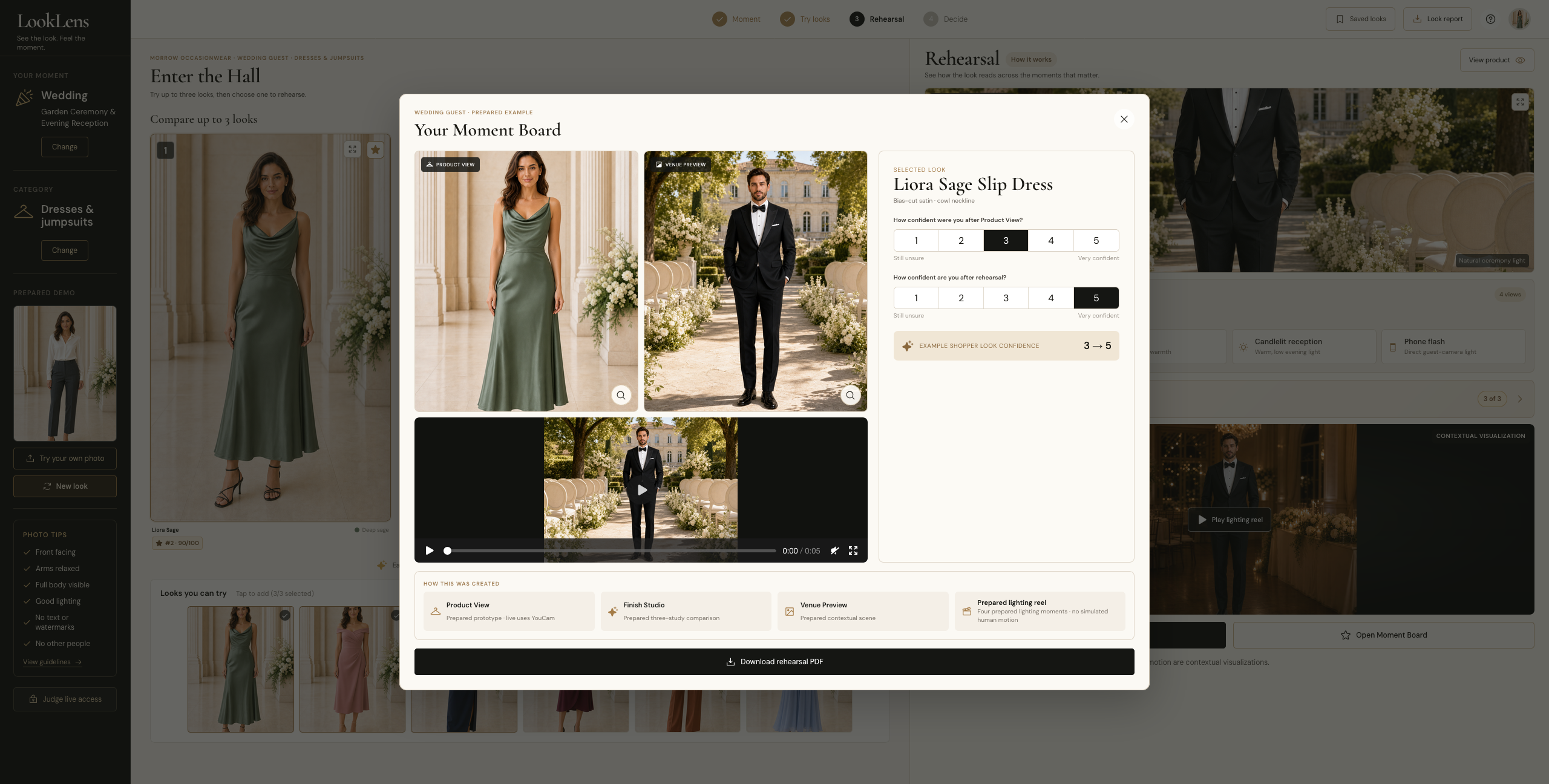
MOment board
-
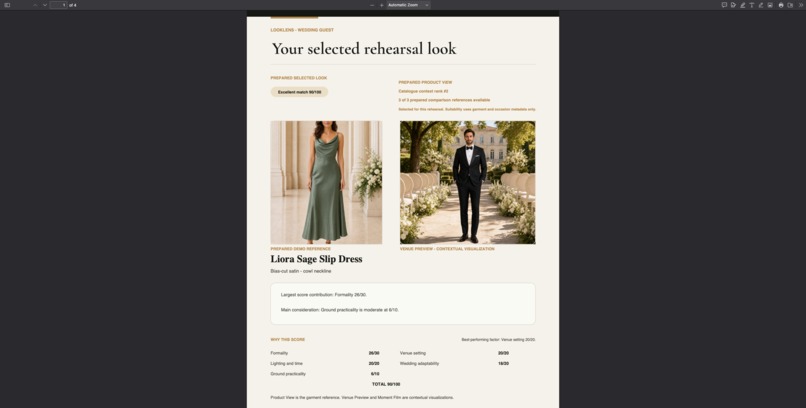
pdf - page 1
-
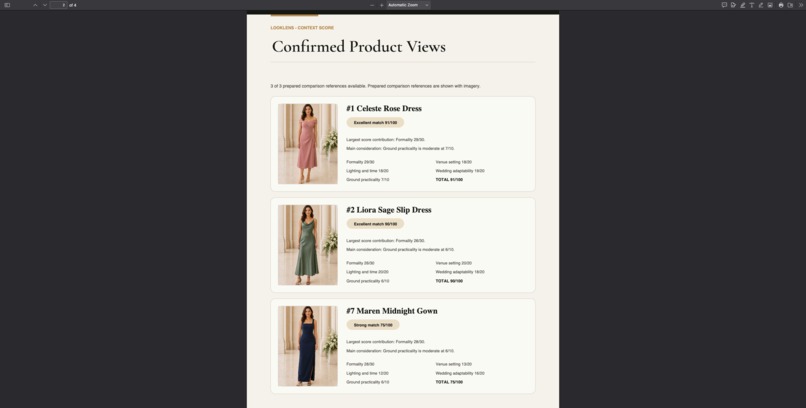
pdf - page 2
-
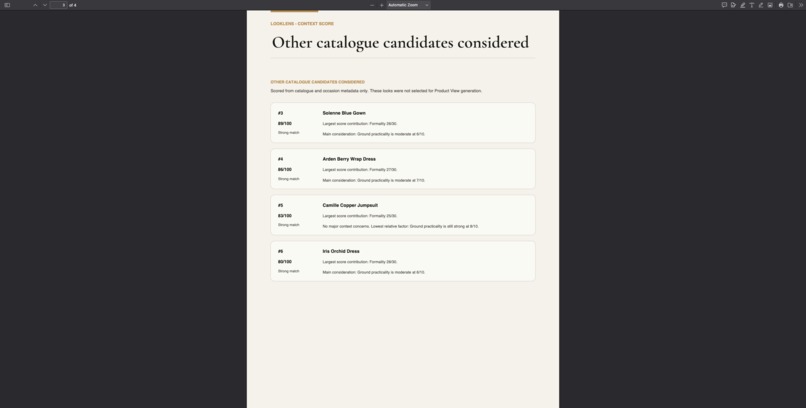
pdf - page 3
-
pdf - page 4
Inspiration
Virtual try-on can answer an important question:
“How does this outfit look on me?”
But when someone is dressing for an important event, there is another question:
“Will this look actually work for where I’m going?”
A dress can look great in a clean Product View and still be the wrong choice for an outdoor wedding, evening reception, phone-flash photography, or a particular level of formality. An interview outfit may work in an office but feel different on camera or at an evening networking event.
LookLens was built to extend virtual try-on from preview into rehearsal.
Instead of generating another outfit image, it helps someone compare looks, evaluate them against the conditions of a real occasion, and decide what they would actually feel confident wearing.
What it does
LookLens is an occasion-aware rehearsal experience built around YouCam Apparel VTO.
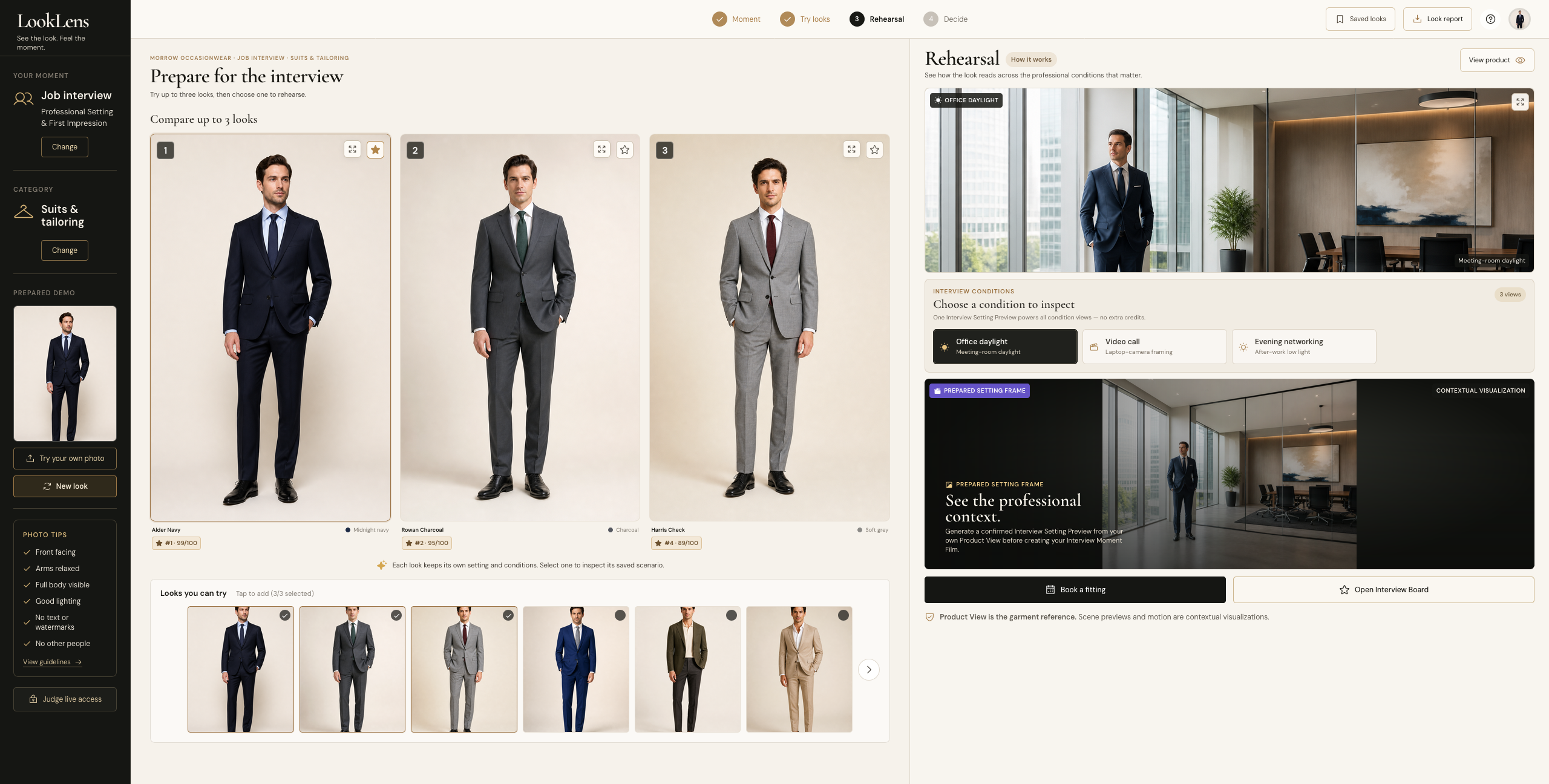
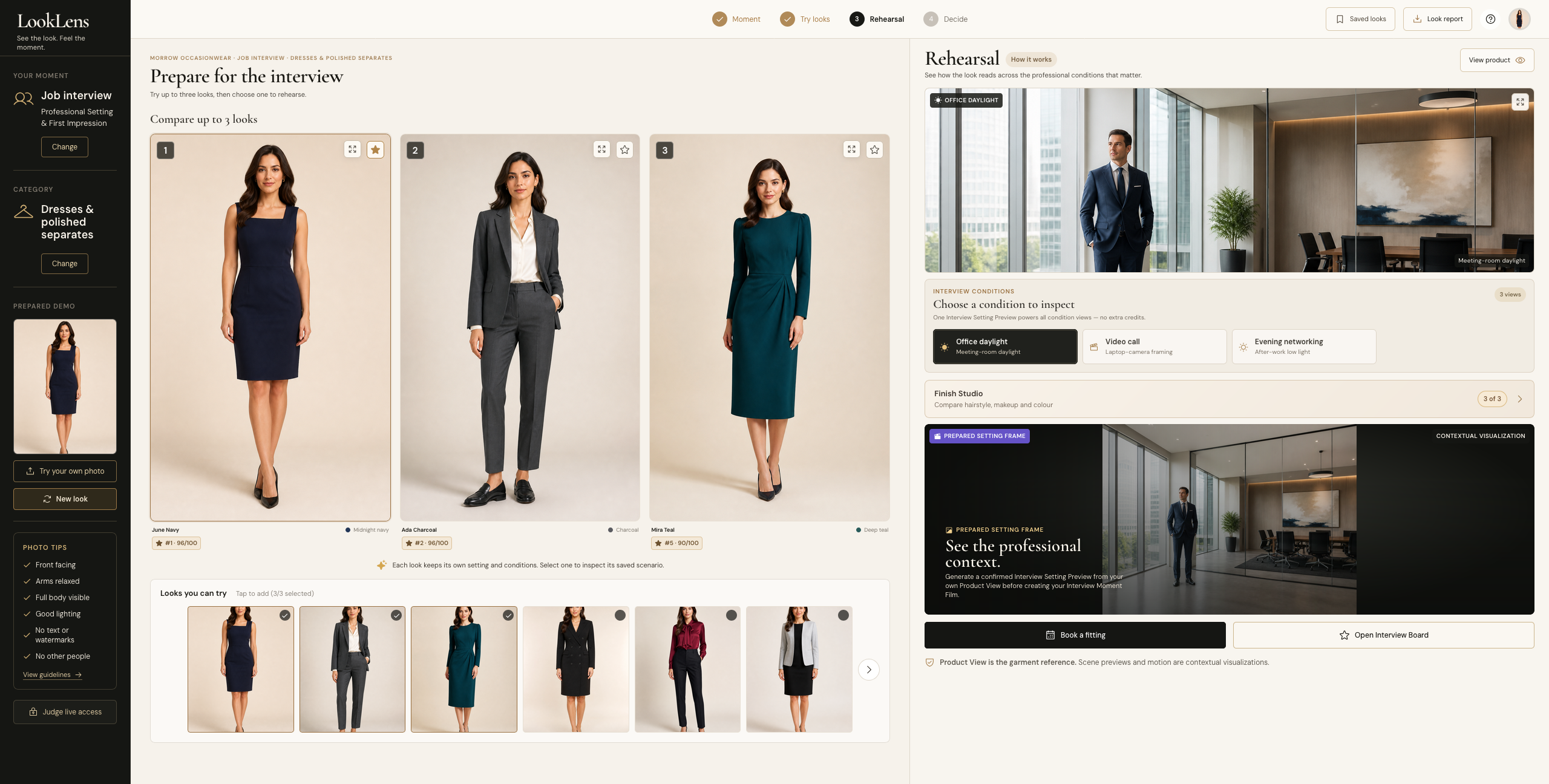
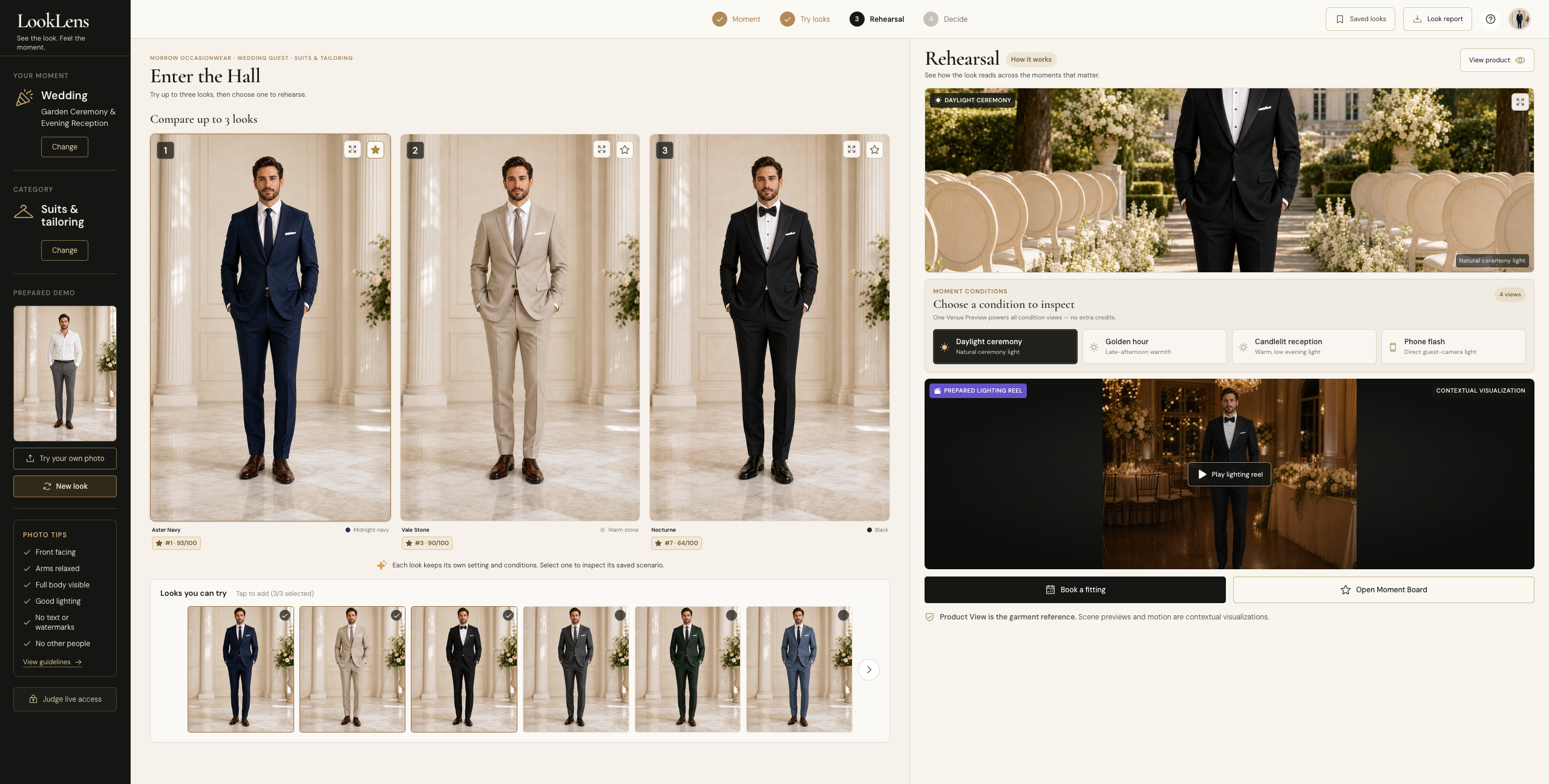
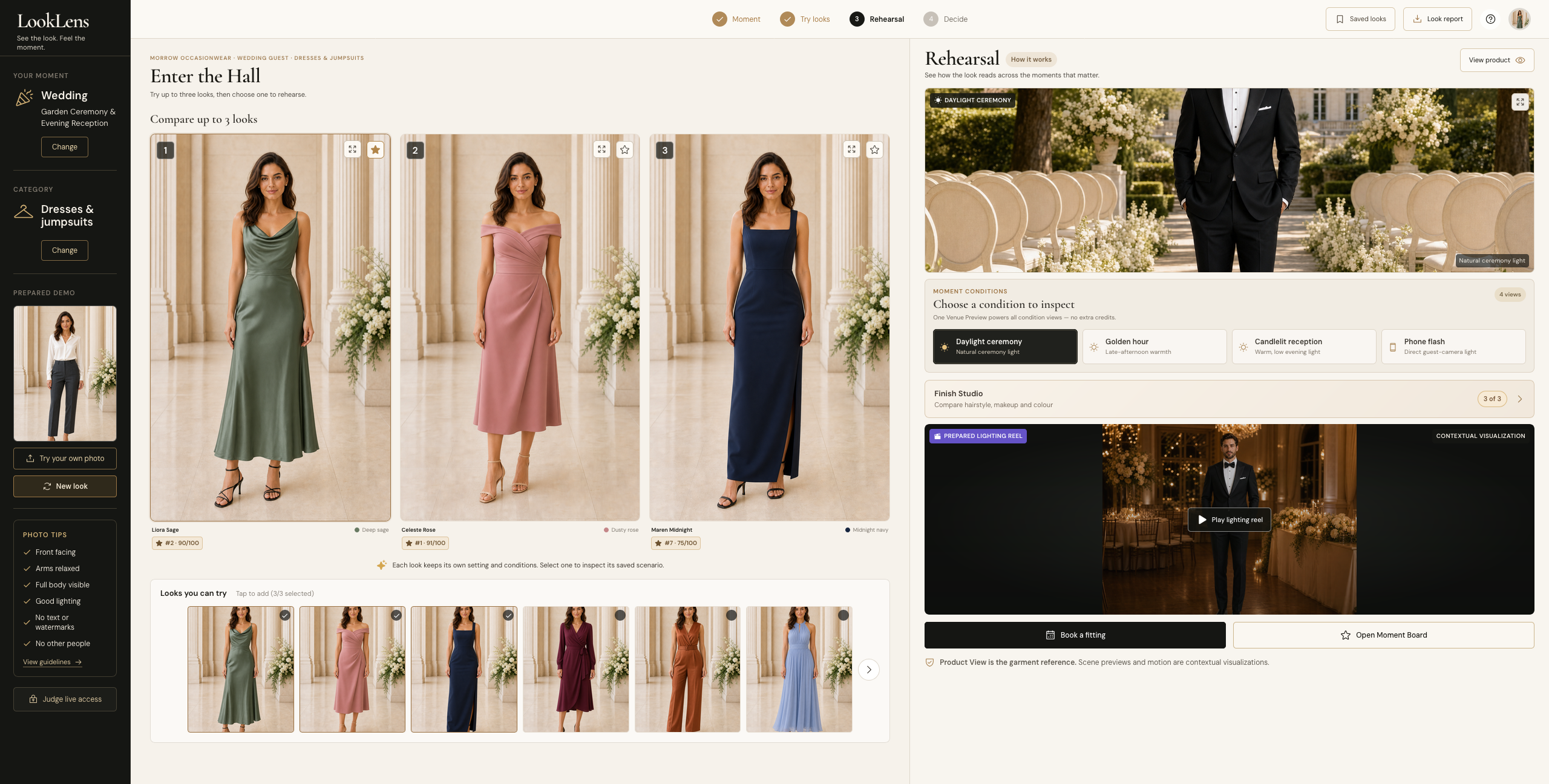
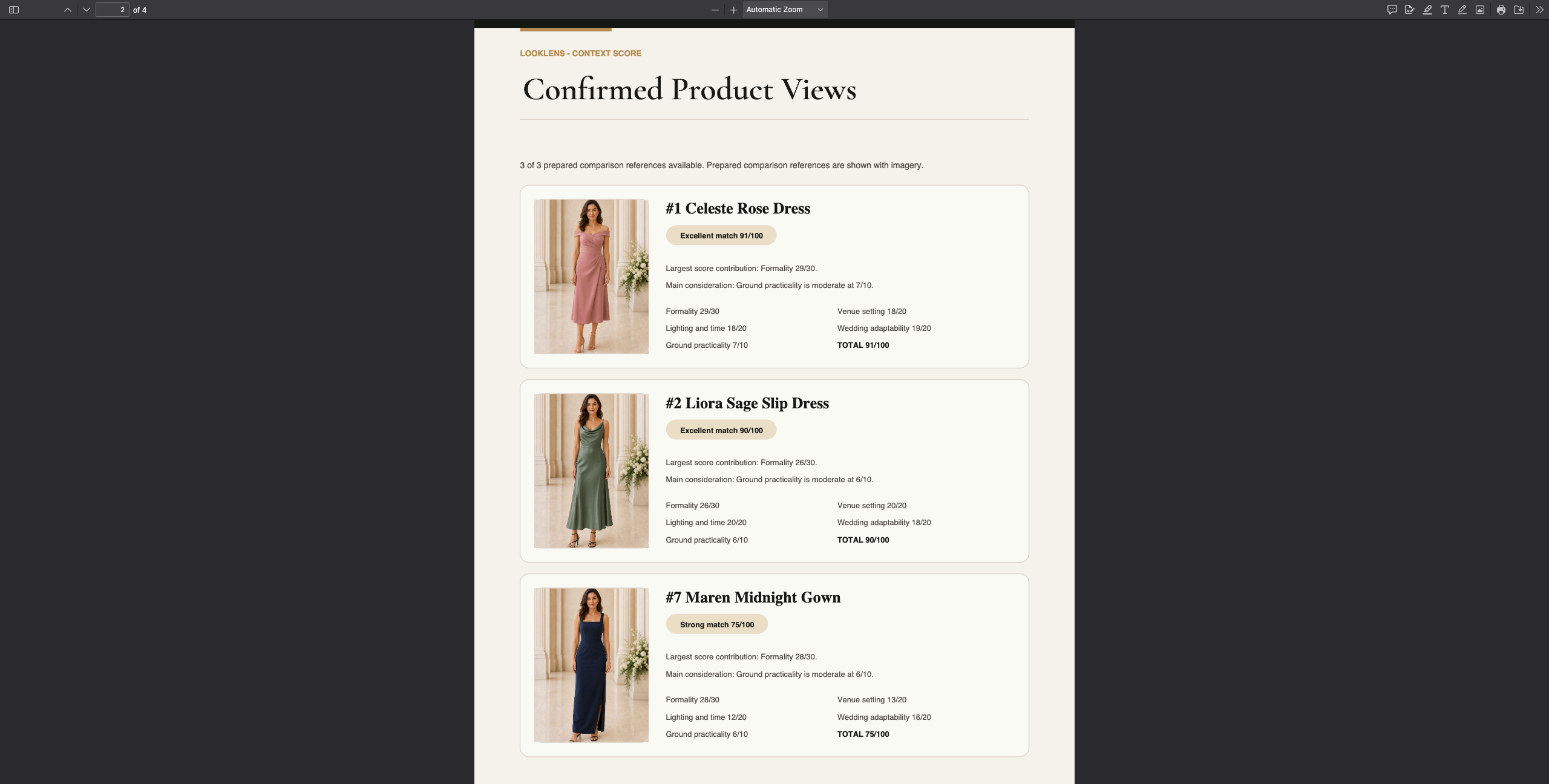
A shopper starts with their own photo and compares up to three candidate looks. YouCam Apparel VTO creates a Product View for each candidate so the comparison is grounded in how the garment appears on the shopper.
LookLens then goes beyond the Product View.
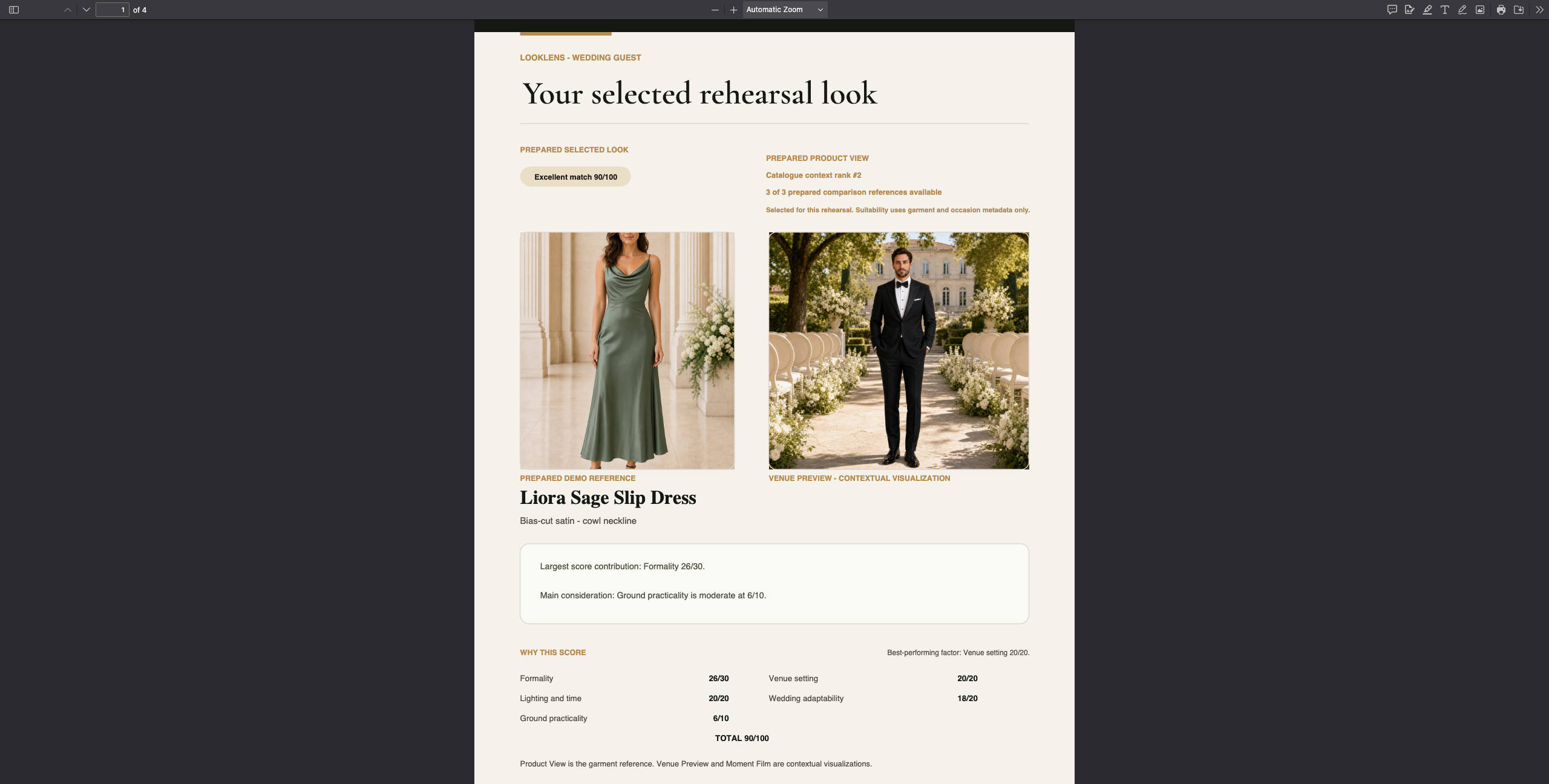
Each look can be evaluated against the context of the occasion, including factors such as:
- formality;
- venue and setting;
- lighting and time of day;
- versatility across different moments of the event;
- practical considerations such as an outdoor surface.
The goal is not simply to identify the most visually impressive outfit. It is to help identify the look that works best for the actual event.
The prototype supports two occasion flows:
- Wedding guest: ceremony, golden hour, reception, phone-flash conditions, and venue practicality.
- Job interview: office daylight, video-call presentation, professional expectations, and evening networking.
Guided Rehearsal
Shoppers can explore every stage manually or use Guided Rehearsal.
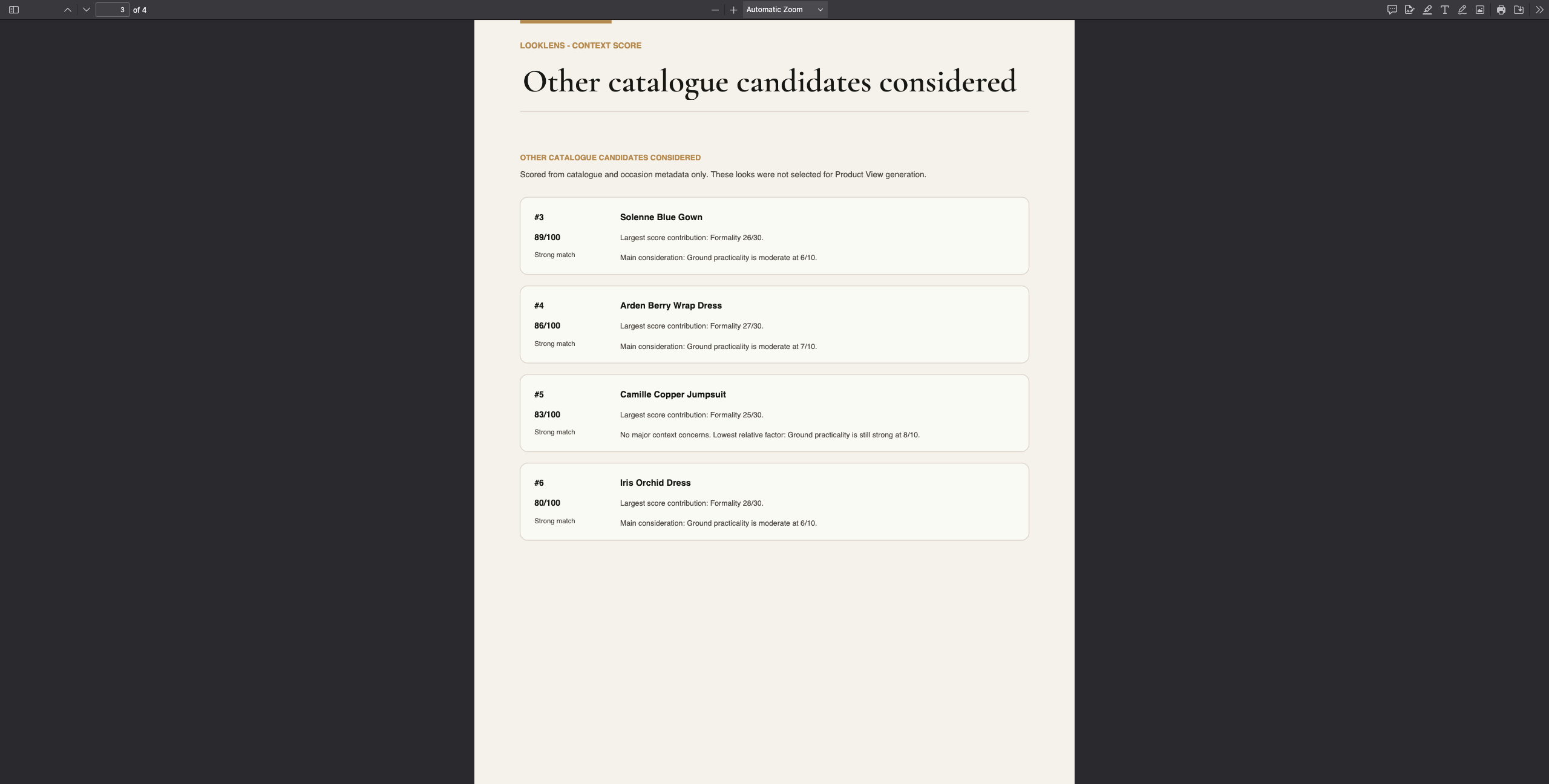
The guided flow compares the strongest candidates, explains why one look is better suited to the occasion, selects a recommended direction, and continues into a contextual Venue Preview.
This creates the central LookLens experience:
Try it on → compare it → understand the trade-offs → rehearse it in context → decide.
The shopper remains in control and can override the recommendation or explore another candidate at any point.
Venue Preview
Once a look has been selected, LookLens can rehearse it in a setting relevant to the occasion.
The Product View remains the garment reference, while Venue Preview helps the shopper imagine how the complete look may read in the environment and lighting where it will actually be worn.
Contextual previews are treated as visualization tools rather than guarantees of exact real-world fit, perspective, or lighting.
Finish Studio
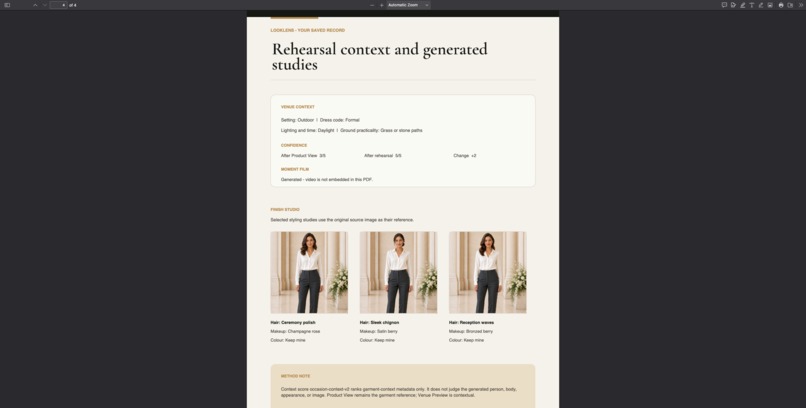
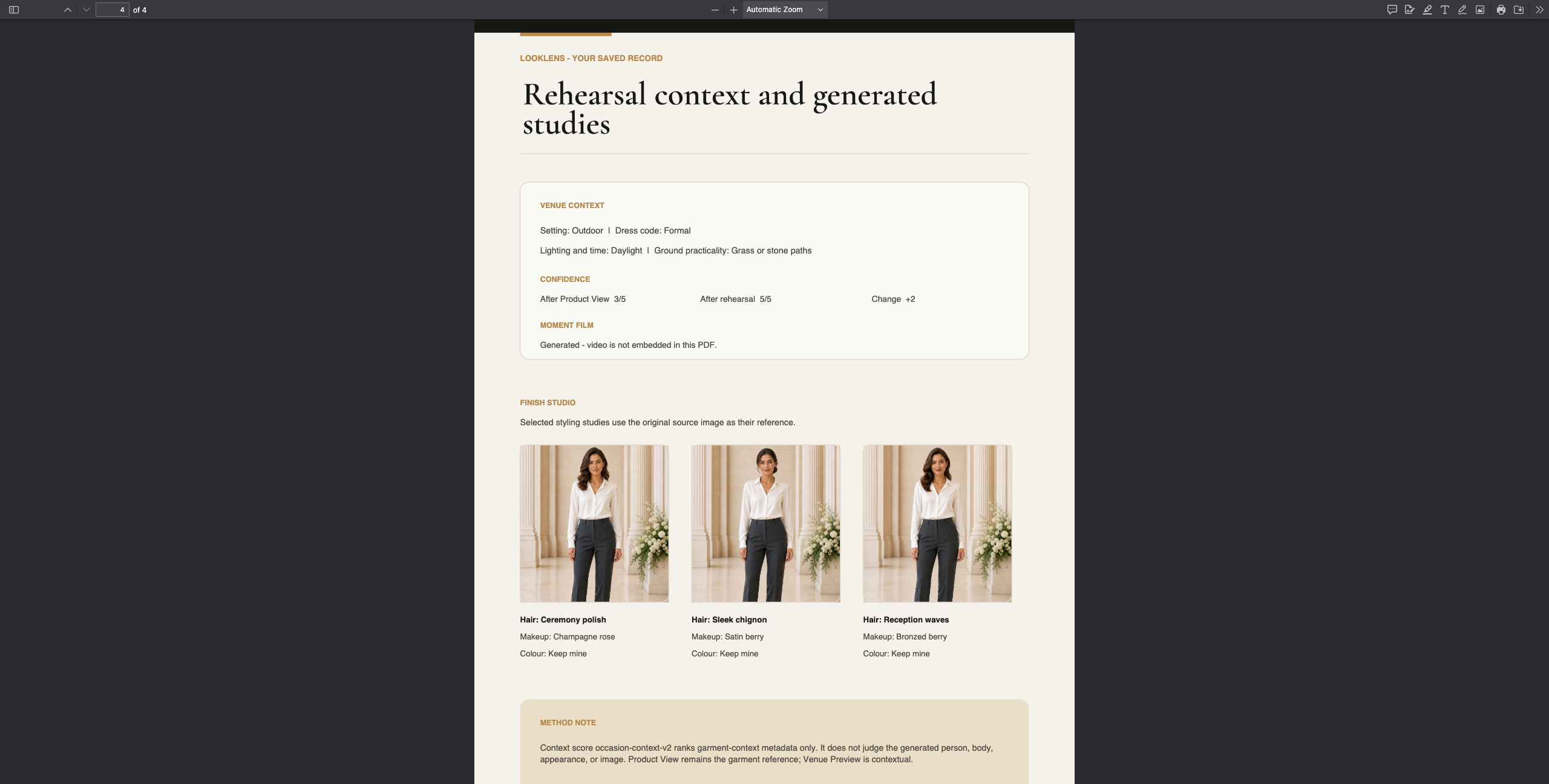
For Dresses & Jumpsuits, LookLens also includes an optional Finish Studio.
The shopper can explore hairstyle, makeup, and hair-colour directions before producing a revised rehearsal.
Finish Studio uses dedicated YouCam capabilities rather than a generic face-generation step:
- Hair Transfer V2.1
- Hair Color VTO
- Look VTO
Hair, makeup, and hair colour remain separate choices so the shopper can refine the look without losing control of the original outfit decision.
Prepared Showcase
LookLens opens with a Prepared Showcase so a first-time visitor can understand the complete experience without immediately consuming generation credits.
Live mode then allows shoppers to repeat the same workflow using their own photo and real YouCam generation.
How we built it
The frontend is built with React and Vite.
A Cloudflare Worker keeps API credentials server-side and manages the YouCam generation workflow.
Cloudflare D1 stores session, selection, scoring, workflow, and generation metadata, while Cloudflare R2 stores protected generated media.
The core live workflow is:
- Choose an occasion.
- Select up to three candidate looks.
- Generate Product Views using YouCam Apparel VTO.
- Review and validate the generated outfits.
- Compare the candidates against the occasion.
- Select or accept the strongest look.
- Rehearse that look in a relevant setting.
- Optionally refine hair, makeup, and hair colour.
- Make the final decision.
A shared workflow state powers both manual exploration and Guided Rehearsal, so automation does not create a separate or simplified version of the product.
Challenges we ran into
One of the hardest challenges was defining what each generated image should be trusted to tell the shopper.
A Product View is useful for evaluating the selected garment.
A contextual Venue Preview serves a different purpose: helping the shopper imagine the complete moment.
We did not want those two outputs to be treated as interchangeable.
That led us to build a fidelity workflow around the generation process.
Before a live Product View can become the reference for later stages, the shopper verifies that the outfit is complete and that there are no obvious copied garments, unexpected accessories, or generation artifacts.
Contextual previews are also checked before they can become part of the final rehearsal.
This turned generation quality from a hidden implementation detail into an explicit part of the user experience.
Another challenge was controlling generation cost during judging and first use. The Prepared Showcase demonstrates the complete product before any API units need to be consumed, while live mode remains available for real generation.
What we learned
The most important thing we learned is that virtual try-on becomes more useful when it participates in a decision rather than ending at the generated image.
The same outfit can be a strong or weak choice depending on where it will be worn, when it will be seen, and what the person needs from it.
That context creates a natural next step for virtual try-on.
YouCam provides the visual foundation:
“This is what the garment looks like on me.”
LookLens adds the rehearsal:
“This is whether it works for the moment I’m preparing for.”
What's next
The next step for LookLens is connecting the rehearsal to real retailer inventory, availability, pricing, and purchase decisions.
That would allow a shopper to move from:
occasion → candidates → virtual try-on → contextual rehearsal → recommendation → available product
inside one decision workflow.
We would also expand LookLens to more occasions and real-world contexts while keeping the same principle:
Virtual try-on should not stop at showing the garment. It should help someone confidently decide what to wear.
Built With
- apparel-virtual-try-on
- cloudflare
- react
- youcam

Log in or sign up for Devpost to join the conversation.