Who it's for
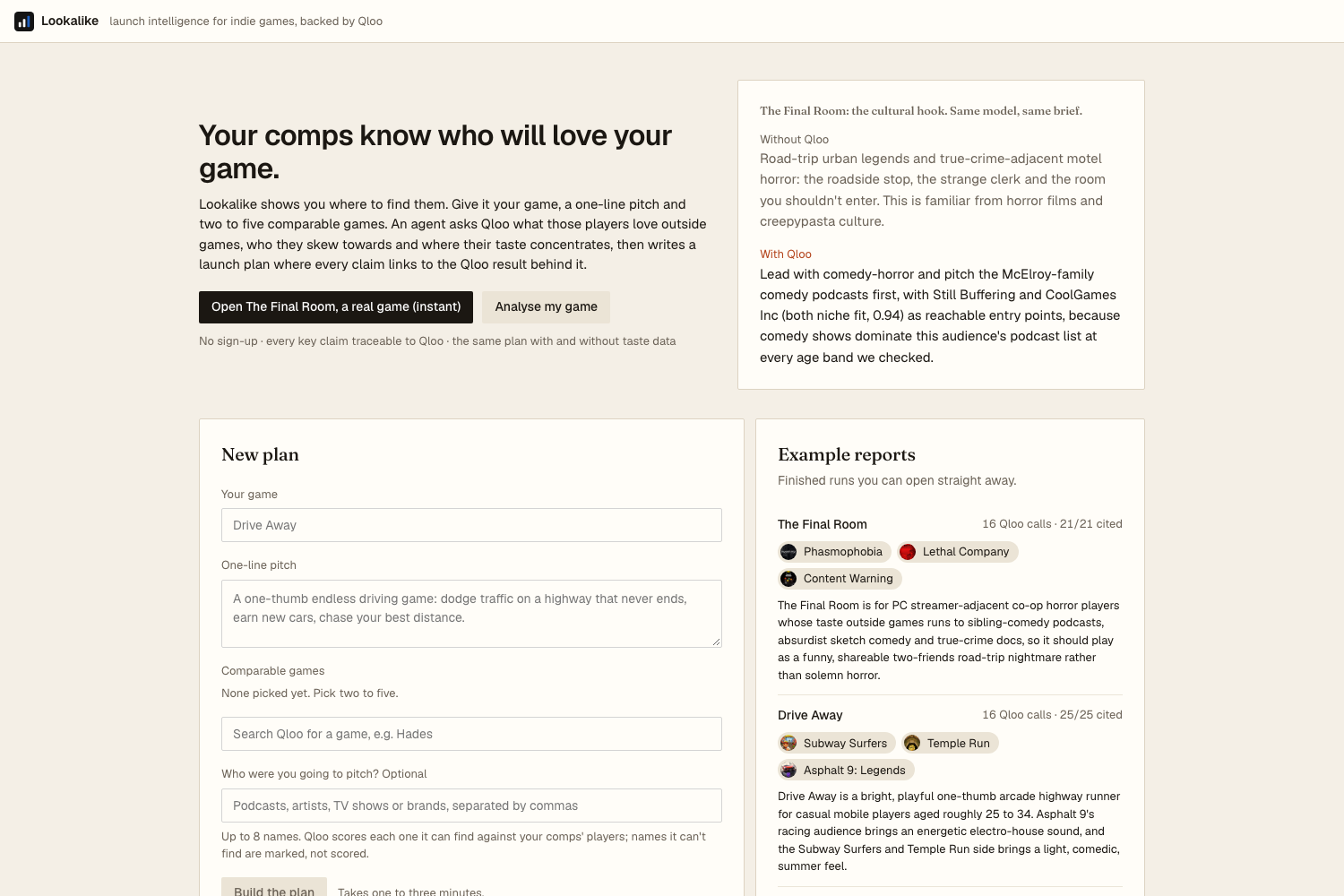
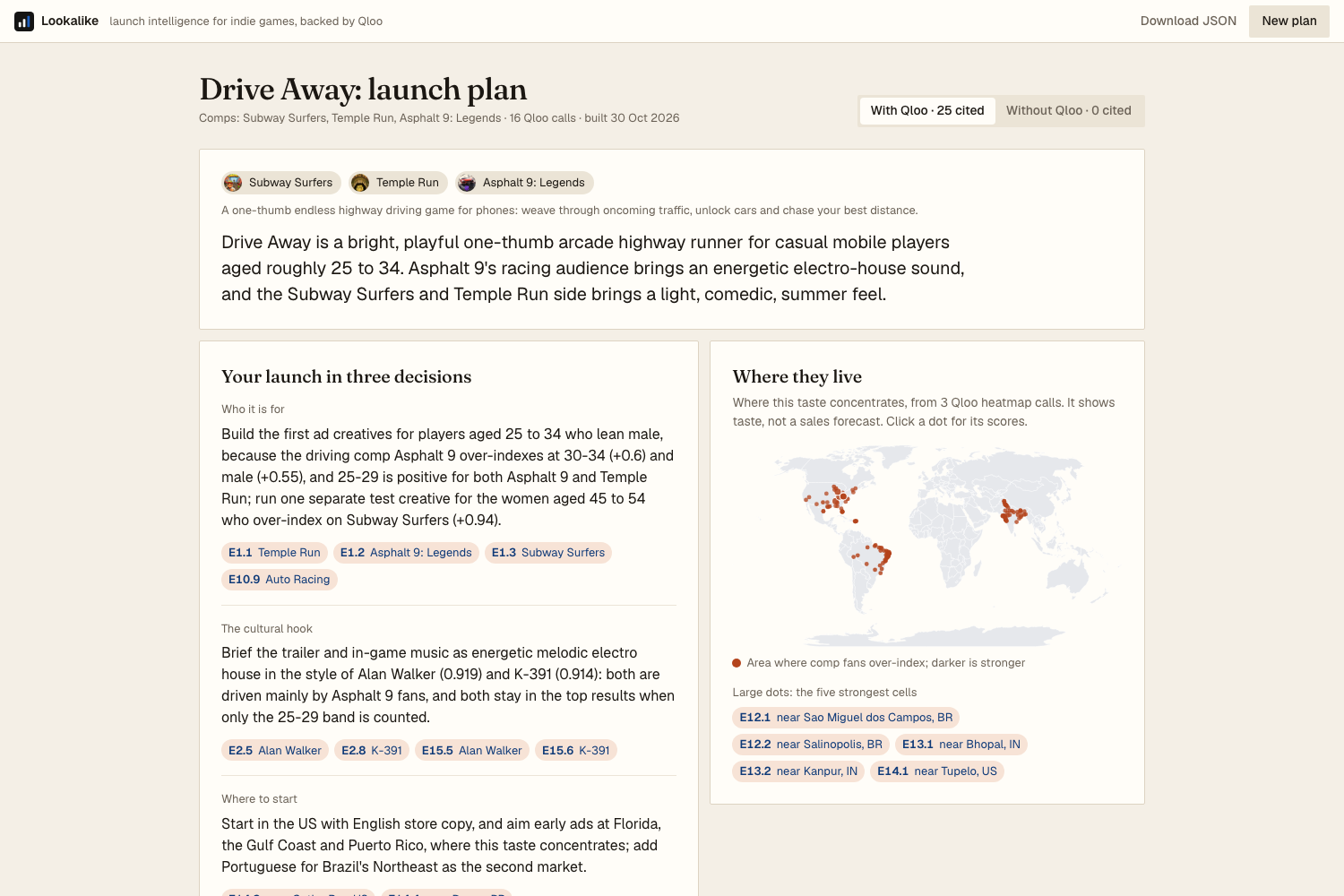
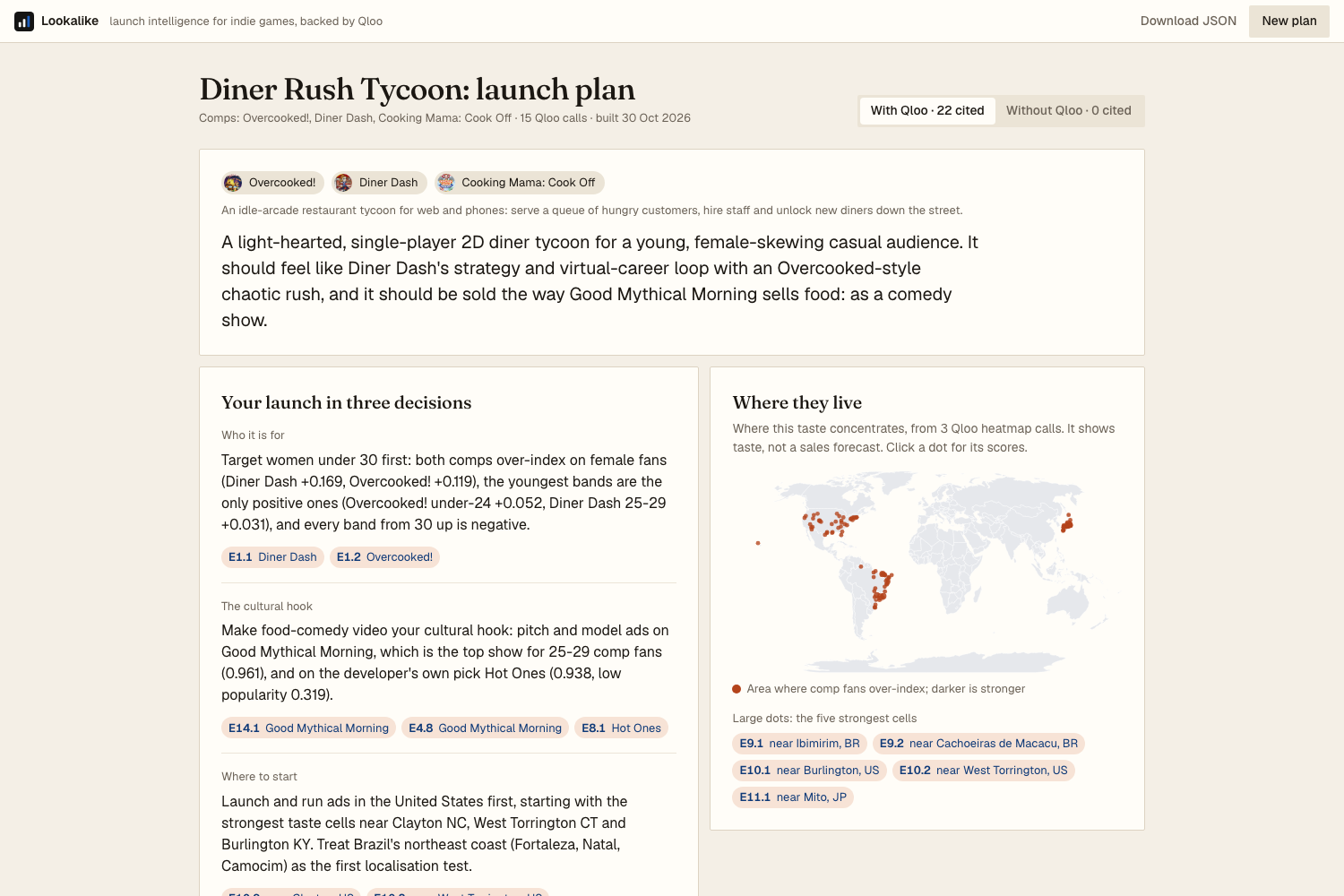
Lookalike is launch intelligence for indie games. Indie studios use it once per launch. The money is in publishers and game-marketing agencies: they screen dozens of pitches a month, and for them it's a per-seat tool for pitch screening and launch planning. Nobody pays for it yet. I'm the first user, and the examples are my own games: The Final Room, Drive Away and Diner Rush Tycoon.
The hard part of a launch is being found. Steam released 19,008 games in 2025, and 9,269 of them had 10 or fewer reviews (GamingOnLinux, How To Market A Game).
Inspiration
I make small games in Sri Lanka and launch them myself. Finishing a game is half the job. The other half is a question small studios rarely have data for: who is this actually for, and how do I reach them?
We already describe our games through comps: "it's Phasmophobia meets Lethal Company." Publishers ask for them. I realised those comps point straight at an audience, and Qloo knows what that audience loves outside games, who it skews towards and where it lives. Big studios pay research teams for that. Lookalike is the research team I couldn't afford.
What it does
You give Lookalike your game, a one-line pitch and two to five comparable games (your comps), picked from Qloo's catalogue. You can also add the podcasts, streamers or artists you were planning to pitch. An agent researches the comps' players through Qloo and returns a launch plan:
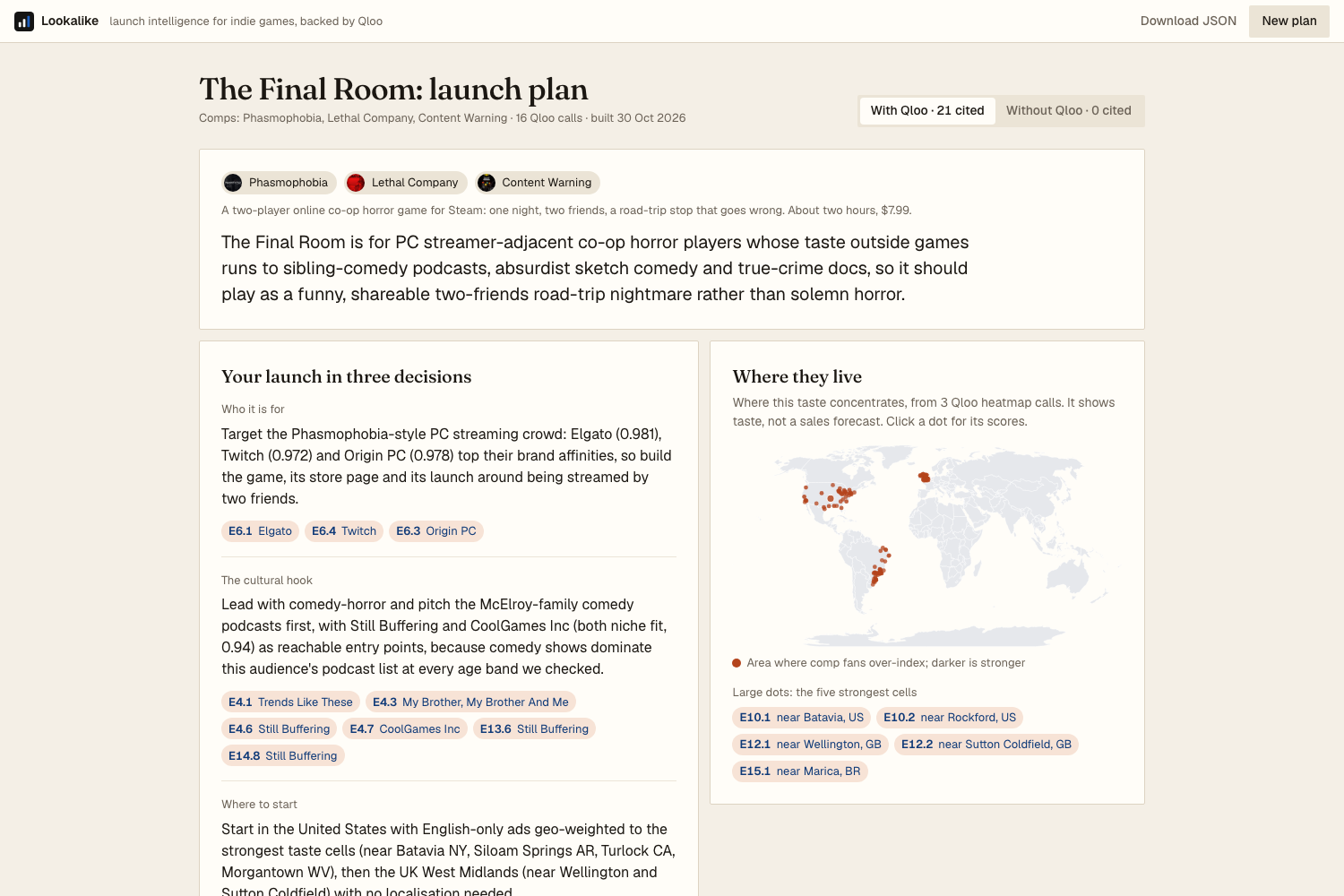
- Your launch in three decisions: who it's for, the strongest cultural hook outside games, and where to start.
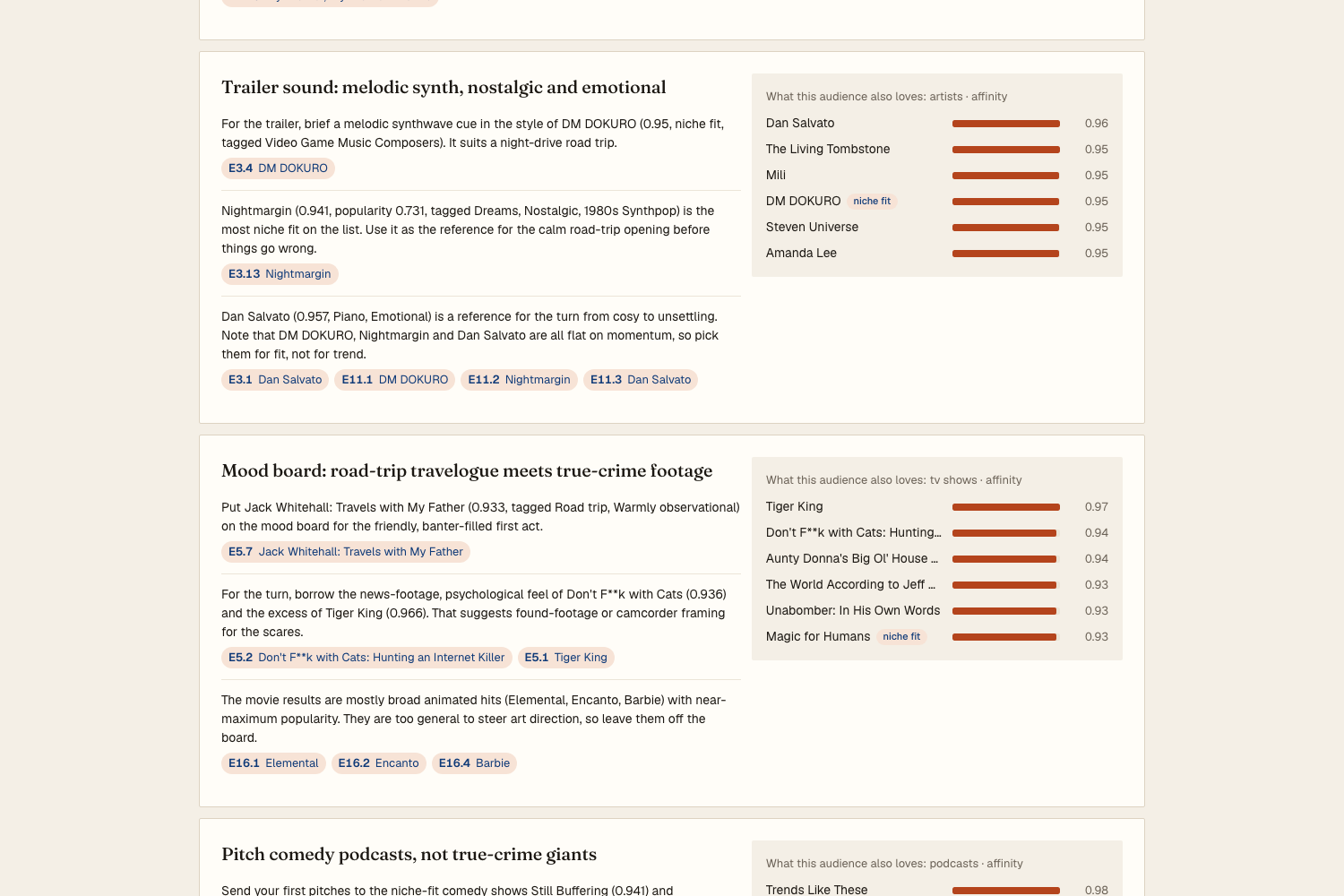
- A cited plan with trailer music, mood-board references, podcasts and creators to pitch, markets, timing and risks.
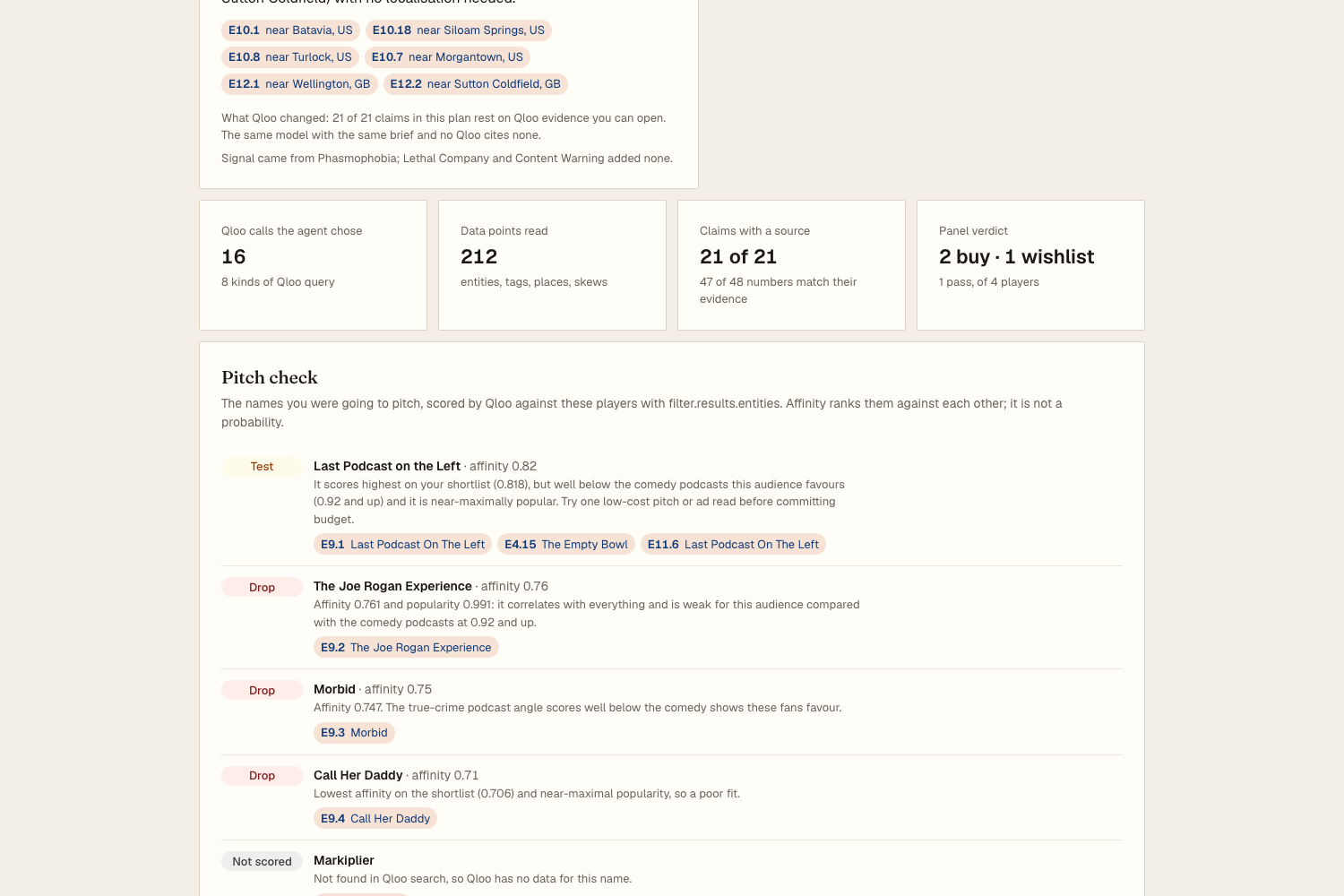
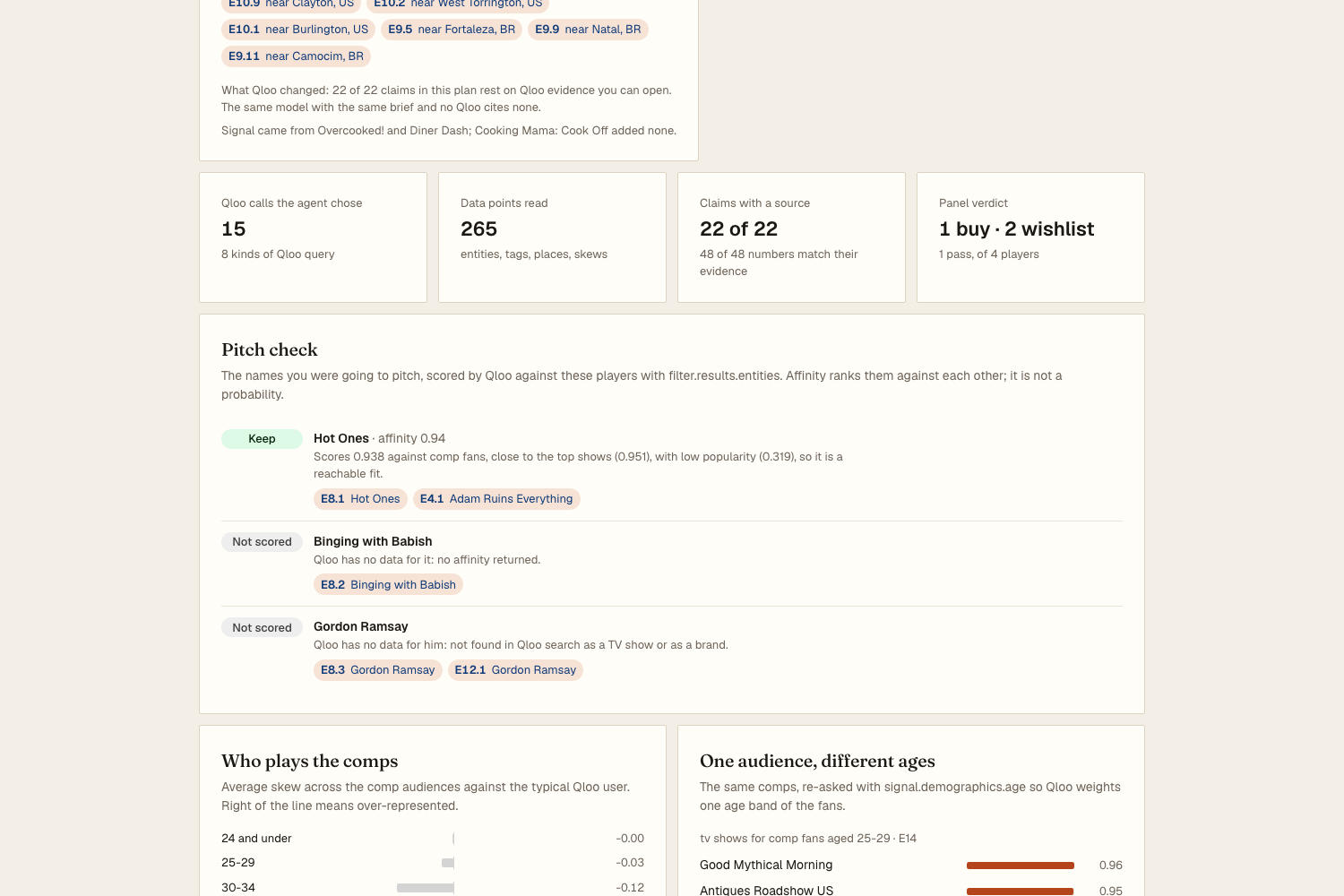
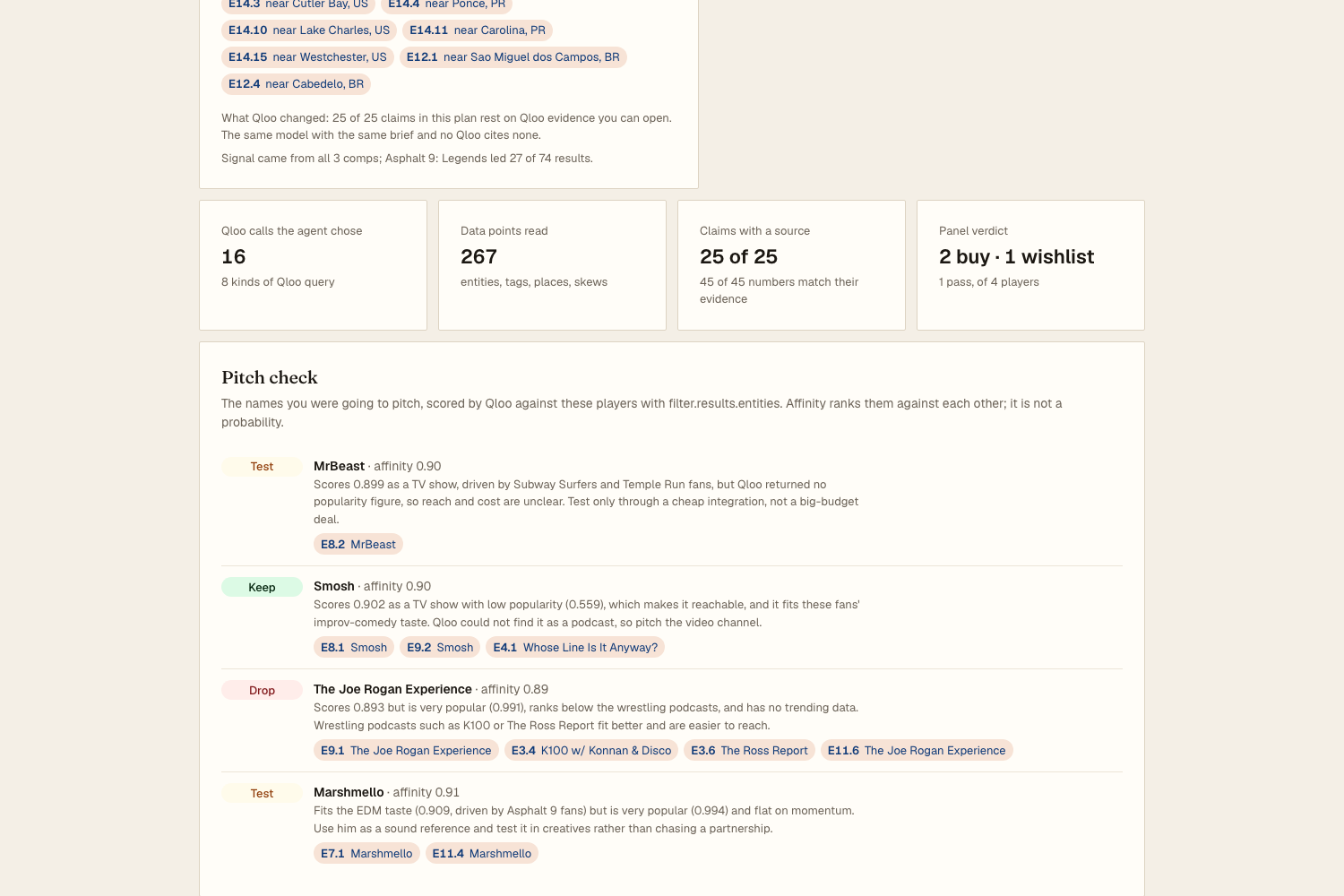
- Pitch check: your own shortlist, scored by Qloo against your comps' players, with keep, test or drop for each name. Names Qloo can't find stay on the list, marked "not in Qloo, not scored".
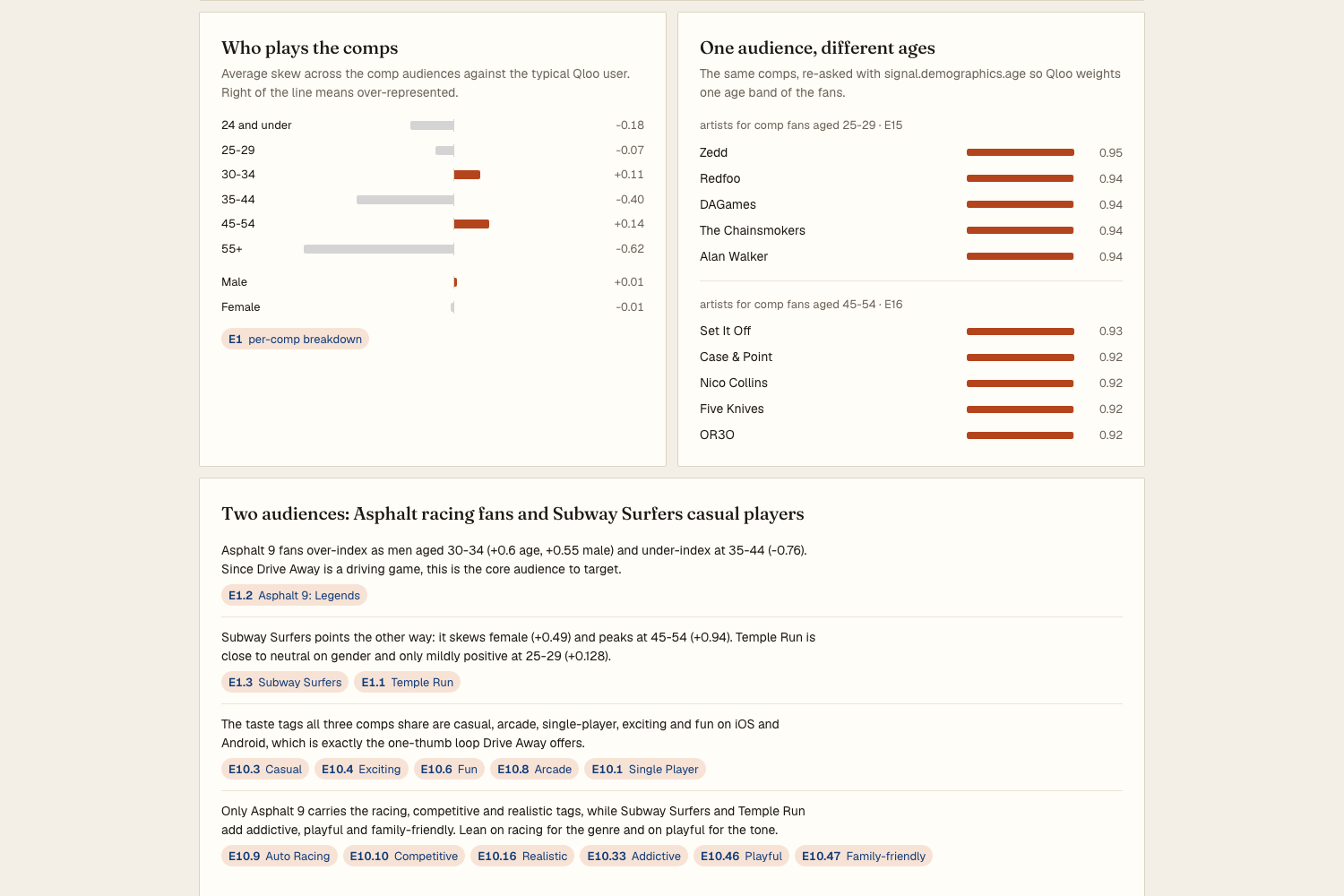
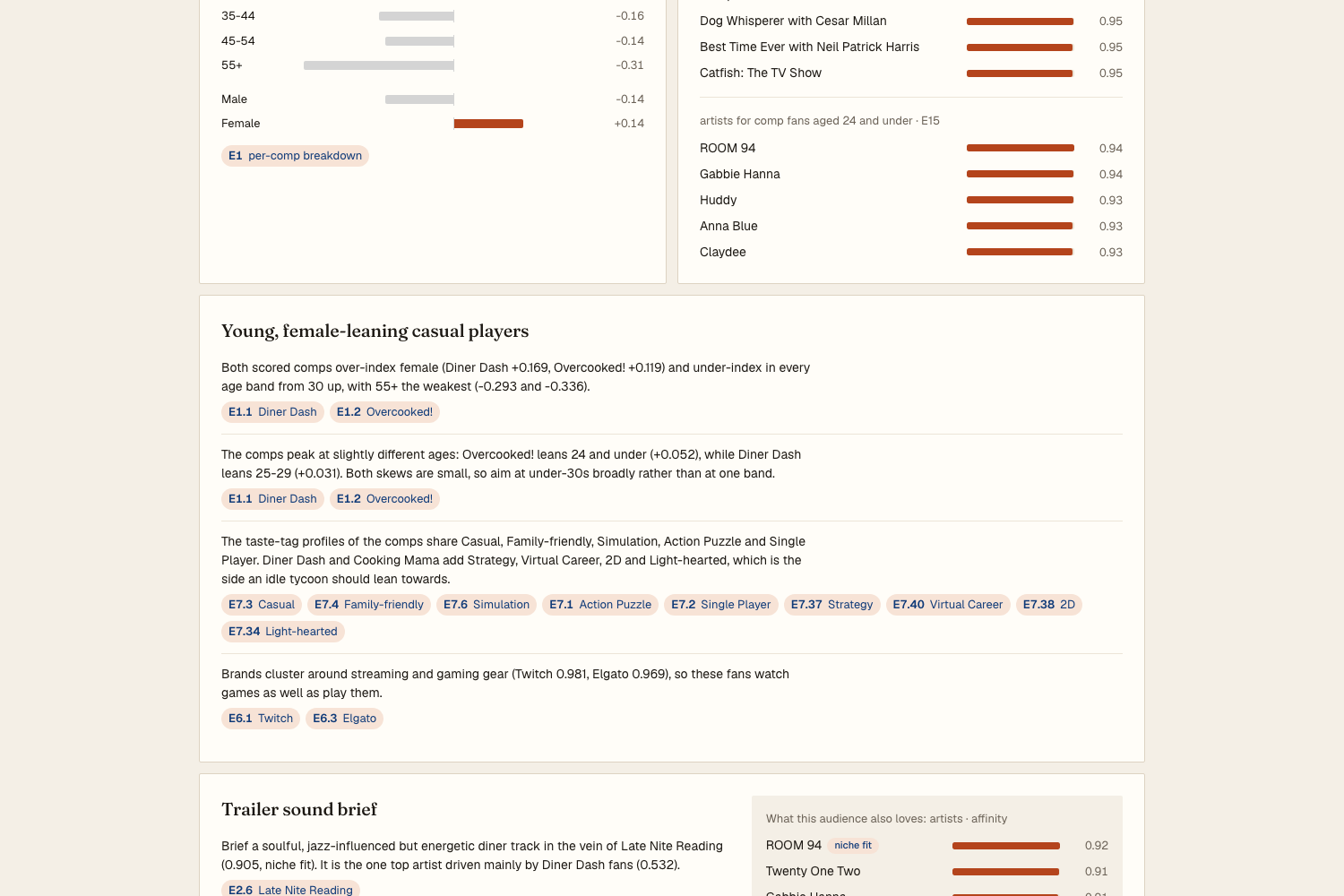
- One audience, different ages: the same question re-asked for one age band at a time.
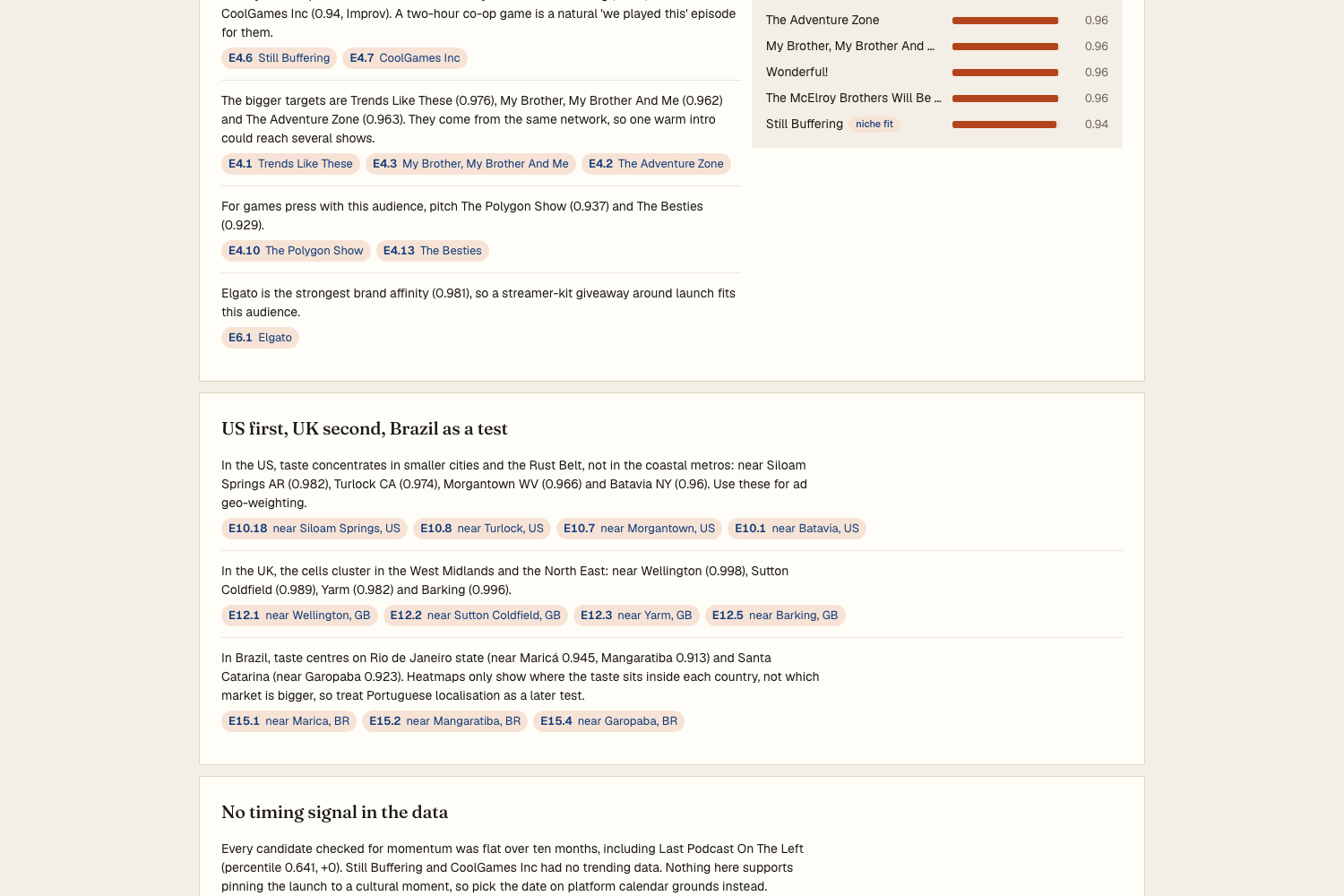
- A map of where the taste concentrates, with place names for each cell, and the comps' age and gender skew when Qloo has it.
- A coverage line that says which comps actually drove the results.
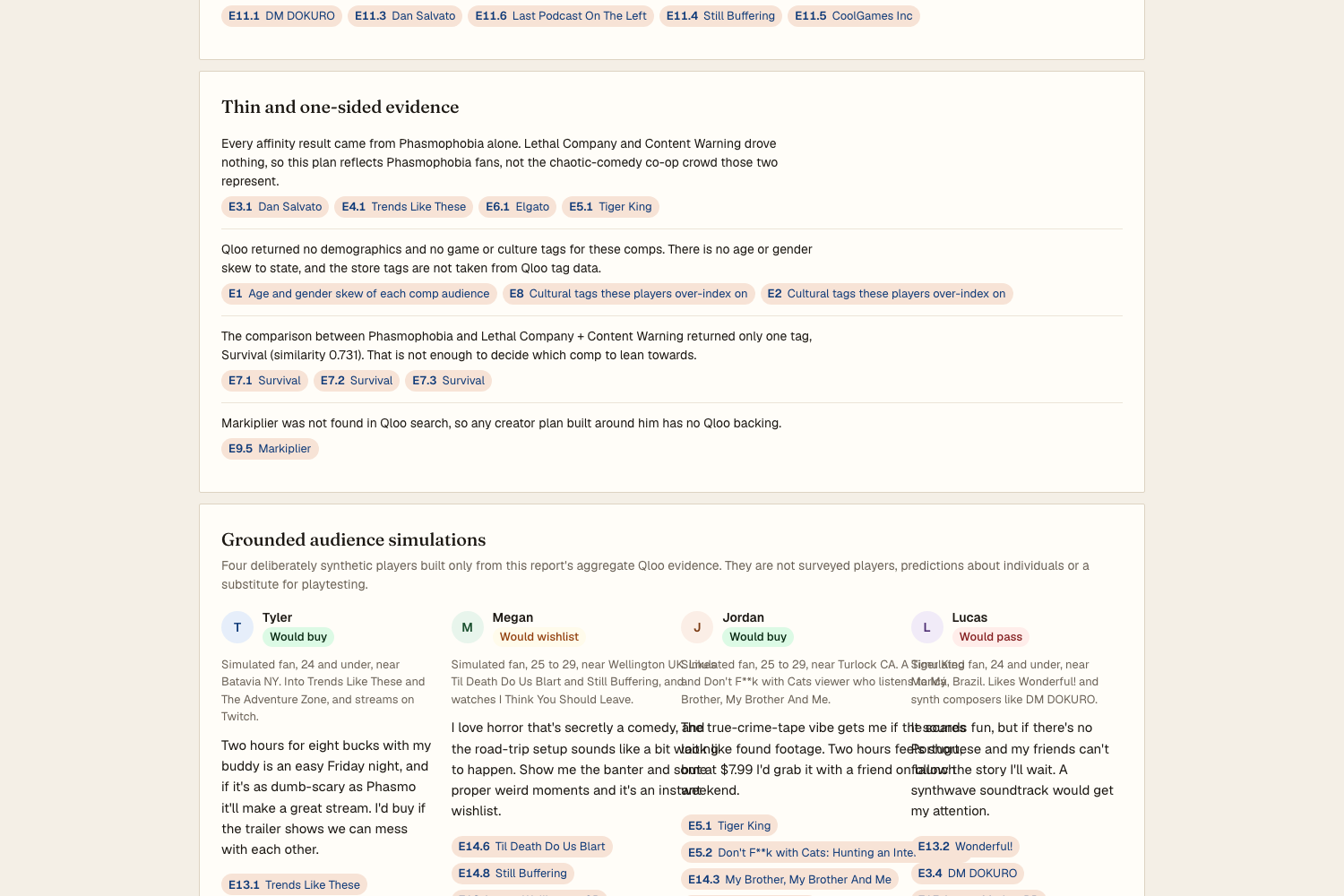
- Grounded audience simulations: four clearly synthetic players built only from the cited data, reacting to your pitch.
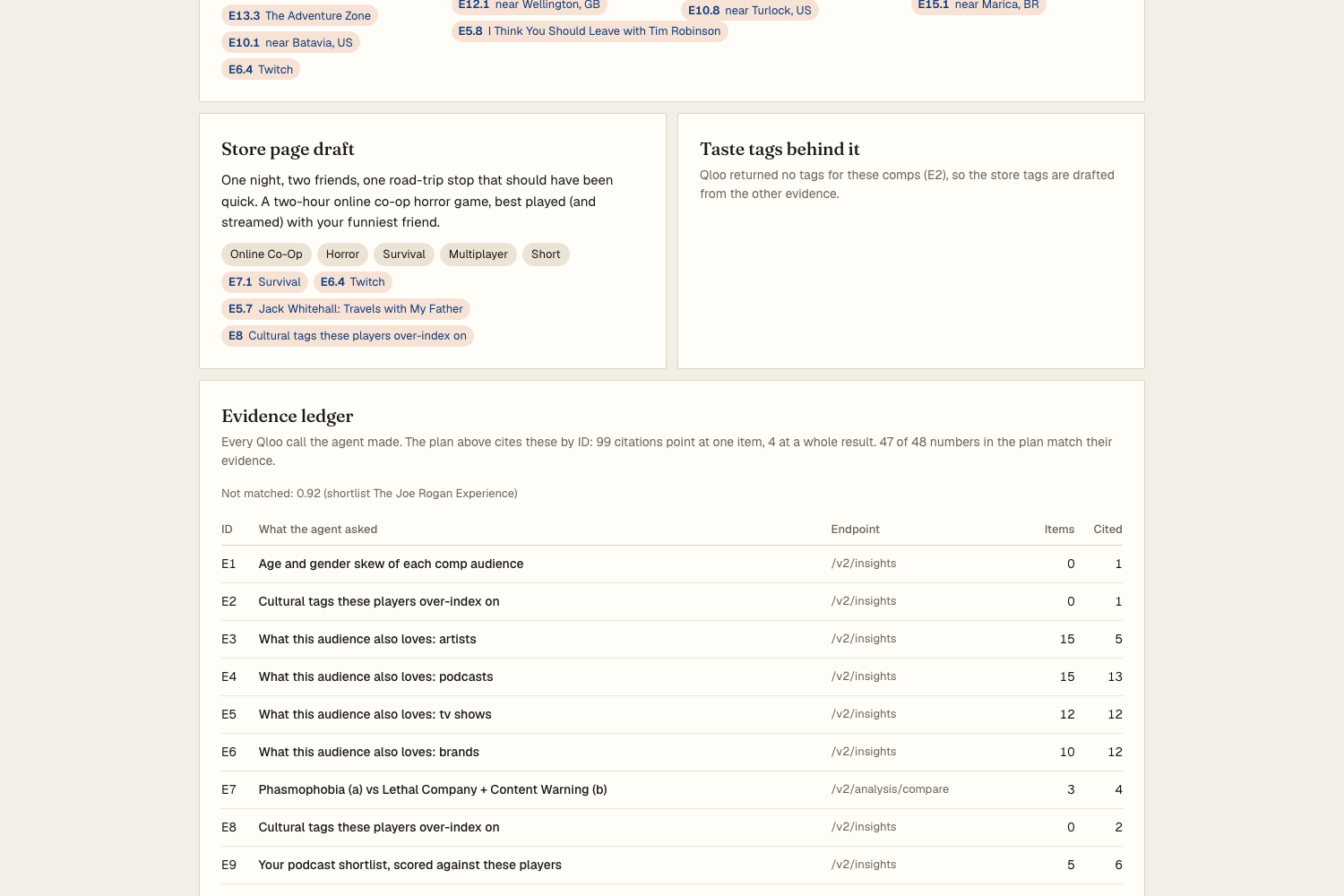
- A store page draft, and an evidence ledger of every Qloo call, failed ones included.
Every claim carries evidence chips. Click one and you see the Qloo item, its affinity, which comp drove it and the exact request the agent made.
The moment Qloo changes the answer
The brief says: "If your submission would work the same without Qloo, you're building the wrong thing." Lookalike tests that on screen. While the agent works, the same model gets the same brief with no Qloo access, and a switch at the top of the report flips between the two plans.
Here's the cultural hook for my co-op horror game, The Final Room, both ways.
Without Qloo: "Road-trip urban legends and true-crime-adjacent motel horror: the roadside stop, the strange clerk and the room you shouldn't enter. This is familiar from horror films and creepypasta culture."
With Qloo: "Lead with comedy-horror and pitch the McElroy-family comedy podcasts first, with Still Buffering and CoolGames Inc (both niche fit, 0.94) as reachable entry points, because comedy shows dominate this audience's podcast list at every age band we checked."
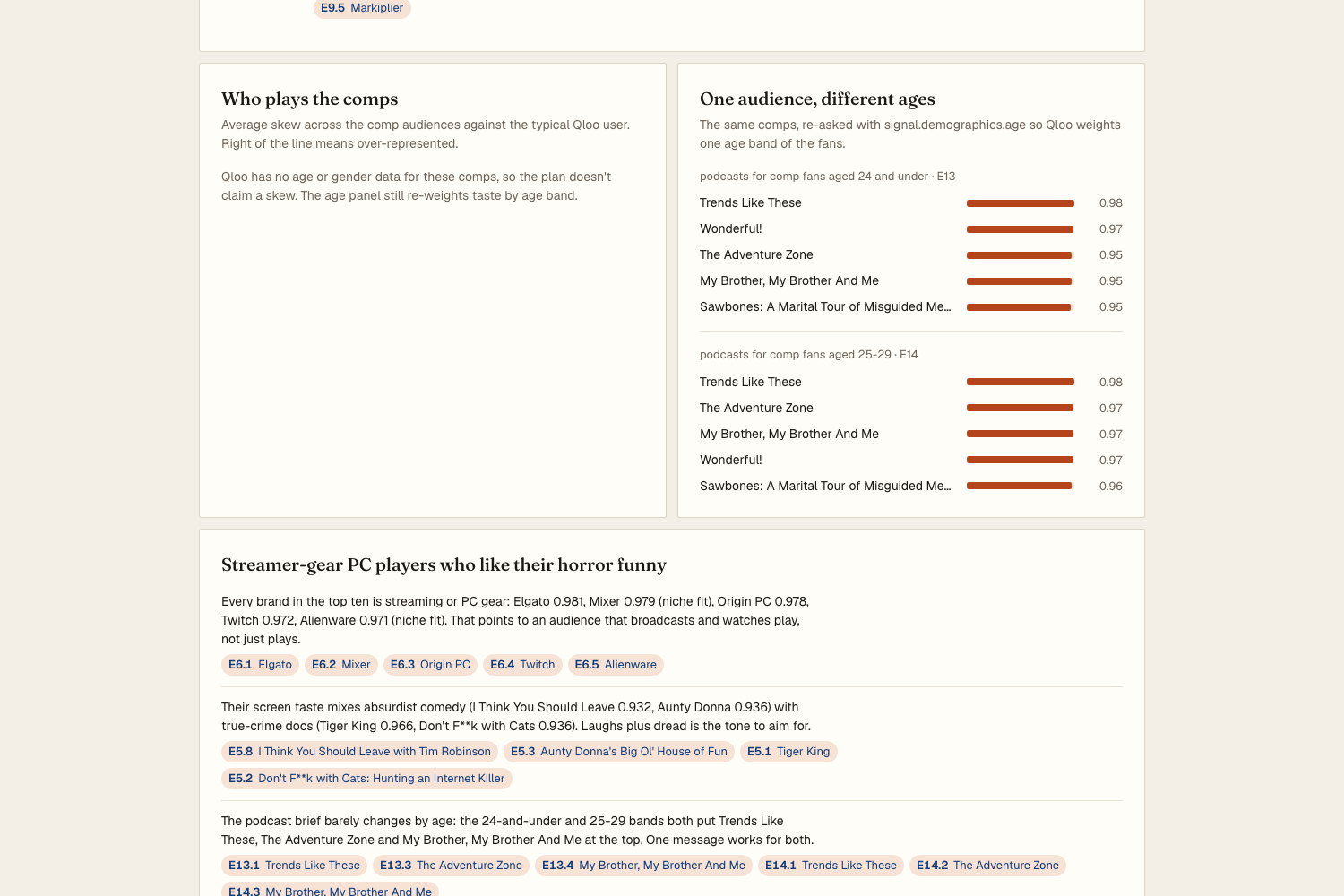
I'd have guessed the first one myself. I wouldn't have guessed the second. The same run scored the podcasts I was planning to pitch: Last Podcast on the Left was the best of them at 0.818, still below the comedy shows, and it told me to drop Morbid, Call Her Daddy and The Joe Rogan Experience. Markiplier isn't in Qloo's search, so it's marked "not scored" instead of getting a guess. Re-asking Qloo for one age band at a time kept the same answer: for fans aged 24 and under the top podcasts were Trends Like These, Wonderful! and The Adventure Zone, and for 25 to 29 they were Trends Like These, The Adventure Zone and My Brother, My Brother And Me.
The run was also honest about its limits. Lethal Company and Content Warning added no signal of their own, so the report says the results rest on Phasmophobia, and Qloo had no age or gender data for any of the three, so it doesn't claim a skew. The number check found 47 of the 48 numbers in the plan in the evidence they cite. The one miss was a real citation slip: the reason for dropping Joe Rogan compares him with "the comedy podcasts at 0.92 and up" without citing those podcasts, and the report lists that instead of hiding it.
How Qloo powers it
| Qloo call | Why Lookalike makes it |
|---|---|
/search with types=urn:entity:videogame |
pick comps, resolve shortlist names |
/v2/insights on artist, podcast, tv_show, movie, book, brand and videogame, with feature.explainability |
what these players love outside games, and which comp drove each result |
/v2/insights + filter.results.entities |
score the developer's own shortlist against the audience |
/v2/insights + signal.demographics.age |
the same taste re-weighted for one age band |
/v2/insights with urn:tag, urn:demographics and urn:heatmap |
store tags, age and gender skew, where the taste concentrates |
/v2/analysis/compare |
taste tags two comps share and the ones unique to each |
/v2/trending |
whether a recommended artist or podcast is rising or fading |
How the agent works
Claude (claude-opus-5-5) runs a tool-use loop. It reads the first answers and decides what to ask next, such as which country to map, which age band to re-ask for, which comps to compare and which picks deserve a momentum check. The example runs made 16 to 18 Qloo calls, with a hard cap of 18. Each step streams to the browser, so you watch it work. When Qloo answers 429, the client waits as long as Retry-After asks and tries again; a call that still fails is shown in the evidence ledger and doesn't count toward the cap.
Every Qloo answer is stored as an evidence block, and every item in it gets an ID. The report is filed through a strict JSON schema in which every claim lists its evidence IDs. The server checks each ID and drops any that point at nothing, so the plan can't cite data it never received. It also checks every decimal in a claim against the Qloo items that claim cites, and the report shows how many match.
Keeping it honest
- Affinity is shown as Qloo's relative score inside a result set, never as a probability or a share of players.
- Numbers in the plan are checked against the cited Qloo items, and the report shows the match count.
- The map shows where a taste concentrates. It isn't a sales forecast.
- The compare endpoint compares taste-tag profiles, so Lookalike never calls it audience overlap.
- When Qloo has no demographic or tag data for a comp, the report says so instead of filling the gap. The coverage line names the comps that actually drove the results.
- Shortlist names Qloo can't find are marked "not in Qloo, not scored" instead of being dropped.
- The audience simulations are labelled synthetic, and each trait cites its evidence.
- Only public game titles and entity IDs go to Qloo. Keys stay on the server, and runs are rate-limited.
Challenges
- The real API differs from parts of the docs. Games use
urn:entity:videogame, notvideo_game. Heatmaps need a country or city. Trending takes one entity of its own type and no games. Compare returns tags for games. I probed each endpoint before building on it, and the README lists the gotchas for other entrants. - Coverage has gaps. Some well-known games have taste data but no demographics or tags, and some mobile hits aren't in the catalogue at all. The agent is told to say "thin data" rather than fill sections from general knowledge.
- Search matches loosely and returns a loosely related entity for names it doesn't know, so the shortlist matcher only accepts close name matches and lists the misses.
- An agent run takes about two minutes, so the examples load instantly, live runs stream every step, and identical inputs return the cached report.
What I learned
Cross-domain taste data is more useful for launching a game than game data alone. A podcast to pitch, an artist to brief for the trailer and a country to start in are things I can act on this week. "Casual mobile players" gives me nothing to do.
What's next
Get Lookalike in front of publishers and game-marketing agencies, who screen dozens of pitches a month, and see whether it earns a seat in their pitch screening. The same engine works for albums, comedy specials and films, but I'm starting with games because I have the problem myself.
Place names on the map come from GeoNames (CC BY 4.0).
Built With
- anthropic
- claude
- d3.js
- javascript
- qloo
- react
- typescript
- vercel
- vite

Log in or sign up for Devpost to join the conversation.