Inspiration
AI has become incredibly powerful, but one major limitation still exists—memory. Most AI assistants forget important user context once a conversation ends, forcing users to repeat preferences, goals, and project details again and again. We were inspired by a simple question: "What if AI could remember like a human, but users remained fully in control of that memory?" This led us to build LongMind, a universal memory infrastructure that gives AI persistent memory, explainable retrieval, and governed recall.
What it does
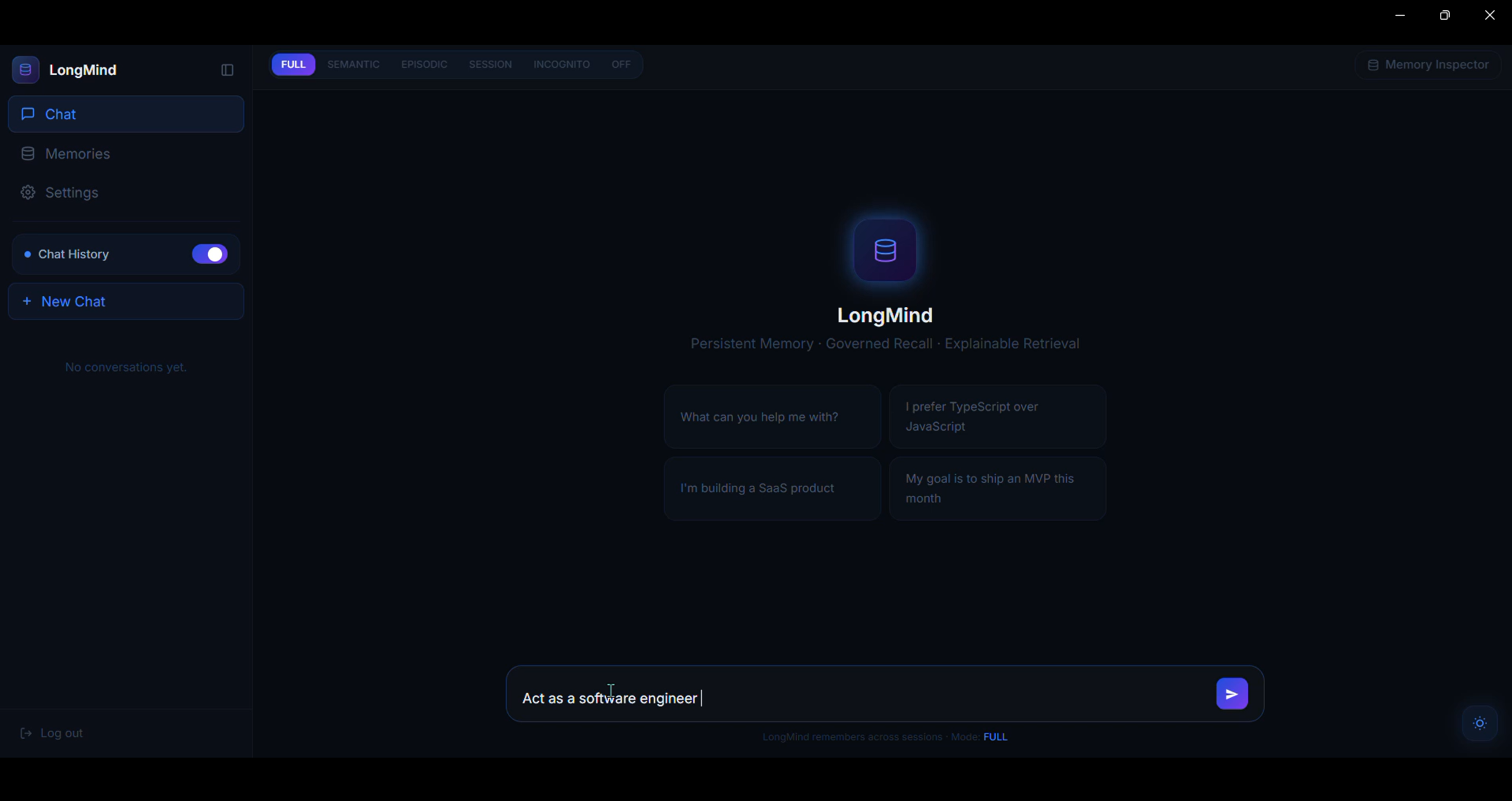
LongMind is a universal memory layer for AI systems. It sits between users and language models and enables: Persistent memory across conversations and sessions Intelligent retrieval of relevant memories Explainable memory recall with scoring and reasoning User-controlled memory governance Context continuity for AI assistants Users can switch between multiple memory modes: FULL – Complete memory enabled SESSION – Session-only memory SEMANTIC – Preference and knowledge memory EPISODIC – Event-based memory OFF – No memory retrieval or storage INCOGNITO – Temporary conversations with zero persistence LongMind transforms stateless AI into context-aware AI.
How we built it
We designed LongMind as a modular AI infrastructure platform. Frontend React.js Tailwind CSS Vercel Deployment Backend Node.js Express.js Memory Infrastructure Neon PostgreSQL pgvector for semantic memory search Upstash Redis for short-term memory caching AI Layer Google Gemini API Custom retrieval engine Context compression pipeline Memory extraction engine Core Components Memory Service Retrieval Engine Governance Manager Orchestrator Explainability Engine Memory Inspector Dashboard The system stores meaningful memories, retrieves them using semantic similarity and recency scoring, and explains exactly why a memory was selected.
Challenges we ran into
Building LongMind required solving several complex challenges: Memory Relevance: Not every conversation should become a memory. We had to determine what information was actually important enough to store. Context Retrieval: Retrieving too much memory overwhelms the model, while retrieving too little reduces usefulness. Finding the right balance was challenging. Explainability: Most memory systems behave like black boxes. Designing a retrieval process that could clearly explain why a memory was recalled required additional scoring and reasoning layers. Governance: Giving users complete control over memory modes while maintaining a seamless experience required careful architectural design. Deployment Simplicity: We wanted an infrastructure-level product while keeping deployment simple enough for a hackathon environment.
Accomplishments that we're proud of
Built a fully functional AI memory infrastructure platform Created user-controlled memory governance modes Implemented explainable retrieval with transparency Enabled persistent memory across sessions Designed a scalable architecture using PostgreSQL and vector search Developed an intuitive Memory Inspector dashboard Successfully transformed stateless AI into context-aware AI Most importantly, we created a product that feels like a foundational infrastructure layer rather than just another chatbot.
What we learned
Throughout this project, we learned that memory is not just about storing information—it is about deciding: What should be remembered When it should be recalled Why it should be recalled Who controls the memory We also gained hands-on experience with: Retrieval-Augmented Generation (RAG) Vector embeddings and semantic search AI orchestration systems Memory governance design Explainable AI principles Full-stack cloud deployment
What's next for Longmind
Our vision is to make LongMind the "Redis for AI Memory." Future plans include: Multi-model support (Gemini, OpenAI, Claude, Llama) Cross-application memory sharing Team and enterprise memory workspaces Advanced memory analytics Memory APIs and SDKs for developers Privacy and compliance controls Adaptive forgetting and memory decay policies Plug-and-play integration for AI agents and copilots Ultimately, we want LongMind to become the standard memory infrastructure layer powering the next generation of intelligent AI applications.
Built With
- css
- express.js
- geminiapi
- neon
- node.js
- postgresql
- react.js
- tailwind
- vercel

Log in or sign up for Devpost to join the conversation.