-
-
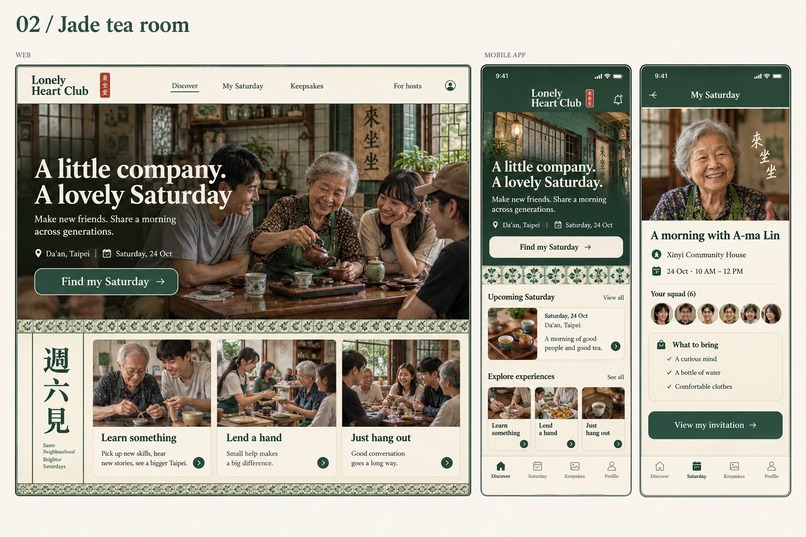
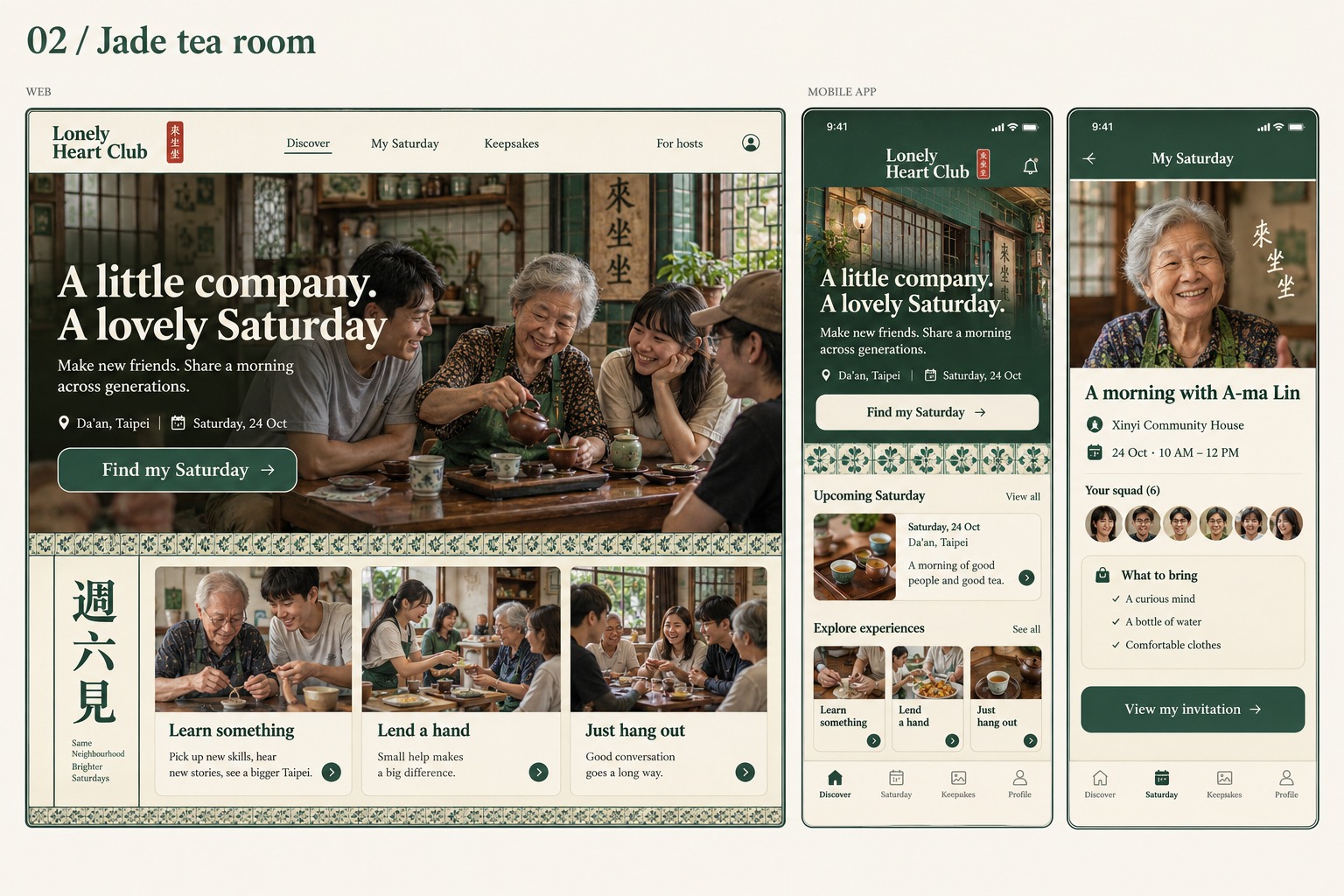
Webapp and mobile app designs
Inspiration
Taiwan officially became a super-aged society at the end of 2025: 20.06% of the population is now 65 or older. Nearly one million seniors live alone, and in a 2020 survey 56.6% of middle-aged and older adults said they feel lonely.
Community care stations (社區照顧關懷據點) are supposed to keep seniors connected, but only about 25% of the 4,828 stations open five days a week, and over a third of their volunteers are already 65+. The people caring for seniors are becoming seniors themselves.
At the same time, we noticed something in our own lives: young people are lonely too. Our friends pay to have dinner with strangers on Timeleft, join run clubs and go to coffee meetups, all to meet people in real life. Volunteering never caught that wave. It feels like a big commitment, solo visits feel awkward, and you rarely see the impact.
So we asked: how might we turn volunteering into a social experience young people actually want, so both generations feel less alone?
What it does
Lonely Hearts is Timeleft for volunteering. Young people are matched into small squads of strangers and spend time with seniors, learning from them or helping them out.
- Members take a short personality quiz (interests, languages like Taiwanese or Hakka, skills, and whether they want to learn, help or hang out), then book an event that fits their week.
- Hosts (care stations, NGOs, social workers) onboard, register the seniors they serve with consent, and publish events on the days they're short of volunteers.
- The day before, members see their squad's makeup. On the day, the place and the senior are revealed.
- Events go both ways. Sometimes Ah-ma teaches the squad (her braised pork recipe, gardening, mahjong). Sometimes the squad lends a hand (cleaning, tidying the garden, setting up video calls). The best events are both.
- A map shows every care center and, at village level only, seniors who live at home and never go to one.
- Afterwards, members choose who they'd meet again (mutual picks unlock a chat) and can ask to visit the same senior again, so seniors get continuity instead of a new stranger every time.
How we built it
[Describe your stack, e.g. "We built the prototype in React with Tailwind, using Leaflet for the map and mock JSON data for hosts, seniors and events."]
We started from the problem, not the tech. We researched Taiwanese government data from the Ministry of the Interior and the Ministry of Health and Welfare to confirm the volunteer gap was real. Then we mapped Timeleft's flow step by step (quiz → match → reveal → event → mutual connections) and adapted each step for volunteering.
For matching, we score each member–event pair on a few weighted factors:
$$ S = w_p \cdot P + w_l \cdot L + w_s \cdot K + w_d \cdot D + w_c \cdot C $$
where $P$ is personality fit with the rest of the squad, $L$ is language match with the senior, $K$ is skill match with the event, $D$ is a distance score, and $C$ is a continuity bonus for members who've visited that senior before. [In the prototype we used fixed weights / hand-picked matches.]
Challenges we ran into
- Privacy vs. visibility. We wanted a map of seniors who need help, but showing where vulnerable people live alone is dangerous. We settled on village-level shading for everyone, with an exact address only for verified members, only on the day of their event.
- Safety for home visits. Seniors living alone are frequent scam targets. We designed a trust ladder: your first event is always at a care station, and home visits require ID checks, at least three members, and host check-in and check-out.
- Not making it feel like charity. Early ideas framed seniors as recipients. Adding events where seniors teach the squad changed the whole tone.
- Scope. Our first idea was a gamified "Loneliness Monster" boss battle. It was fun, but it distracted from the real product, so we cut it back to light motivation like recipe collections and squad streaks.
- [Add a technical challenge you actually hit.]
What we learned
- Volunteer shortages aren't only about numbers. They're about motivation: people show up for friends, not for duty.
- The two-sided design matters. Without an easy host onboarding, there are no events to book.
- Good data changes the pitch. Finding that a third of care-station volunteers are already 65+ reframed the problem from "seniors need help" to "the helpers are aging out."
- [Add something your team learned about building or working together.]
What's next
A 3-month pilot with about 5 care stations and 50 members in one Taipei district, with hand-run matching at first. We'll measure repeat attendance, show-up rate, and a short loneliness check for seniors before and after.
Built With
- caffeine
- claude
- codex
- lovable


Log in or sign up for Devpost to join the conversation.