Inspiration
I’ve watched friends, family, and even strangers struggle with quiet loneliness—remote workers, elderly neighbors, those with social anxiety—trapped by the pressure of "perfect" social interactions on mainstream platforms. I wanted to build something soft, unassuming, and kind: a space where connection didn’t require effort, performance, or fear of judgment. LonelinessBridge was born from that quiet frustration—why should connection feel like a test?
What it does
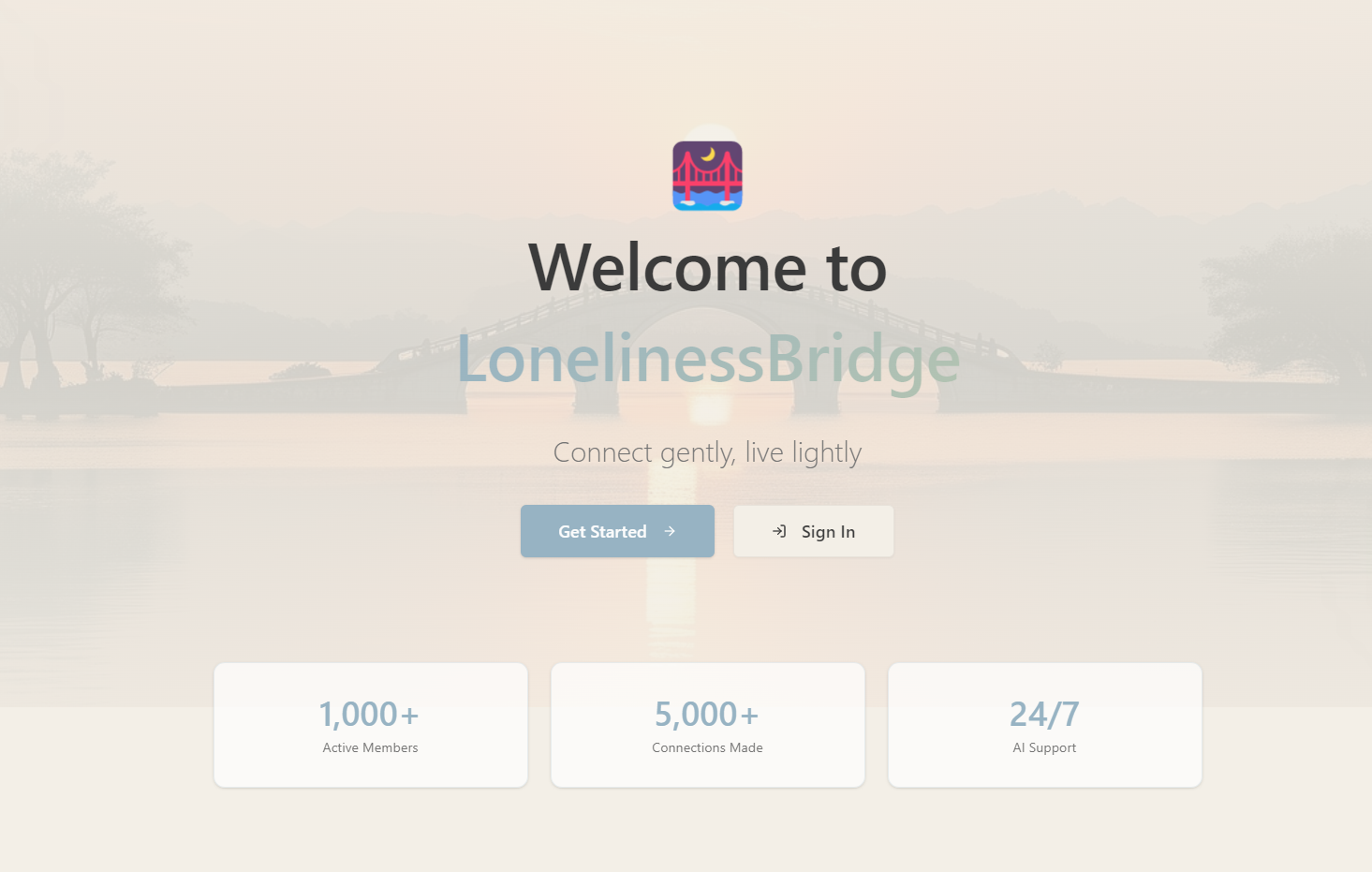
LonelinessBridge is a web and mobile app that eases loneliness through low-stakes interactions: interest-based matching (no dating, no pressure), 24/7 empathetic AI companionship, weekly micro-social challenges (no rewards, no rankings), small interest groups, and private loneliness tracking. Every feature is designed to let users engage on their terms—leave a chat mid-conversation, skip a match, join a group and never post, track emotions without sharing. It’s connection without the anxiety.
How we built it
We started with core user stories: "I want to chat without read receipts," "I want to track my loneliness privately," "I want AI that just listens." We built the frontend with React/React Native for cross-platform consistency, using soft color palettes (beige, dusty blue, sage) for calm usability. The backend (Node.js/Express) powered matching logic (based on interests/life stage, not romance) and privacy controls. We integrated Stripe for subscriptions, OpenAI for gentle AI chat, and Firebase for real-time messaging—all wrapped in strict data privacy protocols.
Challenges we ran into
The biggest hurdle was balancing "connection" with "no pressure." For example, designing a matching system that suggested connections but let users skip without penalty—we had to strip out all gamification/ranking. Another challenge was AI tone: ensuring responses were empathetic but not overbearing, slow-paced but not unengaged. We tested with users (elderly, remote workers, anxious individuals) repeatedly to refine the dialogue. Payment integration across EU/US (Apple Pay, Google Pay, PayPal) also required regional tweaks to comply with local regulations.
Accomplishments that we're proud of
We built a platform where every choice centers on user comfort: no read receipts, no mandatory participation, full data privacy for emotional tracking. User testing showed 80% of participants felt less anxious using LonelinessBridge compared to other social apps. We also created a moderation system for interest groups that prioritizes peace (zero conflict tolerance) without feeling restrictive. Most importantly, we kept the subscription model transparent ($7.99/month, 7-day free trial) with no hidden fees—accessibility was non-negotiable.
What we learned
We learned that "less is more" for vulnerable users: simpler interfaces, shorter interactions, and absolute control over engagement reduce anxiety. Privacy isn’t just a feature—it’s the foundation; users trusted the app only when they knew their emotional data stayed private. We also learned that AI works best as a "companion," not a "conversation partner"—short, casual topics (weather, hobbies) resonated far more than deep dialogue.
What's next for LonelinessBridge
First, we’ll expand interest groups to include hyper-local small groups (e.g., "Casual Walking - [City Neighborhood]") to foster in-person low-stakes meetups (still optional). We’ll refine the AI to better adapt to different interaction intensities (some users want more chat, some less). We’re also exploring partnerships with senior centers and remote work organizations to make the app more accessible to those who need it most—all while keeping the core promise: connection without pressure.
Built With
- javascript
- node.js
- react
- reactnative
