-
-
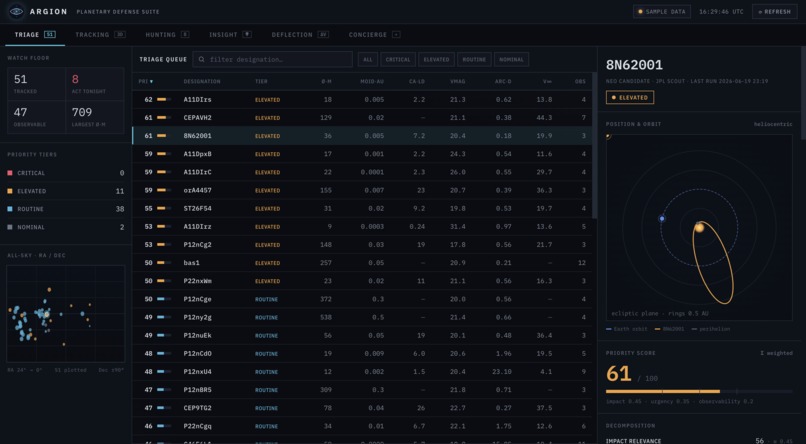
Triage
-
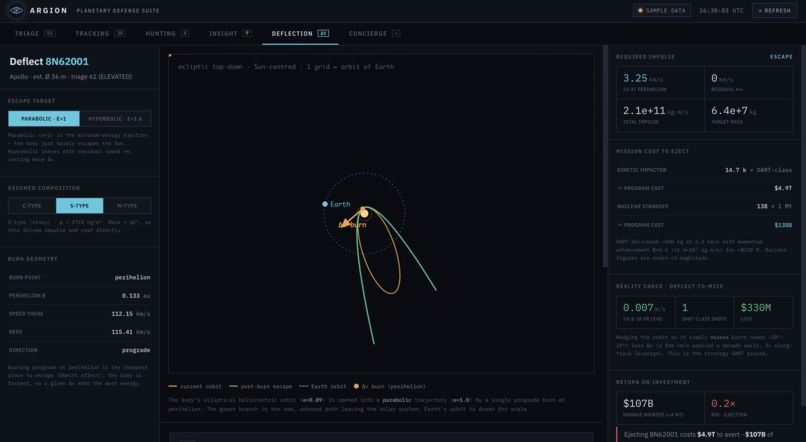
Deflection
-
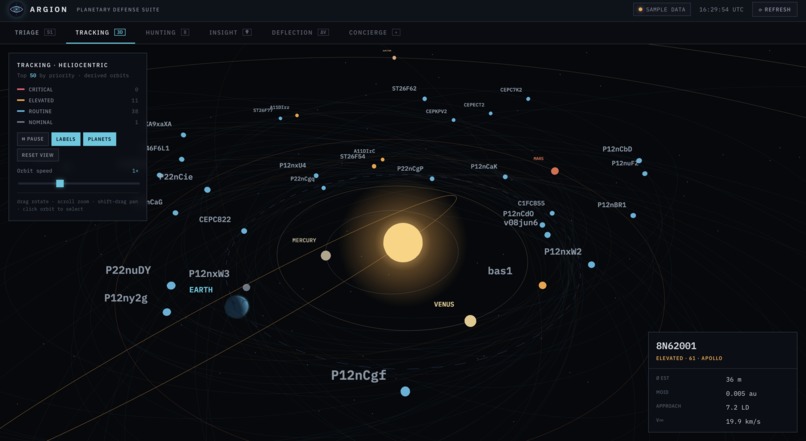
Tracking
-
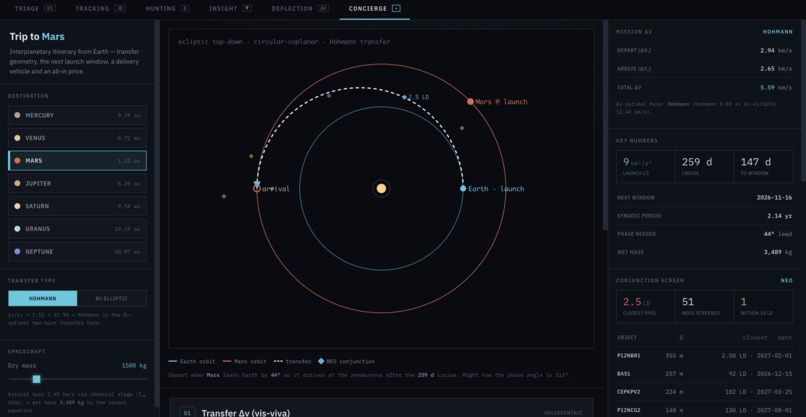
Concierge
Inspiration
Learning about astrobiology and the history of life on Earth, it stood out to us that all species, regardless of how successful they are in survival, are at risk of extinction at the hands of asteroid impacts. The famous example of the Chicxulum crater, discovered by Luis and Walter Alvarez, faculty members of our Physics and EPS departments here at Berkeley, helped scientists understand the risk that these objects play. With multiple NASA missions working on landing on and deflecting asteroids, we thought we would develop a tool to connect different industries sharing this goal with a central module that brings it all together into one tool.
What it does
Argion is an End-to-End Planetary Defense Software Suite. It combines NEO tracking, danger and risk triage, follow up observations, possible deflection scenarios, and predictions for collisions with spacecraft into one simple workbench. Argion collects a list of asteroids near Earth from official Jet Propulsion Lab (JPL) data and analyzes the threat to Earth each one provides using AI Inference.
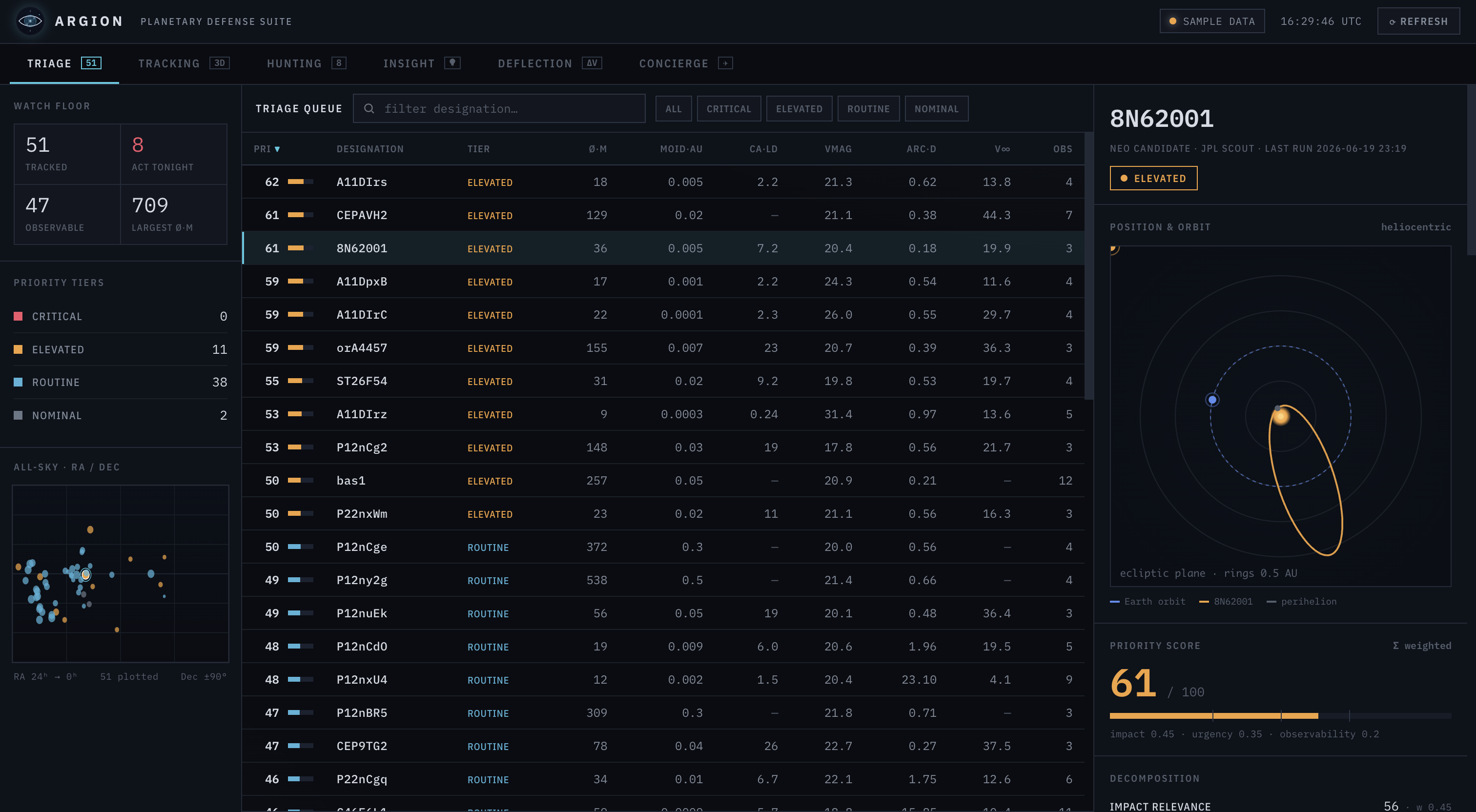
The Triage page is a comprehensive dashboard containing classifications for each asteroid, risk and urgency assessments, orbit visualization, and an AI-powered explanation using JPL data for each classification given.
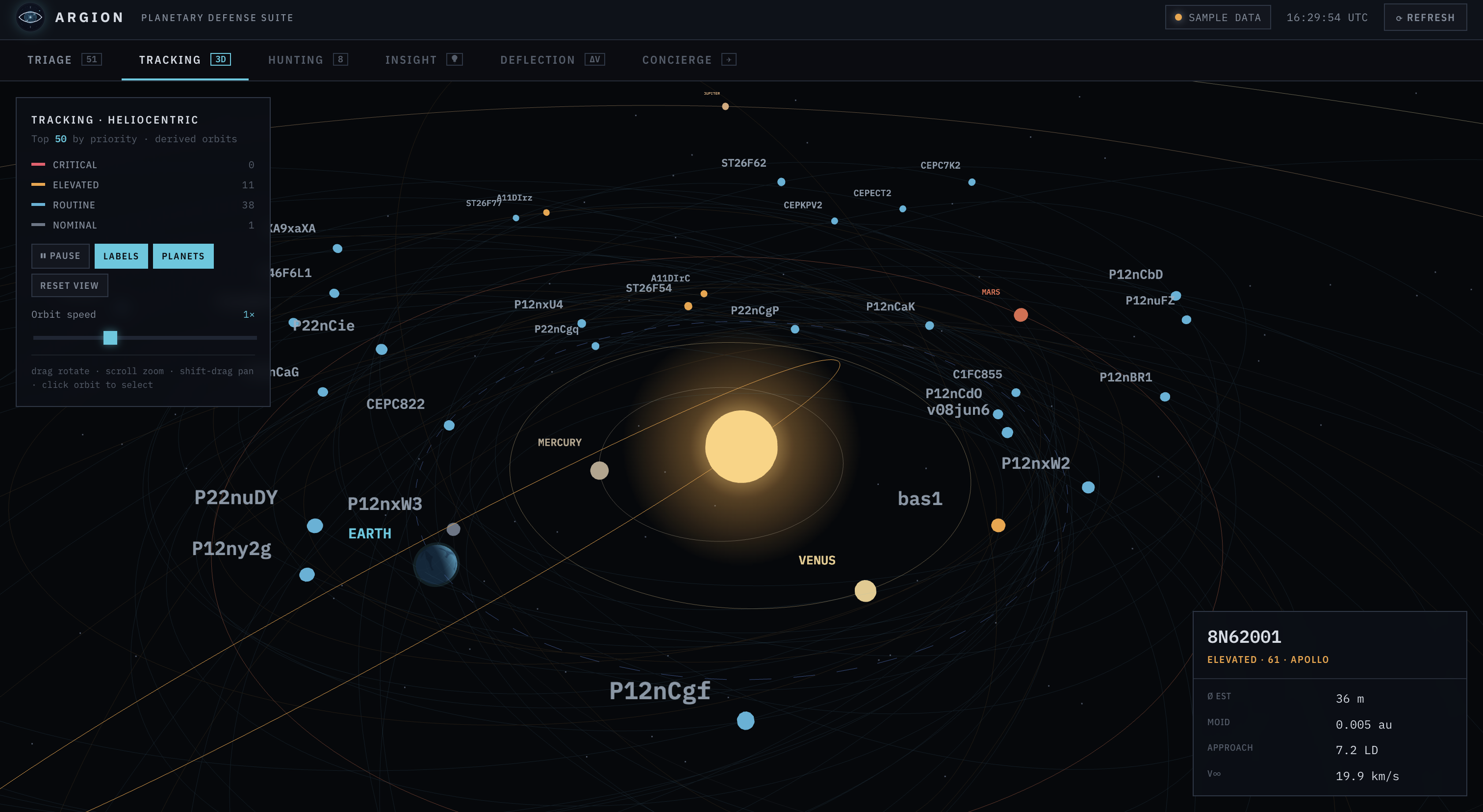
Tracking adds a 3D heliocentric view of the top 50 priority asteroids along with planets. It allows for isolating orbits and simulating different times in each orbit.
Hunting turns high-priority objects into observation plans that optimize for telescopes based on use cases and availability. It specifies what kind of observations astronomers need to take and why, local weather conditions for each optimal telescope, and includes a chat agent backed by Anthropic for classification and what-if questions.
Insight explains the physics behind the decisions and allows for testing the scale of impact damage (i.e. global regime of destruction) depending on velocity.We walk through extracting diameter from H magnitude, impact energy, orbit uncertainty, observability, and how triage scoring relates to official hazard scales, with interactive sliders and equations.
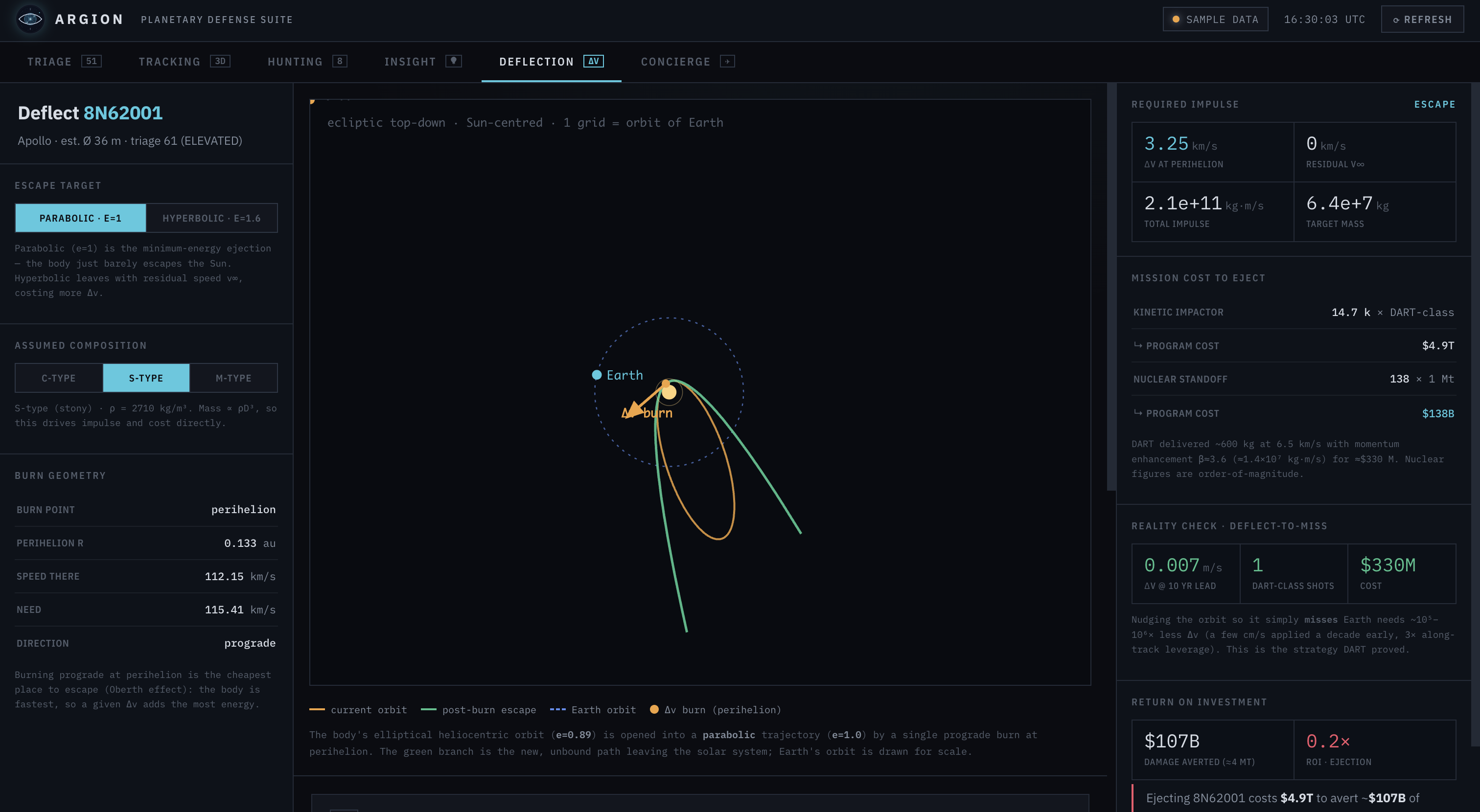
Deflection, our defense mission-design toolbox, simulates how to fully eject a selected NEO object into different trajectories and maps the boosts and orbital changes required. It calculates the burn geometry, economic cost of impact for no action, cost of deflection, and overall ROI.
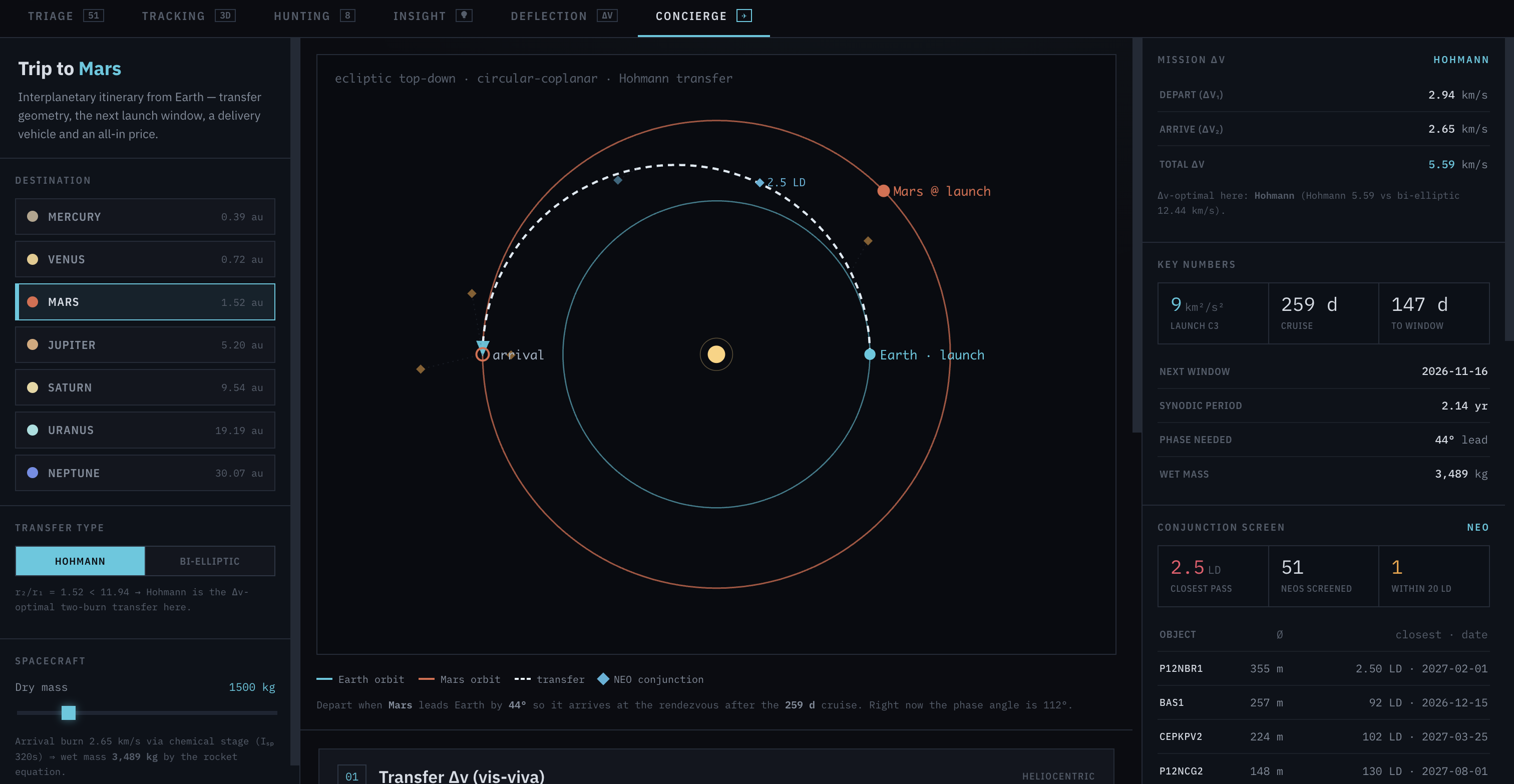
Concierge functions as our local travel agent but for space. It calculates trajectories to different planets using hohmann or bi-elliptic orbital transfers. It then screens for possible NEO conjunctions throughout the cruise path and recommends the best launch vehcle to fulfill the mission.
How we built it
We built this project entirely in JavaScript: frontend, backend, and tools to retrieve external data. All data used is queried directly from NASA databases directly, including JPL data for asteroids and Horizon API data for planet position. We have two LLM integrations in Argion: a risk analysis call and a classification chat agent the user can directly interact with. At our current stage, both call Claude. The risk analysis utilizes the asteroid data queried from JPL to provide a rationale for the risk class given to the asteroid and further estimates the Torino and Palermo risk scores.
Challenges we ran into
We initially had challenges creating the UI for the tracker page and connecting an asteroid chosen on the triage page to the tracking and hunting tabs. In addition, Calculating trajectories for this many asteroids would have created a lot of overhead, so we had to lazily calculate many of these values. Finally, calculating potential deflections and showing that in simulations was also one of the more technical tasks we faced. On the AI side, working with LLMs will inherently add a layer of inconsistency due to LLMs’ non-deterministic behavior. Inconsistency is one of the worst traits an LLM can have, as it rapidly breaks down trust in the LLM’s output. Our goal was to reduce this inconsistency as much as possible and have the LLM generate results that should never differ. To do so, we considered what data and instructions to pass an LLM. Given clear-cut standards, proper instructions, and enough data, a human scientist should be able to come to the same conclusions each time. Using the same logic, by passing in JPL data and a set of standard risk metrics, an LLM should be able to arrive at the same conclusions each time.
Accomplishments that we're proud of
Our connection between the triage page and tracker page
Planetary science and orbital mechanics are fun topics to learn about in the classroom, but through this project, we’ve been able to apply these topics to a real world scenario and create a tangible usable tool. For UI/UX, we are especially proud of our dashboard (the triage page), the tracker page, and the deflection simulations.
What we learned
We learned the importance of not only planning, but also continuously reviewing the code for specific features as they evolved; updating one component can cause or necessitate significant changes in others’ implementations that should be reviewed. ‘
What's next for Argion
One aspect we consider expanding into is analyzing and tracking asteroids for mining value. Asteroids contain significant amounts of both industrially significant and precious metals, and they could prove an alternative source of resources that humans can extract without impacting the earth ecologically.
We could deploy Argion to government, research, and/or engineering institutions to coordinate planetary defense strategies across astronomers, military, aerospace engineers, and governments
Additionally, during expansion, we anticipate the need for more robust data storage. The addition of more databases we query from will push the amount of data we want to sift through. We can consider integrating a data warehouse to store this data and consolidate results for displaying on the frontend or sending for AI inference. We can also consider adding an agent with more robust tools such as a browser search, though that will take more consideration because at our current stage, we only want to consider the use of information from a list of properly vetted sources.
Built With
- claude
- horizon
- javascript
- jpl
- node.js


Log in or sign up for Devpost to join the conversation.