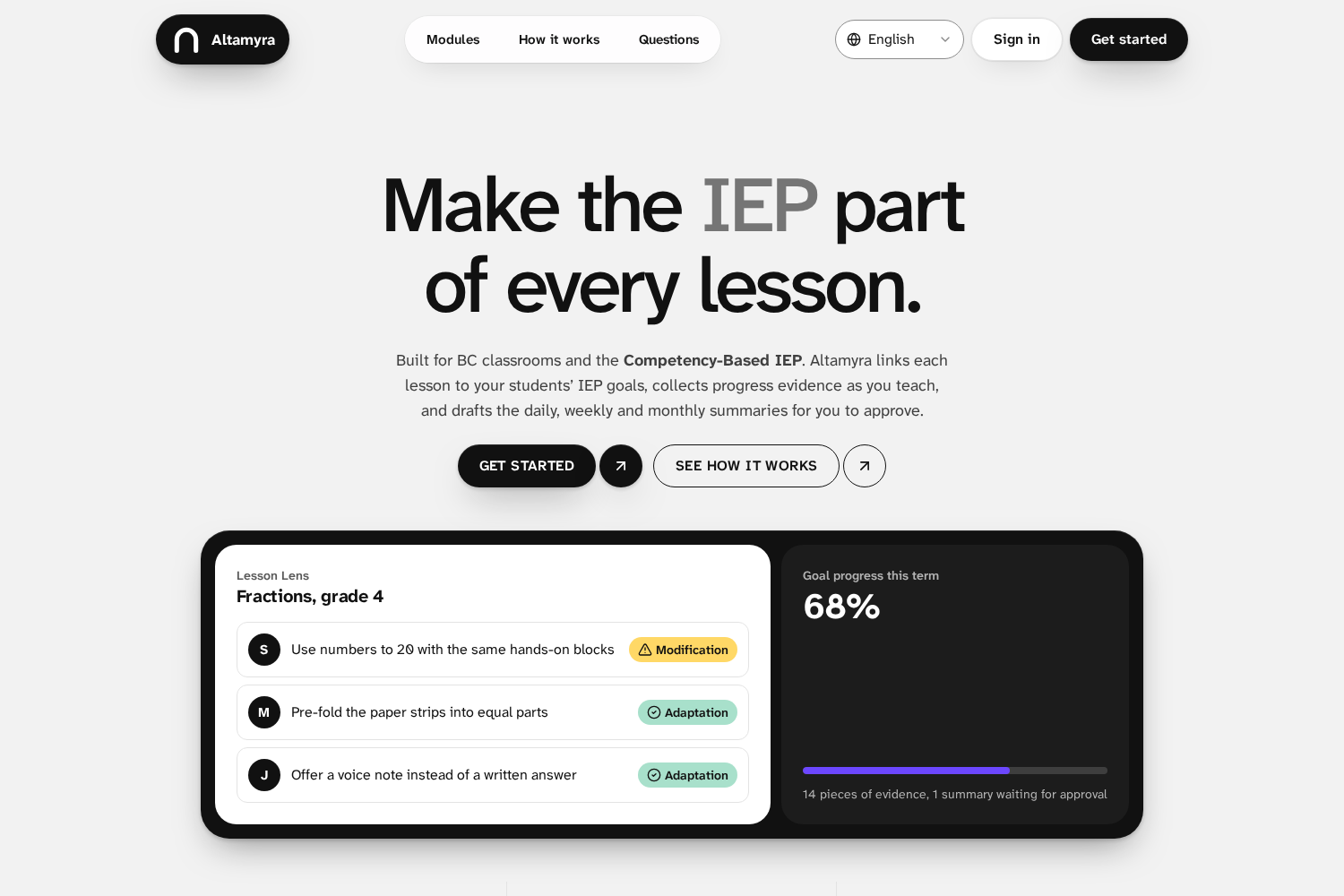
More than $5,000 is dedicated to each IEP student in Canada on average. Altamyra helps make that investment count — using AI to personalize lessons, track measurable progress, and connect educators, EAs, and families through one intelligent platform.
Let's make every dollar count.
Awards
Best Problem-Solution Fit
For students with special needs, having an Individualized Education Plan (IEP) does not always translate into individualized support in the classroom. An IEP is a personalized learning plan that outlines a student's unique learning needs, goals, and the accommodations or supports required to help them succeed in school.
In British Columbia, IEPs are typically developed and reviewed annually through MyEducation BC, yet teachers and education assistants (EAs) must continuously adapt lessons, monitor progress, and coordinate support across changing staff. Much of this relies on memory, manual documentation, and fragmented communication.
Furthermore, limited time and resources often lead to infrequent or inadequate progress tracking, making it difficult for educators to accurately assess student development, identify learning gaps, and adjust individualized support. As a result, students may miss opportunities to receive timely interventions and reach their full learning potential.
The need is growing. According to BC Ministry of Education data, students with disability or diverse-ability designations increased from 10.5% of public school enrolment in 2015/16 to 14.3% in 2025/26, while autism designations more than tripled.
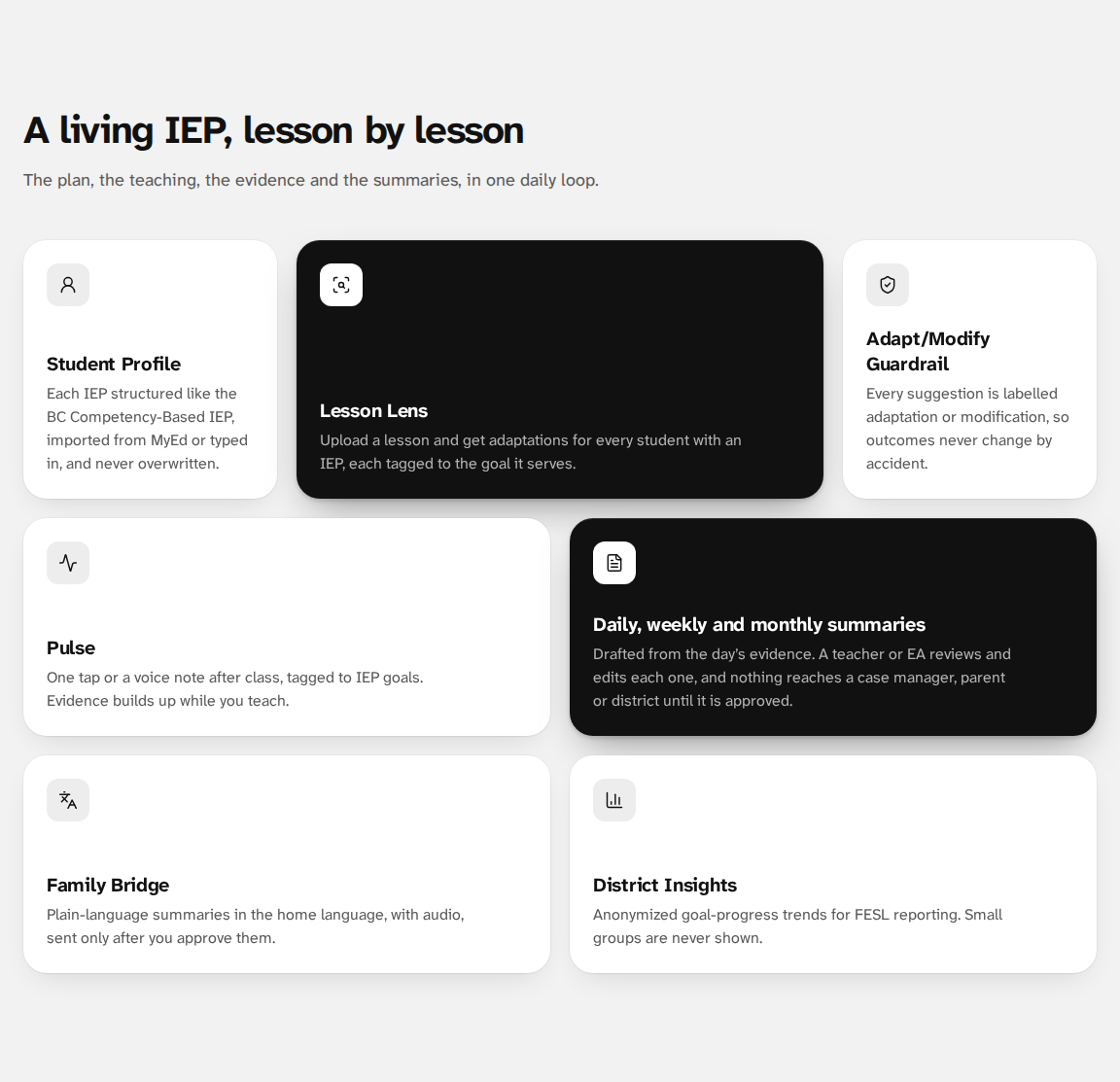
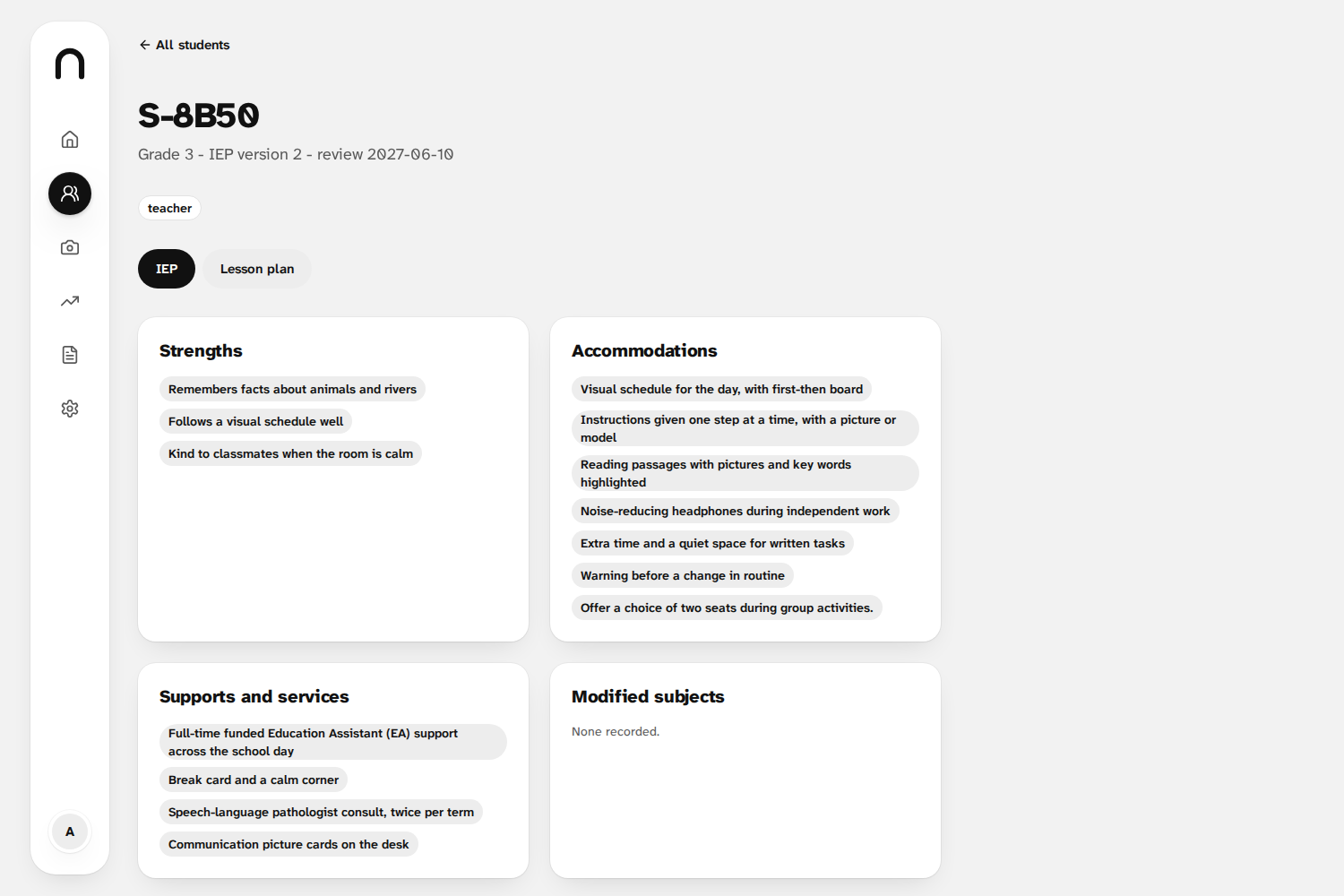
Altamyra bridges the gap between IEPs and everyday classroom learning through two core features:
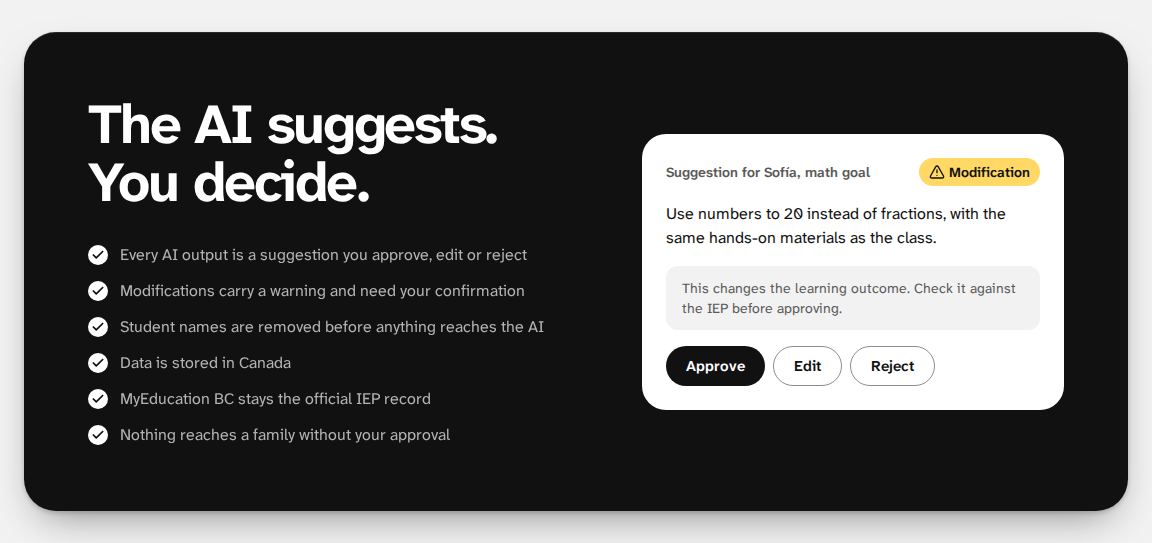
1. AI-powered lesson augmentation: Teachers upload existing materials, including PDFs, DOCX files, presentations, or photos of worksheets. Altamyra compares each lesson against students' IEP goals and generates ready-to-use adaptations, such as simplified instructions, chunked activities, and visual supports. Teachers can review and approve these materials, or reject them but keep these ideas in mind, all in one workflow, as we believe that AI should assist, not replace, educators.
2. Evidence-based progress tracking: Altamyra connects IEP goals to measurable indicators such as accuracy, frequency, and independence, automatically collecting evidence through:
- Coded worksheets: Educators photograph completed worksheets, which AI associates with the correct student and goal and scores against an answer key.
- EA-assisted mode: EAs quickly record observations, prompt levels, and behavioural indicators.
- Student mode: Students complete adapted activities with personalized learning supports applied automatically.
All evidence contributes to a shared progress timeline accessible to authorized educators, preserving valuable learning context across teachers, school years, and school transitions.
Our solution is designed around the people who will use it: less administrative work for educators, more consistent individualized support for students, and better-informed decisions about each child's learning.
Community Impact
Every student deserves an equitable opportunity to learn, regardless of their abilities or the resources available in their classroom.
Altamyra aims to make individualized education more accessible and sustainable for BC's growing community of students with disabilities and special learning needs.
For students, this means more consistent access to personalized learning materials, with progress measured over time so educators can identify what works and adjust support accordingly.
For teachers and education assistants, it means less time spent adapting worksheets, recording observations, and preparing progress reports, freeing up valuable time for direct student interaction and instruction.
For families and schools, shared progress records and future multilingual updates can improve communication, preserve continuity between educators, and make students' achievements more visible.
Starting with BC classrooms, Altamyra has the potential to scale across school districts and educational systems nationally and worldwide facing similar challenges with a system similar to the IEP.
Our vision is simple: a future where every student's unique educational needs are met, every educator is empowered to make a difference, and no child is left behind because the support they deserve was too difficult to deliver. All children deserve to succeed.
How we used DeepSpace
DeepSpace powers Altamyra’s full stack in one deployment. It combines our React interface and Hono API in a Cloudflare Worker, with Google/GitHub authentication, signed JWTs, real-time WebSocket updates, and SQLite Durable Objects.
We use separate Durable Objects for schools, students, and de-identified district insights, with server-enforced roles and per-student permissions. DeepSpace also handles scheduled jobs, agent tools, infrastructure provisioning, and deployment to app.space.
This let us focus the hackathon on helping educators support students instead of assembling authentication, databases, real-time infrastructure, and hosting ourselves.
Full Detailed Info
Inspiration
For students with special needs, having an Individualized Education Plan (IEP) does not always translate into individualized support in the classroom. An IEP is a personalized learning plan that outlines a student's unique learning needs, goals, and the accommodations or supports required to help them succeed in school.
In British Columbia, IEPs are typically developed and reviewed annually through MyEducation BC, yet teachers and education assistants (EAs) must continuously adapt lessons, monitor progress, and coordinate support across changing staff. Much of this relies on memory, manual documentation, and fragmented communication.
In addition, learning progress tracking for these students is infrequent or of low quality due to limitations in resources and time, which is hindering the quality of their learning and the adaptations needed to help them learn at their full-potential.
The need is growing. According to BC Ministry of Education data, students with disability or diverse-ability designations increased from 10.5% of public school enrolment in 2015/16 to 14.3% in 2025/26, while autism designations more than tripled.
We built Altamyra around a simple belief: every student with special needs deserves learning support tailored to their individual needs, without placing additional burdens on teachers and education assistants alike.
What it does
Altamyra bridges the gap between IEPs and everyday classroom learning through two core features:
1. AI-powered lesson augmentation: Teachers upload existing materials, including PDFs, DOCX files, presentations, or photos of worksheets. Altamyra compares each lesson against students' IEP goals and generates ready-to-use adaptations, such as simplified instructions, chunked activities, and visual supports. Teachers can review and approve these materials in one workflow.
2. Evidence-based progress tracking: Altamyra connects IEP goals to measurable indicators such as accuracy, frequency, and independence, automatically collecting evidence through:
- Coded worksheets: Educators photograph completed worksheets, which AI associates with the correct student and goal and scores against an answer key.
- EA-assisted mode: EAs quickly record observations, prompt levels, and behavioural indicators.
- Student mode: Students complete adapted activities with personalized learning supports applied automatically.
All evidence contributes to a shared progress timeline accessible to authorized educators, preserving valuable learning context across teachers, school years, and school transitions.
Our guiding principle is simple: progress tracking should happen naturally through learning, not through additional paperwork.
How we built it
Altamyra is a full-stack TypeScript app built with DeepSpace and deployed on Cloudflare Workers. The frontend uses React, while Hono handles API and WebSocket routes. Data lives in a SQLite-backed RecordRoom, with row ownership and server-side role-based access controls isolating each teacher’s records.
For Lesson Lens, a server action loads the teacher’s class, replaces student names with anonymous labels such as “Student A,” hashes the teacher ID, and sends only the required lesson and goal context to a Node agent hosted on Maritime. The agent uses Google Gemini to generate structured adaptations and modifications, with a rules-based fallback when the model is unavailable.
Model responses are validated against known students and goals before being saved as pending suggestions. Teachers must approve or reject every recommendation. Direct identifiers are removed before AI calls, data is stored in Canada, and server-enforced access controls support privacy planning for BC schools, including considerations under FIPPA.
Challenges we ran into
Our biggest challenge was ensuring Altamyra reduced educators' workloads rather than adding another administrative task. We designed workflows around a target of under 2 minutes of daily interactions per IEP student for teachers, and under 1 minute for EAs.
Another challenge was AI scoring reliability, particularly with handwritten responses. We addressed this through confidence thresholds, human review queues, and sampled verification, targeting 90% AI-teacher scoring agreement before enabling broader automatic confirmation.
We also had to balance quantitative progress monitoring with professional judgment. Numbers can reveal learning trends, but they cannot capture everything about a student. Altamyra therefore keeps educators responsible for final assessments and instructional decisions.
Finally, protecting sensitive student information required carefully designed permissions, consent gates, and restricted student-facing views.
Accomplishments that we're proud of
We're particularly proud of designing an end-to-end workflow connecting personalized lesson adaptations directly to measurable learning outcomes.
Our key accomplishments include:
- Under-5-minute lesson adaptation target: A streamlined upload-and-review workflow designed to adapt one lesson for all IEP students in a class.
- "Confirm by exception" architecture: AI prepares adaptations and progress data while educators focus on reviewing uncertain results instead of duplicating work.
- Coded worksheet integration: Connecting traditional paper-based classroom activities to structured progress monitoring without manual student or goal selection.
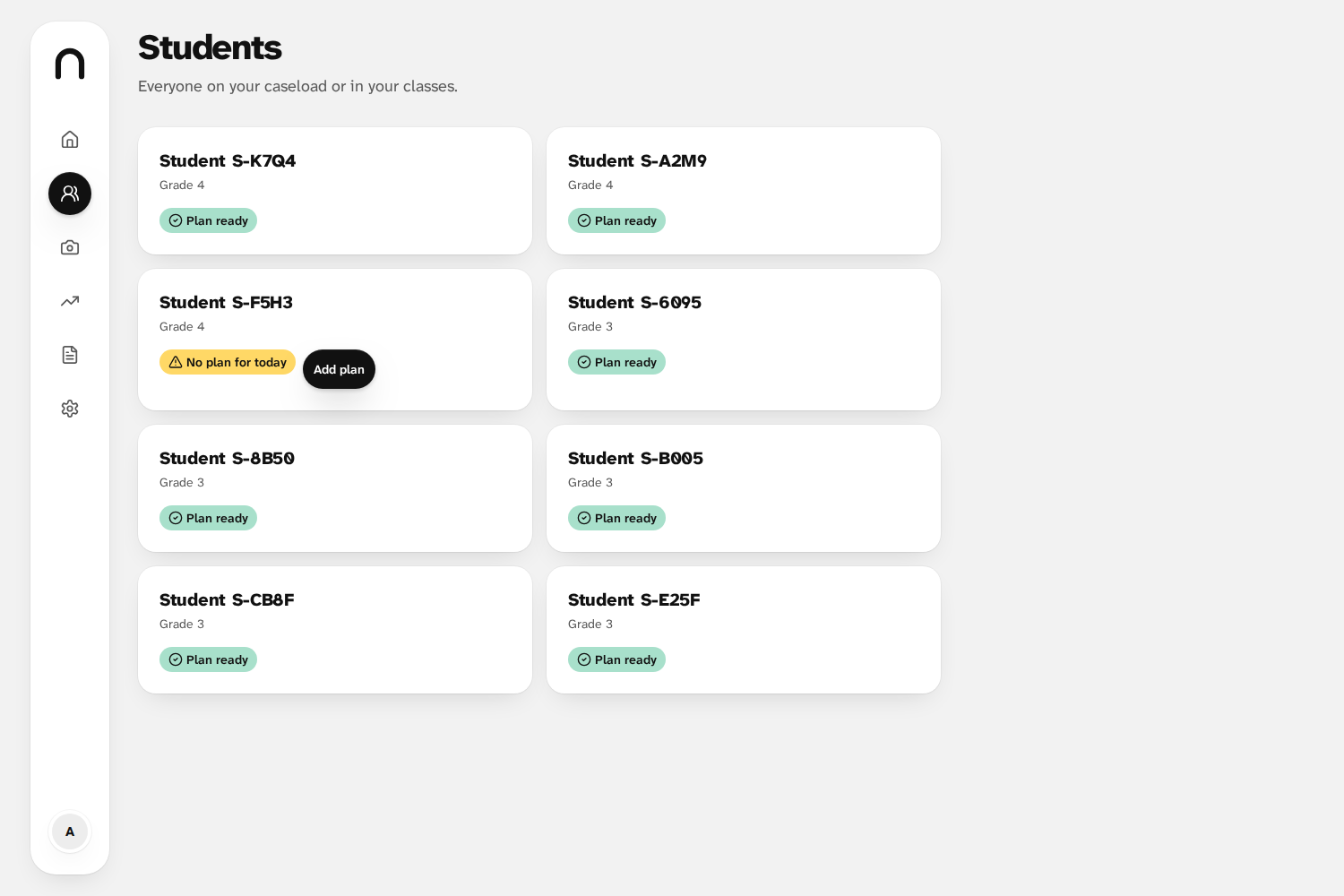
- Role-based permissions: Designing access boundaries for case managers, teachers, EAs, students, and guardians to protect sensitive information.
Together, these features demonstrate how AI can support individualized education without disrupting existing classroom practices.
What we learned
Our biggest takeaway was that effective educational technology should eliminate work, not merely digitize it. Even sophisticated AI tools can become burdens if they require educators to interrupt teaching or repeatedly enter information.
We also learned the value of continuous, evidence-based progress monitoring. Rather than relying on end-of-term recollection, frequent measurements can help educators identify trends and adjust instructional strategies, as described in the IRIS Center's progress-monitoring resources.
Most importantly, we learned that AI should assist, not replace, educators. It can generate suggestions, organize evidence, and draft reports, but final educational decisions must remain in human hands.
What's next for Altamyra
We plan to expand Altamyra in three directions:
- Advanced progress tracking: Introduce rate, duration, latency, and rubric-based measurements, with automatic rubric scoring gated by demonstrated 90% AI-teacher agreement.
- Family Bridge: Provide educator-approved, plain-language progress summaries in families' preferred languages, including audio, through a dedicated Parent/Guardian mode.
- District Insights: Develop dashboards showing aggregated student progress and adaptation trends, with small-group suppression for fewer than 10 students, to support reporting under BC's Framework for Enhancing Student Learning.
Our vision is simple: a future where every student's unique educational needs are met, every educator is empowered to make a difference, and no child is left behind because the support they deserve was too difficult to deliver.
Built With
- antigravity
- cloudflare
- deepspace
- entire
- gemini
- hono
- maritime
- react
- sqlite
- tailwindcss
- typescript
- vite
- vitest
- zod


