-
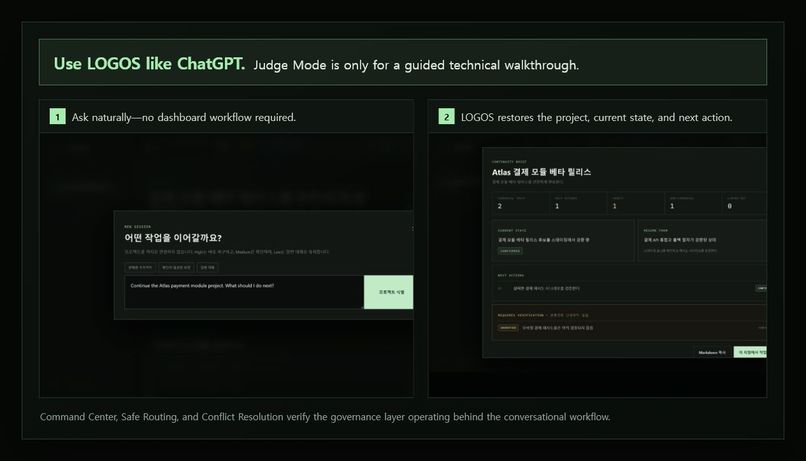
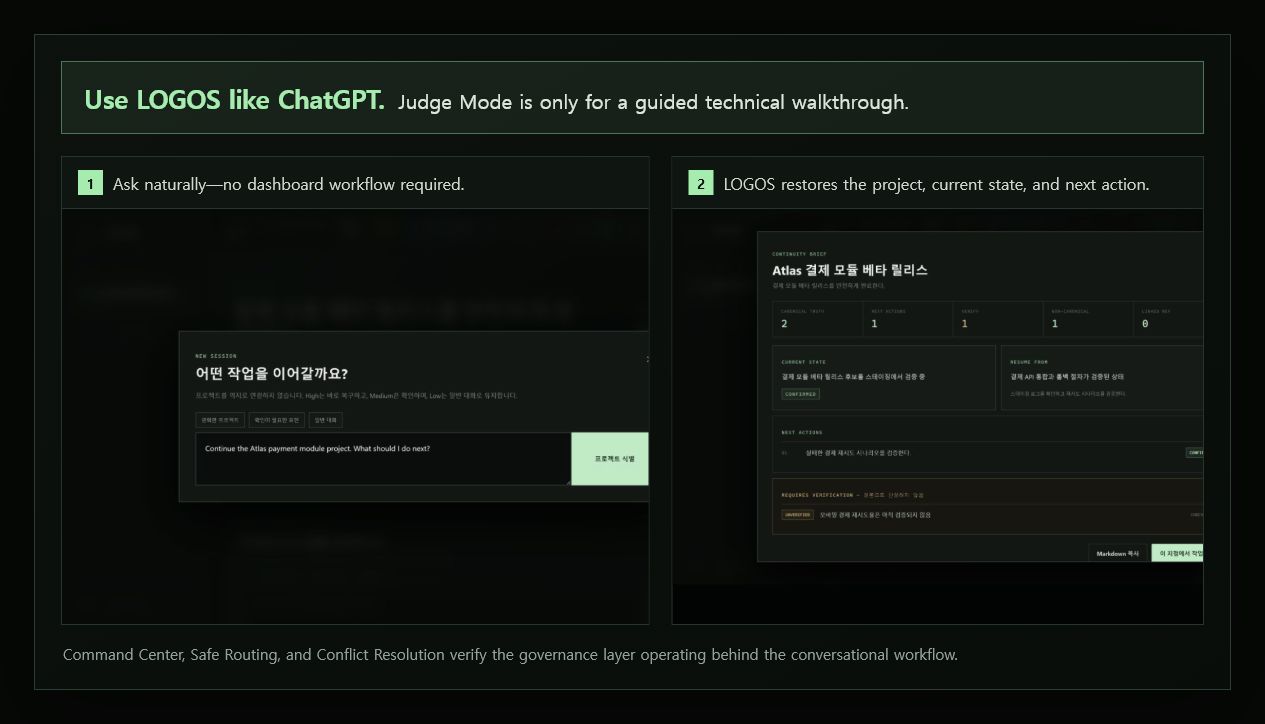
Ask LOGOS naturally. It identifies the project and restores current state and next actions; Judge Mode is a guided technical walkthrough.
Inspiration
What it does
How we built it
Challenges we ran into
Accomplishments that we're proud of
What we learned
What's next for LOGOS Continuity
Inspiration
AI assistants are increasingly used for projects that span days, weeks, and many separate conversations. The most damaging failure is not simply forgetting a detail. It is remembering something with the wrong authority: treating an old state as current, a possibility as a decision, or an unverified claim as completed work.
What it does
LOGOS Continuity adds an explicit continuity layer for long-running AI work. It identifies the intended project from natural language, assembles an authority-ordered Continuity Brief, and keeps Project Truth, Current State, Next Actions, Exploration, and the Active Checkpoint separate.
GPT-5.6 performs structured project recognition and statement classification. Deterministic local rules prevent model output from directly changing canonical state. When information conflicts with existing truth, the user explicitly chooses to keep the canonical decision, apply a temporary exception, or approve a new canonical decision. Every committed change records its before state, after state, reason, verification state, and provenance.
Linked-project context remains reference-only until explicitly promoted, and provenance drift is detected when the original source later changes. A Continuity Command Center ranks the most urgent continuity risks across projects, while a seven-step Judge Mode demonstrates the complete workflow in under three minutes.
How we built it
The application uses React, TypeScript, Vite, Node.js 24, and the built-in SQLite engine. GPT-5.6 is called through the OpenAI Responses API for project recognition and safe structured classification. A deterministic domain service enforces approval gates, verification states, conflict handling, project structure, archive rules, provenance promotion, drift detection, and context authority.
The app is packaged with Docker and deployed on Render. A portable judge build can also run without npm, pnpm, a build step, or an API key.
How we used Codex
Codex accelerated schema and state-machine design, API and UI implementation, GPT-5.6 integration, automated safety tests, browser QA, Docker deployment, portable packaging, and submission tooling. The collaboration was iterative: the human defined the product problem, safety principles, conflict semantics, track, priorities, and demo narrative; Codex implemented and validated those decisions, surfaced defects, and proposed focused fixes.
One concrete example occurred during the public Judge Mode rehearsal. Codex detected that the guide panel covered a modal action button at a common recording viewport, traced the issue to stacking order, implemented a minimal CSS fix, ran all tests and the production build, deployed it, and verified the corrected public UI.
How we used GPT-5.6
GPT-5.6 has a meaningful runtime role. It identifies the intended project from a natural-language request and classifies new statements into safe structured destinations such as Exploration, Truth proposal, Current State proposal, or Next Action proposal. The model returns confidence and rationale, but its outputs remain advisory. Deterministic rules and explicit human approval control canonical commits.
Challenges
- Designing useful memory without allowing uncertain model output to become truth.
- Separating authority, verification, and operational state without overwhelming the user.
- Handling conflicts without forcing an automatic winner.
- Demonstrating a complex continuity model clearly in less than three minutes.
- Providing a live GPT path and a reproducible safe fallback.
Accomplishments
- Built a complete public product experience rather than a static prototype.
- Implemented approval-gated canonical transactions and three-way conflict resolution.
- Added provenance-aware context promotion and drift monitoring.
- Created a portfolio-level continuity risk Command Center.
- Passed 54 automated tests and a full public browser rehearsal.
What we learned
Reliable AI continuity is not primarily a retrieval problem. It is an authority problem. A system must know which information is canonical, current, speculative, or awaiting human approval. GPT-5.6 is most valuable when it helps interpret intent and structure information while deterministic rules protect the state boundary.
What's next
- Durable multi-user storage and authentication.
- Long-term history compression.
- Deeper integrations with AI workspaces and project tools.
- User studies measuring recovery accuracy and time saved.
- Cross-model continuity while preserving the same authority rules.
Try it
To use LOGOS normally, wait for the free Render instance to wake if needed, confirm the GPT-5.6 LIVE badge, open New Session, and enter a natural-language request. Judge Mode is an optional guided technical walkthrough for reviewers. No account, payment, or API key is required.
Built With
- codex
- docker
- gpt-5.6
- node.js
- openai-responses-api
- react
- render
- sqlite
- typescript
- vite

Log in or sign up for Devpost to join the conversation.