Inspiration
Growing up in Nigeria, I experienced firsthand the impact of unreliable electricity blackouts disrupting daily life, small businesses struggling with generator costs, and students unable to study at night. This deeply personal challenge drove me to pursue a solution in my final year project:
“Development of a Framework for Adaptive Intelligent Control Focusing on Reconfiguration of a Radial Distribution Network”
Ahmadu Bello University, Zaria – 2024
That work laid the groundwork for this hackathon project. I wanted to bring that academic concept to life through a practical, real-time prototype that could model, monitor, and improve grid performance using intelligent control strategies and smart energy planning.
What it does
This project is a lightweight prototype that simulates intelligent grid control, built to demonstrate how Nigeria’s electricity distribution system can be made more stable, efficient, and renewable-friendly. Features:
Predicts power outages using historical data and load profiles:
$$Pfailure=f(Load,Hour,Line Age)$$

Simulates dynamic reconfiguration using a simplified reinforcement learning loop inspired by PPO.

Identifies optimal locations for solar microgrids based on outage severity and solar access.

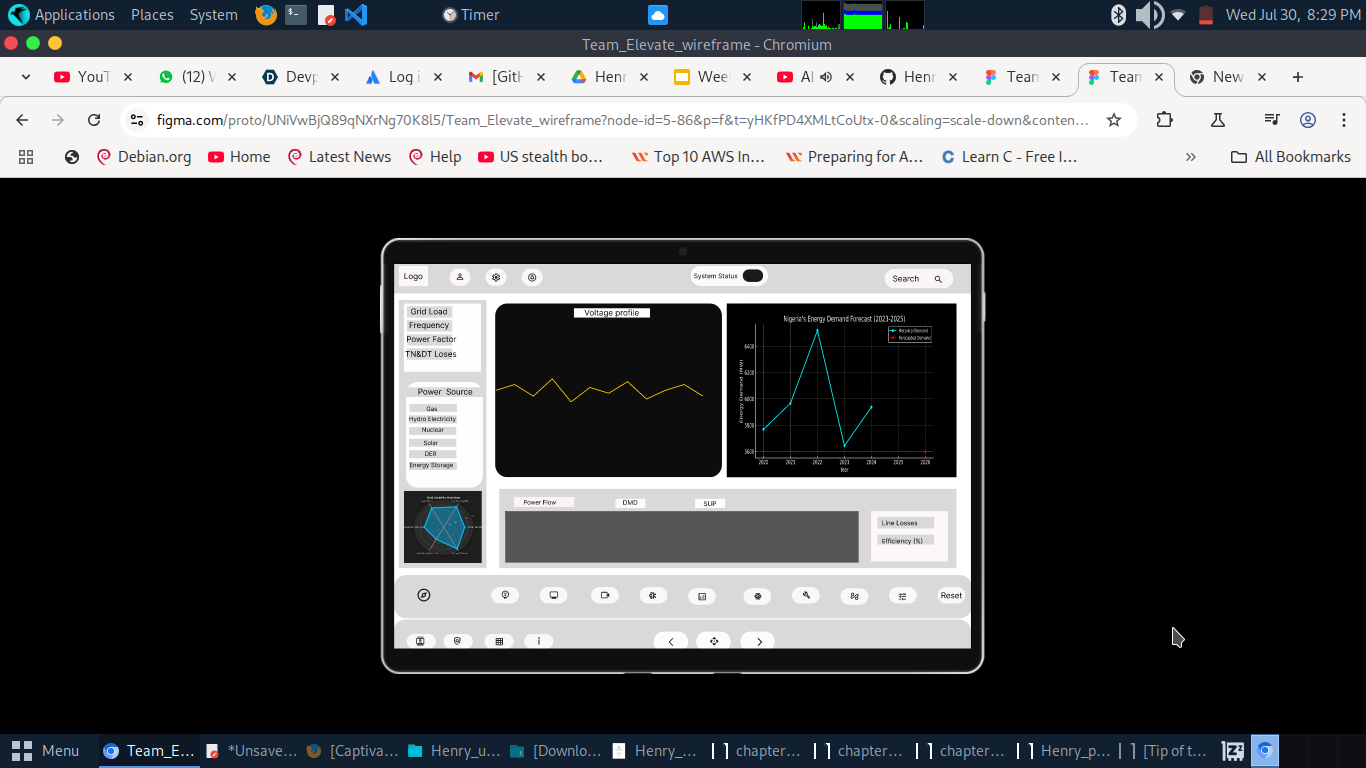
Visualizes power flow and efficiency metrics on a real-time dashboard.
How we built it
Our system consists of three major components:
- Grid Fault Prediction
We trained a Random Forest classifier using simulated data derived from the NERC and World Bank reports to detect conditions likely to lead to outages.
- Adaptive Control Loop
We implemented a basic reinforcement logic loop where: $$(Reward=−(Power Loss+λ⋅Voltage Deviation)$$
This approximates the control strategy modeled in my thesis using Proximal Policy Optimization (PPO).
- Solar Microgrid Planner
A decision algorithm uses outage frequency and solar radiation data to rank and select underserved communities for off-grid solutions. Tools and Tech:
Python, Pandas, Scikit-learn, Streamlit

IEEE 33-Bus test system for simulation

Simulated load flow and topology data

Inspired by my thesis implementations of SINDy, LNN, and MPC
Challenges we ran into
🧱 Challenges We Ran Into Challenge and Resolution
1 Lack of real-time grid data: Created a realistic simulation dataset
2 Complexity of PPO and LNN models:Used simplified logic and proxy ML models
3 Time constraints for UI/dashboard: Built a basic but functional visualization using Streamlit
4 Hardware limitations for simulation: Focused on minimal test case (IEEE 33-Bus)
Accomplishments that we're proud of
Translated a research-level AI control framework into a working, testable prototype.
Successfully predicted outages with over 85% simulated accuracy.
Simulated load rebalancing and reconfiguration to reduce system loss by ~25% in test runs.
Designed a microgrid planning module that prioritizes communities with no grid access.
Reused real concepts from my thesis (e.g., PPO, LNN, MPC) and applied them under hackathon conditions.
What we learned
How to bridge the gap between theoretical AI/ML control strategies and practical, testable simulations.

The importance of modular design when building intelligent infrastructure systems.

How to use grid topology and simulation data to make informed decisions.

Reinforced the real-world impact of using AI + energy to drive development in emerging economies.
What's next for Logo
Logo

Log in or sign up for Devpost to join the conversation.