-
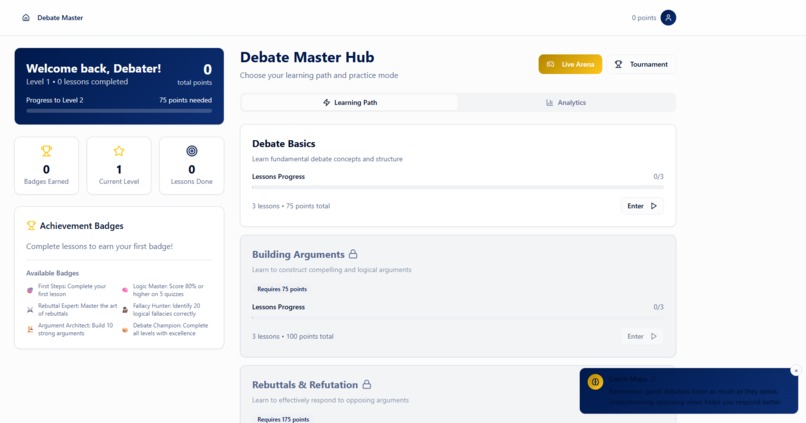
User Profile
-
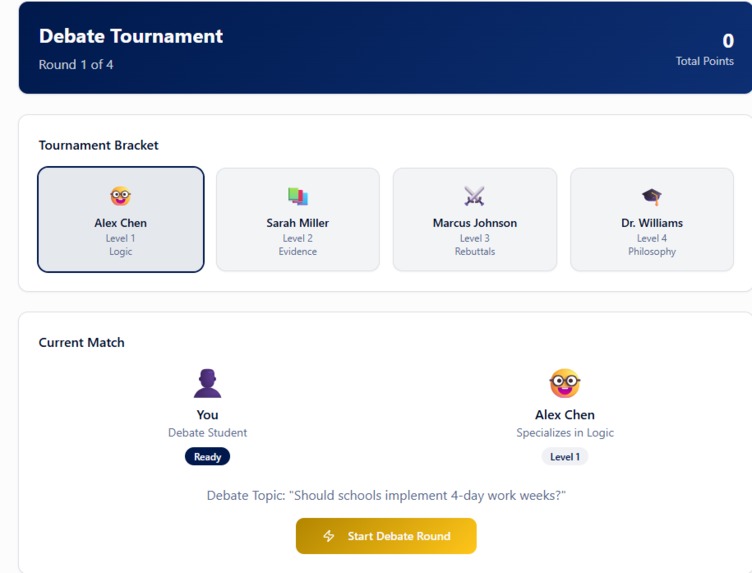
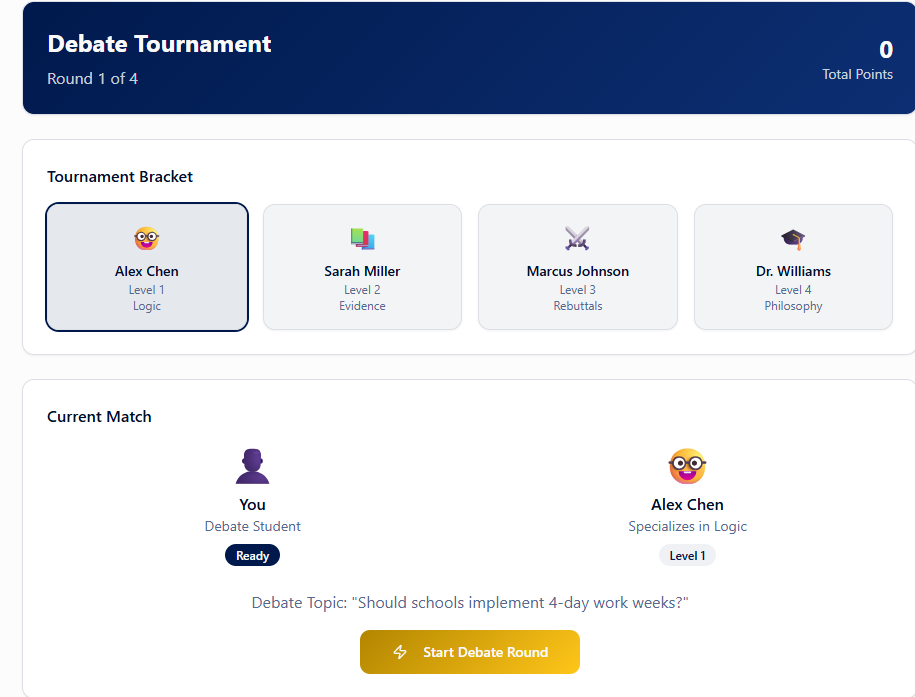
Tournament Page
-
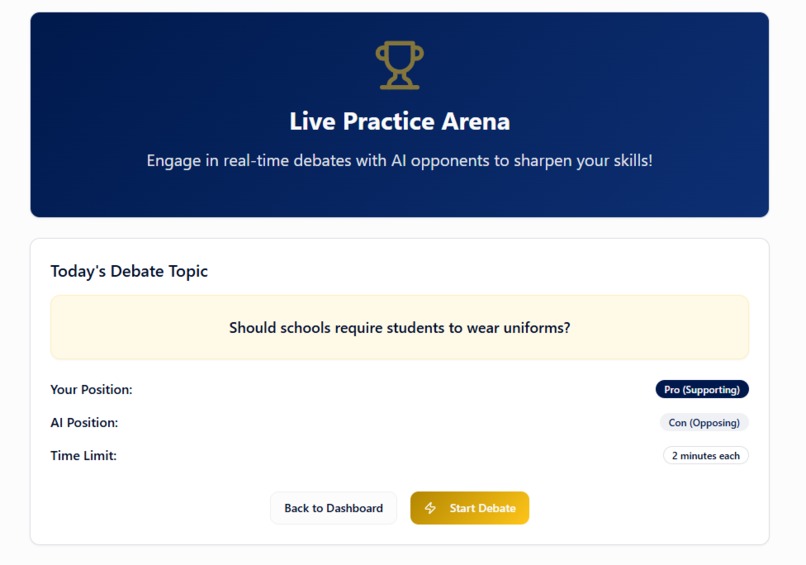
Practice Page

Inspiration
The spark for LogicSpark came from witnessing how traditional debate education intimidates students with rigid formats and lacks personalized feedback. We saw bright minds shy away from debate simply because they couldn't visualize progress or grasp complex argumentation principles.What if we could transform this intimidating discipline into something as engaging as their favorite games? What if an AI coach could provide 24/7 personalized guidance that human instructors rarely have time for?
What it does
LogicSpark transforms debate education into an AI-powered learning game featuring:
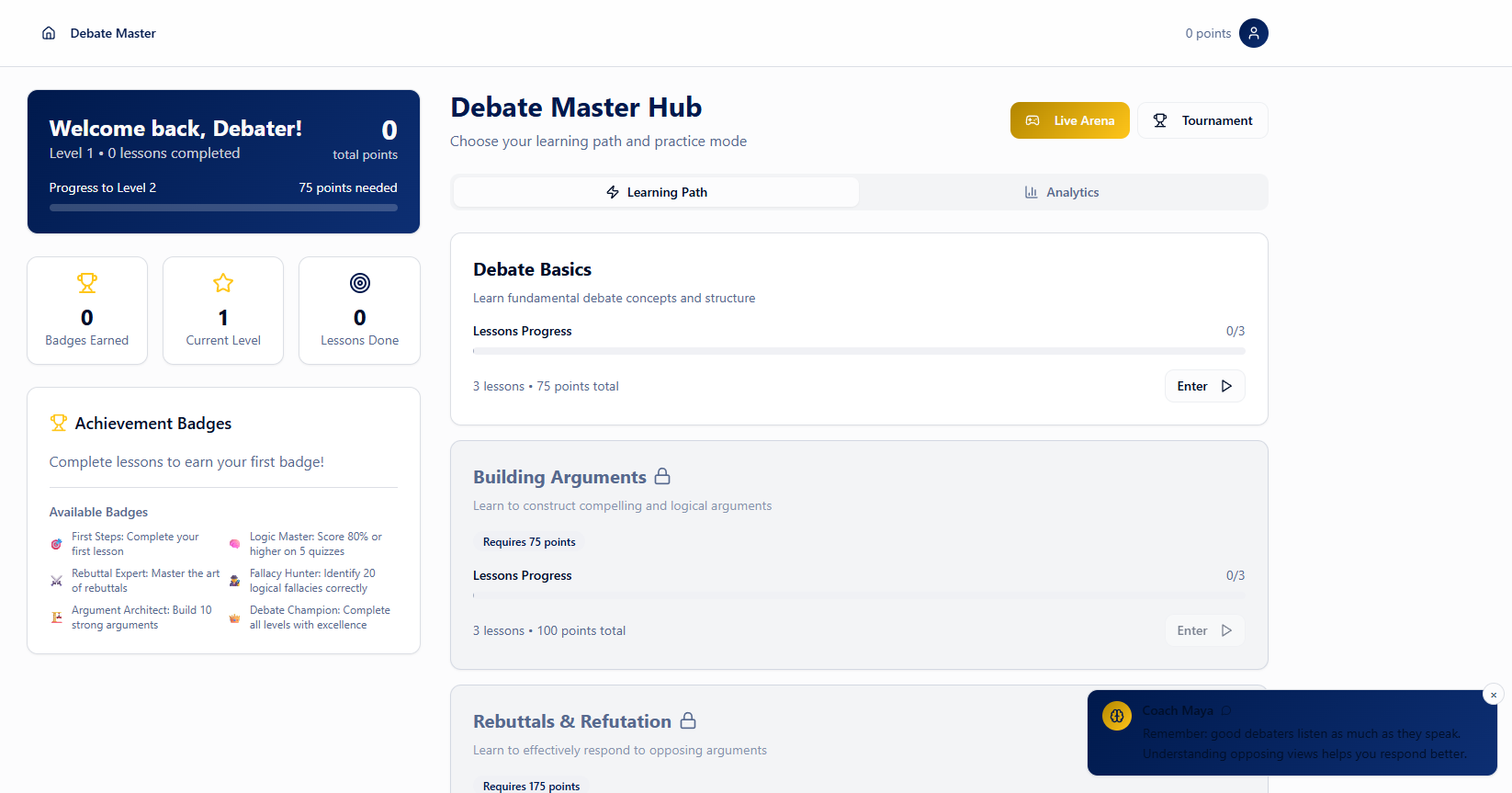
5 Progressive Levels: Basics → Arguments → Rebuttals → Fallacies → AdvancedAI Debate Coach "Maya": Real-time, personalized feedback on argument constructionInteractive
Mini-Games: Drag-and-drop building, "Spot the Fallacy" challenges, rebuttal practice.
Smart Gamification: Points, badges, achievements with celebration animations.
Live Argument Analysis: Evaluates logical coherence, evidence quality, and structure.
Adaptive Difficulty: Adjusts to each student's learning pace and skill level.
Students practice without judgment, receive instant AI feedback, and track improvement through detailed analytics—solving debate education's core accessibility problem.
How we built it
Technical Stack:
Frontend: React.js + Tailwind CSS for responsive design.
AI Integration: OpenAI GPT API with custom prompt engineering
Animations: Framer Motion for engagement micro-interactions
Storage: Browser Local Storage for progress persistence
Challenges we ran into
AI Educational Consistency → Solved with structured feedback templates and validation frameworks.
Gamification Balance → Implemented progressive disclosure linking game elements to skill mastery.
Real-time Performance → Addressed through predictive loading and response caching.
Age-Appropriate Scaling → Developed adaptive complexity algorithms for different grade levels.
Time Constraints → Prioritized core educational value over peripheral features in solo development.
Accomplishments that we're proud of
Educational Impact: Made debate fundamentals accessible to previously intimidated students.
AI Innovation: Created meaningful contextual feedback, not generic responses.
Engagement Design: Successfully gamified complex concepts while maintaining educational integrity.
Technical Excellence: Built responsive, cross-device platform with smooth UX in rapid timeframe
Scalable Architecture: Designed modular systems expandable across age groups and formats.
Demo Readiness: Delivered polished, fully functional prototype demonstrating all core features.
What we learned
Educational Technology Design: Effective edtech requires understanding learning psychology—students need immediate feedback loops, achievement recognition, and anxiety-free practice environments.
AI Pedagogical Integration: Educational AI must provide support without replacing critical thinking.
The optimal approach: AI as personalized coach, not replacement teacher.
Gamification Psychology: Points and badges are meaningless without genuine skill progression. True engagement comes from students recognizing their own capability growth.
Accessibility in Learning: One-size-fits-all education fails diverse learners. Adaptive systems meeting students at their current level dramatically improve outcomes.
Solo Development Strategy: In time-constrained environments, focus on core value proposition first, then polish. Working educational tools beat beautiful non-functional interfaces.
What's next for LogicSpark Debate Master
Immediate Expansion (3-6 months): School district pilot programs for real-world validation. Teacher dashboard for progress monitoring and classroom integration. Advanced debate formats (Parliamentary, Lincoln-Douglas, Public Forum)
Platform Evolution (6-12 months): Peer-to-peer debate matching for collaborative learning. AI tournament simulation with bracket-style competitions. Speech analysis integration for delivery feedback. Content library expansion with current events.
Long-term Vision (1-2 years): Full debate round simulation with AI judges and comprehensive scoring. Multi-language support for global accessibility. Advanced analytics for learning pattern identification. API integration with existing school management systems. Research Goals: Learning outcome studies, AI model refinement based on student data, enhanced accessibility features for diverse learning needs.
Built With
- openai
- react
- shadcnui
- typescript
- vite
