-
-
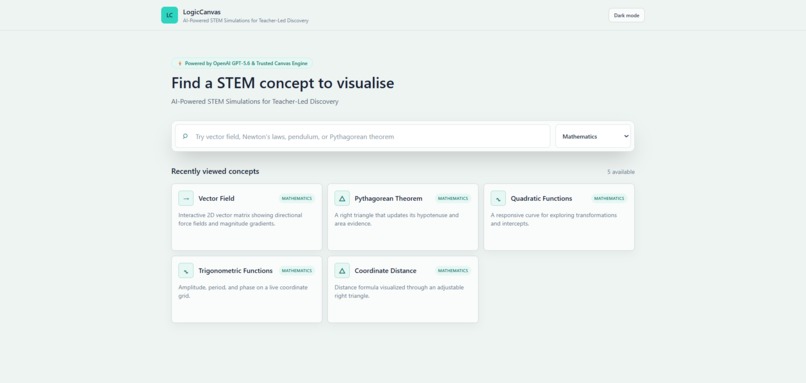
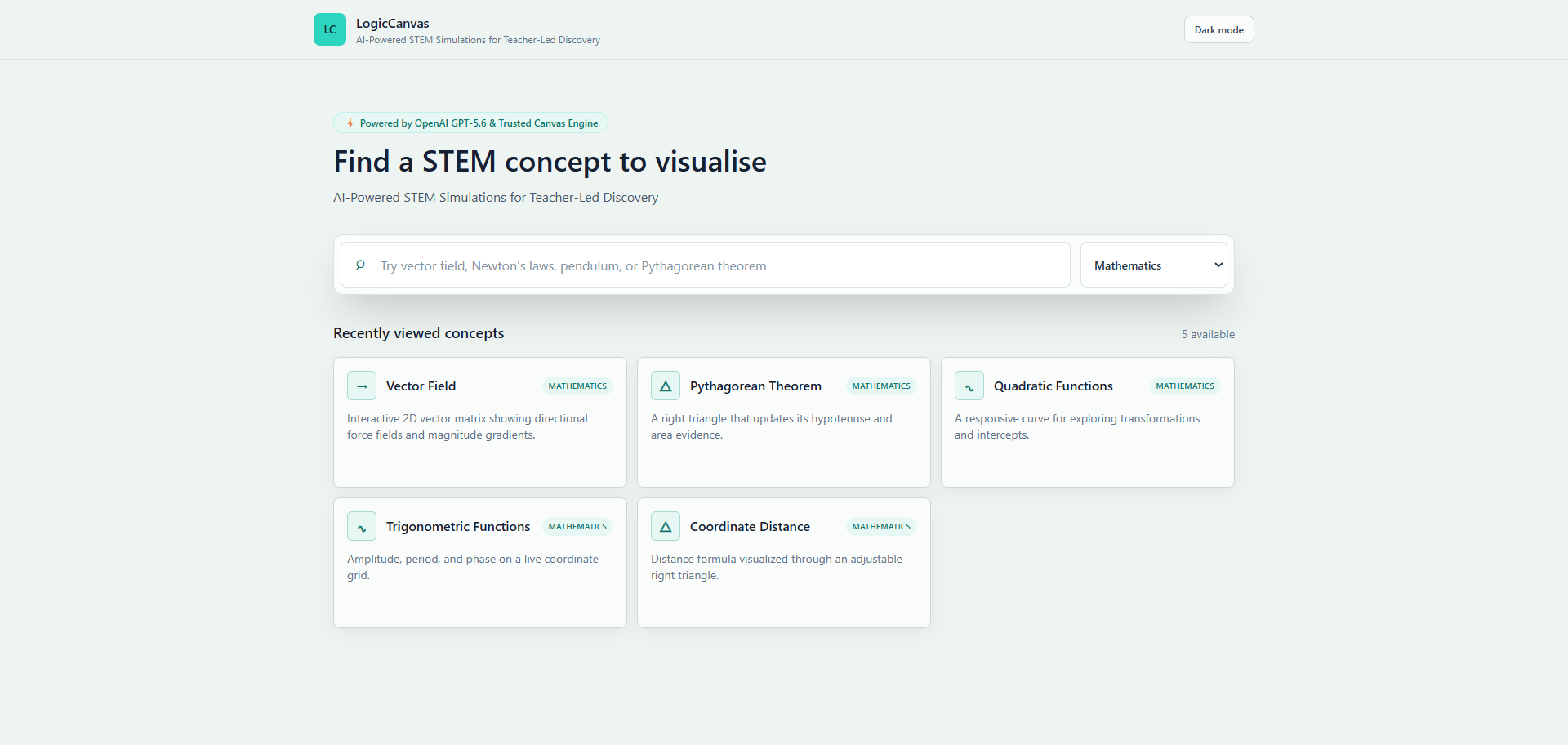
Homepage
-
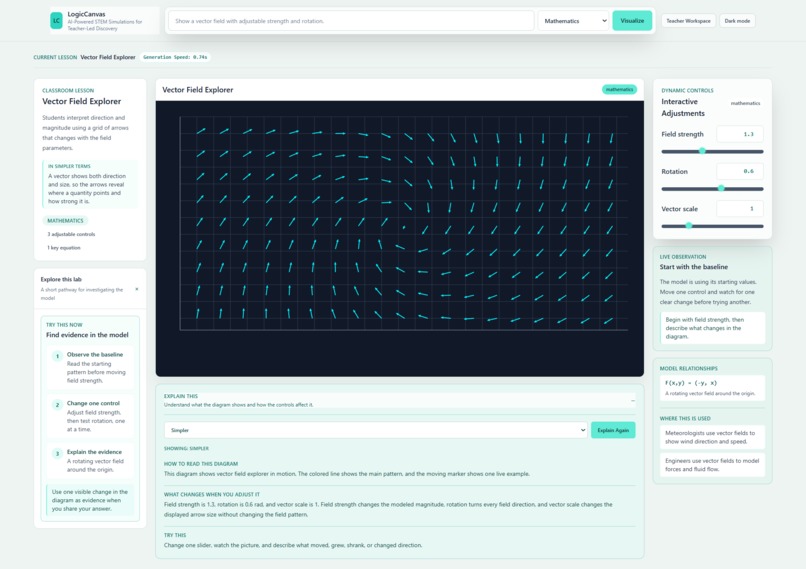
Classroom mode
-
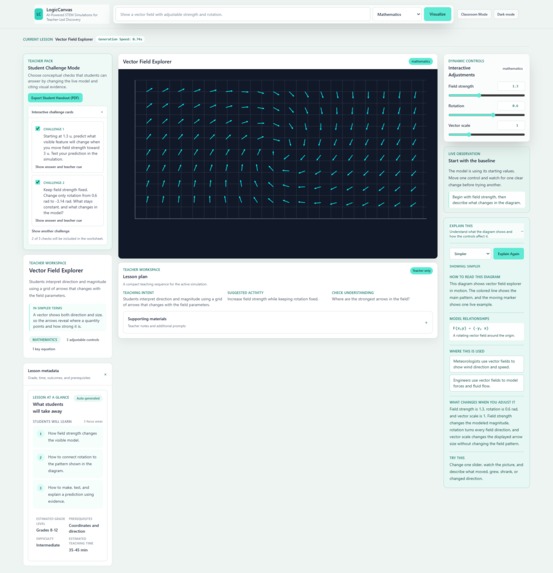
Teacher workspace
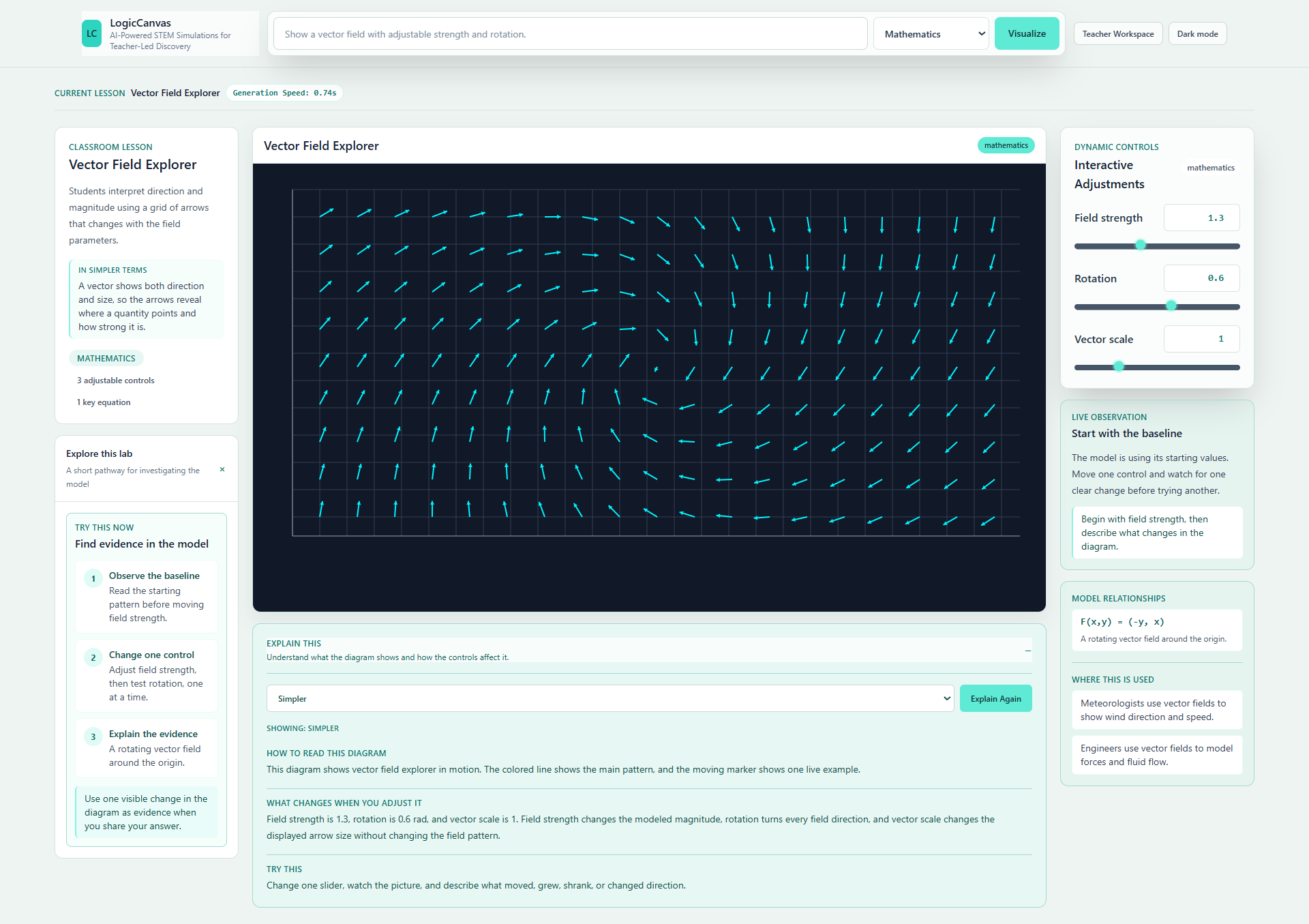
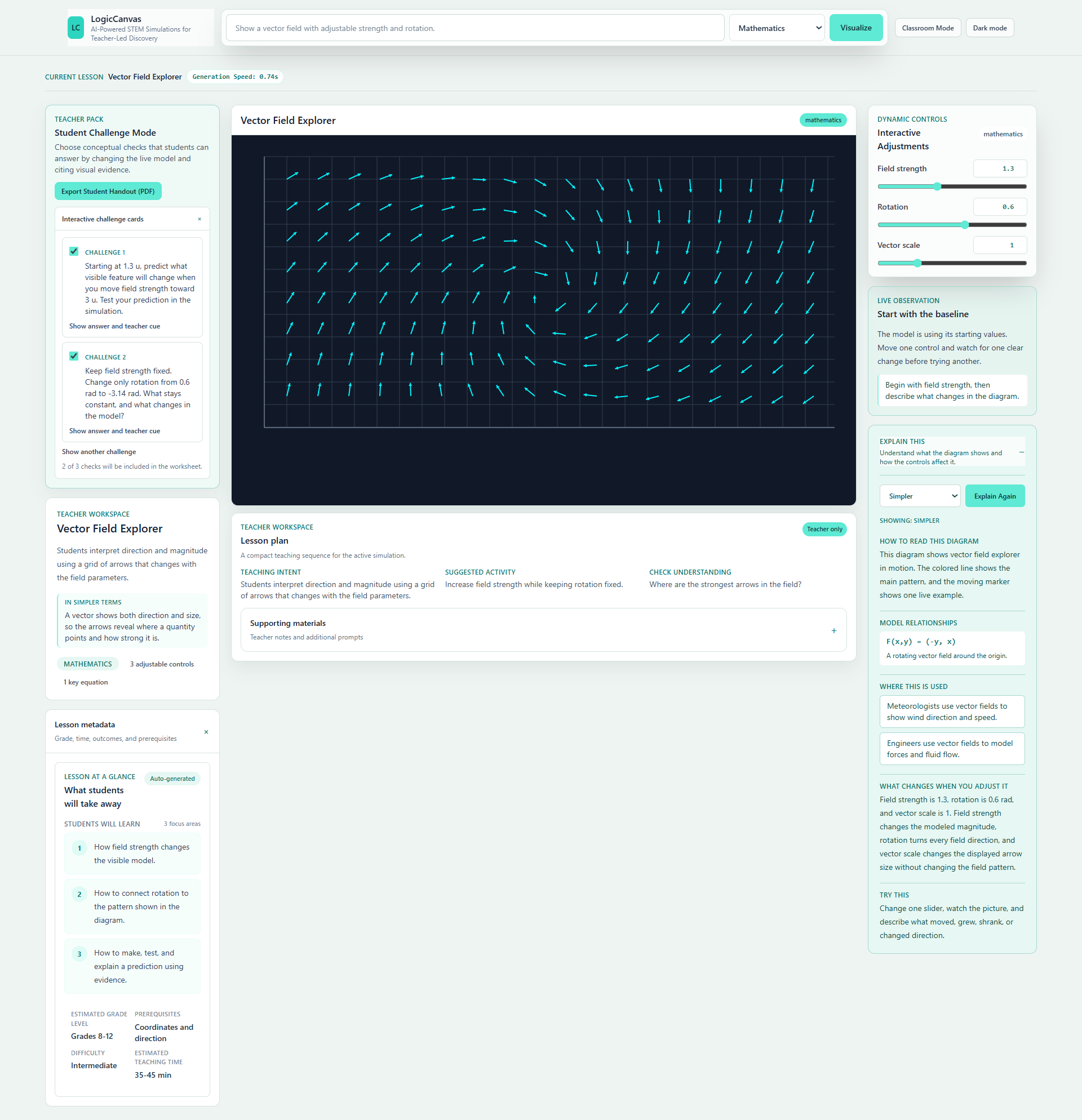
Project Name: LogicCanvas
LogicCanvas helps teachers turn difficult STEM concepts into interactive visual lessons.
A teacher selects or describes a concept such as projectile motion, Snell's law, Newton's laws, circuits, pendulums, vectors, or the Pythagorean theorem. LogicCanvas presents a live visual model with meaningful controls, equations, guided explanations, student challenges, and classroom-ready lesson materials.
Why I built it
Many STEM concepts are taught as formulas before students can see what the formulas mean. Teachers often need separate tools for simulations, lesson planning, assessment prompts, and handouts. LogicCanvas brings these teaching tasks into one focused workspace.
Students change a control, observe the model respond, make a prediction, and explain the result using evidence from the visualization. Teachers can prepare a concept before class, reveal answer cues, address common misconceptions, and export a student handout.
The role of GPT-5.6, Zod, and Codex
GPT-5.6 is designed as LogicCanvas's scientific reasoning layer. It converts a teacher prompt into a structured visualization specification containing the STEM domain, controls, equations, learning objectives, misconceptions, and guided experiments.
Zod is the validation layer between AI reasoning and the simulation. It checks that the generated lesson data matches the exact expected structure and rejects invalid or unexpected fields before they can reach the visualization.
Codex compiles the validated specification into a trusted, self-contained visualization runtime. Reusable HTML5 Canvas renderers keep models fast and predictable, while the browser executes the simulation in a sandboxed iframe with loop guards.
For a reliable demo, the current UI uses curated lesson fixtures(mock data to highlight the capability of codex and gpt5.6). The repository also includes an optional GPT-5.6 structured-output endpoint for live reasoning integrations.
What makes it different
LogicCanvas is not just a simulation gallery. It is a teacher-led learning workflow:
- Teachers prepare a concept with challenges, teaching notes, assessment prompts, and printable lesson materials.
- Students investigate through live controls and immediate visual feedback.
- Explanations are tied directly to the active model and equations.
- Classroom and Teacher Workspace modes support instruction and lesson preparation without unnecessary complexity.
What I learned
The key design decision was separating scientific reasoning from rendering. GPT-5.6 produces validated educational data, while trusted reusable renderers create the visual model. This makes the experience safer, more factual, and more practical for classroom use.
In a production version, vetted STEM databases and digital textbooks can provide retrieval-grounded context for GPT-5.6. This would help teachers generate reliable, curriculum-aligned visual lessons faster, giving them more time to teach while helping students investigate complex concepts with confidence. Developed with Codex, Model: Combination of Gpt5.6 Tierra and Luna Effort: Light to Medium to High Effort for cost and credit optimisation.
Built With
- codex
- github
- gpt-5.6
- gpt5.6
- html5
- javascript
- node.js
- openai-api
- openai-javascript-sdk
- react
- sandboxed-iframe
- tailwind-css
- zod


Log in or sign up for Devpost to join the conversation.