-
-
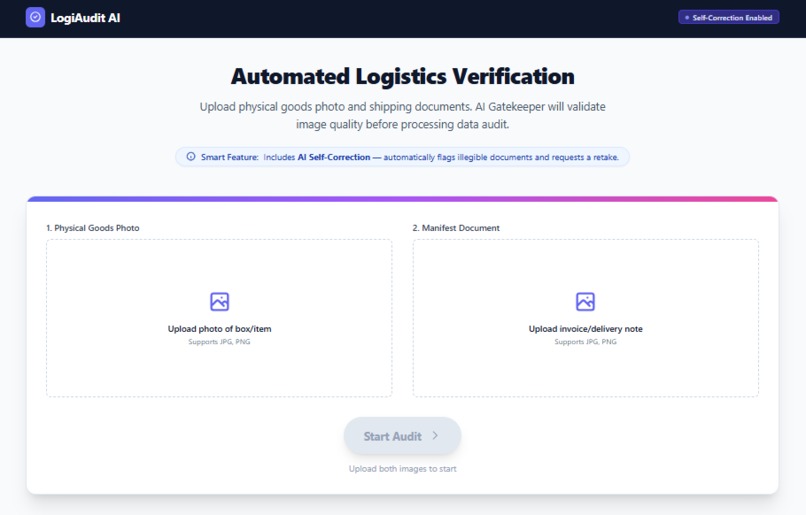
LogiAudit AI - Web Interface
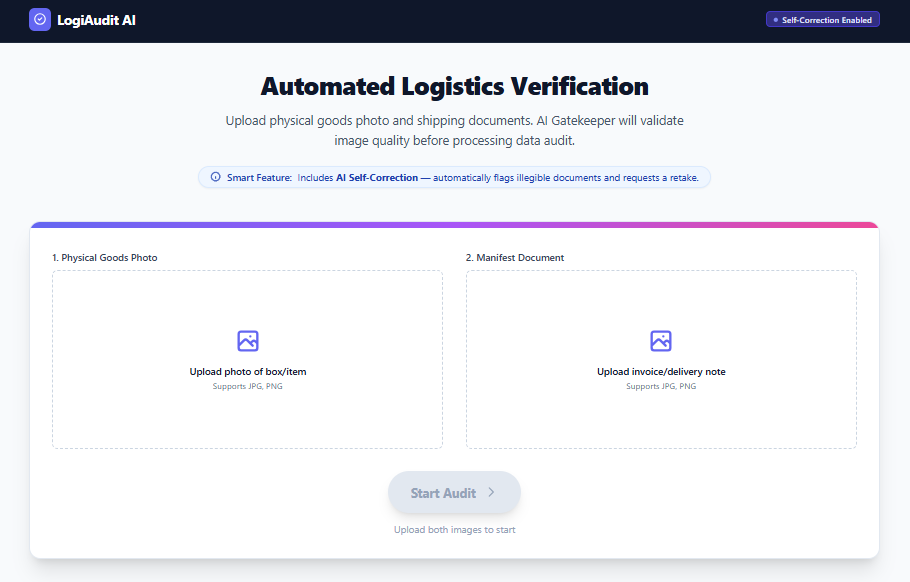
Inspiration
The inspiration for LogiAudit AI stems from observing critical inefficiencies in the logistics sector, where manual verification between physical goods and shipping documents remains a major point of failure leading to significant financial losses. As a student currently working on a thesis involving rice plant disease classification using Computer Vision, I realized that the potential of AI extends far beyond basic object identification. This drove me to build an autonomous Guardkeeper capable of bridging the physical-digital gap in warehouses, ensuring supply chain integrity without the bottlenecks of slow, manual bureaucracy.
What it does
LogiAudit AI is an autonomous logistics audit assistant that bridges the gap between physical warehouse reality and digital shipping documentation. Leveraging Gemini 3, the application performs Cross-Modal Analysis by directly comparing physical cargo photographs against invoices or shipping manifests. The system intelligently calculates item quantities using Spatial Reasoning, detects quantity or quality anomalies, and if a mismatch is identified autonomously generates a professional "Complaint Email Draft" to be sent to vendors.
How we built it
This project was designed as an Autonomous Orchestrator leveraging the Google Cloud and AI Studio ecosystems.
- Frontend: Developed using React to create a responsive and intuitive web interface.
- AI Engine: Integrated the Gemini 3 API to utilize Native Multimodal Reasoning and Spatial Reasoning for advanced item counting.
- Orchestration: Utilized Structured JSON Output from Gemini to trigger application logic, such as audit status determination and automated email drafting.
- Data Strategy: Implemented an Offline-First storage strategy using LocalStorage to ensure audit history remains persistent and accessible in low-connectivity warehouse environments.
Challenges we ran into
Building this project as a solo developer presented significant technical and management challenges:
- Multimodal Consistency: Aligning OCR extraction from occasionally blurry documents with visual estimates of physical goods required highly precise system instruction optimization to prevent data hallucinations.
- Autonomous Logic: Developing an AI Self-Correction feature capable of intelligently distinguishing between low-quality image inputs and actual shipment anomalies.
Accomplishments that we're proud of
- Autonomous Action: Successfully implemented an agent that not only identifies problems but also prepares contextual solutions, such as automated complaint drafts.
- Precision Counting: Achieved high accuracy in grid-based item counting (e.g., in fruit crates) using pure spatial reasoning.
- Effective UI/UX: Created a simple yet powerful audit workflow that can be used by field officers immediately without complex technical training.
What we learned
Through this project, I gained a profound understanding of Vibe Engineering building AI agents capable of verifying their own work and taking autonomous corrective actions. I learned that effective AI integration in industry is not merely about prompting, but about system orchestration that connects visual inputs, business logic, and functional outputs.
What's next for LogiAudit AI
- Cloud Persistence: Migrating history storage from LocalStorage to Firebase Firestore with Anonymous Authentication to facilitate better team collaboration. Video Auditing: Developing video processing capabilities to handle large-scale cargo audits that require spatial-temporal understanding. ERP Integration: Building APIs to integrate audit results directly into corporate ERP systems to enable broader supply chain automation


Log in or sign up for Devpost to join the conversation.