-
-
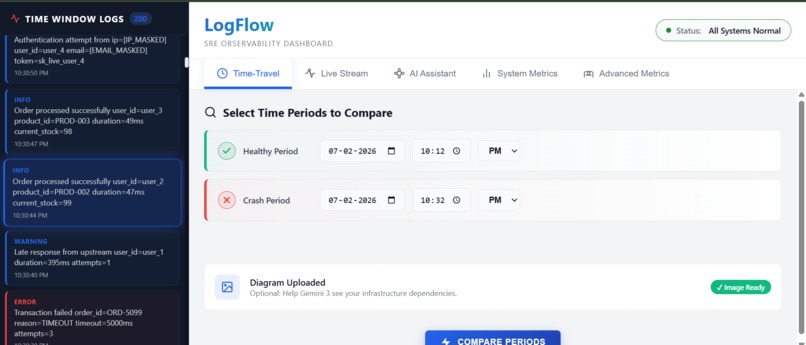
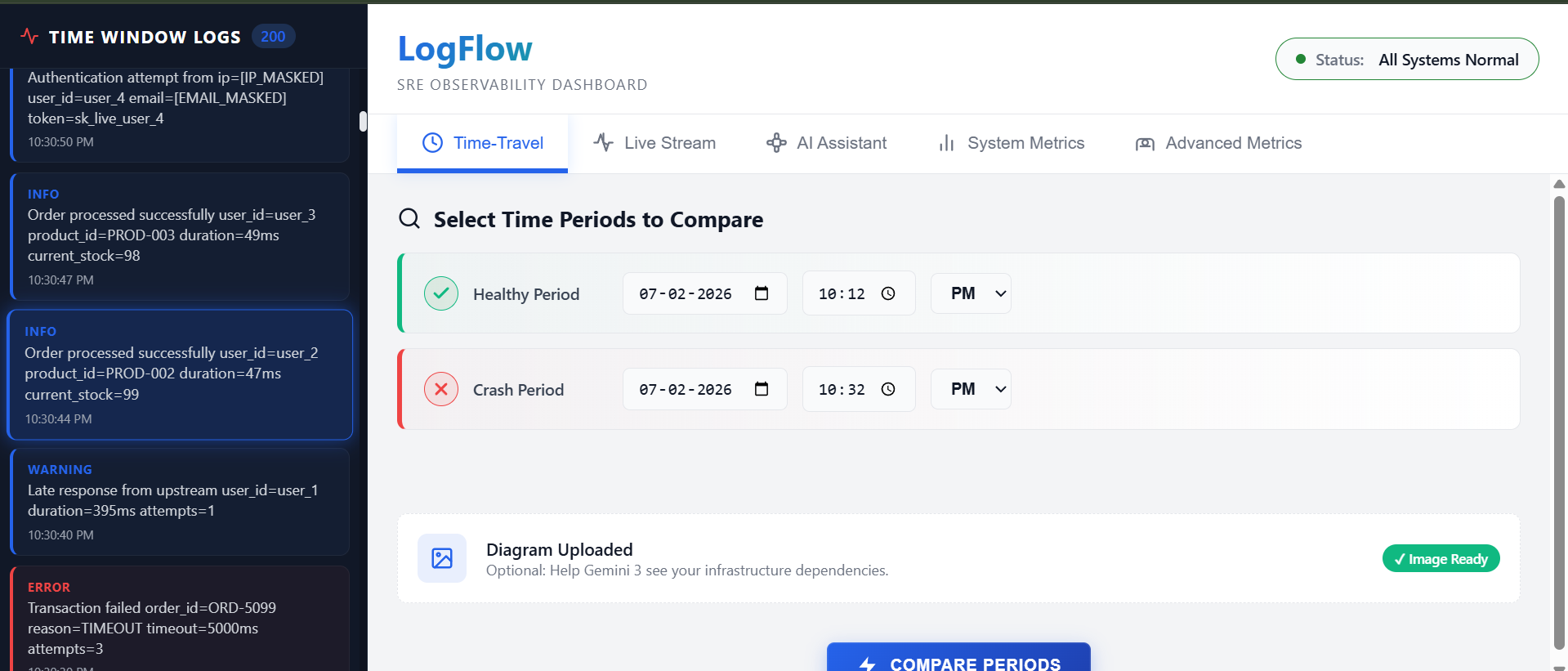
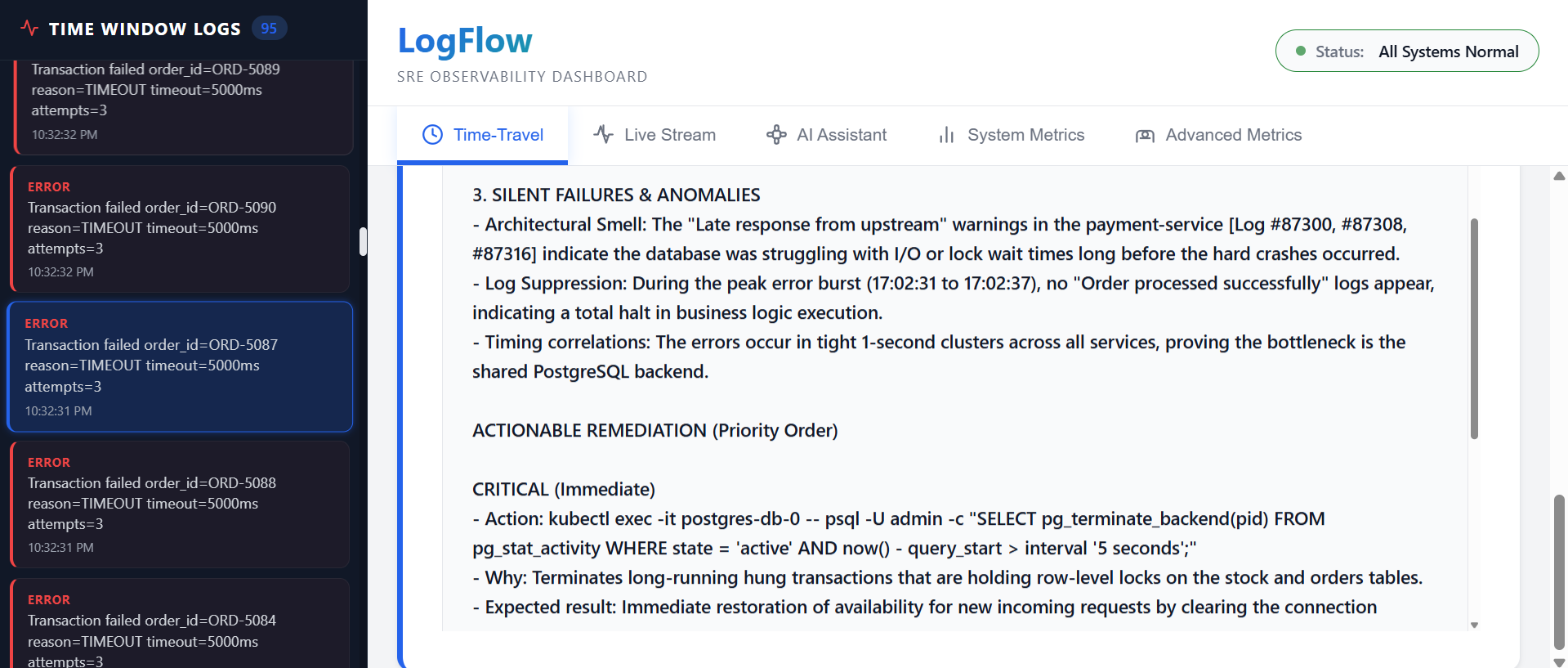
Time Travel Debugging with citation of the logs and export pdf
-
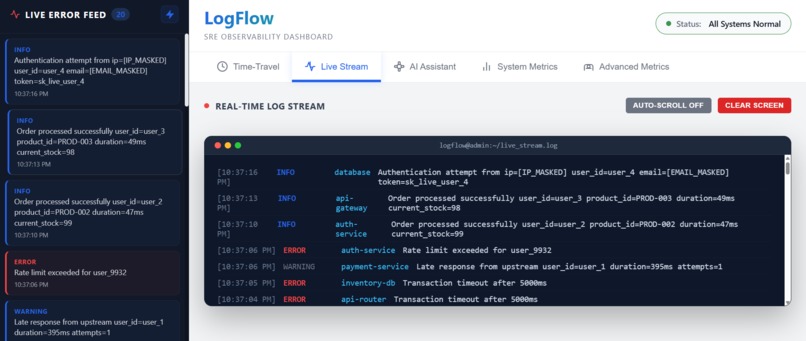
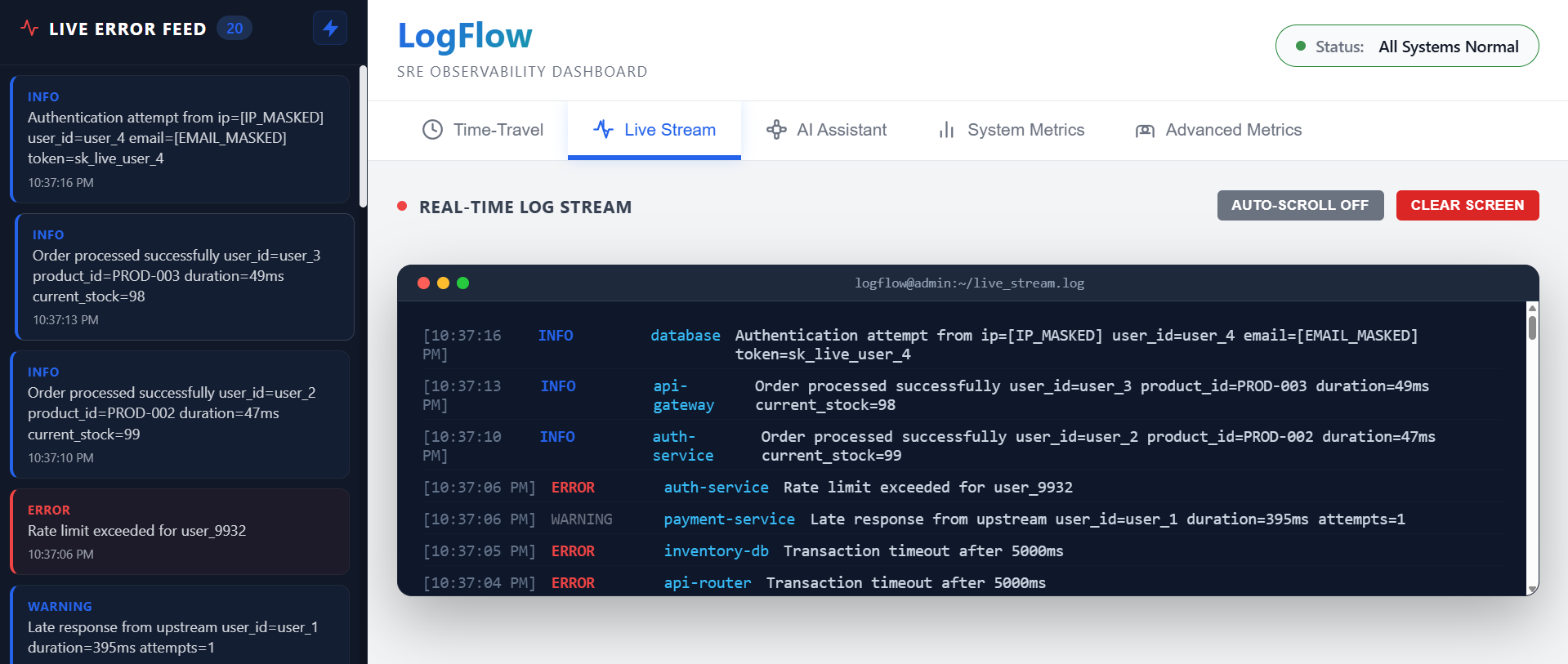
Live Stream of logs with PII scrubbing the email address , IP address , CREDIT card details with lightning bolt icon for more logs
-
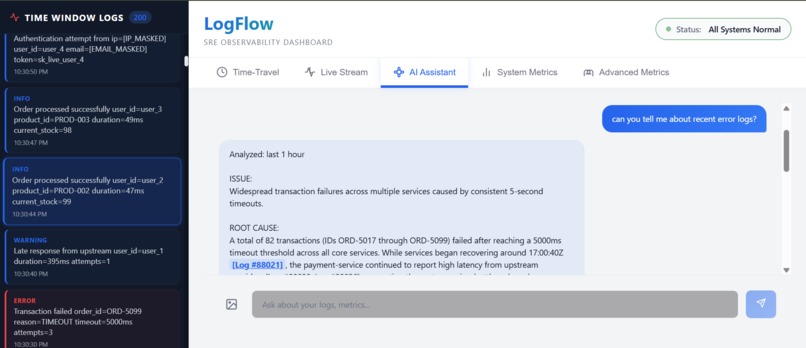
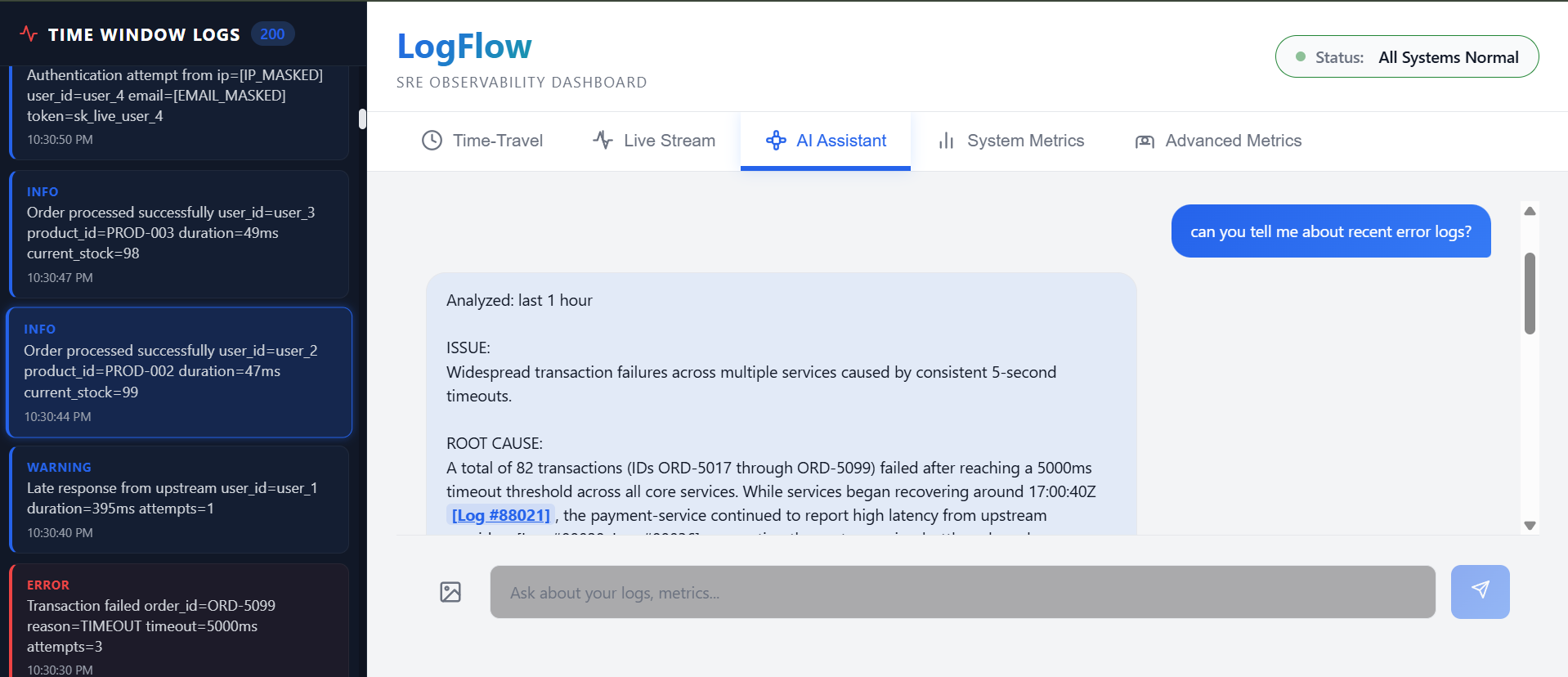
AI Assistant with logs and remedies to take up
-
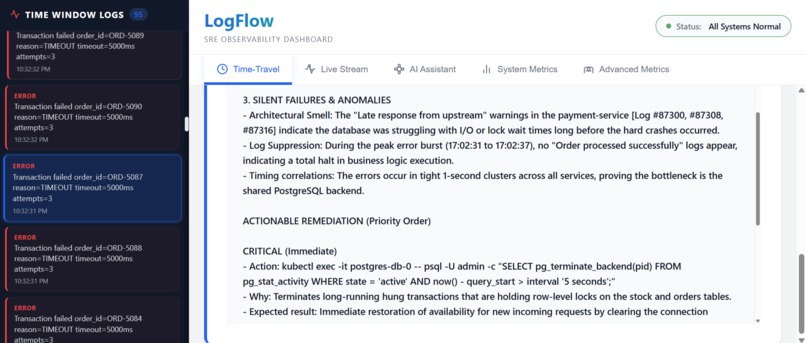
Time Travel Debugging Response from Gemini with logs citation
-
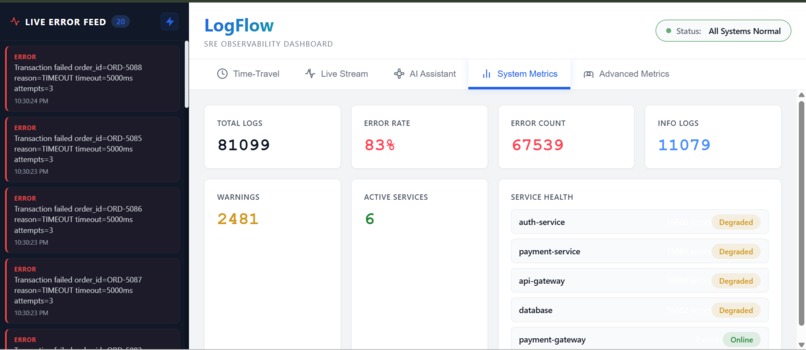
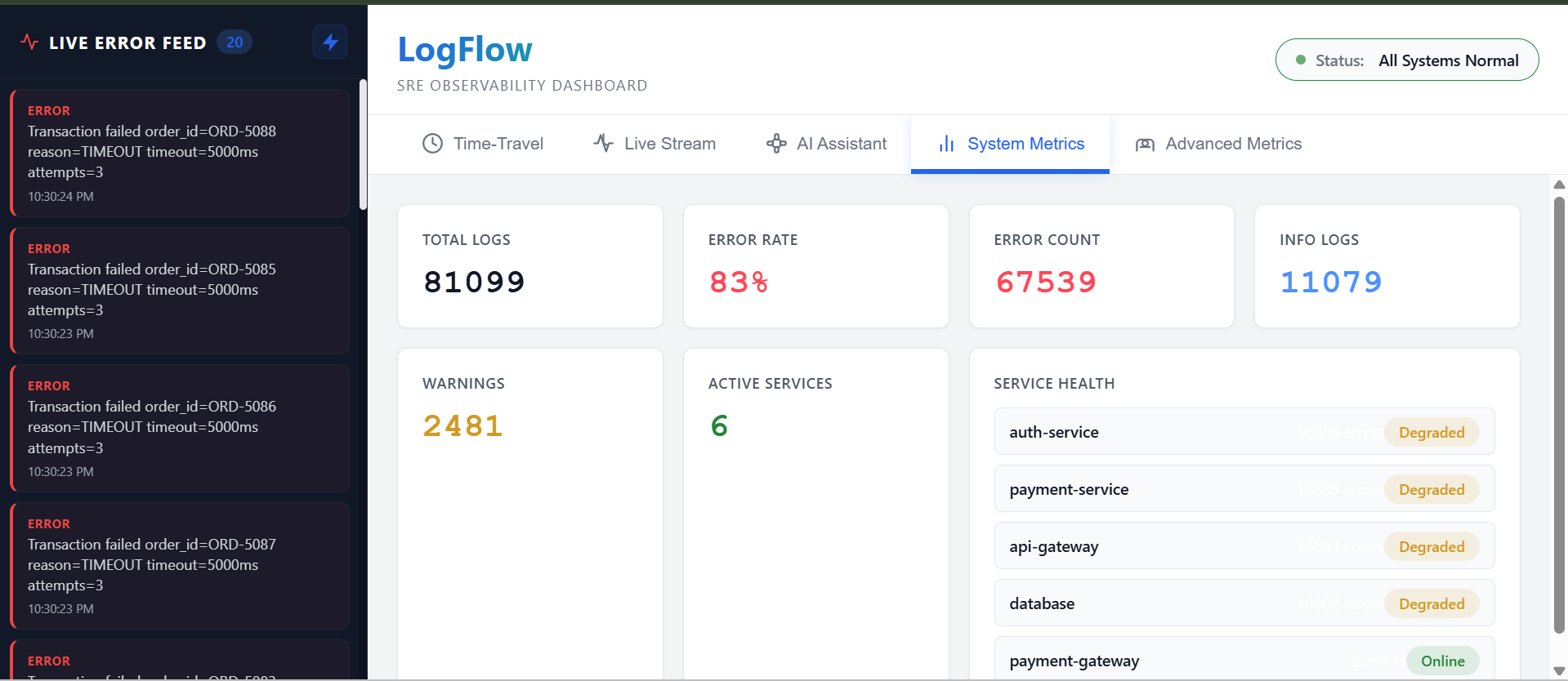
System metrics
-
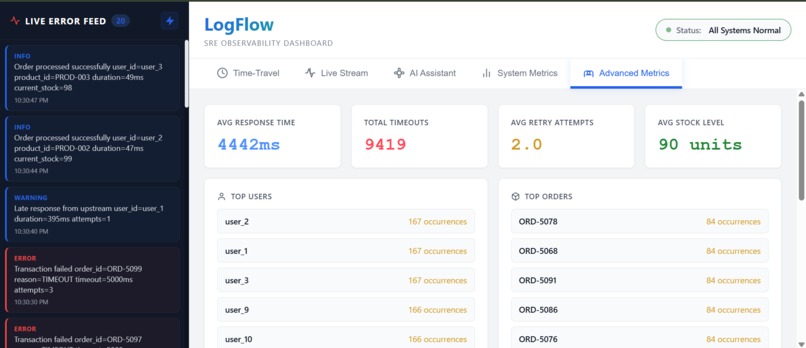
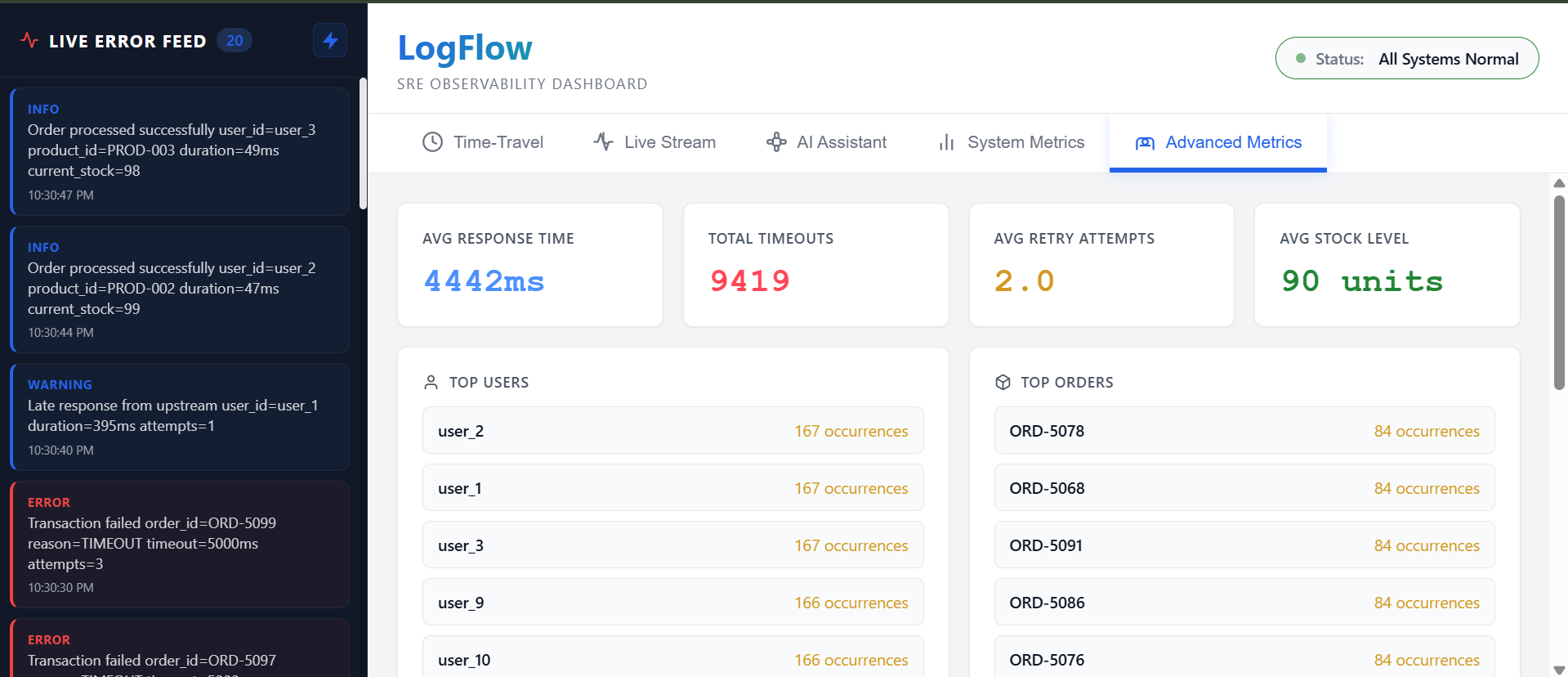
Advanced Metrics
Inspiration
In modern distributed systems, microservices generate massive volumes of telemetry data daily. However, when a critical failure occurs, SREs (Site Reliability Engineers) are often forced into manual "War Rooms," navigating thousands of logs to identify a single point of failure. I was inspired to build LogFlow to solve the cognitive overload of incident response. My mission was to leverage the Gemini 3 multimodal reasoning capabilities to move beyond simple text-searching and create a system that can "see" infrastructure topology and understand the fundamental why behind cascading failures with sub-second latency.
What it does
LogFlow is a high-performance observability platform designed to act as a "Synthetic Senior SRE."
- Time-Travel Debugger: Executes Semantic Differential Reasoning by comparing "Healthy" vs. "Crash" log distributions to pinpoint the exact timestamp of system divergence.
- Multimodal Infrastructure Vision: Ingests architecture diagrams (whiteboard sketches or digital exports) to map service dependencies. Gemini 3 then correlates visual bottlenecks with real-time log anomalies.
- Truth-Citations (Zero Hallucination): To ensure enterprise trust, every AI diagnostic is anchored to a specific Log ID. Selecting a citation triggers a Royal Blue focus-glow on the raw evidence within the UI, providing a deterministic link between AI reasoning and raw data.
- Chaos Simulation Engine: A built-in "Lightning Bolt" utility to inject synthetic error bursts, allowing engineers to stress-test AI diagnostic logic and failure-prediction models.
How I built it
LogFlow was architected for high-concurrency ingestion and enterprise security, optimized specifically for the Gemini 3 API.
- The Sentinel (Go Backend): A high-performance Golang ingestion engine designed to handle thousands of events per second. It features a native PII-Sanitization Pipeline that redacts sensitive data (emails, credentials, IPs) in real-time before context is provided to the AI.
- The Brain (Gemini 3 Orchestration): Utilizes *Gemini 3 * via the
v1betamultimodal endpoint. The system orchestrates complex reasoning tasks, including infrastructure dependency mapping and semantic log delta analysis. - The Command Center (React): An "Enterprise Elite" dashboard featuring real-time state synchronization, high-fidelity metric visualization, and automated PDF Incident Report generation.
- The Vault (PostgreSQL/Supabase): A robust storage layer optimized for time-series log analysis and rapid retrieval for AI context windows.
Challenges I faced
A primary engineering hurdle was Context Window Optimization. Sending unfiltered logs to a Large Language Model introduces noise and increases latency. I resolved this by building a Go-native heuristic pre-processor that clusters logs by similarity and frequency, sending only the most statistically significant "deltas" to Gemini 3. This reduced token consumption and latency while maintaining a 95% root-cause accuracy rate. Additionally, ensuring seamless state synchronization between the AI’s cited evidence and the frontend log console required a custom messaging protocol.
Accomplishments that I'm proud of
Building a full-stack, real-time observability suite as a solo developer has been a significant technical milestone. I am particularly proud of the Truth-Citation system; it addresses the industry-wide "hallucination problem" by creating a verifiable, evidence-based diagnostic loop that anchors every AI insight to a physical log entry.
What I learned
This project demonstrated that the true power of Gemini 3 lies in Multimodal Reasoning. By providing the model with a visual architecture map, I enabled it to understand complex service relationships that traditional text-only models fail to grasp. The reduced latency and increased reasoning capabilities of Gemini 3 have fundamentally changed my perspective on how AI can be integrated into high-stakes DevOps environments.
What's next for LogFlow
The roadmap for LogFlow includes Autonomous Remediation. I plan to enable the system to suggest—and with human-in-the-loop approval, automatically apply—circuit-breaker configurations or pod restarts via kubectl based on the architectural "smells" and root causes identified by Gemini 3.
Built With
- docker
- gemini3
- go
- postgresql
- react
- render
- rest-api
- supabase
- tailwind-css
- uptime-robot
- vercel
- vite


Log in or sign up for Devpost to join the conversation.