-
-
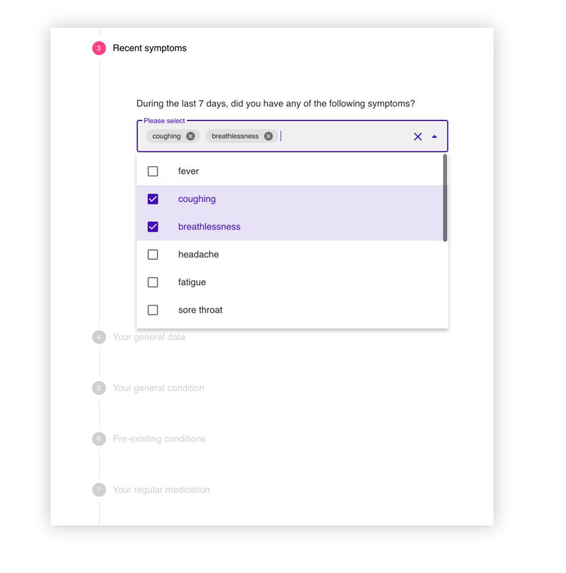
questionnaire
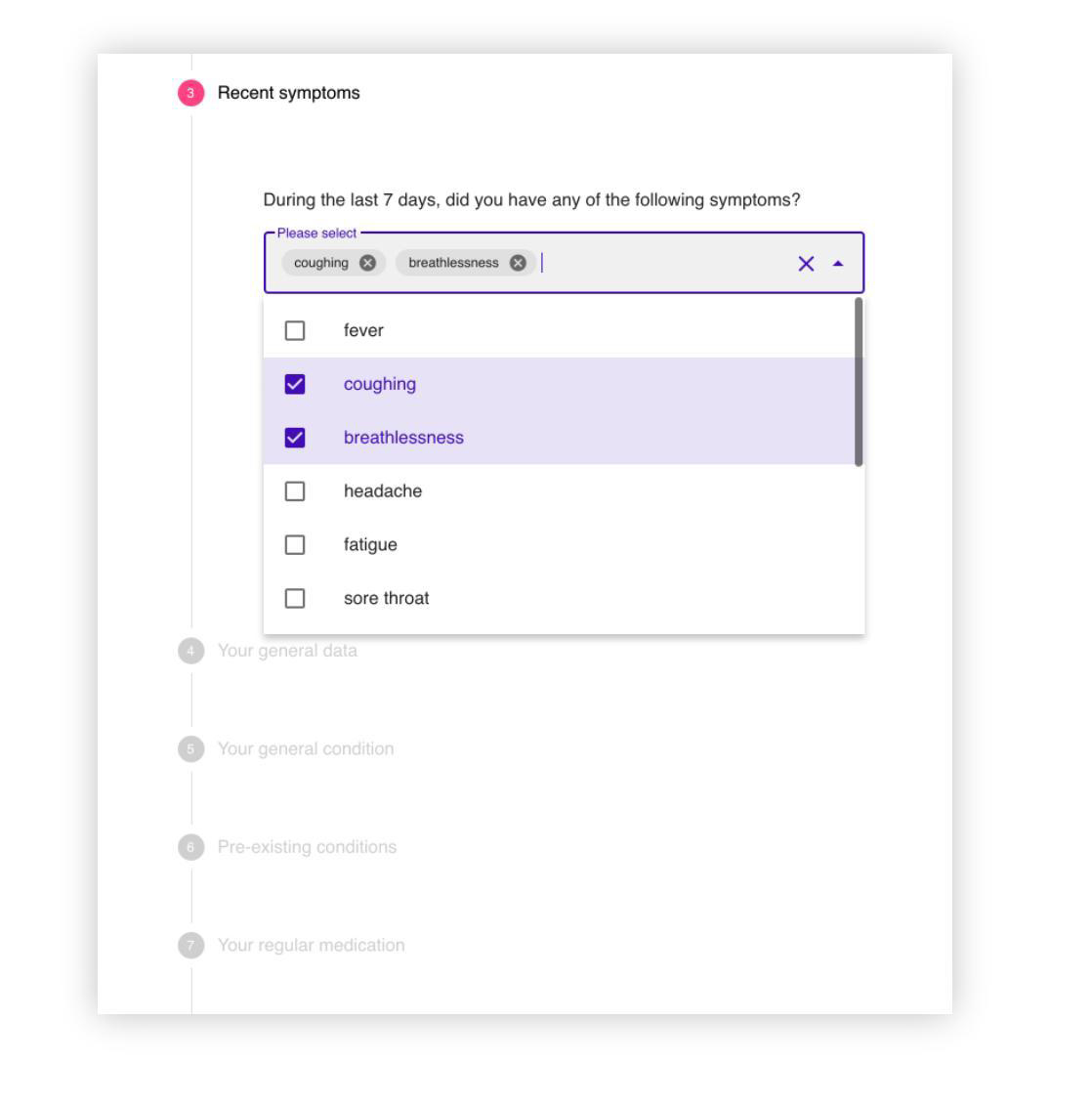
THE PROBLEM: Data on non-hospitalized COVID-19 cases are hardly available
One of COVID-19’s main characteristic - and one of the reasons that caused so many unknown and widespread infections in the past few months - is the broad range of disease courses: On the one hand, some cases take a severe or even deadly course, most cases are mild or unnoticeable. And that’s only the known cases; given that a big number of cases isn’t noticed by the patient at all, the number of mild cases is even bigger. Nevertheless, for science and its fight against the novel disease, it’s vital to scrutinize the full range of cases to understand the Virus and COVID-19.
While cases that are hospitalized are documented carefully and data is made available to scientists, there’s no easy way to get accurate information on cases that are treated at home and that - at best - are monitored remotely. At the same time, people are becoming more aware of the necessity to keep track of their health stats - not only to make treating their diseases more effective but also for their peace of mind. Still, there’s no easy and safe way to store all those data - let alone a way to share these data with scientists to support the fight against the pandemic.
THE SOLUTION: A patient’s diary helps both, patients and science
log19.com is providing the public with an easy, fast, and secure way to gather relevant data on their health status focused on the COVID-19 pandemic. These data are stored anonymized and therefore can be securely provided to scientists to close the gap of data of non-hospitalized cases of the disease.
For patients, log19.com offers a patient’s diary: After setting up an anonymous account, some general questions are asked; these questions are about facts that won’t change to quickly, such as general vital stats, diet, etc. Based on the input, users have to answer a more specific set of questions regularly - the questionnaire, which was designed in cooperation with doctors, is dynamically generated based on the individual answers. For example, as long as no symptoms are reported, a small number of questions is only answered once a week; if one or more symptom comes up, the questionnaire gets more detailed and switches to daily. Questions are - among others - symptoms, medication, temperature, etc. Over time, a detailed picture of the patient’s course of the disease becomes visible and is linked to supporting data such as medication.

On a personal dashboard, the user can access a graphical representation of the input data - for example, his or her temperature and changes over time. These data and the representation are not only for the user’s peace of mind. In cases when the disease gets more severe and can’t be treated at home any longer, the data can be used as a basis for doctors to provide a more effective treatment.
Additionally, to provide a personal health diary, log19.com makes use of the people's willingness to support the greater good during the pandemic - as all data are store anonymized they can be shared securely with science. Those data support science’s fight against the pandemic uniquely; as normally these data on mild cases that are cured at home but also on cases that aren’t recognized officially at all, aren’t easily accessible, let alone available at all.
While users can access their data in a graphical representation, scientists can apply for access to the structured data as they’re available in the database. With a growing number of cases, this enables scientists to find a certain pattern more easily.
Key features of log19.com are:
- language-independent: No textual entry is required, thus the data independent from the user’s language, data can be gathered in every country in the world.
- questionnaire created by doctors: The questions and the dynamics behind it were created in cooperation with doctors
- multi-device application: log19.com is web-based; it can be used on any internet-enabled device, no installation necessary
- anonymized database: All data is stored anonymized, thus no personal data can be abused
- independent initiative: log19.com is run by a non-profit initiative, there’s no link to a single institution, country or company
THE HACKATHON: Improving the solution and enable to scale
In the last 72h, most of the work was invested in the business side of the initiative, but also in finalizing the platform and adding some more feedback on content from doctors and other health professionals to the questionnaire. Now, as a working first iteration of the platform itself is available and accessible at log19.com, the main focus shifts to scaling both groups of users, patients on the one hand, and scientists on the other. In that area, the Hackathon was used to create and refine pitch material - including the 2min Hackathon pitch video - to present the idea more easily to potential partners such as scientists, laboratories, and institutions (i.e. universities).
THE IMPACT: Peace of mind for the public, data for science
log19.com has an impact in more than one areas during the crisis:
- People are feeling safer when they can keep track of their health stats, especially if there’s a guided process that asks the right questions; log19.com provides a structured way to gather relevant data. That improves the public’s peace of mind in regards to concerns on the COVID-19
- Cases that are getting more severe over time can be treated more effectively if the medical documentation doesn’t start in the second of hospitalization but as early as possible.
- The fight of scientists against the virus and the disease is supported by gathering data that won’t be accessible without log19.com - and still is valuable data that gives scientists access to the whole bandwidth of COVID-19 cases and is not limited to severe cases that are treated in hospitals.
- In future iterations of the platform, log19.com can also play a role in the recognition of the disease and support doctors and health professionals by assessing a big number of cases automatically based on historical data.
THE REQUIREMENTS: Scale the number of patients and scientists using the platform
Although log19.com is a non-profit initiative, it’s still running on the principles commercial business models are built on. The platform, we’re working on, is a two-sided-platform with patients on the one side and scientists on the other side. For both sides, it’s more interesting to join the platform: Patients intend to use the platform is not limited to use the platform as a personal health diary, especially nowadays the opportunity to donate something - in this case data - for a good cause, a greater good that affects every single one of us, is important for this group of users. The worth of donated data rises with scientists making use of the data. Scientists require a big number of cases - the bigger the number of patients providing and donating data becomes, the more relevant become potential findings based on these data.
Taken that into account, log19.com requires trusted partnerships with scientists, laboratories, and institutions that can make use of the data that is already available and that will be gathered in the future. These partnerships will then automatically scale the number of patients using the platform.
As the platform and the whole idea behind it is independent of languages, another necessity to accelerate growth is internationalization. Right now, log19.com is available in German and English - to add additional languages, a simple translation is sufficient as the data and the structure remains unchanged.
Once the number of patients using the platform reaches a certain level, more advanced technical improvements will also become possible - such as using AI / ML to automatically search the data for a certain pattern to not only gather information for science (i.e. future cases) but also supports the treatment of the individual cases of users entering their data.
THE FUTURE: Not limited to a certain disease
Of course, the questionnaires are now tailored to learn about COVID-19 cases, but the technology that’s behind log19.com can be used to keep track of data on all diseases that are cured without doctors directly involved. (e.g. the flu or future COVID-19 cases after the pandemic) Given log19’s architecture that doesn’t require specific devices or installation and can be used on any internet-enabled device, future use-cases are not limited to diseases that are cured at home - the platform can also be used in territories with fragmented health care systems as self-service health documentation for patients.
THE TEAM: Working in data
Log19 was created by a non-profit initiative formed by a team of Berlin-based developers and entrepreneurs that normally work in the field of databases, structured data, data security, and privacy. During the COVID-19 pandemic, the team wanted to make use of their skills to support the good cause and thus started log19.com.


Log in or sign up for Devpost to join the conversation.