-
-
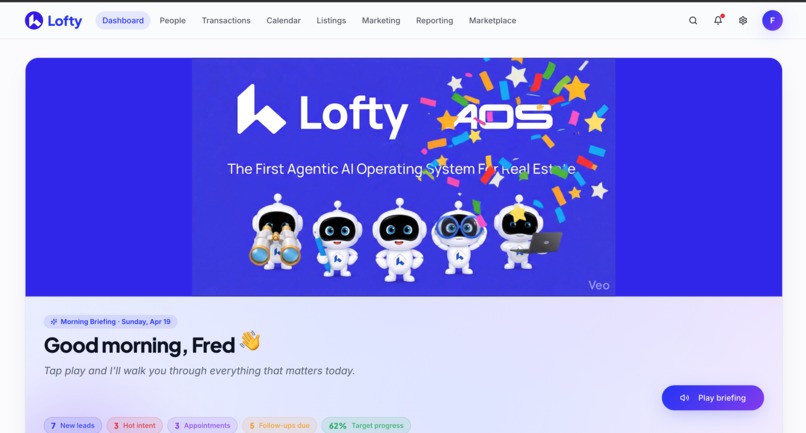
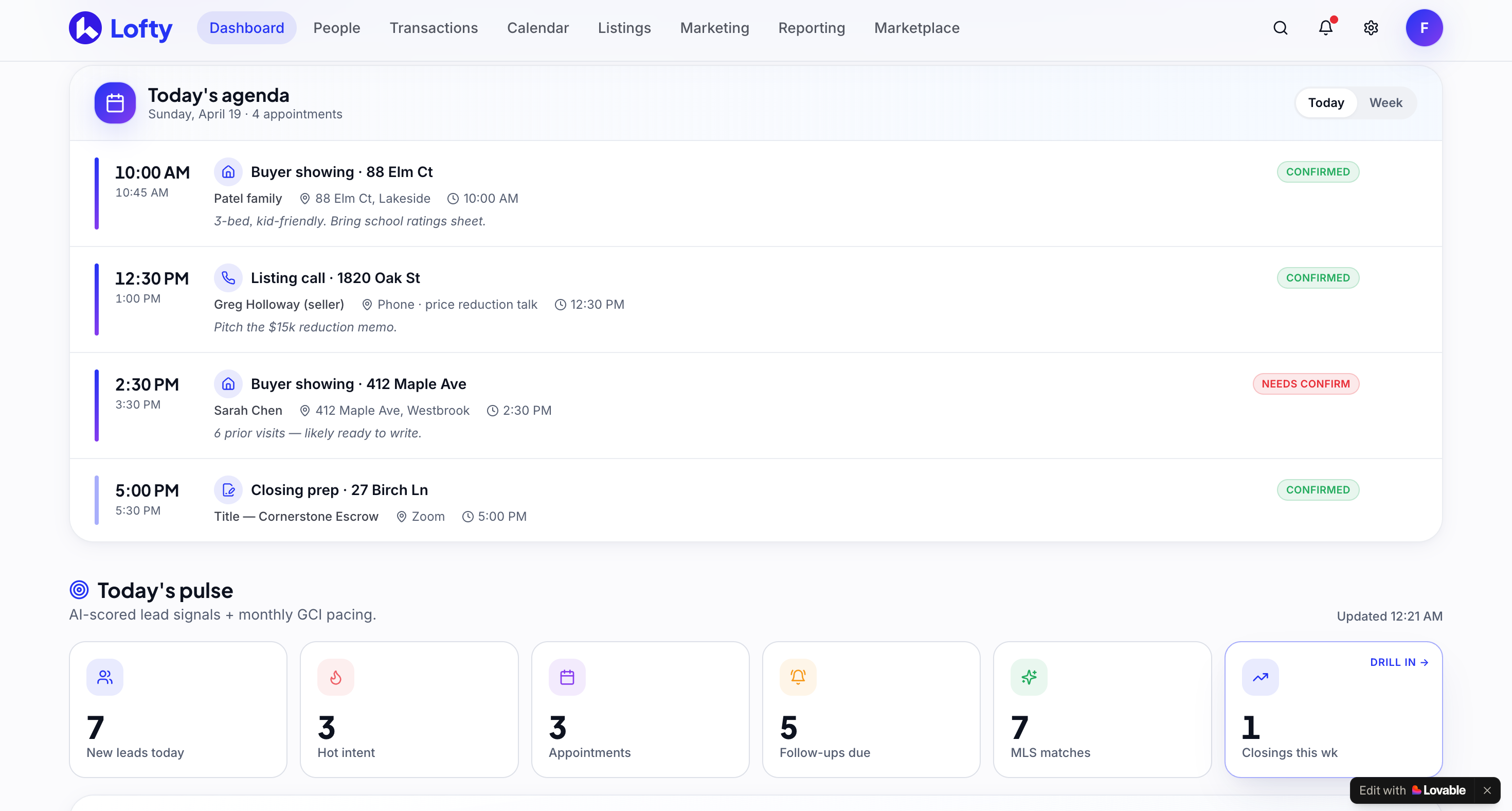
Lofty new Dashboard (AI Brief)
-
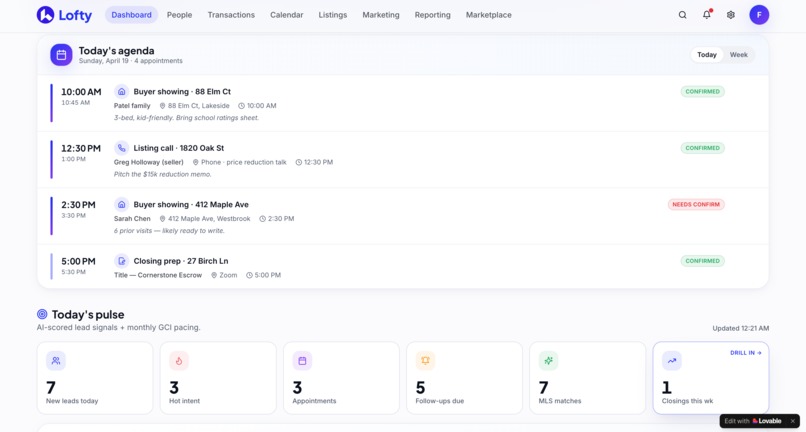
Agenda, Key Metrics
-
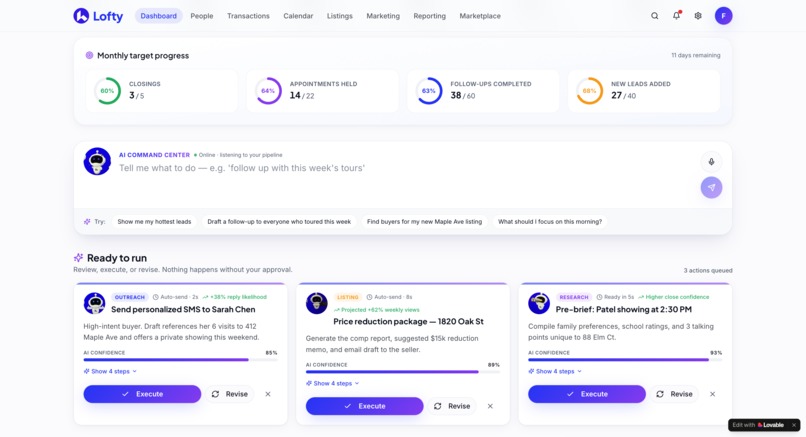
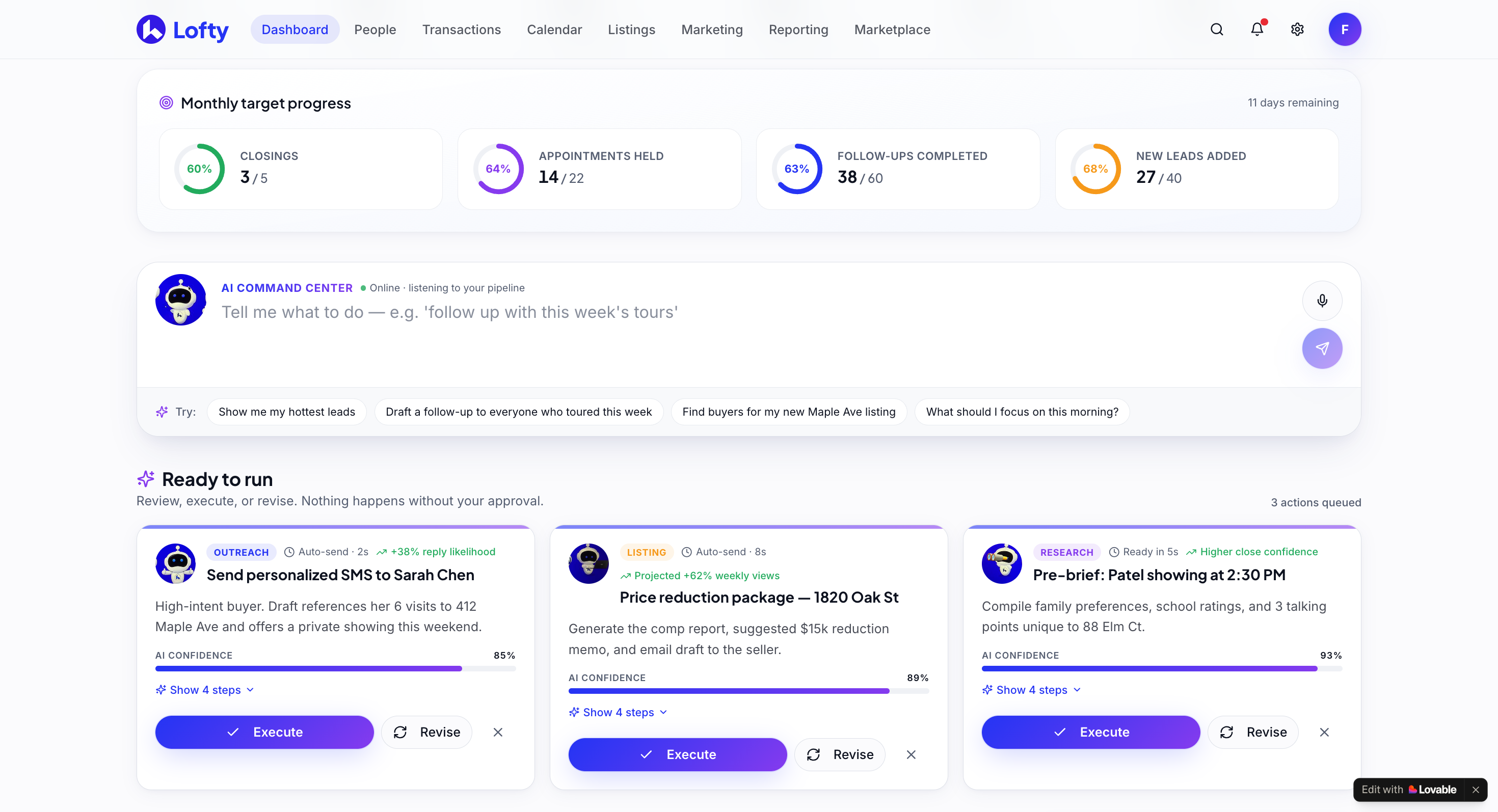
Monthly Progress, AI Command center
-
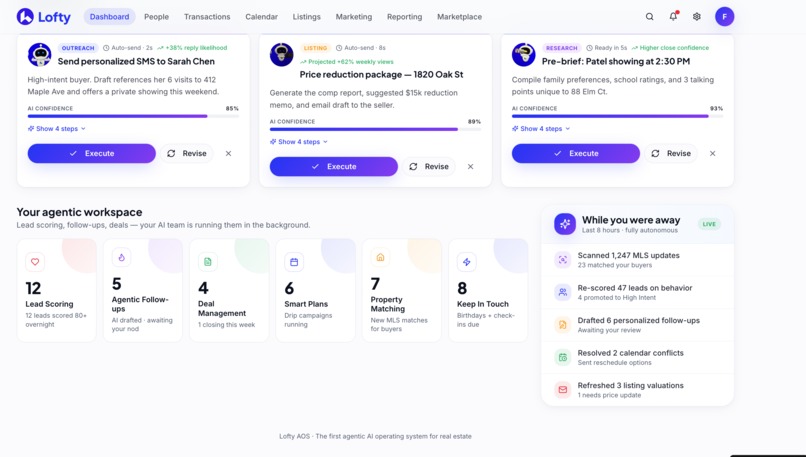
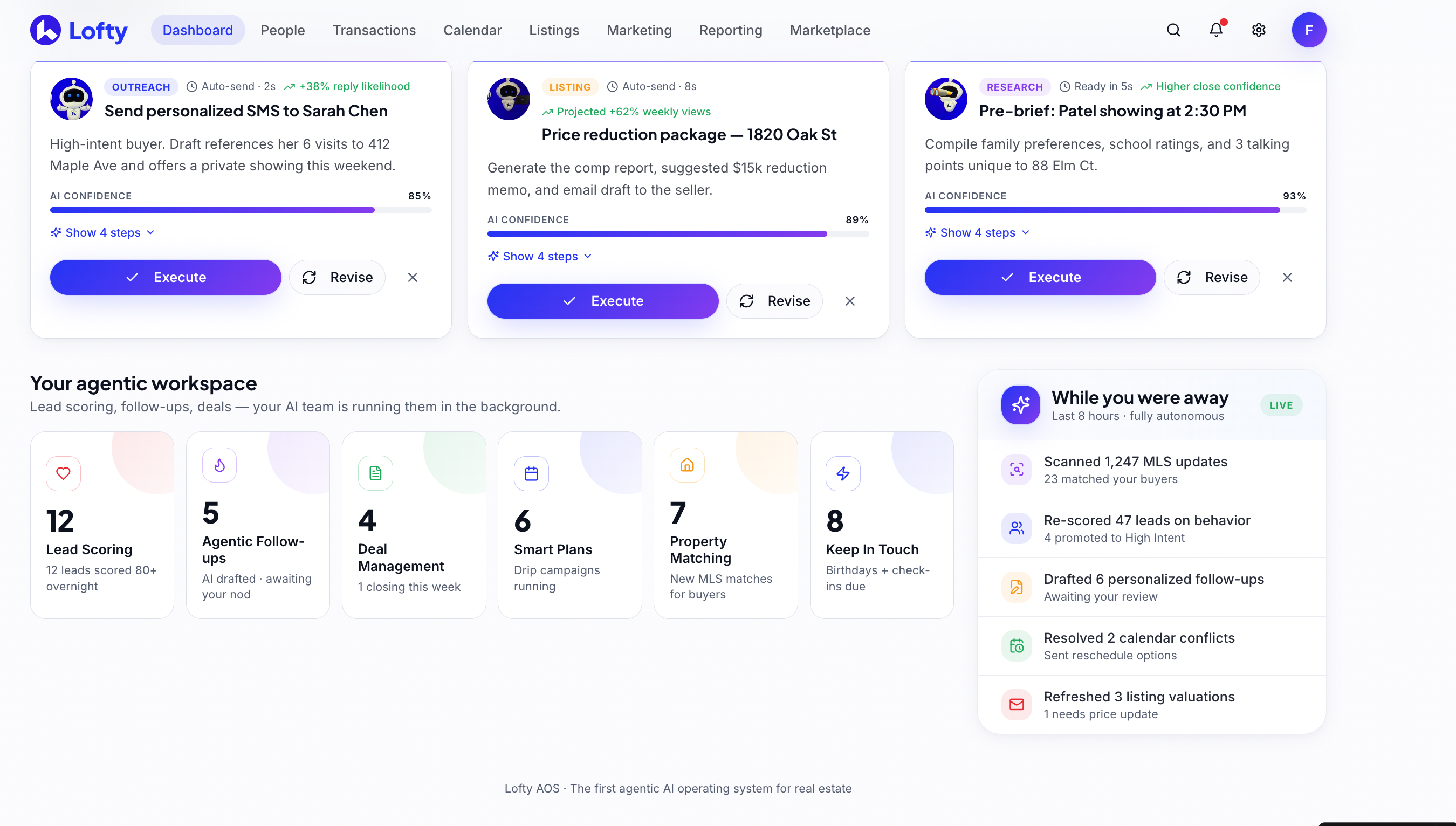
Agentic actions, Agentic mode brief/metrics
Inspiration
When we looked at today’s real estate platforms including Lofty’s classic home experience we kept seeing the same friction: cognitive overload. The product is powerful, but agents still land on a static grid of dense widgets leads, tasks, follow-ups, opportunities—and have to manually synthesize what matters first.
Around the same time, the category is shifting: Lofty AOS (positioned as the industry’s first agentic AI operating system, launched February 2026) moves the story from reactive, prompt-by-prompt help to proactive orchestration planning and executing whole workflows with a multi-agent “orchestra,” while keeping professionals in command through rules, approvals, and decision logs.
That direction inspired us: flip the paradigm from “the agent manages the software” to “the platform helps run the day” starting at login with a proactive, conversational front door that pairs autonomy with transparency.
What it does
LoftyAIDashboard replaces the traditional widget interface with a "one-stop solution" for high-level operations.
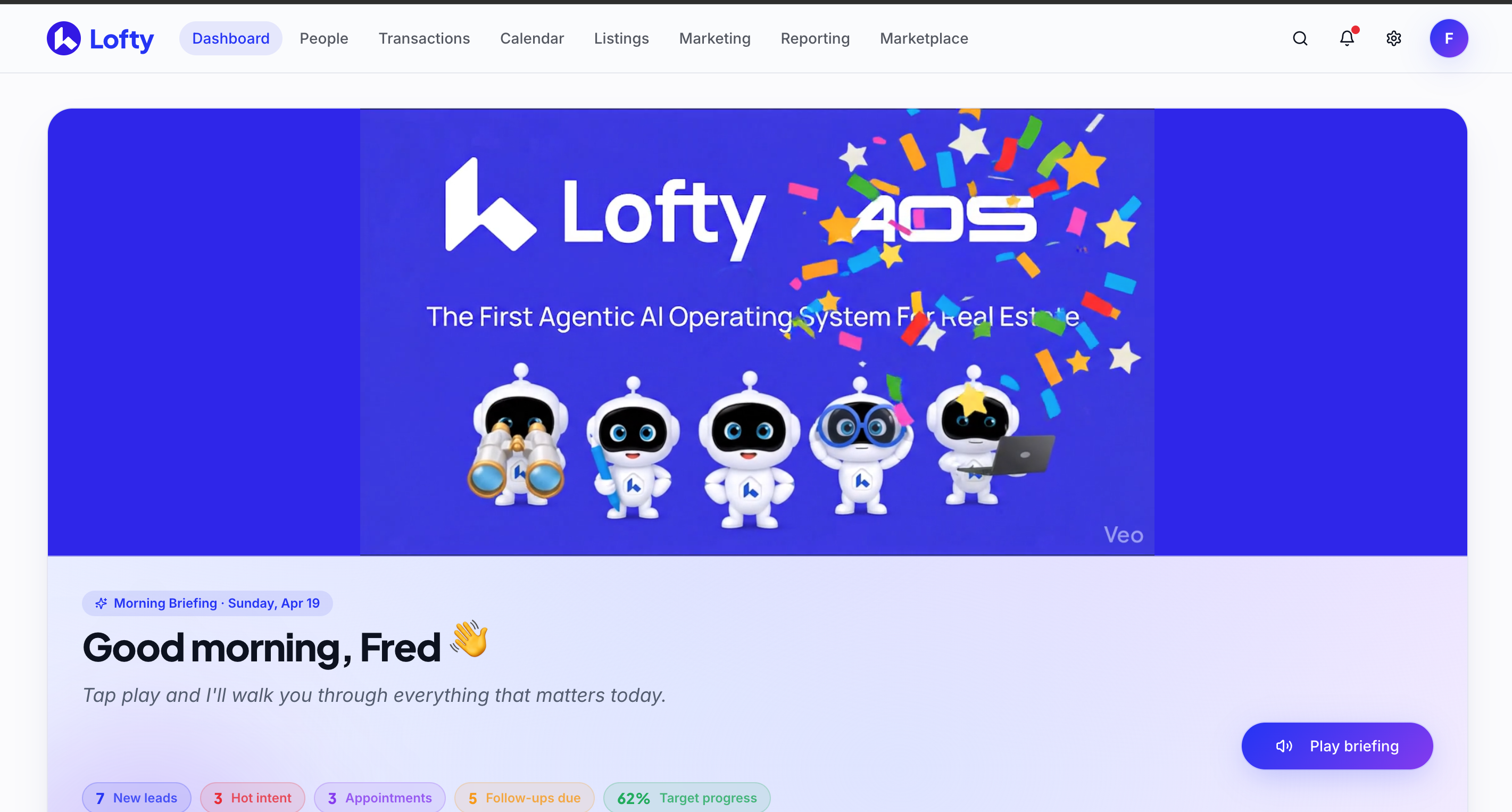
- Morning Briefing: A multimodal, voice-enabled AI summary that instantly gives agents the pulse of their pipeline and their daily agenda.
- AI Command Center: A natural language interface to execute complex tasks (e.g., "Draft a follow-up to everyone who toured this week").
- Agentic Workflow Review: The AI proactively queues "Ready to Run" Action Cards. Before anything executes, agents can review the exact steps, then choose to Execute, Revise, or Cancel.
- Autonomous Log: Tracks everything the AI accomplishes in the background, ensuring complete accountability.
How we built it
We built LoftyAIDashboard as a modern, high-performance web application:
- Frontend Framework: React with TypeScript and Vite.
- Styling & UI: Tailwind CSS combined with highly customized shadcn/ui components for a premium, minimalistic aesthetic.
- AI Integration & Assets: We utilized Gemini to generate dynamic mascot animations and video assets, adding a layer of humanizing delight to the AI.
- Prototyping: We leveraged Lovable to rapidly scaffold our initial working prototype and iterate on the UI.
- Presentations: We utilized Gamma to structure our go-to-market slide decks.
Challenges we ran into
Our biggest challenge was balancing automation with user trust. Real estate agents are fiercely protective of their client relationships. If an AI is fully autonomous, agents fear it might send a robotic or incorrect email to a VIP client.
To solve this, we had to rethink the UI. We couldn't just have an invisible AI working in the background. We designed the Agentic Workflow Review, which explicitly displays the AI's confidence score and exposes a dropdown of the exact steps the AI will take. By forcing an approval gate, we established a "Human in the Loop" system that builds trust rather than anxiety.
Accomplishments that we're proud of
We are incredibly proud of successfully transforming a dense, data-heavy dashboard into a delightful, consumer-grade experience without sacrificing functionality. Introducing the animated mascot and the Text-to-Speech (TTS) Morning Briefing took the platform from feeling like "just another database" to a true AI Co-pilot that agents will actually enjoy waking up to.
What we learned
We learned that in AI-native design, transparency is a feature, not just a backend requirement. Showing the user how the AI is thinking (via streaming text, confidence bars, and step-by-step disclosures) drastically increases their willingness to use it.
We also learned the mathematical value of cognitive load reduction. If \( T_{admin} \) is the time spent on administrative tasks per lead, and \( T_{close} \) is the time spent actively closing deals, an agent's capacity is strictly bound. By introducing our Agentic OS, we change the equation:
Impact on Agent Productivity
We don’t just reduce admin time — we eliminate the cognitive load of deciding what to do next.
ROI = (Time shifted from admin → closing) × Conversion Rate
AI efficiency (~80%) directly reallocates effort toward revenue-generating activities.
By letting the AI handle administrative prioritization (where \( \text{AI}_{efficiency} \approx 0.8 \)), we mathematically shift the agent's time allocation directly toward revenue-generating activities.
What's next for LoftyAIDashboard
With more time, we plan to build deep execution integrations—such as inline email editors directly within the Action Cards and enable real-time MLS data fetching via the natural language Command Center.
Built With
- gemini
- lovable

Log in or sign up for Devpost to join the conversation.