Inspiration
Scientists often find things they cannot see by watching how other things move around them. Astronomers spot hidden planets from the wobble of a star, and dark matter shows up in how galaxies spin. We wanted a daily puzzle built on that feeling: you never see the answer, only its effect, and you have to reason backwards.
A lodestone is a naturally magnetic rock, the first compass. The game hides a few of them on a board and gives you three marbles to find them.
What it does
Every day at midnight UTC a new Lodestone post appears in the subreddit. Its board hides 2 or 3 magnets, and every player gets the same board.
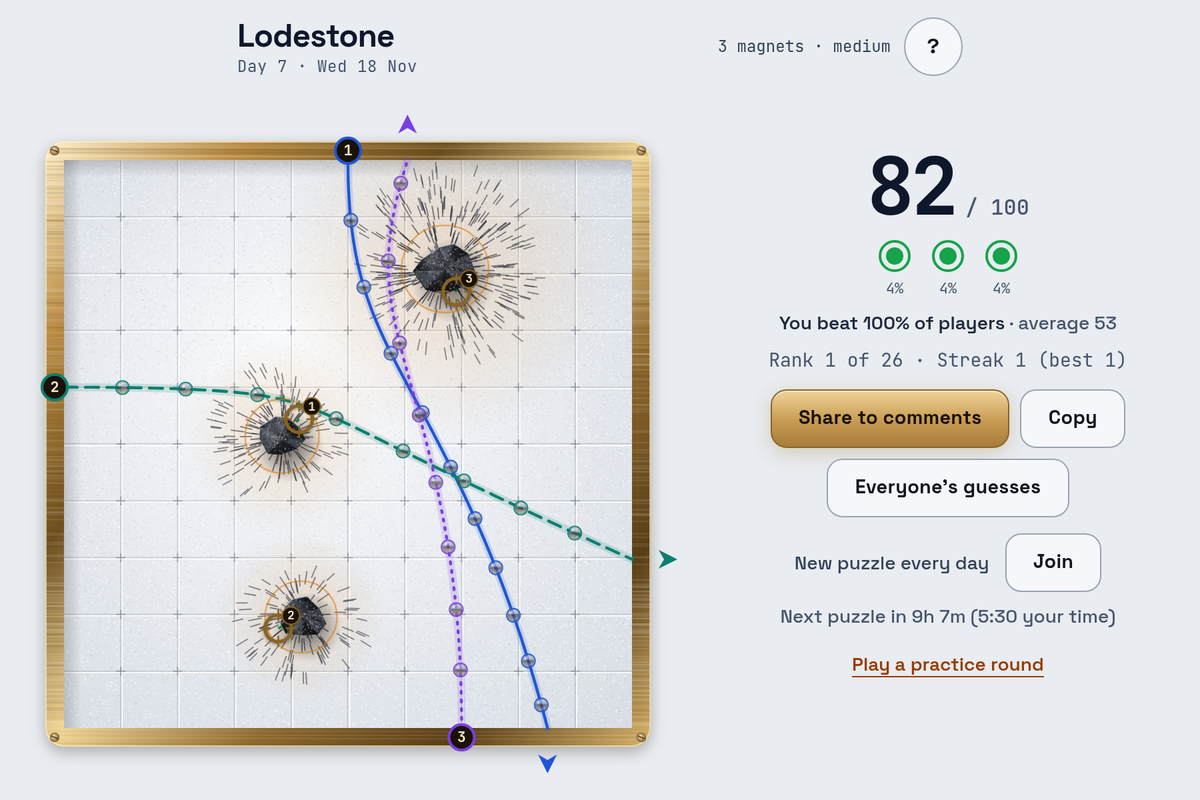
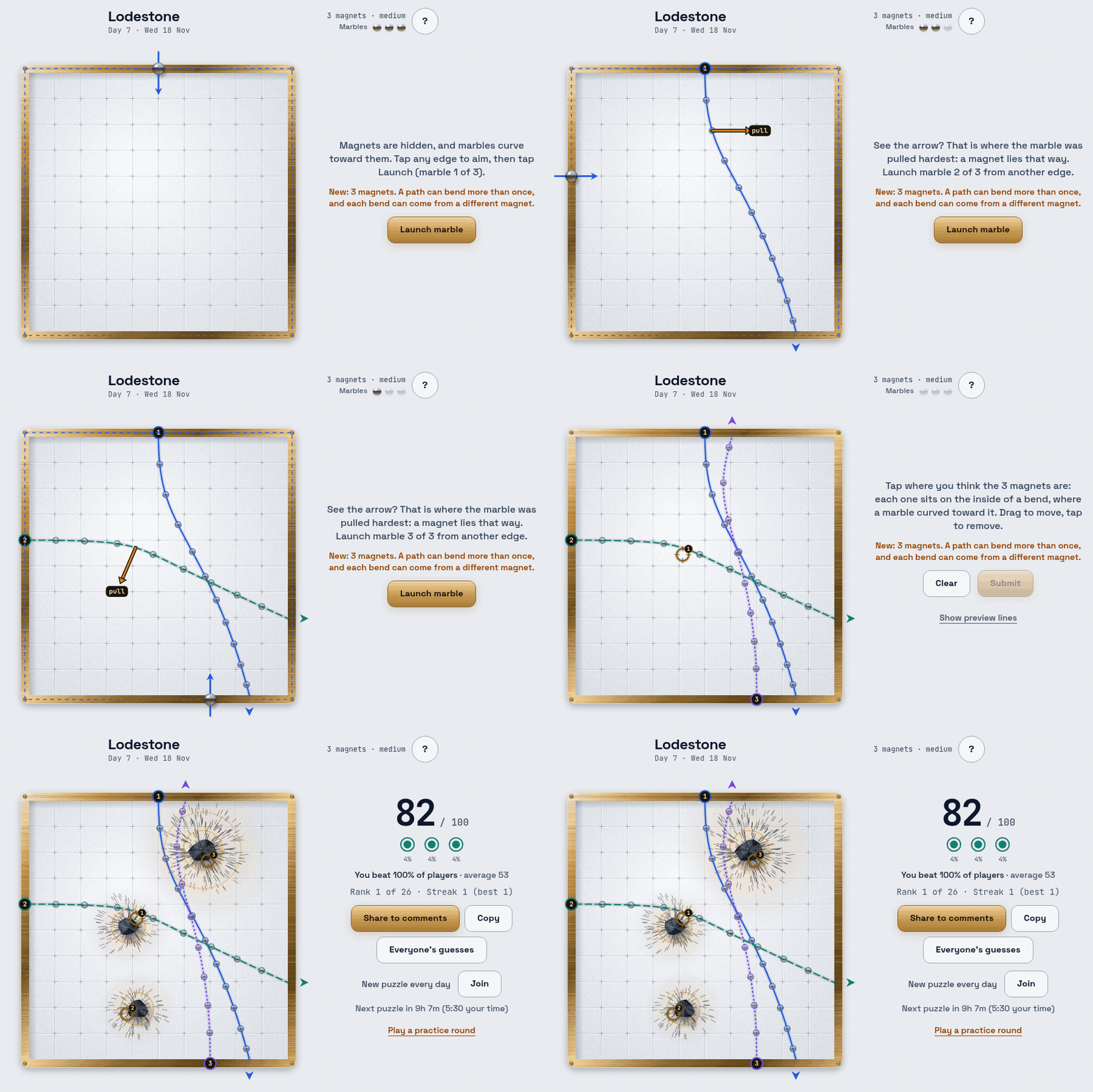
- Probe. Tap any edge to roll a marble in. It curves through the invisible field and leaves a trace. You get three marbles.
- Guess. Read the bends and drop one marker where you think each magnet is.
- Reveal. The magnets appear, the traces replay, and your score counts up from 0 to 100 based on how close you were. Your worst miss gets a short lesson that points at the bend you misread.
After you play, the game turns into a community moment:
- Everyone's guesses as a heatmap, plus the crowd guess: all players' guesses combined into one answer, scored like a player. Can you beat the crowd?
- "You beat X% of players" and the day's average.
- Share to comments posts your result (emoji only, no spoilers) as a reply under the pinned leaderboard comment, from your own account.
- Streaks with user flair, a countdown to the next puzzle, and unlimited practice rounds at Easy, Medium or Hard.
Difficulty rises through the week: easier boards early on, closer and edgier magnets at the weekend. New players get a 30-second tutorial (one magnet, then two), and anyone logged out can still play the tutorial and practice rounds.
How we built it
Lodestone is a Devvit Web app: a React and TypeScript client in the post, and a small Hono REST server on Reddit's runtime with Redis for storage.
- Same puzzle for everyone. The date is hashed into a seed, and a seeded generator places the magnets by weekday rules: 2 well-spaced magnets on Monday and Tuesday, 3 from Wednesday, tighter and closer to the edge at the weekend.
- Fair, cheat-proof physics. Marbles run on the server with a fixed-step velocity Verlet integrator and a softened magnetic pull. The math avoids functions whose results can differ between engines, so the same launch gives the same trace on every device. Lint rules block randomness and clocks in the shared game code, and golden tests lock the output.
- Solvable, not lucky. A script fits magnets to three traces like an ideal player. Every weekday scores 61 to 97 that way, against 11 to 35 for blind guesses, so a good reader can always crack the board.
- Drawn in plain canvas. The "instrument tray" look (brass rim, engraved grid, steel marbles, iron filings on reveal) is drawn in code with bundled fonts, in light and dark mode, with no image files or outside requests.
- Built into Reddit. A scheduled job creates each day's post and a pinned leaderboard comment. Shares post from the player's own account, streaks set user flair, and a splash in the feed shows the day, difficulty, players today and your streak.
- Tested. 99 unit tests, plus a headless browser check that plays a full round on phone and desktop sizes, in light, dark and reduced motion.
Challenges we ran into
- Too steep a jump. Our first r/Devvit playtester went from a 1-magnet tutorial straight into a 4-magnet weekend board and felt lost. We capped daily boards at 3 magnets, kept weekends hard through tighter spacing instead, added a second tutorial step with 2 magnets, and offer an easy warm-up on hard days.
- Helpful lines that felt busy. Dashed preview paths showed where marbles would go if your guesses were right. Players found them distracting, so they stay in the tutorial and are an opt-in toggle elsewhere.
- Subtle bends. At first the marbles barely curved. We measured exit shifts across hundreds of boards and doubled the pull until about half of launches swing clearly, without loops or stuck marbles.
- An empty day broke the daily post. On a fresh day with no players, the leaderboard asked Redis for zero names, which real Redis rejects. The post appeared without its pinned comment. Our in-memory test store had accepted the empty request, so we made it fail the same way Redis does and fixed the code.
- Permissions. Sharing as the player silently fell back to the app account until we declared the right user permissions. Subscribing from inside the game still needs admin approval, so the Join button falls back to opening the subreddit.
Accomplishments that we're proud of
- A puzzle type we haven't seen on Reddit: you never see the answer, only its effect, and the score rewards careful reading over luck.
- The crowd guess turns a solo puzzle into a shared one. Every day there is a community answer to beat.
- A first minute that teaches itself: a two-step tutorial, a pull arrow for your first rounds, and a lesson on your worst miss, instead of a wall of rules.
What we learned
- Watching one stranger play beats any amount of guessing. Two playtest comments reshaped the difficulty curve.
- Determinism takes discipline: banning a few math functions and clocks from the shared code was worth it for fair scores.
- Test fakes should fail the way production fails, or they hide real bugs.
What's next for Lodestone
- Devvit Journeys events, once the app is approved for them.
- Soft sounds and haptics with a mute button, and streak milestones at 3 and 7 days.
- A daily "Which magnet fooled you?" prompt in the pinned comment to start conversations.
