-
-
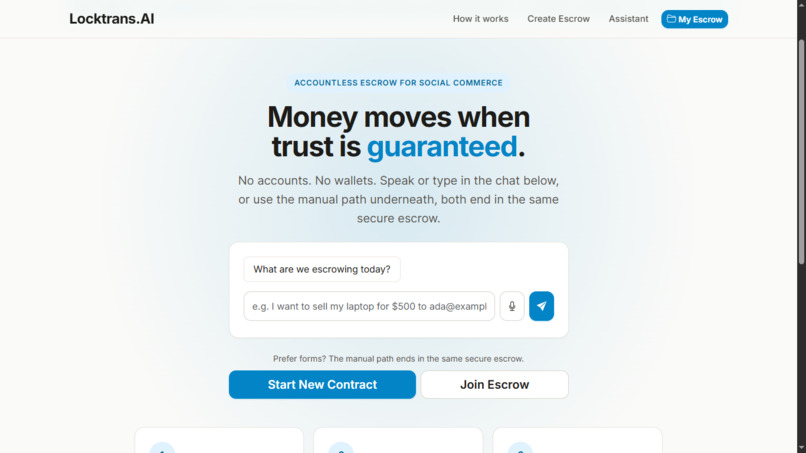
Landing Page
-
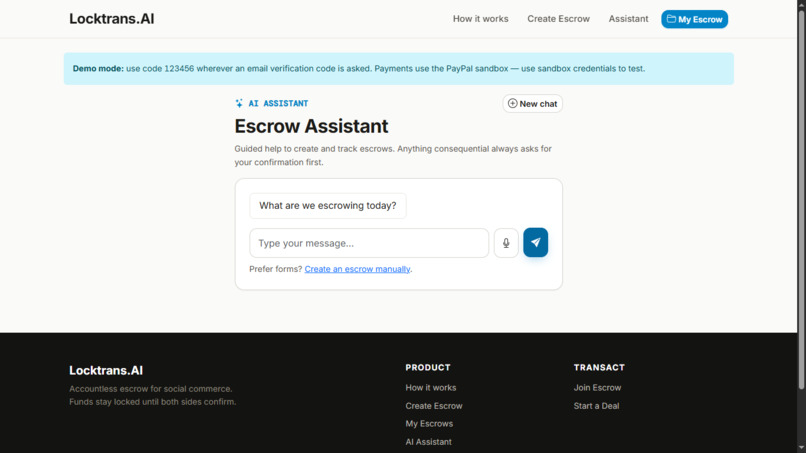
AI chat UI
The Story Behind Locktrans.AI
Inspiration
Social media has transformed how people buy and sell. Platforms like Instagram, WhatsApp, Facebook, and TikTok have made it easier than ever for individuals and small businesses to reach customers. However, trust remains a major problem in these transactions.
Buyers worry about paying sellers who might never deliver, while sellers worry about delivering products or services without receiving payment. Many transactions still depend entirely on trust between strangers.
I wanted to solve this problem by making escrow accessible to everyone, without the complexity of traditional escrow services.
That idea inspired Locktrans.AI, an AI-powered escrow platform designed to make social commerce safer and more accessible. Instead of navigating complicated forms and procedures, users can interact with an AI agent using natural language to create and manage escrow transactions.
What We Built
Locktrans.AI combines AI agents with escrow infrastructure to simplify how people establish trusted transactions.
Users can describe their transactions conversationally, and the AI agent helps extract relevant information, identify missing details, and guide them through creating an escrow agreement.
The platform brings together three important components:
- AI-powered interaction: Users can describe transactions in natural language instead of manually navigating complicated processes.
- Escrow transaction management: Buyers and sellers can establish transaction terms, agree on conditions, and track the progress of their transactions.
- Payment integration: PayPal provides the payment infrastructure for processing escrow payments.
We also designed the experience around the communication channels people already use, particularly WhatsApp, making escrow more accessible to social media merchants and their customers.
How We Built It
I built Locktrans.AI independently, approaching the project from both the software engineering and AI integration perspectives.
The backend was developed with Python and Django, providing the transaction infrastructure, validation, authorization, and business logic.
The AI component acts as an intelligent interface to the underlying system. Rather than allowing the AI to independently make financial decisions, it interacts with backend tools that validate requests and execute authorized operations.
We integrated payment functionality through PayPal and used external communication services to support verification and transaction notifications.
One of the most important architectural decisions was separating the AI interaction layer from the core escrow engine. This allows users to interact with the same transaction infrastructure through different interfaces without duplicating the underlying business logic.
Challenges and What I Learned
Building an AI-powered financial application presented challenges beyond simply integrating a language model.
One major challenge was getting reliable tool calling. Natural language models can interpret user intentions correctly but still produce incorrect tool parameters or fail to invoke the appropriate backend operations. This was particularly important for sensitive actions such as releasing escrow funds.
I learned that AI applications involving financial transactions must not rely on the model alone for authorization or execution. Critical operations must be validated by deterministic backend logic, with proper transaction states and authorization checks.
Another challenge was integrating multiple services while maintaining a simple user experience. Payment processing, identity verification, communication, and transaction management all needed to work together without making the process complicated for users.
The experience taught me that building useful AI products is not just about making models smarter. It is about designing reliable systems around them.
What's Next?
Locktrans.AI is a step toward making secure transactions accessible beyond traditional e-commerce platforms.
Our vision is to make escrow as simple as sending a message. Whether someone is buying a product from an Instagram vendor, hiring a freelancer through WhatsApp, or conducting business with someone they have never met, they should have access to a reliable way of protecting their transaction.
We believe trust should not be a luxury reserved for large businesses and established marketplaces. It should be accessible to everyone.
