-
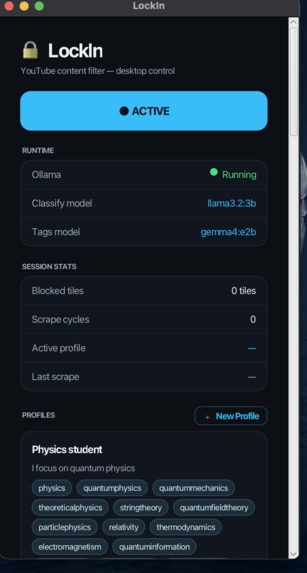
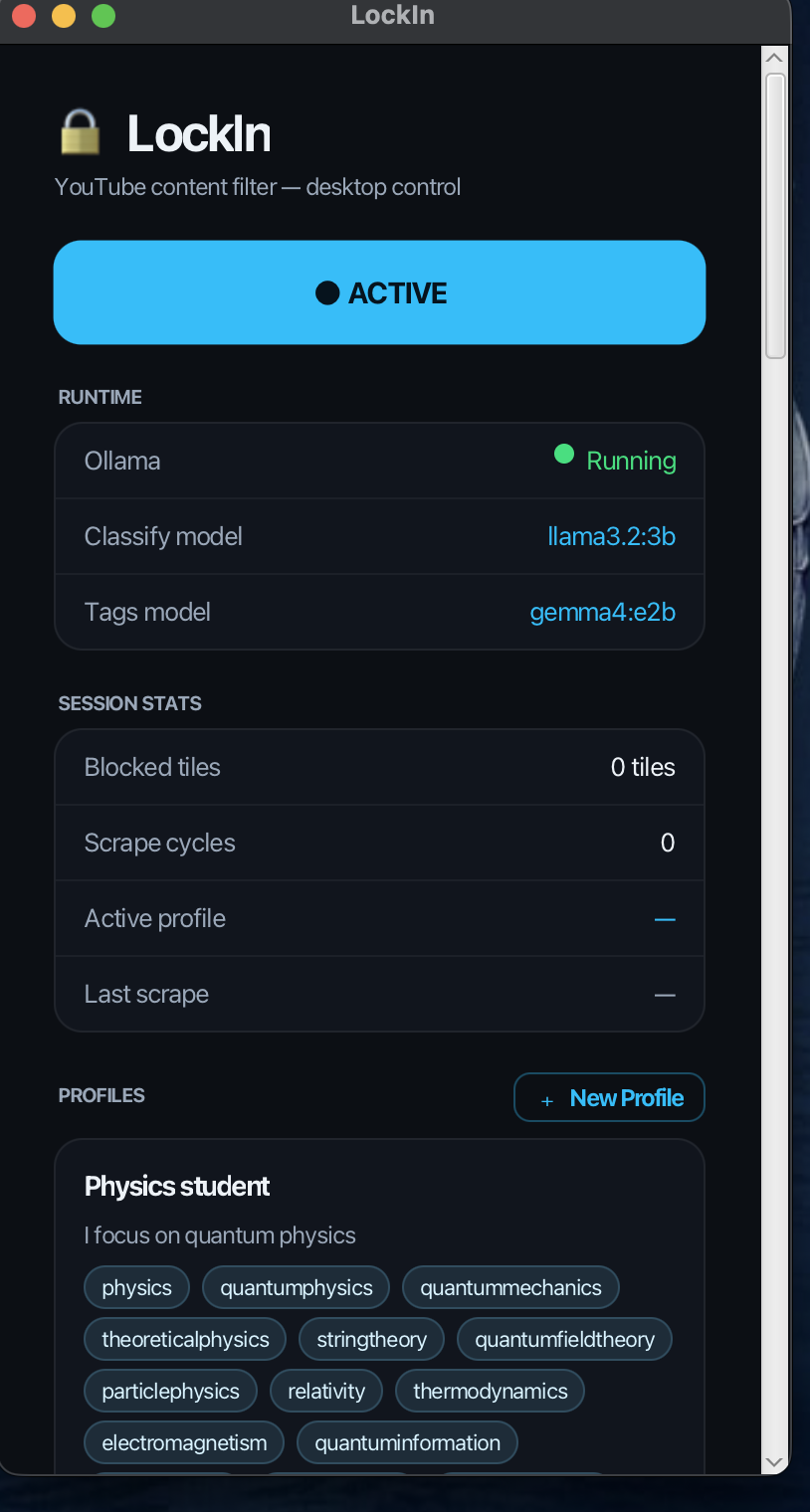
Desktop app
-
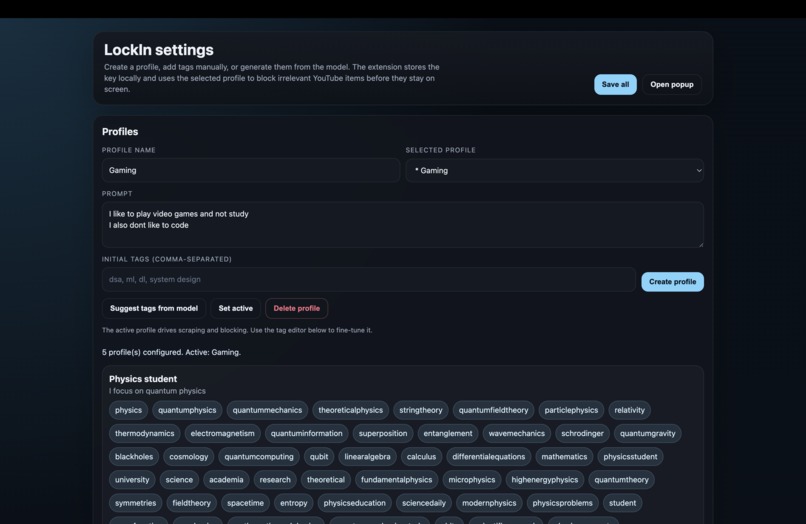
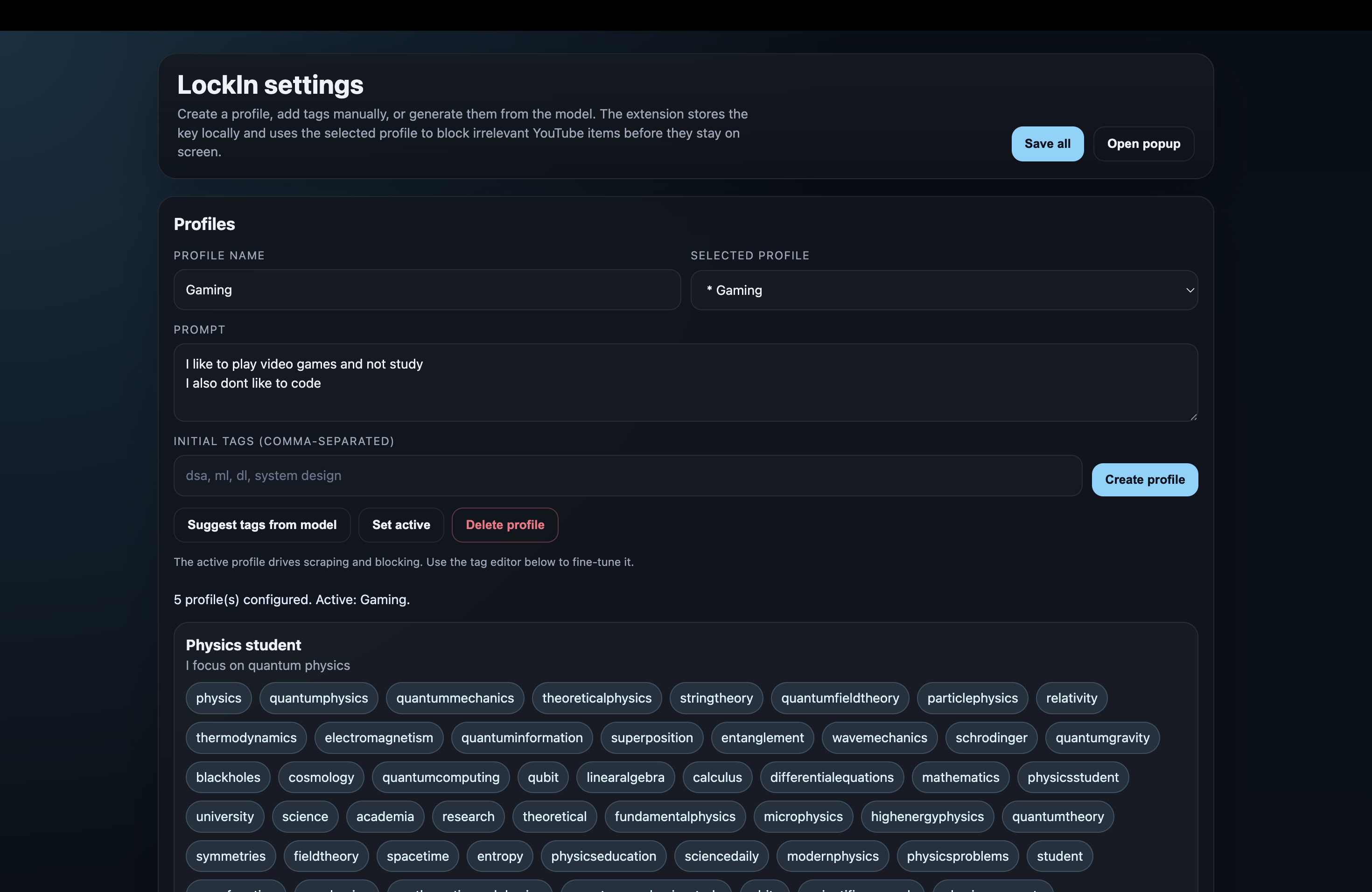
LockIn — Our Story
Inspiration
What if there are no distractions on YouTube? The idea grew from a simple question: can the attention-sapping parts of modern video platforms be separated from the useful content? LockIn aims to create that separation so focused work and intentional learning can coexist with video content.
What it does
LockIn reduces impulse viewing by detecting and controlling distracting paths (recommended videos, autoplay, trending feeds) while preserving requested content. It applies lightweight heuristics and user rules to:
- hide recommendation surfaces
- pause autoplay unless explicitly allowed
- surface a distraction score and quick override
How we built it
Stack: Electron desktop shell + a small local service and content hook (see tab-scrapper/) that inspects DOM patterns and navigation events. Core components:
- UI: Electron + React for quick cross-platform delivery
- Scraper: deterministic DOM detectors and heuristics to identify "recommendation" nodes
- Policy engine: rule-based layer that decides hide/allow actions
We score pages with a linear model:
$$ S = w_R R + w_V V + w_T T,\quad w_R + w_V + w_T = 1 $$
where $R$ = recommendation density, $V$ = visual salience, $T$ = time-of-day factor. The distraction probability is modeled as
$$ P(D\mid t)=1-e^{-\lambda t} $$
to estimate escalating risk with longer passive exposure.
Challenges we ran into
- Site fragility: platform DOMs change often — required robust selectors and graceful fallback.
- False positives: blocking useful sidebar links led to user friction; needed fine-grained allowlists.
- Privacy: running analysis locally to avoid sending browsing data off-device.
- Cross-platform quirks (macOS background activity, Windows focus rules).
Accomplishments that we're proud of
- Working prototype that removes recommendation surfaces while keeping the requested video intact.
- Local-only analysis preserving privacy.
- Usable override flow so users never feel "locked out" — control remains in their hands.
What we learned
- Minimal friction beats heavy-handed enforcement: soft nudges + easy overrides had better retention.
- Deterministic heuristics are simpler to maintain than early ML attempts for this scope.
- User control and transparency (showing why something was hidden via the score) builds trust.
What's next for LockIn
- Personalized models (on-device) to adapt weights $w_R,w_V,w_T$ per user.
- Extension to mobile and browser extensions with synchronized policies.
- Community-driven rules and presets for different workflows (study, coding, light learning).

Log in or sign up for Devpost to join the conversation.