-
-

Logo
-
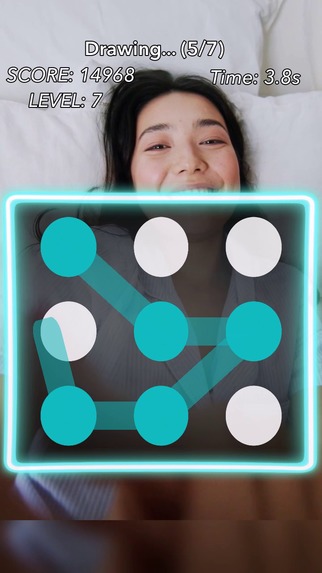
Playing screen
-
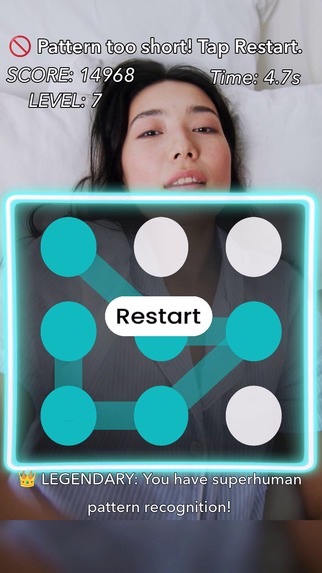
Game over screem
-
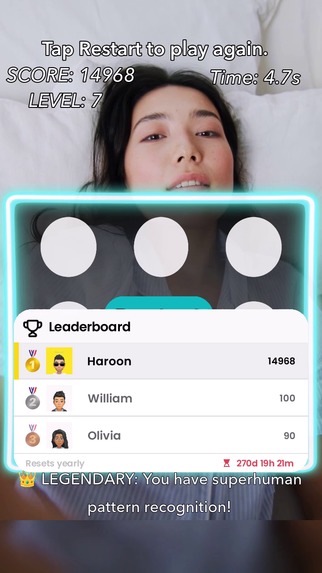
Leaderboard

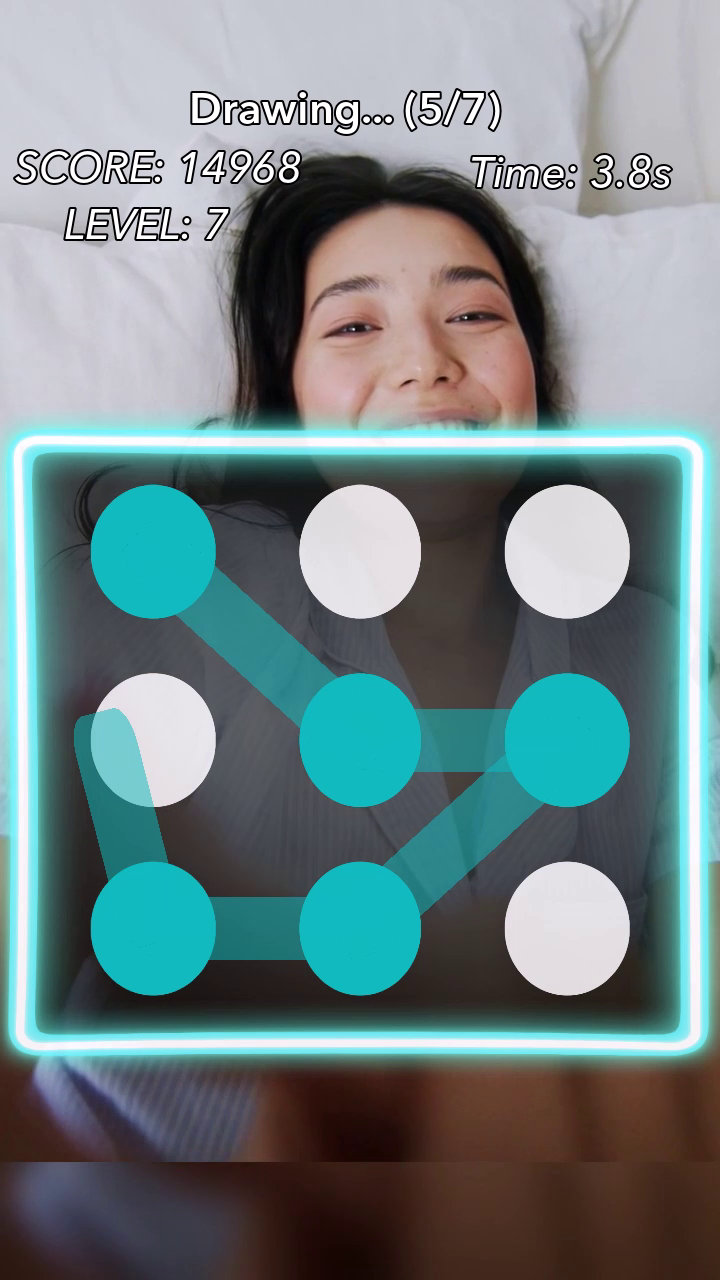
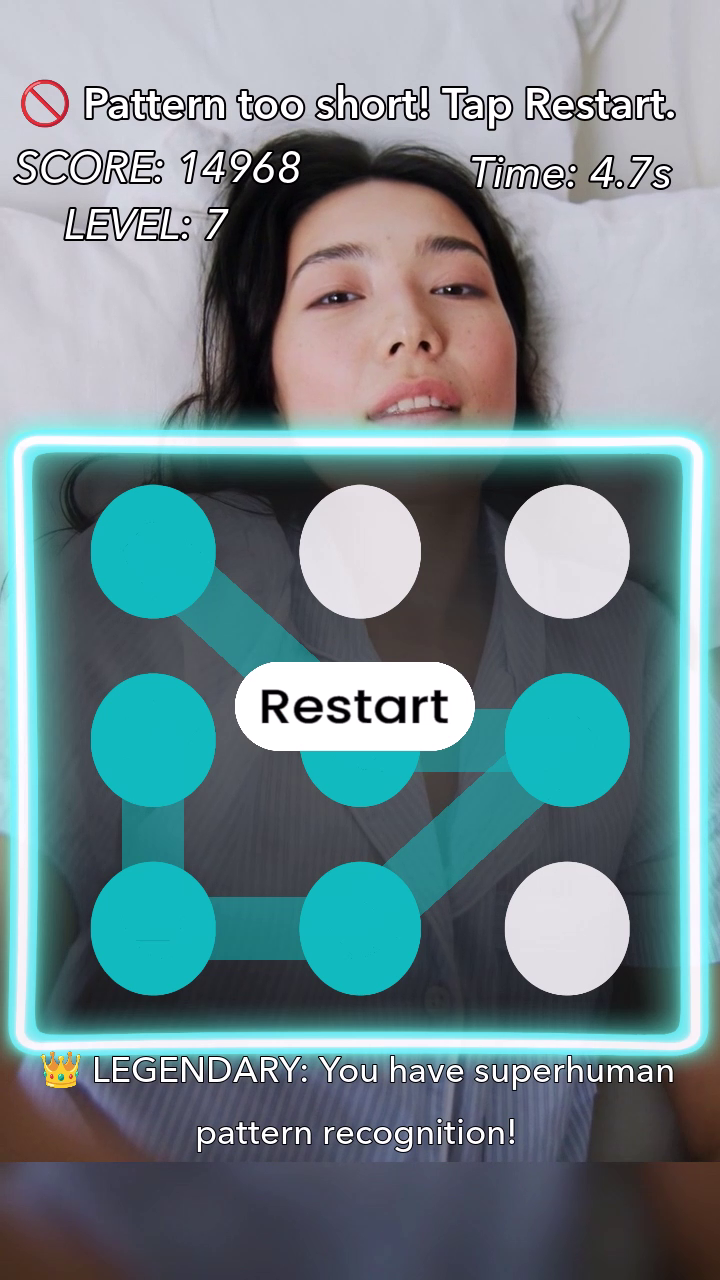
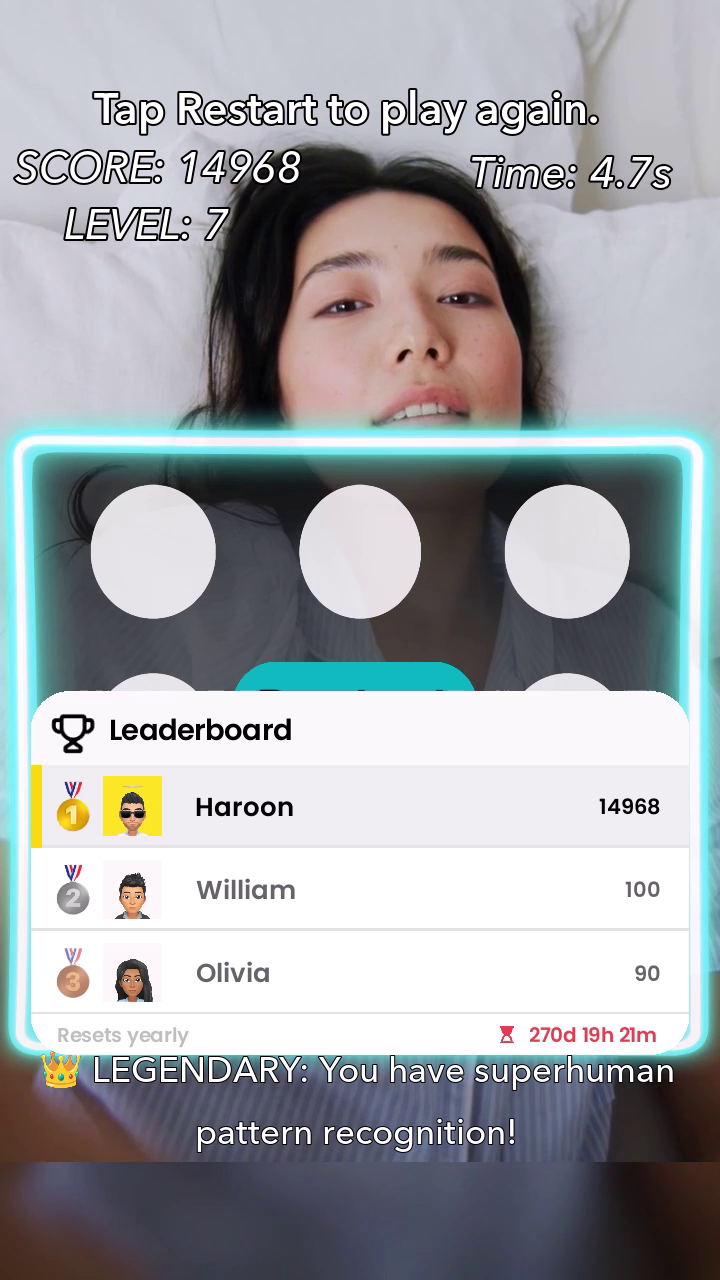
The Inspiration
The project was inspired by the tactile security of smartphone lock patterns.
I wanted to transform a mundane utility into a high-speed memory challenge. The goal was to create a spatial rhythm puzzle where memory is rewarded with higher scores and increasing difficulty, turning a simple interface into a competitive game.
Building the Experience
The game centers on a 3×3 grid of responsive nodes.
I built a procedural pattern generator that respects spatial adjacency, ensuring every sequence is physically drawable without illogical jumps.
The core loop alternates between two phases:
- Display Phase: The Lens demonstrates the pattern using timed animations.
- Guess Phase: The user must replicate the pattern perfectly under a ticking clock.
The Technical Logic
To draw the connection lines in real time between nodes, the script calculates the distance $d$ between two points $P_1(x_1, y_1)$ and $P_2(x_2, y_2)$ to determine the line scale:
$$ d = \sqrt{(x_2 - x_1)^2 + (y_2 - y_1)^2} $$
The rotation angle $\theta$ is dynamically updated using the arctangent of the directional vector, ensuring the line always follows the user’s finger:
$$ \theta = \operatorname{atan2}(y_2 - y_1, x_2 - x_1) $$
The final score is calculated based on pattern length $L$ and elapsed time $t$, weighted by a difficulty multiplier $D$:
$$ Score = \left( \frac{L \cdot 1000}{t} \right) \cdot D $$
Challenges Faced
The primary hurdle was memory and event cleanup.
When a user restarts or advances to a new level, previous animation timers (DelayedCallbackEvents) could overlap, creating ghost patterns. I solved this by implementing a robust safeRemove function that clears all active callbacks before initializing a new round.
Another challenge was touch precision. Making the system feel snappy required fine-tuning the touchTolerance. I also added a vertical offset correction to account for how users naturally touch the screen slightly below their line of sight.
What I Learned
- State Management: Coordinating transitions between Showing and Playing states without logic conflicts.
- Dynamic UI: Managing Screen Transform anchors to keep the grid perfectly centered across different smartphone aspect ratios.
- UX Feedback: Using color shifts and audio cues to provide immediate Match or Fail feedback—crucial for high-speed puzzle games.
Built With
- api
- javascript

Log in or sign up for Devpost to join the conversation.