-
-
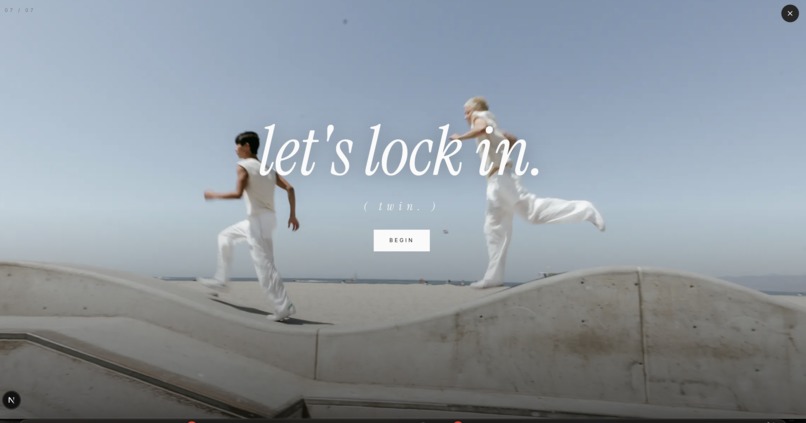
That's me and my friend in Venice should out Charis for the photo
Lock-In Twin
What if a locked-in version of you existed?
Lock-In Twin humanizes productivity: It creates you. Yes, litterally you. Your twin. It has your personality, your lingo, and your focus habits to hold you accountable during work sessions, whether its through encouragement or by reminding you of the girl that broke your heart. It's not another chatbot with a timer. It's a persistent AI agent that learns how you talk, speaks in your cloned voice, checks in on you, roasts you when you slack, hypes you with hand gestures, and evolves after every session.
Inspiration
Idea inspiration: Every productivity app treats you like a generic user. Same Pomodoro timer. Same bland notifications. Same "you got this!" energy from an app that doesn't know you at all. I wanted something that actually mirrors how I work, my energy, my lingo, my voice. And who knows you better than yourself?
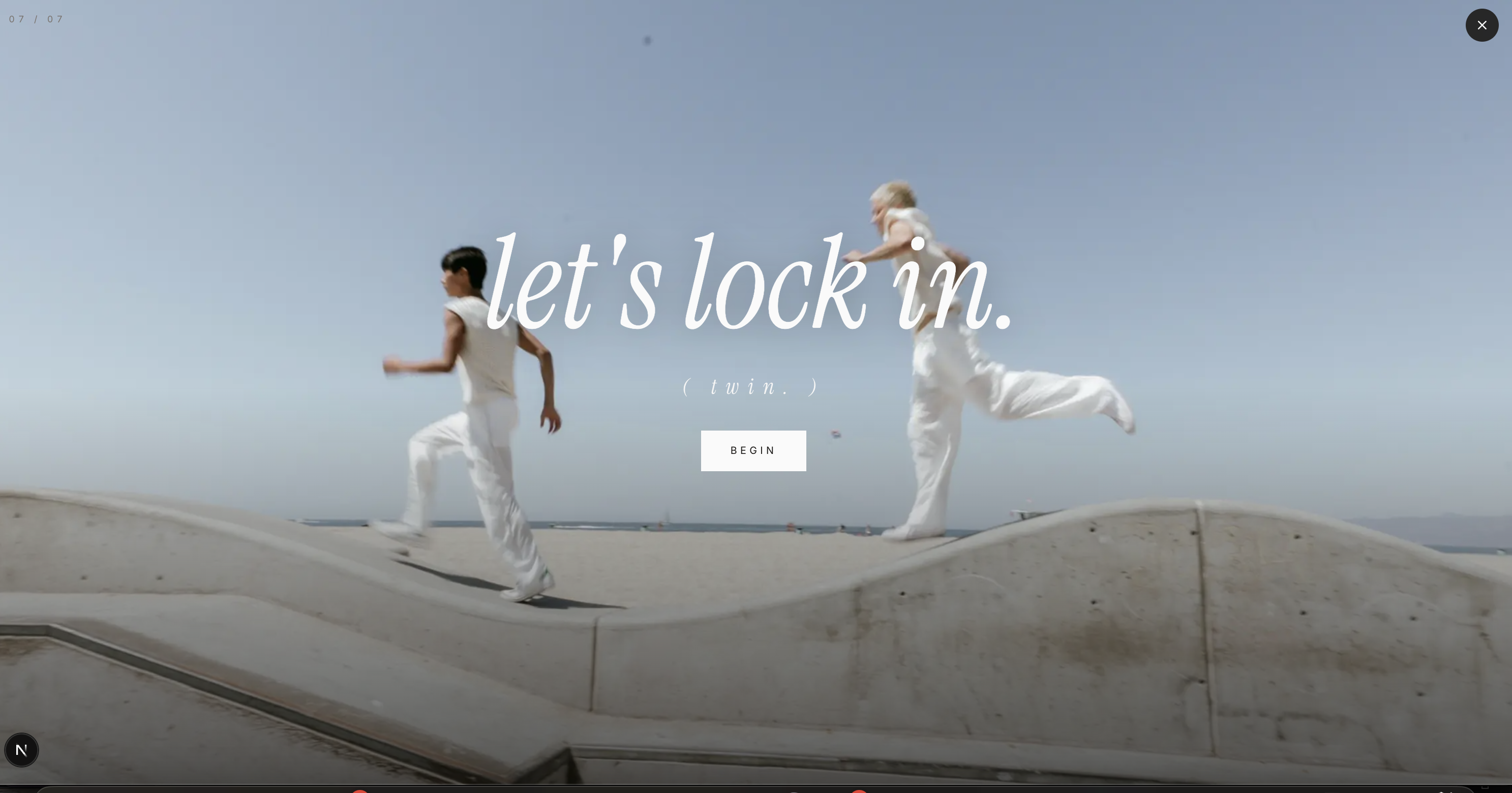
Creative Inspiration: I utilized Figma Make to treat this how I treat a modeling photoshoot. For the baseline, I uploaded 2 boards on Pinterest (Chiq and April Moodboard/), giving it to Figma Make to give it a general framework of the styling. Then I realized that my app needed more soul, so I incorporated photos and themes that resonated with me. I chose pictures of the ocean and beach because I am originally from San Diego. One of those pictures, the thumbnail of this project, is a photo of me and my friend running in Venice beach, perfectly encapsulating the motion and freedom that productivity enables us towards.
What it does
Lock-In creates an AI twin that mirrors your personality, lingo, and workstyle through a three-phase loop:
1. Create your twin Pick a personality archetype (toxic motivator, hype beast, chill coach, or drill sergeant), teach it how you talk by pasting your text messages, set your work preferences, clone your voice with a 30-second recording, and verify your twin with World ID.
2. Lock in Describe what you want to accomplish. Your twin clarifies your goal, breaks it into timed sub-tasks with estimated weights, then motivates you throughout the session with vocal stims, personality-aware check-ins, and hand gesture interactions (because of how bad everyone's attention spans are) all spoken in your cloned voice. Hold up horns for a hype phrase. Palm to pause. Shaka to skip. No keyboard needed.
3. Your twin evolves After each session, the agent reflects on what worked and what didn't, updating its memory of your patterns. Over time, it gets better at pushing you.
You can also create multiplayer rooms to lock in with friends for group accountability sessions.
How I built it
Lock-In runs on a multi-model personality cloning pipeline where each AI tool handles what it's best at:
Claude Sonnet 4.6 (Anthropic) is the brain of the entire system. It handles goal clarification (is your goal specific enough?), task splitting (breaking goals into timed sub-tasks with breaks and weights), personality-aware check-ins during sessions (adapting to your twin's archetype — toxic roasts vs. chill encouragement), vocal stims (short 3-8 word hype phrases), and post-session agent reflection where it analyzes the session and updates the twin's memory for next time.
Gemma 4 27B (Google) does something no other model in our stack does: it reads how you actually talk and extracts your linguistic fingerprint. Feed it your text messages and it outputs a structured profile: slang dictionary, sentence starters, tone summary, emoji habits, punctuation style. This profile is what makes your twin sound like you instead of a generic AI. We're not using Gemma for chat: we're using it for identity.
ElevenLabs provides text-to-speech and instant voice cloning. Users record 30 seconds of audio during onboarding, and from that point on, every check-in and vocal stim is spoken in their own cloned voice. The moment your twin speaks in your voice, the entire experience shifts from "AI tool" to "digital twin." Falls back to browser SpeechSynthesis when the ElevenLabs API is unavailable.
Auth0 + NextAuth v5 secures the identity layer. Each user authenticates through Auth0, and their AI twins are private and tied to their real account. Our twins aren't just chatbots: they're persistent AI agents with memory, personality, and voice that act on behalf of authenticated users. Auth0 ensures each user's agent ecosystem is isolated and secure.
World ID (Worldcoin) provides proof-of-humanity verification at the agent level. Instead of verifying accounts, we verify agents: your digital twin has proof that it's backed by a real human. This uses World ID v4 with RP signing, the IDKit widget, and nullifier hash storage. In multiplayer rooms, this becomes the foundation for trust: verified-only rooms where you know everyone locking in is real.
MongoDB Atlas stores persistent agent memory, session history, voice profiles, and room data. Every session feeds back into the agent's memory, creating a continuous improvement loop. The agent remembers your work patterns, what motivation styles worked, and how to push you better over time.
MediaPipe enables real-time hand gesture detection entirely client-side. Five gestures are recognized: horns (hype me up), palm (pause session), shaka (skip task), thumbs up (confirm), and both palms (end session). No keyboard or mouse needed during a focus session: just your hands and your twin's voice.
Next.js 16 with App Router and Turbopack powers the frontend and API routes. Framer Motion handles animations throughout the warm paper-aesthetic UI. Tailwind CSS for styling.
How it applies to company challenges
Auth0: Best Use of Auth0 AI Agents: Lock-In's twins ARE AI agents: persistent, memory-equipped, personality-driven agents that act on behalf of authenticated users. Auth0 secures the identity layer so each user's agent is private and evolves over time tied to a real account. This goes beyond login: it's AI agents with identity.
Google: Best Use of Gemma: Gemma 4 27B is used for personality cloning, not generic chat. It analyzes raw text messages and extracts a structured linguistic fingerprint (slang, tone, sentence starters) that powers how the twin speaks. A unique, identity-focused use case for the model.
ElevenLabs: Best Use of ElevenLabs: Voice cloning turns a focus timer into a digital twin. Your twin doesn't just text you — it talks to you in your own voice. Hearing yourself say "lock in" hits different. TTS powers check-ins, vocal stims, and the entire audio layer of the experience.
World ID: Build for the future of the internet with World: We verify agents, not accounts. Your AI twin has proof of humanity. In multiplayer, this creates sybil-resistant focus rooms where every participant is verified as real. Uses World ID v4 with full RP signing integration.
MongoDB Atla: Best Use of MongoDB Atlas: Persistent agent memory, session history, voice profiles, and multiplayer room state. Every session writes back to the agent's memory, enabling a continuous learning loop where the twin improves over time.
Arista Networks - Connect the Dots: Lock-In connects 5 different AI and identity systems into one cohesive focus experience. Users connect to personalized AI agents, Auth0 connects users to secure identities, World ID connects agents to verified humans, multiplayer rooms connect users to each other, and session data routes back to agents for continuous improvement. The data loop is: user → agent → session → reflection → better agent. Every session makes the connection stronger.
Figma Make: Used Figma Make to prototype the session flow UI and iterate on the warm paper aesthetic before writing code. Helped test the onboarding steps and timer layout rapidly during the first hours of the hackathon. See above for creative inspiration
Challenges we ran into
- ElevenLabs voice cloning requires a paid plan, so we made that step optional and added browser SpeechSynthesis as a fallback. The free tier works for TTS but not cloning.
- ElevenLabs API key quota settings were per-key (not total credits), which caused confusing 500 errors until we dug into the dashboard and realized "quota of 10" meant the per-key rate limit, not 10 API credits.
- World ID's sybil check blocked users from verifying multiple agents with the same World ID — we had to rethink the verification model to allow one human to back multiple twins while maintaining sybil resistance.
- Balancing 6 different sponsor APIs in one cohesive flow without any feeling bolted on. Each integration had to serve a real purpose in the user experience, not just exist for prize eligibility.
- Building the entire thing solo in under 24 hours meant ruthless prioritization — multiplayer sync is room-based but not real-time yet.
Accomplishments that we're proud of
- The personality cloning pipeline: Gemma extracts your lingo, Claude uses it to speak like you, ElevenLabs says it in your voice. It genuinely feels like talking to yourself. Three models, each doing what they're best at.
- Hand gesture controls that actually work in a focus session: hold up horns and your twin hypes you, no keyboard needed. MediaPipe runs entirely client-side with real-time landmark detection.
- 6 sponsor integrations that all serve a genuine purpose. Not a single bolt-on. Auth0 secures identity, Gemma clones personality, ElevenLabs clones voice, World ID verifies humanity, MongoDB stores memory, MediaPipe enables gestures. Each one has a unique, non-overlapping role.
- Built the entire thing solo in under 24 hours. Full-stack Next.js 16 app with 14 API routes, 5 pages, auth, voice cloning, gesture recognition, multiplayer rooms, and a polished warm paper aesthetic UI.
What we learned
- Multi-model orchestration beats single-model everything. Using the right model for the right job (Gemma for analysis, Claude for reasoning, ElevenLabs for voice) produces a better experience than forcing one model to do everything.
- Voice makes AI feel real in a way text never can. The moment your twin speaks in your voice, the whole experience shifts from "chatbot" to "digital twin." That emotional response is impossible to replicate with text alone.
- API quota debugging is its own skill. ElevenLabs rate limits, World ID nullifier hash conflicts, and Auth0 callback configuration all required debugging that had nothing to do with code logic and everything to do with reading API dashboards carefully.
- Personality-aware prompting is hard. Getting Claude to consistently maintain a "toxic motivator" vs "chill coach" voice across check-ins, stims, and reflections required careful system prompt engineering and lingo injection.
What's next for Lock-In Twin
- Real-time multiplayer sync so room members can see each other's progress live and receive group check-ins
- Agent-to-agent interaction — your twin can hype up your friend's twin in multiplayer rooms
- Mobile app with always-on voice companion for on-the-go accountability
- Long-term memory across sessions so your twin knows your patterns over weeks and months, not just individual sessions
- Calendar and task management integration so your twin can proactively suggest what to work on based on your schedule
Built With
next.js react typescript tailwind-css framer-motion claude-sonnet-4.6 anthropic-api gemma-4-27b google-ai elevenlabs mongodb-atlas mongoose auth0 nextauth world-id worldcoin mediapipe vercel
Built With
- anthropic-api
- auth0
- claude-sonnet-4.6
- elevenlabs
- framer-motion
- gemma-4-27b
- google-ai
- mediapipe
- mongodb-atlas
- mongoose
- next.js
- nextauth
- react
- tailwind-css
- typescript
- vercel
- world-id
- worldcoin

Log in or sign up for Devpost to join the conversation.