Inspiration I have a memory palace I can't use.
The method of loci — placing what you want to remember along a route through a building you already know — is the oldest mnemonic in the world because spatial memory outlasts verbal memory. Mine lived on index cards, and index cards have no rooms.
Every flashcard app flattens knowledge into a list, losing the one memory system your brain is genuinely good at. Every VR productivity app I tried was a floating screen in an empty void — the headset was a bigger monitor. LOCII inverts that. The room is not the backdrop. The room is the mnemonic.
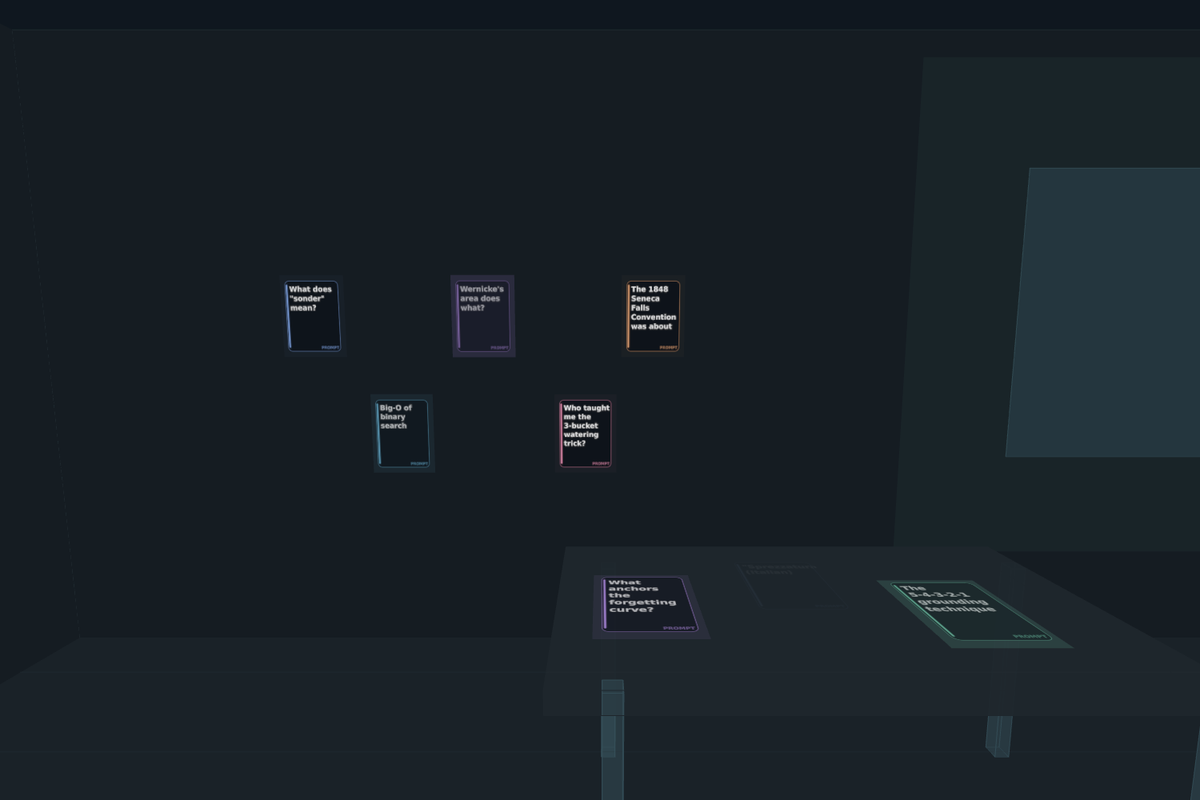
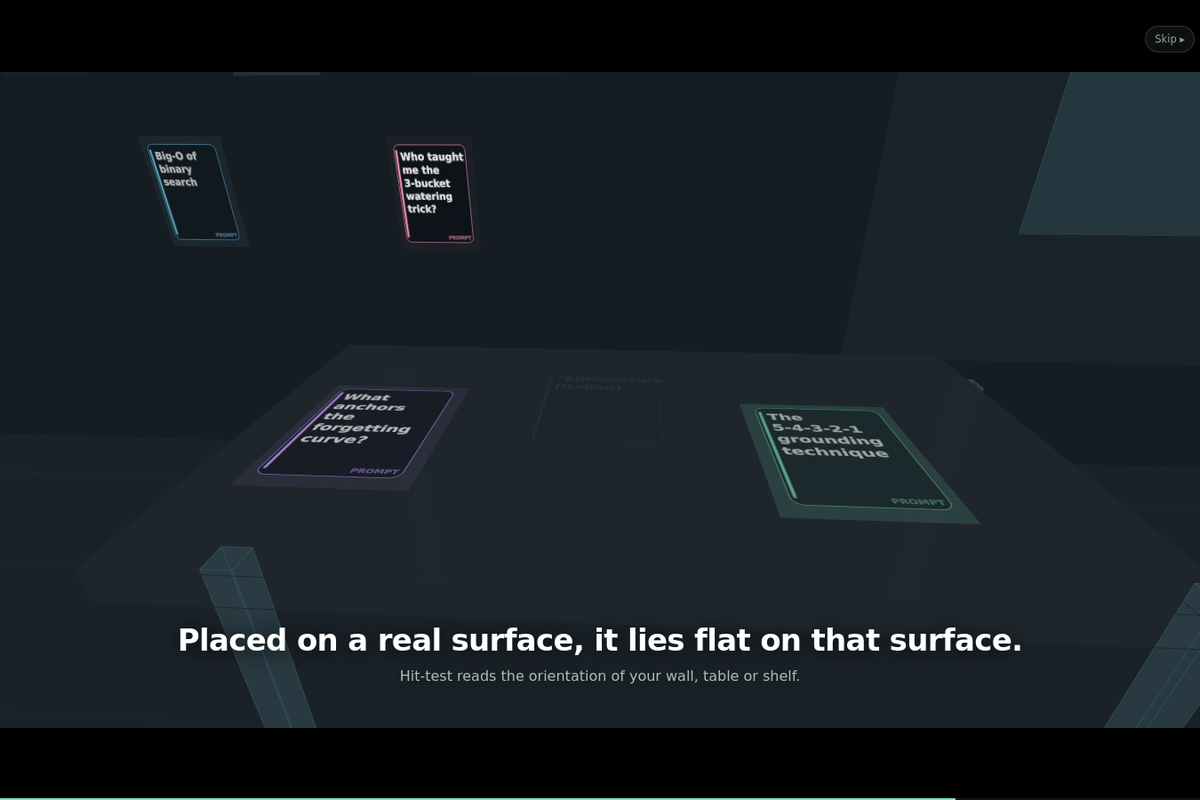
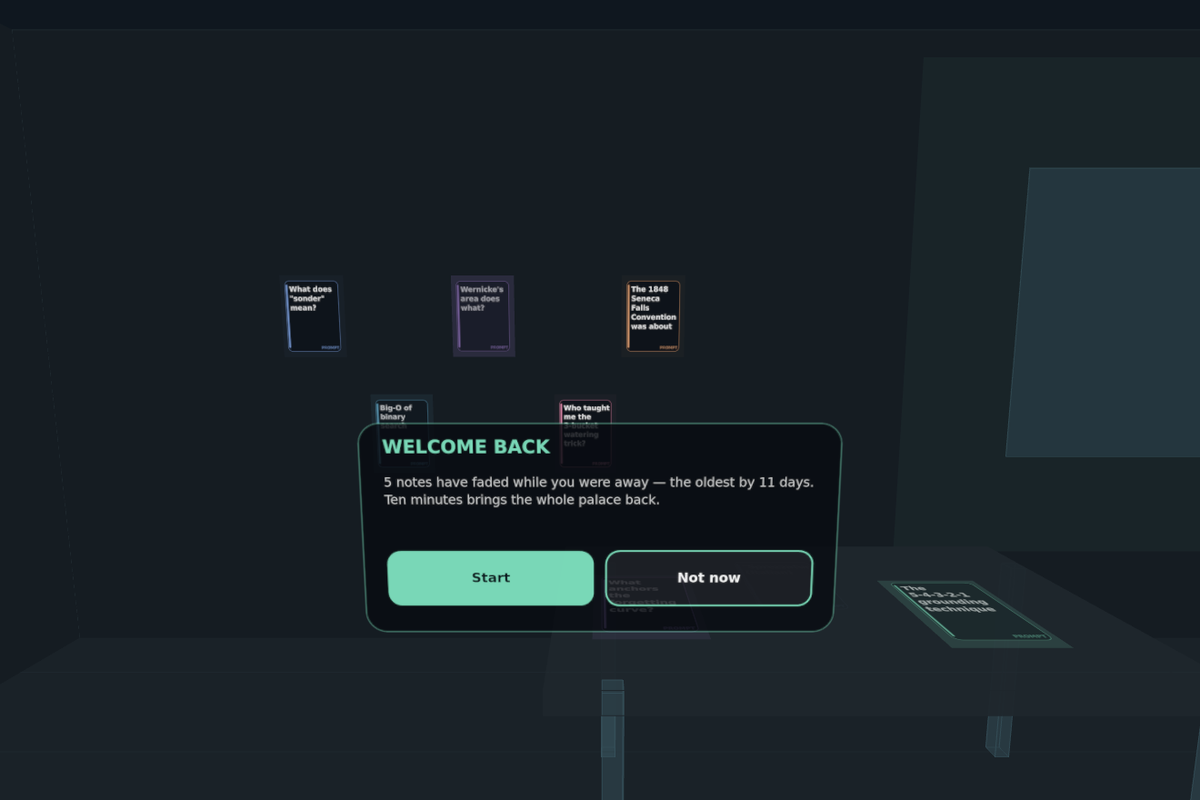
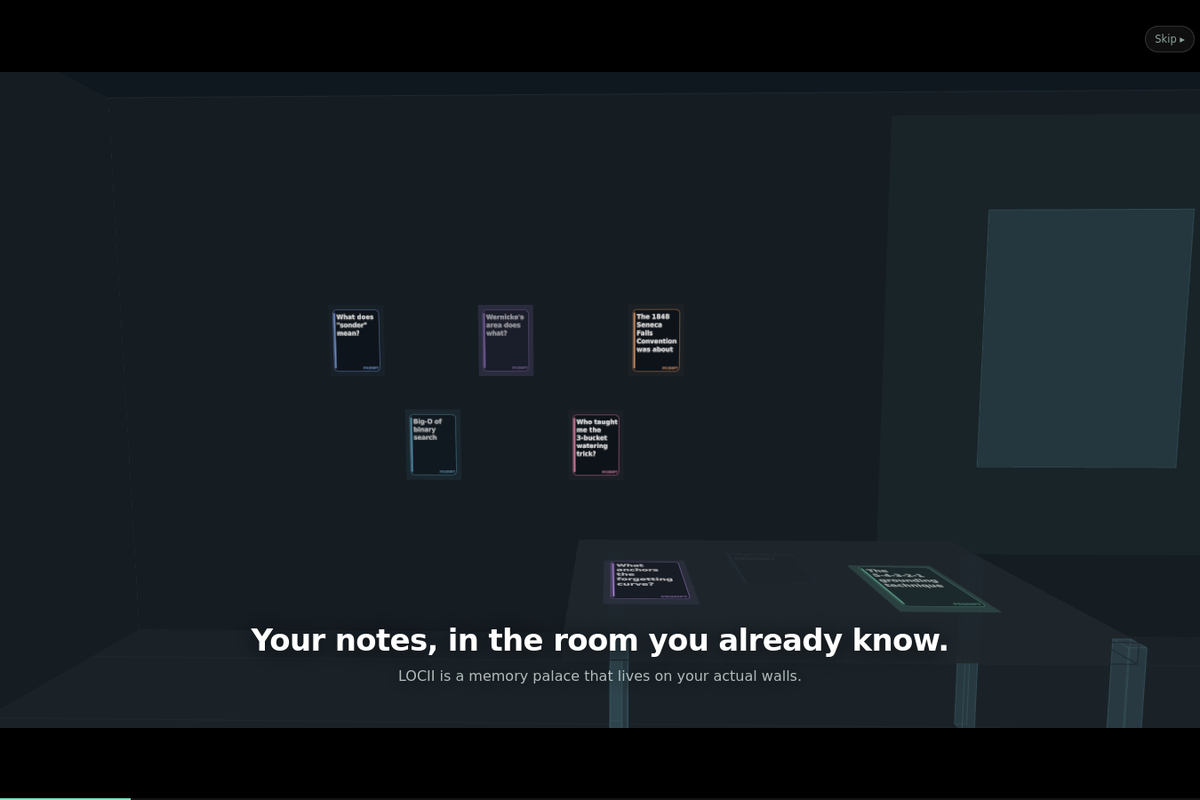
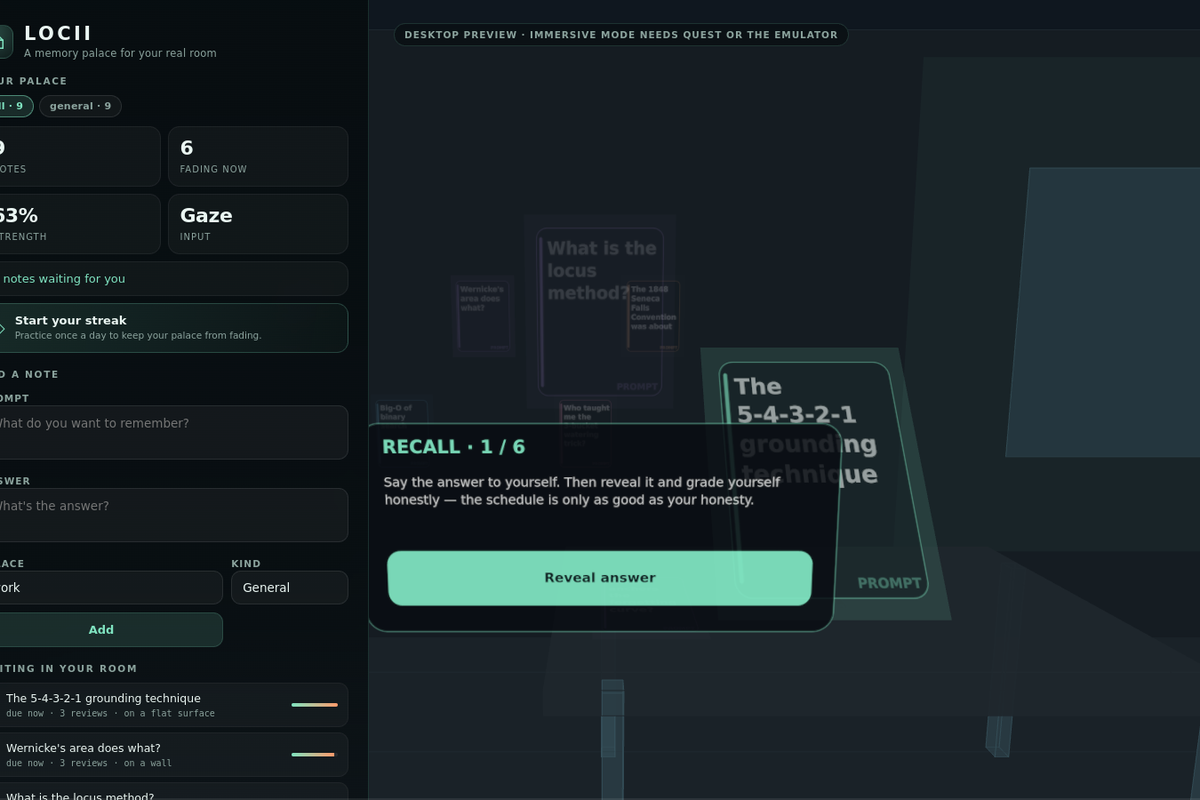
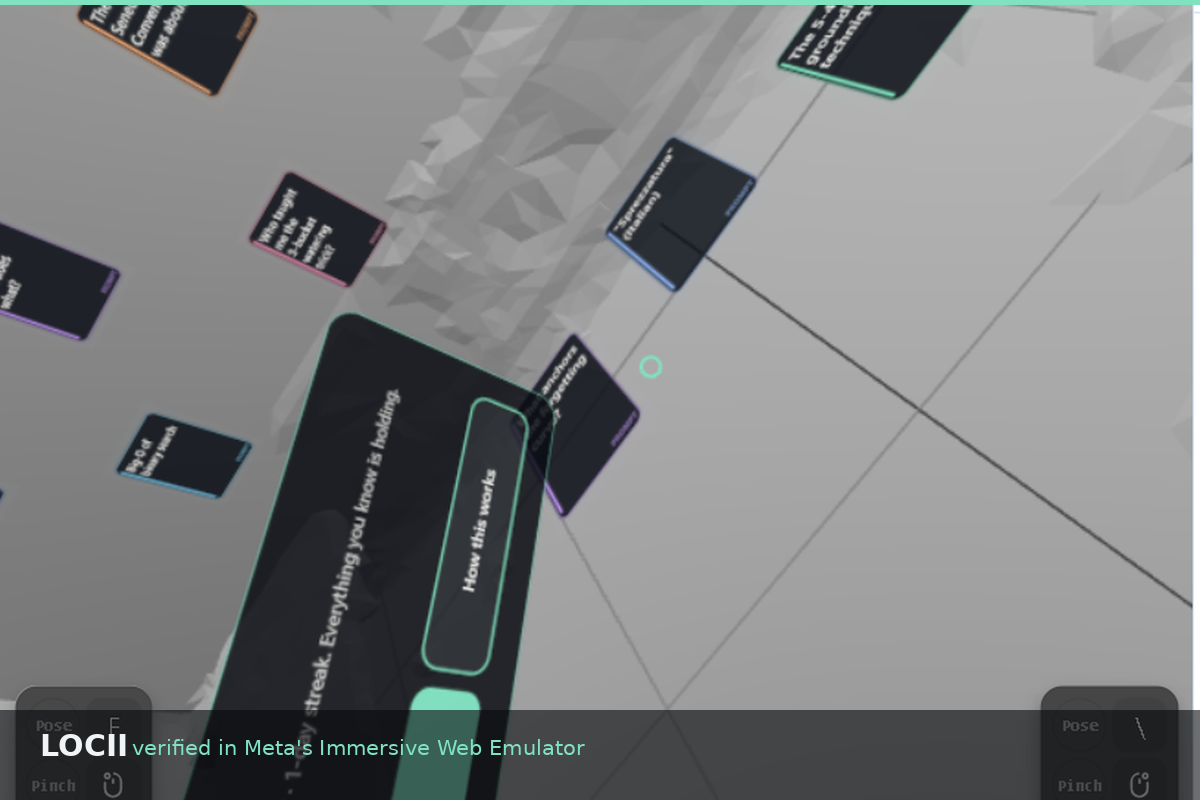
What it does Author notes on the flat screen, where you have a real keyboard — you never type inside a headset, because that is where VR productivity goes to die. Then put the headset on: passthrough stays on, and LOCII lays your notes onto your actual walls, table and shelves.
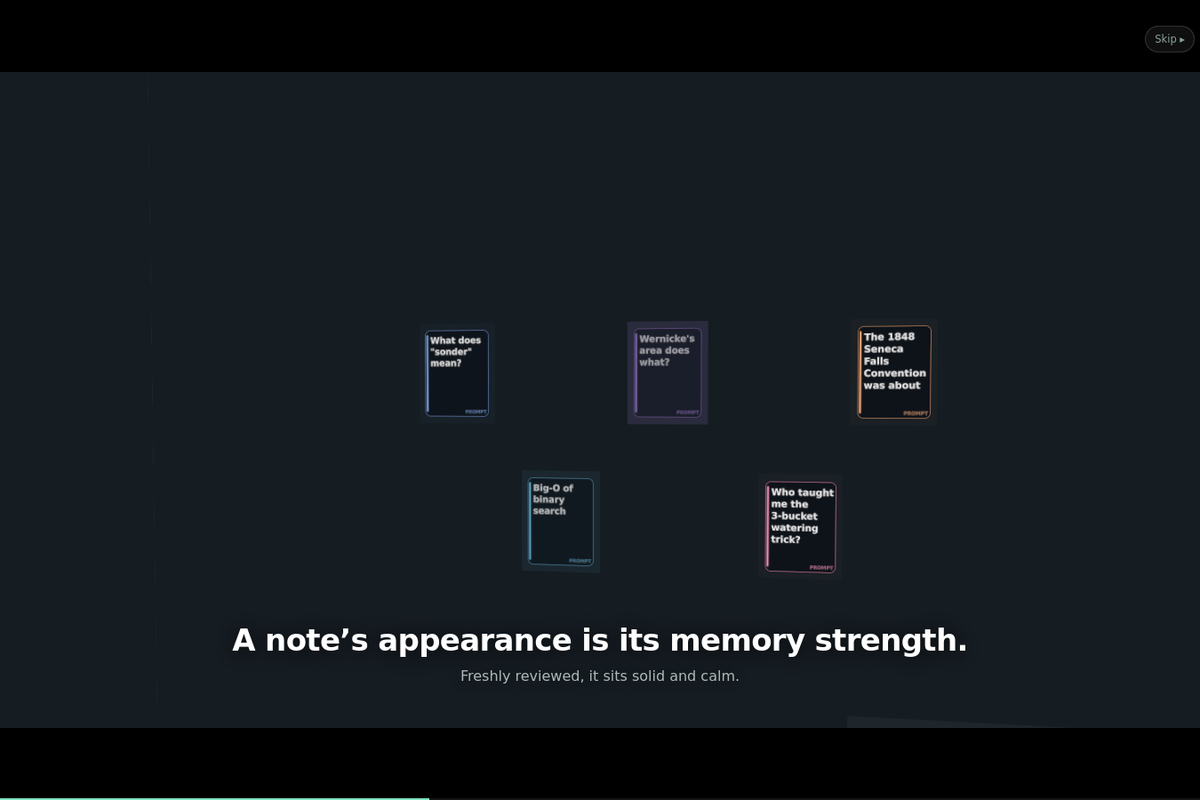
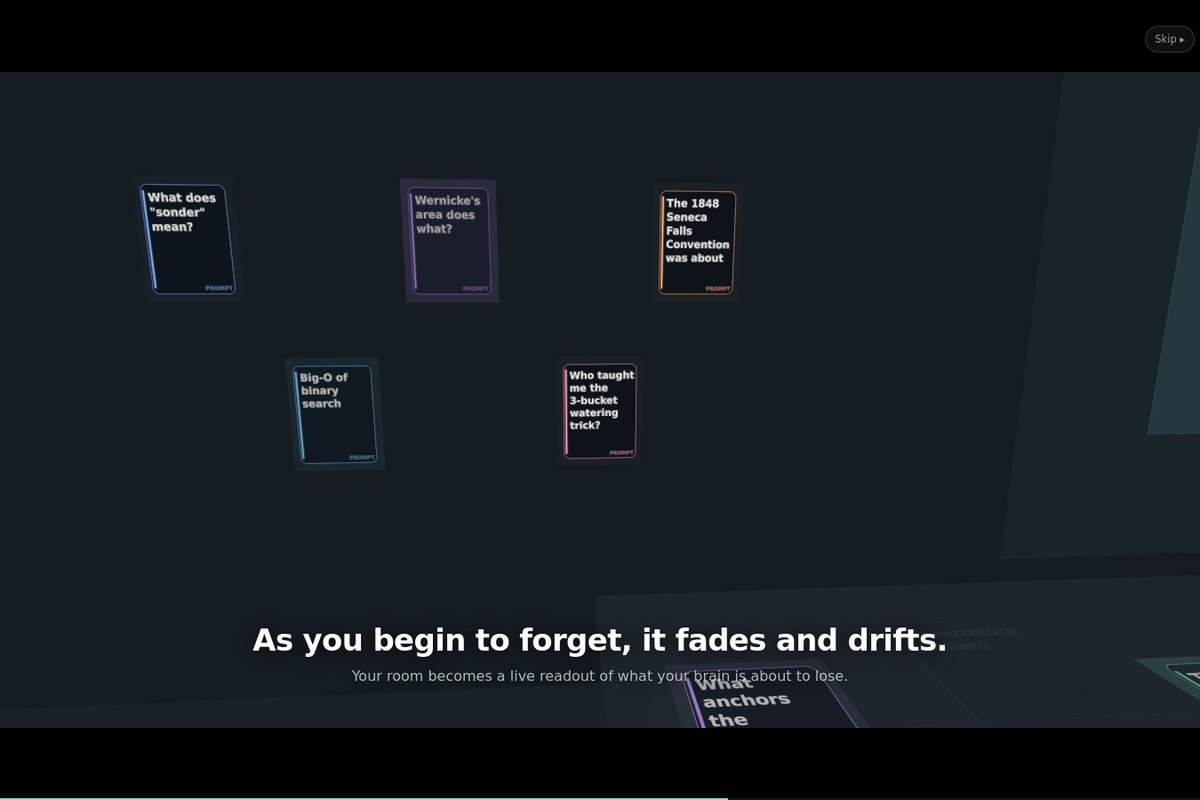
A note's appearance is its memory strength. Freshly reviewed, it sits solid and calm. As you begin to forget, it fades, desaturates and drifts. Your room becomes a physical readout of what your brain is about to lose — the art direction and the mechanic in one idea.
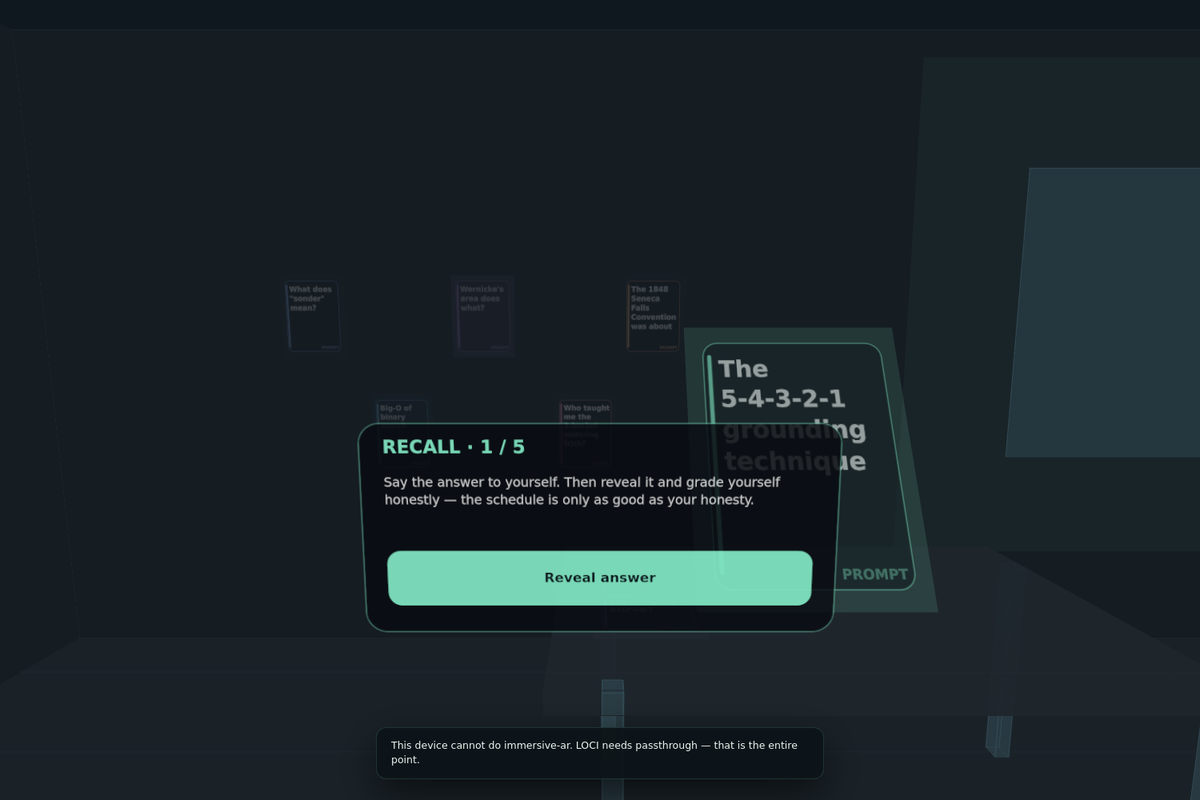
Daily, the fading notes wait where you left them. Look at one, pinch, recall, grade yourself honestly. A lapse collapses it back to tomorrow and visibly dims; a clean recall buys a longer gap and it settles. Sessions cap at ten notes — ten minutes, finishable on a bus.
Gaze aims, pinch confirms. Gaze is precise; pinch is the most reliable discrete signal a hand produces; neither tires your arm from a sofa. A dwell ring fills as you hold your gaze, so the experience is fully operable by someone who cannot pinch. No controllers appear anywhere.
An on-device Curator watches for things you would not notice: a note that keeps being lost, notes written but never placed, several notes sitting too close to tell apart, or a return after a gap and what decayed while you were away. One suggestion at a time, one pinch to act, always explained. It never touches the network.
How I built it WebXR with the Immersive Web SDK and three.js, in plain ES modules — no framework, no build-time magic.
Placement uses the hit-test module and reads the hit pose orientation, so a note aimed at a wall lies flat on that wall and a note aimed at a table lies flat on the table, rather than billboarding toward the camera. Each placement takes a persistent XRAnchor where supported, with a local-floor pose fallback so nothing breaks when anchors aren't available. Placement is clamped to a 0.45–2.2 m shell and checked against your horizontal field of view, so the airplane-seat test holds.
The scheduler is an FSRS-style stability/difficulty model — retrievability = exp(ln(0.9) · elapsed / stability) — with lapse and success multipliers that produce genuine spacing. Sessions are urgency-sorted, interleaved and capped at ten.
Everything is generated at runtime: note textures are rasterised to canvas, every sound is synthesised through WebAudio. Nothing to download, nothing to license, no third-party services, no accounts, no network calls of any kind.
It ships with 91 automated checks — scheduler, daily ritual, Curator policy, pinch robustness, end-to-end browser tests, and 30 "rubric conformance" assertions that encode the competition's own requirements as executable tests so a future edit cannot silently break hands-first input or the word limit.
The bug that only an emulator would have found Testing in Meta's Immersive Web Emulator surfaced a real crash, and it would have fired on a Quest too.
XRHand.get() returns undefined for any joint the runtime hasn't begun tracking yet, and my pinch detector passed that straight into frame.getJointPose(). The result was a TypeError on every animation frame. An uncaught throw inside an XR frame callback can end the render loop — so the failure mode was not "pinch feels flaky," it was "the palace freezes the first time you raise a hand."
I guarded the joint lookup, fell back to the hand's emulated gamepad state, and wrapped the per-frame spatial and input updates so a single bad frame can never take down the loop. Then I wrote nine regression tests that reproduce the crash — undefined joints, a missing getJointPose, a method that throws, an empty session, a malformed source — plus tests proving a real pinch still registers and a close-but-not-touching hand does not false-positive.
That is the honest version of "tested": I ran the immersive session in the emulator, verified hand tracking and anchoring, and it found a bug I would otherwise have shipped.
Challenges The hardest constraint was comfort, not graphics. A seated experience means everything must be reachable, legible and finishable in ten minutes. That ruled out locomotion, out of arm's reach, and out of field of view — and it's why the session caps at ten notes rather than showing you all eighty.
The second was honesty about testing. I don't own a headset. The competition explicitly allows emulator capture, so I used it, stated that plainly in the video, and wrote the claims to match exactly what I verified — hand tracking, gaze targeting, hit-test placement, persistent anchors across session re-entry. Not "tested on Quest," which would have been a lie a judge might have believed.
What's next Hand-drawn spatial grouping, drafting a card straight from a photo, and shared palaces.
Built With
- actions
- anchors
- api
- app
- audio
- canvas
- es
- github
- hit
- immersive
- javascript
- modules
- progressive
- sdk
- test
- three.js
- web
- webxr
