About the Project
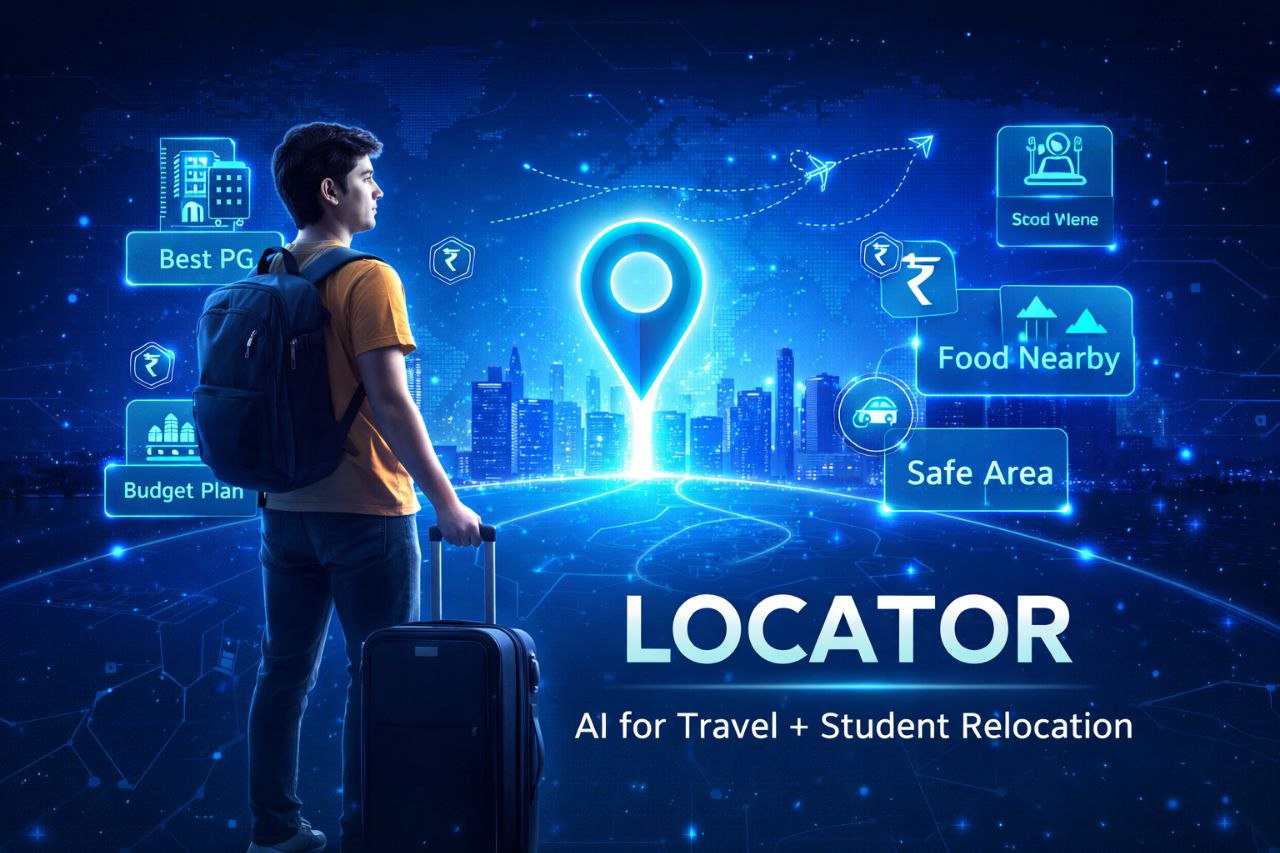
Locator is an AI-powered platform designed to help two types of people who often feel lost in a new city: travelers and students relocating for education.
The idea for Locator came from observing a very real problem: whenever someone wants to travel or move to a new city, they usually have to search across multiple platforms just to answer basic questions like:
- Where should I stay?
- What can I afford within my budget?
- Which areas are safe?
- Where can I find affordable food?
- What is the real cost of living or traveling there?
For travelers, trip planning is scattered across Google searches, YouTube videos, blogs, hotel sites, and maps. For students moving to cities for college, the problem is even harder—they often rely on random brokers, incomplete advice from seniors, or trial and error.
I wanted to build a platform that could bring all of this together into one place and give users clear, personalized, budget-based recommendations instantly.
That’s how Locator was born.
What Inspired Me
The biggest inspiration behind Locator was the realization that people don’t just need more information—they need clarity.
I also started thinking deeply about how many platforms focus only on the customer side and ignore the provider side. For example, after speaking to a Rapido driver in Pune, I understood how important it is for a platform to create value not just for users, but also for the service providers behind it.
That influenced the way I thought about Locator.
Instead of building something that only helps users find the cheapest option, I wanted to build something that helps them find the best value option within their budget, while also creating opportunities for PG owners, hostels, and food providers to reach the right audience.
What Locator Does
Locator acts like an AI city planning assistant.
For Travelers:
Users can enter:
- Destination
- Number of travelers
- Budget (₹)
- Trip type (family, friends, solo, college, etc.)
- Interests (food, adventure, culture, nature, etc.)
The AI then provides:
- Budget-friendly places to visit
- Hotel / stay recommendations
- Food expense estimates
- Local transport suggestions
- Area recommendations
- Hidden gems and local insights
- Suggested itinerary
For Students Relocating:
Users can enter:
- College name
- Course
- City / State / Country
- Monthly budget (₹)
- Stay preference (PG, hostel, shared room, single room)
The AI then provides:
- Low budget / mid budget / high budget stay categories
- PG / hostel recommendations
- Estimated rent and monthly living cost
- Budget food / mess / café suggestions
- Safe and student-friendly areas
- Local language insights
- Transport options to college
- Practical student lifestyle guidance
How I Built It
I designed Locator as a modern AI-powered web platform with a startup-style approach.
The project was planned with:
- A clean, futuristic frontend
- Stylish sign up / login flow
- Separate user flows for travel and student relocation
- AI-powered recommendation logic
- Budget-based categorization
- Personalized outputs in Indian Rupees (₹)
For development, I explored building the project using AI-assisted web tools and planned to structure it in a way that can later connect to:
- A real frontend
- A backend database
- Authentication
- AI recommendation logic
- Potential integrations like Supabase for data storage and user testing
Challenges I Faced
One of the biggest challenges was clarifying the exact problem the platform should solve.
At first, the idea was broad. It included multiple types of AI agents and many directions. Over time, I realized that the strongest version of the idea was not “many random AI agents,” but one focused platform solving a real-life planning problem.
Another major challenge was understanding the data side of the product.
For example:
- PG and hostel data is not always clean or reliable online
- Food provider information is often scattered
- Many listings can be outdated
- A student-focused relocation experience needs more than just property listings
This made me realize that building Locator is not only an AI challenge—it is also a marketplace and trust challenge.
I also learned an important lesson about platform businesses: If users are happy but providers are unhappy, the platform will eventually fail.
That insight changed how I thought about pricing, recommendations, and long-term growth.
What I Learned
Building Locator taught me that the best startup ideas are not just “cool AI ideas.” They are ideas that solve a clear pain point.
I learned:
- The importance of narrowing the problem
- How to think about users and providers together
- Why data quality matters more than flashy features
- Why validation should happen before overbuilding
- How AI should act as a useful assistant, not just a chatbot
Most importantly, I learned that a strong product is built around a simple question:
“How can I live or travel in this city within my budget?”
Locator is my answer to that question.
Vision
The long-term vision for Locator is to become:
An AI-powered platform that helps people confidently navigate a new city—whether they are traveling there for a few days or moving there for the next few years.
I want Locator to eventually become a trusted planning tool for:
- Budget travelers
- College students
- Families
- First-time city movers
- Anyone who needs practical, affordable, personalized local guidance
Final Note
Locator is more than just a travel planner or a student relocation tool.
It is a platform built around one core mission:
To reduce confusion, save time, and give people confidence when entering a new city.
Built With
- chatgpt
- codex
- emergent
- gemini
- lovable
- perplexity


Log in or sign up for Devpost to join the conversation.