-
-
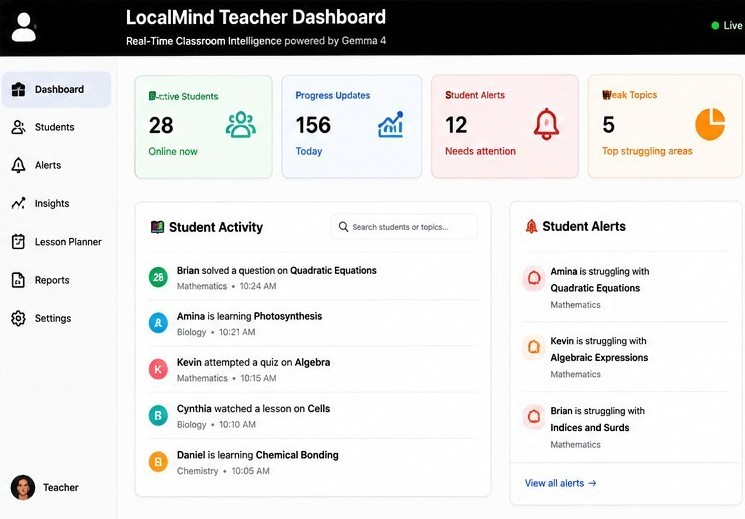
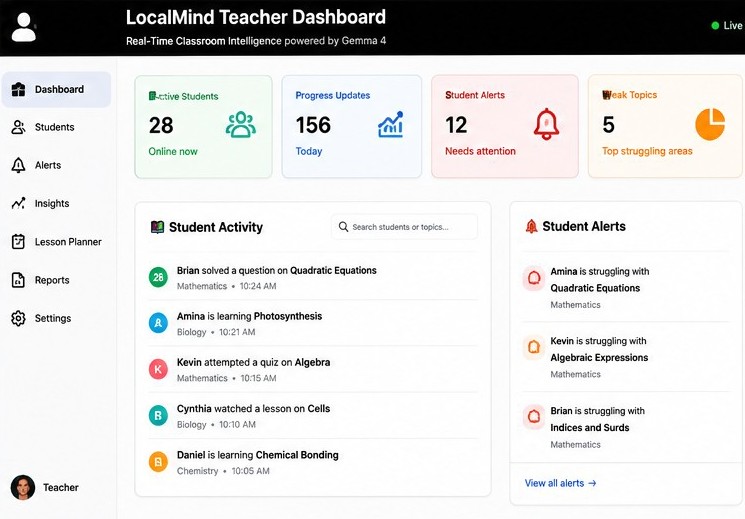
Teacher assessing student progress using Gemma4 E4B for Real-time Classroom Intelligence
-
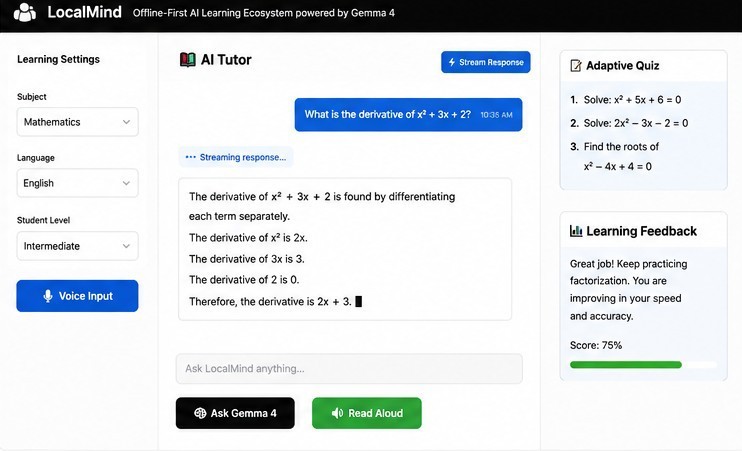
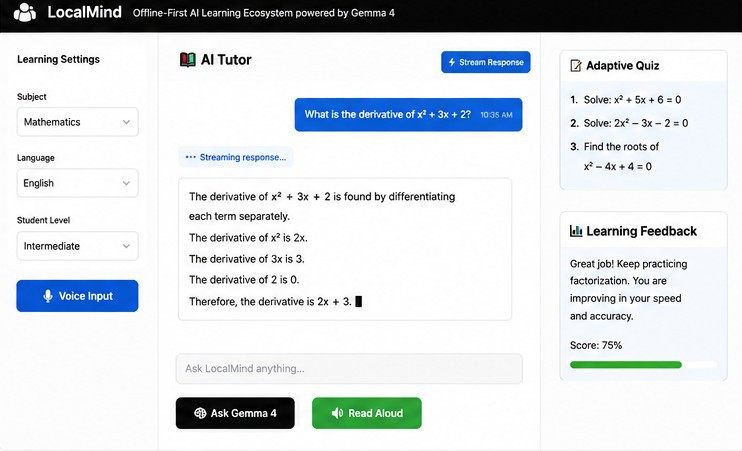
Gemma 4 E4B answering students mathematics derivative
-
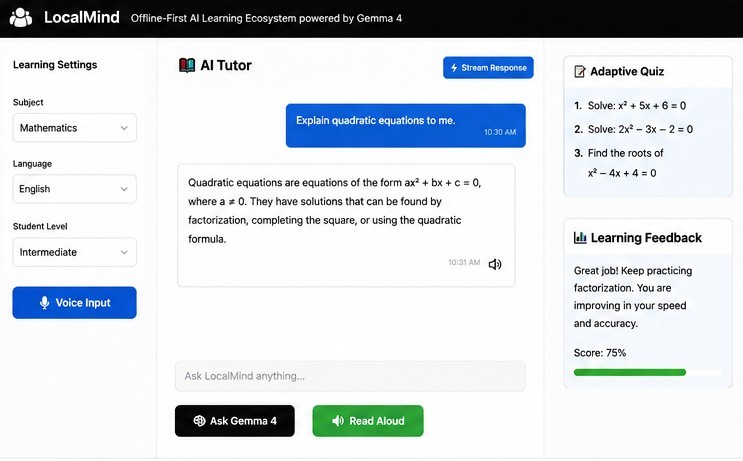
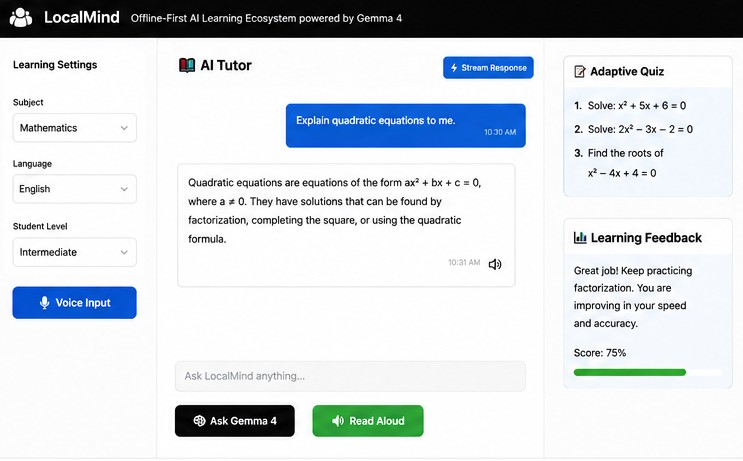
Student Learning Quadratic Equations from LocalMind AI Tutor
-
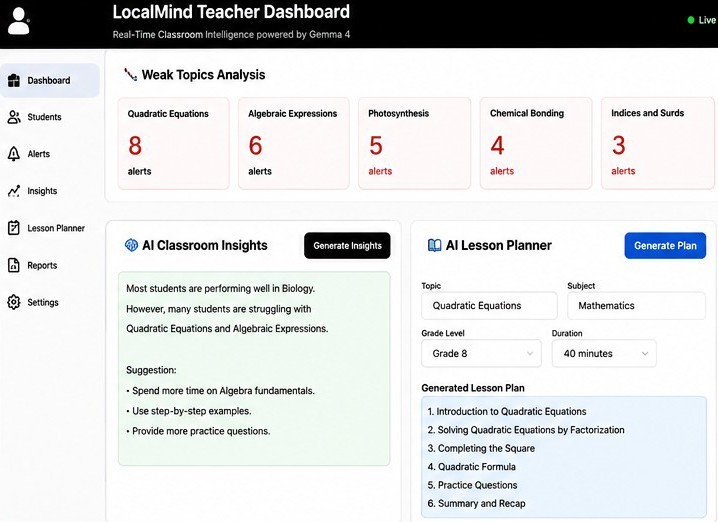
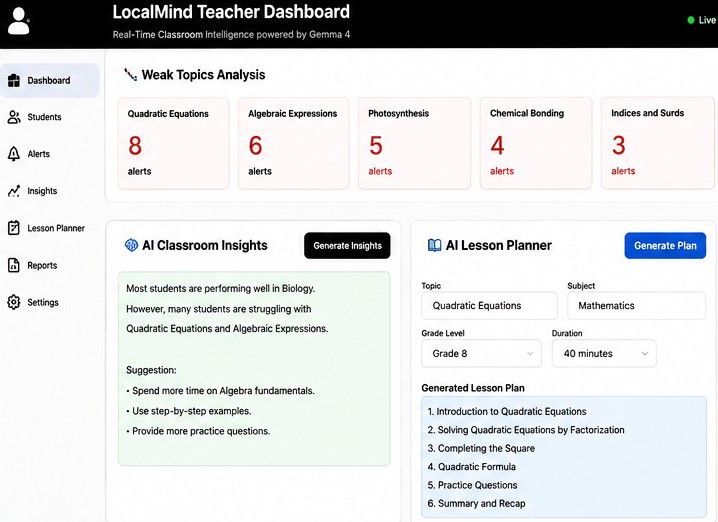
Teacher generating student lesson plans using GEMMA4 E4B
📘 About the Project
💡 Inspiration
Across many parts of Africa, millions of students still face barriers to quality education. Limited teacher-to-student ratios, inconsistent access to learning materials, poor internet connectivity, and the lack of personalized support make learning difficult—especially for students preparing for major national examinations such as KCPE and KCSE.
I wanted to build something bigger than a chatbot.
I wanted to create an AI tutor that behaves like a patient teacher—one that can explain concepts multiple times, adapt to different student levels, generate revision questions, and remain accessible even in low-connectivity environments.
That question became the foundation of LocalMind:
What if every student had a personal AI tutor in their pocket—available anytime, personalized to their level, and capable of working offline?
This led to the development of LocalMind AI Tutor, an intelligent educational system designed to make quality learning more accessible through local and generative AI.
🏗️ What It Does
LocalMind AI Tutor is an AI-powered educational assistant built for students, especially those following KCPE/KCSE-level curricula.
Instead of providing one-size-fits-all answers, LocalMind adapts explanations based on the learner’s educational level and learning needs.
The platform can:
📚 Explain Concepts Based on Student Level
Students can ask questions in natural language, and the AI responds with age-appropriate explanations tailored to their level of understanding.
For example:
- A Form 1 student receives beginner-friendly explanations
- A KCSE candidate receives more advanced detail and exam-focused responses
📝 Generate Practice Questions
LocalMind dynamically creates:
- Revision questions
- Multiple-choice quizzes
- Practice exercises
- KCPE/KCSE-style assessments
- Answer explanations
This turns passive learning into active revision.
🧠 Intelligent Multi-Agent Routing
Rather than relying on a single monolithic AI response system, LocalMind uses a multi-agent architecture.
A dedicated routing system intelligently determines:
- Whether the user needs tutoring
- Question generation
- Curriculum retrieval
- Subject-specific assistance
- Step-by-step explanation
The /ask endpoint acts as an intelligent orchestrator for routing educational tasks.
🔎 Retrieval-Augmented Generation (RAG)
Educational accuracy matters.
Instead of relying purely on LLM memory, LocalMind uses a Retrieval-Augmented Generation (RAG) system to fetch relevant educational content before generating answers.
This helps:
- Reduce hallucinations
- Improve curriculum alignment
- Ground responses in educational material
- Produce more reliable learning content
⚡ Real-Time Streaming Responses
To make interactions feel natural and conversational, LocalMind streams responses in real time.
Instead of waiting for an entire response to finish, students can watch explanations appear progressively—creating a more interactive tutoring experience.
📱 Offline & Low-Connectivity AI
One of LocalMind’s core goals is accessibility.
Many African students experience unstable internet access, so LocalMind explores offline-first AI and local inference approaches to reduce dependency on cloud infrastructure.
This makes the project especially relevant for underserved communities.
⚙️ How I Built It
LocalMind combines modern AI engineering, local inference, fine-tuning, retrieval systems, and scalable backend architecture.
🧩 Multi-Agent AI Architecture
The platform uses multiple specialized agents:
1. Intelligent Router Agent
Acts as the brain of the system.
It analyzes student intent and routes requests to the appropriate AI pipeline:
- Tutor agent
- Retrieval system
- Quiz generation
- Subject explanation
- Personalized response handling
This prevents unnecessary computation and improves response quality.
2. Tutor Agent
Responsible for:
- Explaining educational concepts
- Breaking down difficult topics
- Simplifying responses by grade level
- Providing guided learning support
The tutor adapts explanation complexity depending on the learner’s level.
3. Retrieval Agent (RAG Layer)
A retrieval system fetches curriculum-relevant information before generation.
This ensures:
- Better factual consistency
- Reduced hallucinations
- Educational grounding
- Improved accuracy for exams
4. Question Generation Agent
Generates:
- Revision exercises
- Personalized quizzes
- Exam practice
- Learning reinforcement questions
This makes LocalMind more than an assistant—it becomes a revision companion.
🤖 AI Models & Local Inference
A major goal of this project was enabling local, privacy-friendly AI tutoring.
Gemma 4 (e4b-IT)
LocalMind experiments with Gemma 4 e4b-IT, a lightweight instruction-tuned model suitable for educational reasoning and conversational tutoring.
Gemma enables:
- Educational explanations
- Question answering
- Personalized tutoring
- Lightweight inference
The goal is to eventually run educational AI efficiently on local devices.
Ollama
I used Ollama for local model serving and experimentation.
This enabled:
- Running LLMs locally
- Rapid testing
- Model switching
- Offline inference workflows
Using local AI reduces cloud dependency and improves privacy.
llama.cpp
To improve efficiency, LocalMind explores llama.cpp for optimized inference.
This is especially important for:
- Low-resource devices
- CPU inference
- Offline deployment
- Faster educational responses
This aligns with the broader mission of making AI accessible even on modest hardware.
Unsloth for Fine-Tuning
To explore educational specialization, I experimented with Unsloth for efficient fine-tuning workflows.
This made it easier to:
- Train faster
- Reduce memory usage
- Customize educational behavior
- Improve curriculum adaptation
Efficient fine-tuning is important for creating region-specific educational assistants.
Cactus Embeddings / Retrieval
For retrieval and educational grounding, LocalMind explores embedding-based retrieval systems to improve educational search and contextual understanding.
This strengthens the RAG pipeline and improves answer relevance.
🛠️ Tech Stack
Frontend
- Next.js
- React
- Streaming UI
Backend
- Node.js
- Express.js
- REST APIs
AI/ML
- Gemma 4 (e4b-IT)
- PyTorch
- Hugging Face Transformers
- Unsloth
- Ollama
- llama.cpp
- RAG pipeline
- Embedding retrieval
- Multi-agent orchestration
Programming Languages
- JavaScript
- Python
Database & Storage
- SQLite
- Prisma ORM
🧗 Challenges Faced
1. Designing a Multi-Agent System
Building multiple AI agents that cooperate effectively was one of the biggest challenges.
Routing educational requests correctly while preventing overlapping outputs required careful orchestration.
2. Curriculum Alignment
LLMs can hallucinate.
Ensuring answers remained relevant to KCPE/KCSE educational standards required adding a retrieval layer instead of depending purely on model memory.
3. Latency vs Intelligence Tradeoff
Combining:
- retrieval
- reasoning
- streaming
- personalization
introduced performance challenges.
Balancing fast responses with educational quality required constant optimization.
4. Running AI Locally
Making AI work locally on limited hardware introduced new constraints:
- GPU limitations
- CPU inference optimization
- memory usage
- quantization
- lightweight deployment
This is where tools like Ollama, llama.cpp, and Unsloth became important.
5. Building for Low-Connectivity Environments
Many educational tools assume stable internet access.
Designing for intermittent connectivity pushed me toward local inference and offline-first architecture decisions.
🎯 What I Learned
This project taught me far more than just model integration.
I learned:
- How to build multi-agent AI systems
- How RAG improves factual reliability
- Local inference optimization using Ollama and llama.cpp
- Efficient fine-tuning with Unsloth
- Working with Gemma 4 for educational use cases
- Building real-time streaming AI interfaces
- The tradeoffs between performance, memory, and response quality
- Designing AI for real-world low-resource environments
🌍 Future Improvements
LocalMind is still evolving.
Planned improvements include:
📱 Full Offline Android App
A lightweight mobile tutor optimized for low-end devices.
🎙️ Voice-Based Learning
Speech-to-text and text-to-speech tutoring for younger learners.
🧑🏫 Teacher Dashboard
Allow teachers to monitor student performance and identify weak areas.
🌍 Multi-Country Curriculum Support
Expand beyond Kenya into other African educational systems.
🧠 Smarter Personalization
Adaptive learning based on:
- strengths
- weaknesses
- learning pace
- revision history
🖥️ On-Device AI Optimization
Further optimize Gemma-based tutoring using:
- quantization
- efficient inference
- local model serving
- lightweight deployment
LocalMind’s mission is simple: make personalized, high-quality education accessible to every student—regardless of geography, income, or internet access.
Built With
- express.js
- gemma4:e4b-it
- huggingface
- python
- pytorch
- sqlite
- tensorflow.js

Log in or sign up for Devpost to join the conversation.