Inspiration
LocalFit was inspired by watching my mum and friends struggle with their individual small businesses in San Jose,California, I helped them by traveling with their with inventory, setting up and interacting with customers, feeling the high and lows of low conversion and wondering if there is a better way.
The way early physical product founders use local events to grow. For many small businesses, markets, pop-ups, festivals, and community events are not just places to sell. They are where founders test demand, refine their pricing, learn what customers respond to, and build relationships beyond online clicks.
The problem is that choosing the right event is stressful and time-consuming. Vendors often have to dig through Instagram posts, event websites, application forms, and organizer messages just to decide whether an event is worth the booth fee, travel, inventory, and time. We heard this pain point from several small business owners across the Bay Area.
What it does
LocalFit is an AI-powered event matching platform for soloprenuers, makers, artisans and organic food vendors.
Vendors create a profile with details like what they sell, their price point, ideal customer, travel radius, setup needs, and business goals. LocalFit compares that profile against upcoming local events and ranks the best-fit opportunities.
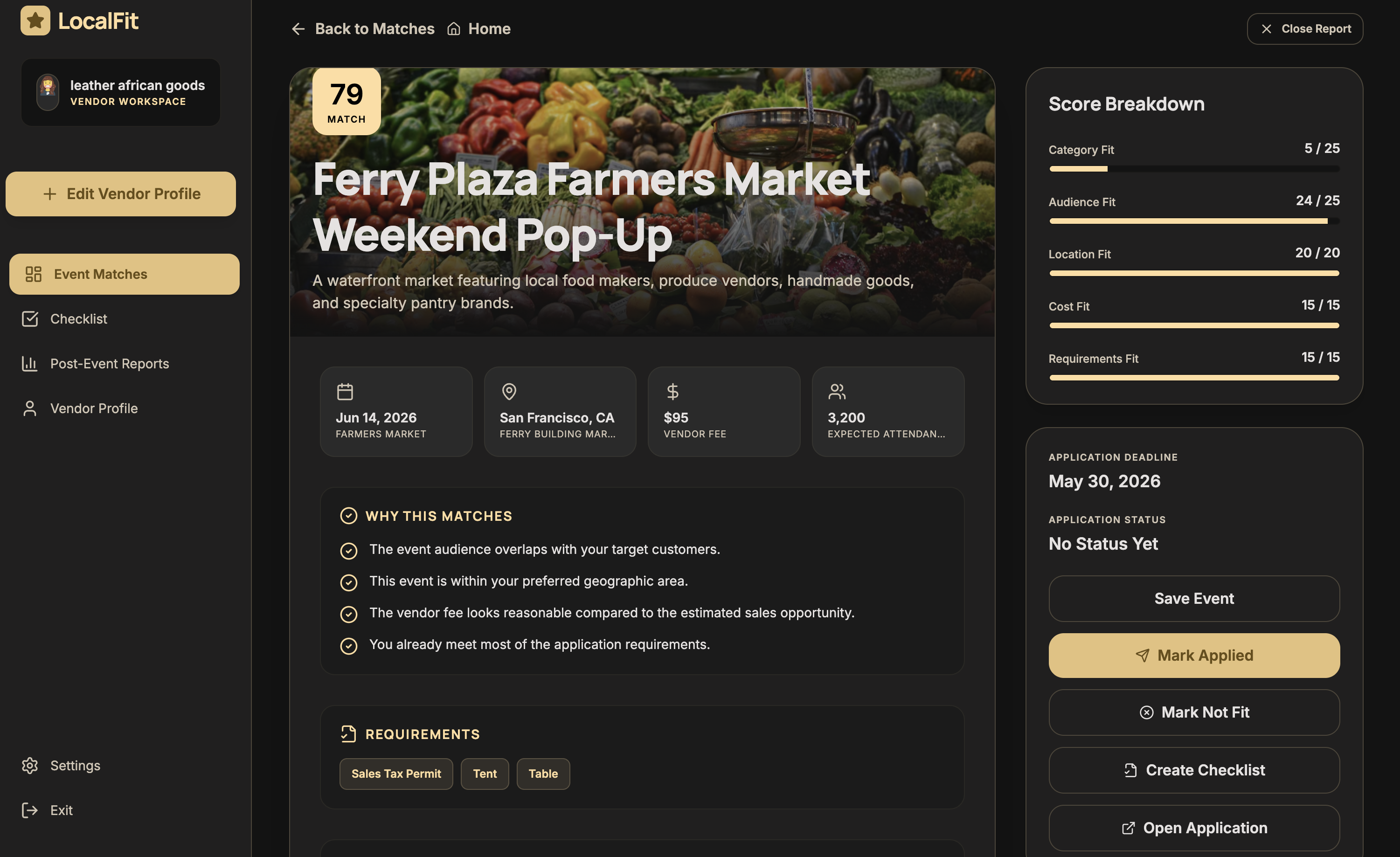
Instead of giving vendors a generic event list, LocalFit explains why each event is or is not a strong fit. Vendors can review event details, understand risks, save events, apply, mark events as not a fit, and generate an application checklist.
A simplified version of our matching logic is:
$$ MatchScore = CategoryFit + AudienceFit + LocationFit + CostFit + RequirementsFit $$
The score is calculated across five areas:
Category fit: up to 25 points
Events score higher when their tags match the vendor’s category, subcategory, and preferred event type.Audience fit: up to 25 points
The more overlap between the vendor’s target audience and the event’s audience tags, the stronger the match.Location fit: up to 20 points
Events in the same city receive the highest score. Events in the same state receive partial credit.Cost fit: up to 15 points
LocalFit compares the vendor fee to estimated sales potential. Lower fee-to-upside ratios score higher.Requirements fit: up to 15 points
Events score higher when the vendor already meets the application and setup requirements.
The final score is the sum of these five parts. Results are sorted by highest score first, with earlier event dates used as a tie-breaker.
LocalFit also generates plain-language match reasons and risk flags. Match reasons may include category alignment, audience overlap, nearby location, reasonable booth fee, and requirements being mostly met. Risk flags may include restricted categories, high fee versus upside, missing requirements, upcoming deadlines, or events outside the vendor’s preferred area.
How we built it
We built the MVP using Next.js, TypeScript, Supabase, Tailwind CSS, and Vercel.
We structured the product around a simple workflow: vendor onboarding, event matching, ranked recommendations, event detail pages, and an application checklist. We created sample vendor and event data, then built the matching logic in src/lib/matching.ts.
The matching system compares each vendor profile against event data such as category tags, audience tags, location, vendor fee, estimated sales potential, application requirements, and deadlines. The same function that calculates the score also generates match reasons and risk flags, which are displayed in the event detail views.
We also used AI tools to support interface planning and development workflows.
Challenges we ran into
The biggest challenge was narrowing the scope. LocalFit has the potential to become a broader growth platform for physical product businesses, but for the hackathon we needed to focus on one clear wedge: helping vendors decide which events are worth pursuing.
Another challenge was working with messy event information. In the real world, event details are often scattered across flyers, Instagram pages, websites, Google Forms, and organizer messages. For the MVP, we used structured sample data, but we designed the product with future data ingestion and enrichment in mind.
We also had to make sure recommendations felt trustworthy. A score alone is not enough. Vendors need plain-language explanations, visible risks, and actionable next steps.
Accomplishments that we're proud of
We are proud that LocalFit addresses a real, validated problem for small business owners. We translated a common but under-supported workflow into a product that feels practical, focused, and easy to understand.
We are also proud of creating a strong end-to-end MVP flow: vendors can create a profile, receive ranked event matches, open a match report, and move toward applying. This gives LocalFit a clear foundation for future features while still being useful in its first version.
Most importantly, we are proud that the product reframes local events as more than one-time sales opportunities. LocalFit treats events as live product-market-fit labs where founders can learn, grow, and build lasting customer relationships.
What we learned
We learned that vendors do not just need help finding events. They need help deciding which events are worth the risk.
We also learned that in-person selling provides a kind of customer insight that online channels cannot fully replace. Founders learn from body language, questions, hesitation, excitement, and repeat interest. Those signals can shape product, pricing, branding, and go-to-market strategy.
From a product perspective, we learned the importance of explainability. For AI recommendations to be useful, users need to understand the reasoning behind them and trust that the recommendation reflects their actual constraints.
What's next for LocalFit
Next, we want to expand LocalFit from event matching into a full growth loop for physical product founders.
Future features include:
- Market Match Reports with demographic and audience insights
- Demographic heatmaps to evaluate neighborhood, affluence, and aesthetic fit
- Lead Capture Kit using QR codes to turn event visitors into Instagram followers, email leads, or future customers
- Pre-order & Pickup Hub so vendors can sell before the event and reduce financial risk
- The Digital Handshake with automated follow-up after events
Our long-term vision is for LocalFit to turn local events into growth engines, helping physical product founders find the right audience, validate demand, capture customers, and scale beyond the market table.
Built With
- codex
- figma
- vercel



Log in or sign up for Devpost to join the conversation.