-
-
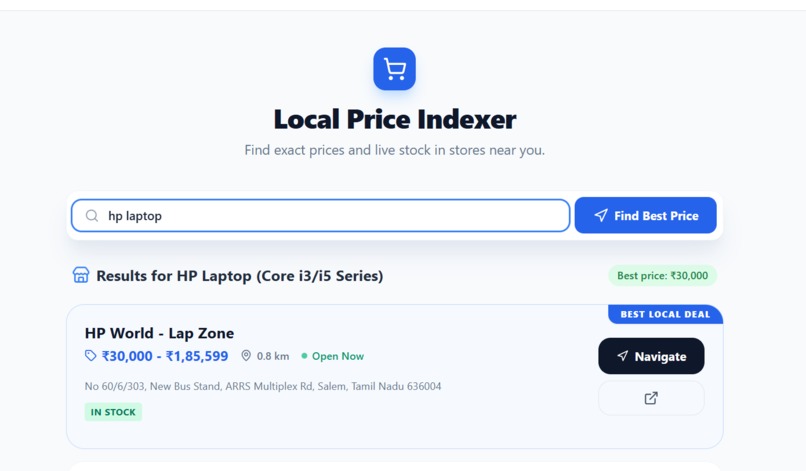
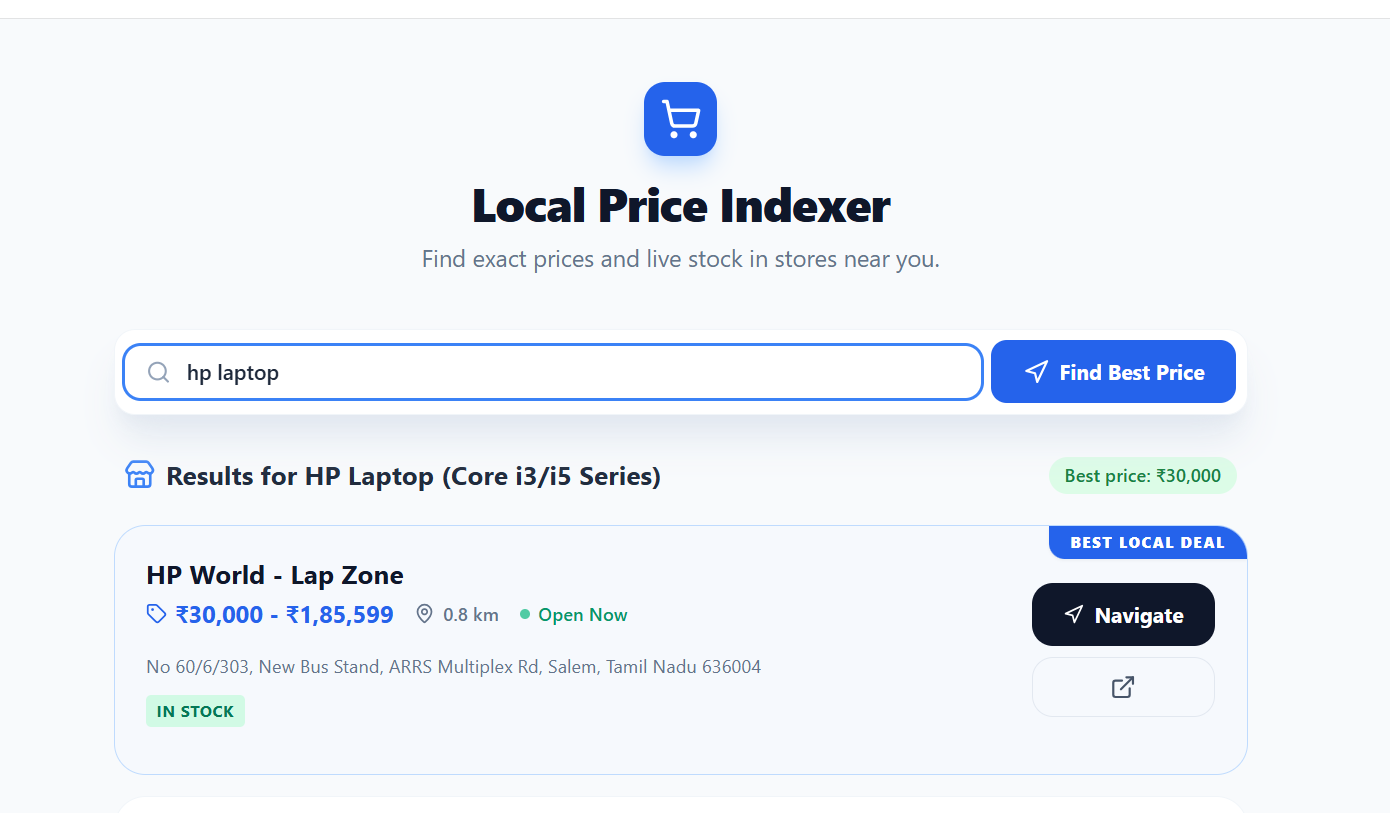
Local Price Indexer interface displaying real-time price comparison and nearby store availability for the product (HP laptops).
Inspiration
The inspiration for this project came from the everyday difficulty of finding exact products in nearby physical stores. While e-commerce platforms allow users to search brands, compare prices, and check availability instantly, offline shopping still lacks this level of transparency and convenience. Consumers often spend significant time visiting multiple stores just to locate a specific item or to find a better price.
We observed that this gap is especially noticeable for essential products such as skincare items, electronics, and stationery, where brand preference and price differences strongly influence purchase decisions. Despite the growth of digital maps and local business listings, there is no unified system that connects product-level search with real-time local store discovery.
This project was envisioned as a bridge between online intelligence and offline retail. The goal was to create a platform where users could search for an exact product and instantly see which nearby stores are most likely to stock it, how much it costs, and where they can get the best deal.
By combining AI product matching, location awareness, and grounded store data, the project aims to make local shopping as searchable, comparable, and efficient as online shopping.
What it does
The project functions as a hyper-local product discovery and price comparison engine that helps users find exact products and brands in nearby physical stores. When a user searches for an item, the system intelligently matches the query to the specific product and identifies the most relevant store categories likely to stock it, such as pharmacies for skincare or electronics retailers for laptops.
Using location data from GPS coordinates or user-provided addresses, the engine discovers nearby stores within a defined radius and calculates their proximity. It then retrieves available pricing information through grounded sources. If exact product pricing is available, it is displayed directly. If not, the system provides estimated price tiers and comparable product benchmarks to guide purchase decisions.
Search results are automatically ranked to highlight the lowest-priced option as the best local deal. The platform also provides additional insights, including stock availability indicators, store operating status, distance, and navigation links for easy in-store visits.
All results are structured in UI-ready formats, enabling seamless integration with applications focused on hyper-local commerce, retail analytics, and smart shopping assistance.
How we built it
We built this project as an AI-powered, location-aware product search engine by combining intelligent query processing with real-world store discovery. The system architecture consists of three core layers: product matching, location grounding, and price indexing.
First, we developed a product and brand matching engine that interprets user queries and maps them to exact items and relevant retail categories. This ensures that branded searches return precise results while generic searches expand across multiple store types.
Next, we integrated Google Maps grounding to retrieve real physical store data, including business names, addresses, distances, and live operating status. User location is captured through GPS coordinates or address input, allowing the engine to filter and rank stores within a defined search radius.
For pricing, we implemented a hybrid model. Where live product prices are available, they are displayed directly. Otherwise, the system uses store price tiers and comparable product benchmarks to estimate cost ranges.
Finally, we structured the output into UI-ready JSON formats, enabling seamless frontend integration for store listings, price comparison, stock indicators, and navigation links. The system was iteratively refined to balance real-time data accuracy, performance, and user experience.
Challenges we ran into
One of the biggest challenges we faced was the limited availability of real-time, item-level pricing for small and local retail stores. Unlike e-commerce platforms, most physical shops do not publicly expose live inventory or exact product prices through APIs. This required us to design fallback mechanisms such as price-tier estimation and comparable product benchmarking to maintain useful outputs.
Another challenge was accurate product-to-store category mapping. Users often search using brand names or informal product terms, which required building intelligent matching logic to route queries to the most relevant store types, such as pharmacies for skincare or electronics retailers for laptops.
Handling “not found” scenarios without breaking the user experience was also complex. Instead of returning empty results, we implemented probability-based suggestions that surface nearby stores likely to stock the requested item.
Location grounding introduced its own constraints, including distance calculation accuracy, radius filtering, and handling incomplete business metadata like missing hours or contact details.
Finally, balancing real-time grounding with system performance was critical. Ensuring fast responses while processing location data, store discovery, and price ranking required iterative optimization of search logic and result structuring.
Accomplishments that we're proud of
One of our biggest accomplishments was successfully bridging the gap between online search convenience and offline retail discovery. We built a system that allows users to search for exact products and brands while receiving structured, location-aware results from real physical stores nearby.
We are particularly proud of the product matching engine, which accurately interprets branded and category-based queries and maps them to the most relevant store types. This ensured high search relevance and minimized unrelated results, improving overall user trust in the platform.
Another key achievement was implementing price intelligence despite limited public retail data. By combining exact pricing (where available) with price-tier estimation and comparable product benchmarks, we created a reliable price comparison experience that still highlights the best local deals.
We also developed a robust ranking model that balances price, distance, and availability to surface the most valuable purchasing options first.
From a system design perspective, delivering structured, UI-ready JSON outputs made the platform highly adaptable for frontend apps, dashboards, and hackathon demos.
Overall, we are proud of building a scalable foundation for hyper-local commerce that transforms how users discover, compare, and purchase products in nearby physical stores.
What we learned
Through building this project, we gained practical experience in designing and deploying a real-world, location-aware application. One of the most important learnings was how to translate user search intent into structured product queries. Developing accurate product and brand matching logic taught us how small differences in wording can significantly impact search relevance.
We also learned how to integrate grounded location data to retrieve real store information such as distance, operating status, and navigation details. Working with mapping services helped us understand geolocation handling, radius filtering, and proximity-based ranking.
Another key learning was dealing with incomplete or unavailable retail data. Since many local stores do not expose live inventory or exact pricing, we designed fallback systems such as price-tier estimation and comparable product benchmarking. This improved system reliability without compromising user experience.
We further developed skills in structuring backend outputs into UI-ready JSON formats, ensuring seamless frontend integration.
Finally, the project strengthened our understanding of balancing accuracy, performance, and usability while building scalable solutions for hyper-local commerce and real-time retail discovery systems.
What's next for Local Price Indexer
The next phase of Local Price Indexer focuses on expanding data depth, improving real-time accuracy, and enhancing user interaction. One of our primary goals is to integrate direct retailer inventory APIs and POS (Point of Sale) systems to access live stock counts and exact shelf-level pricing rather than relying on partial public data.
We also plan to introduce user-driven data contributions, allowing shoppers to upload bills or price snapshots to strengthen the pricing database through crowdsourced validation. This will improve coverage for small and independent retailers.
On the intelligence side, we aim to refine the ranking algorithm by incorporating additional factors such as store ratings, wait times, promotional offers, and historical price trends. Predictive restocking insights using demand patterns are also part of the roadmap.
From a product perspective, we plan to launch mobile app support with real-time notifications for price drops and nearby deals. Multi-city scaling, language localization, and accessibility enhancements will further broaden usability.
Long term, Local Price Indexer envisions becoming a foundational infrastructure layer for hyper-local commerce, enabling integrations with delivery platforms, smart shopping assistants, and retail analytics dashboards.
Built With
- css3
- distance
- gemini-api
- gemini-flash
- geolocation-api
- google-ai-studio
- google-cloud
- google-maps
- html5
- javascript
- json
- node.js
- react
- typescript
- web-based-deployment

Log in or sign up for Devpost to join the conversation.