-
-
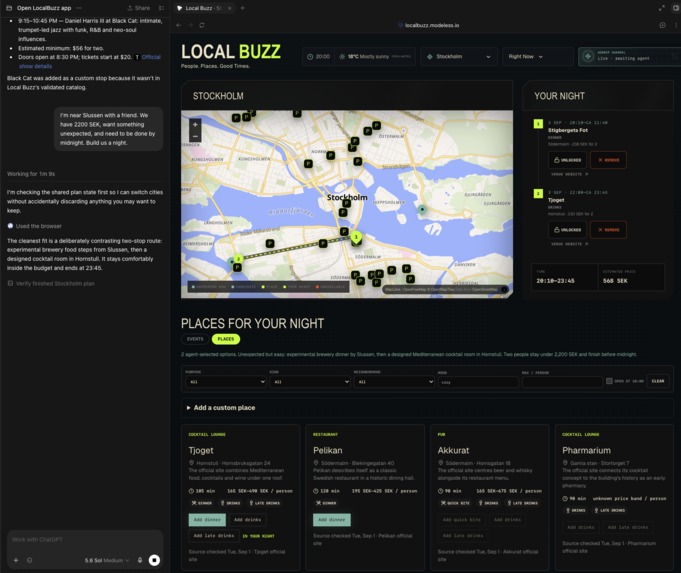
-
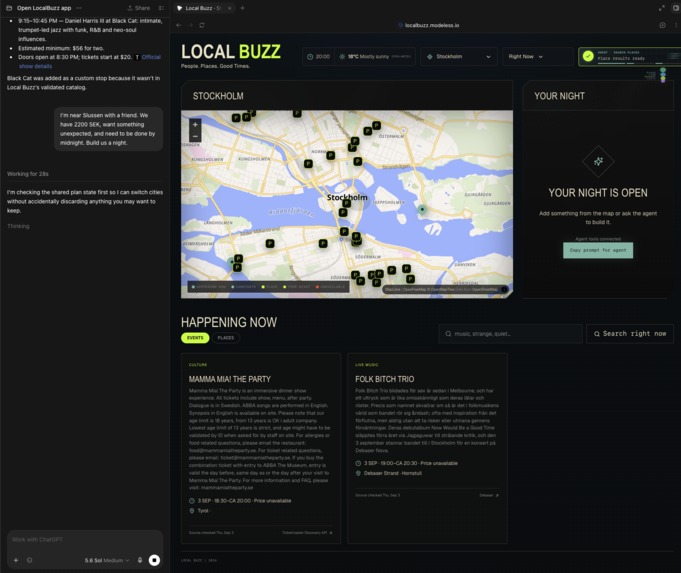
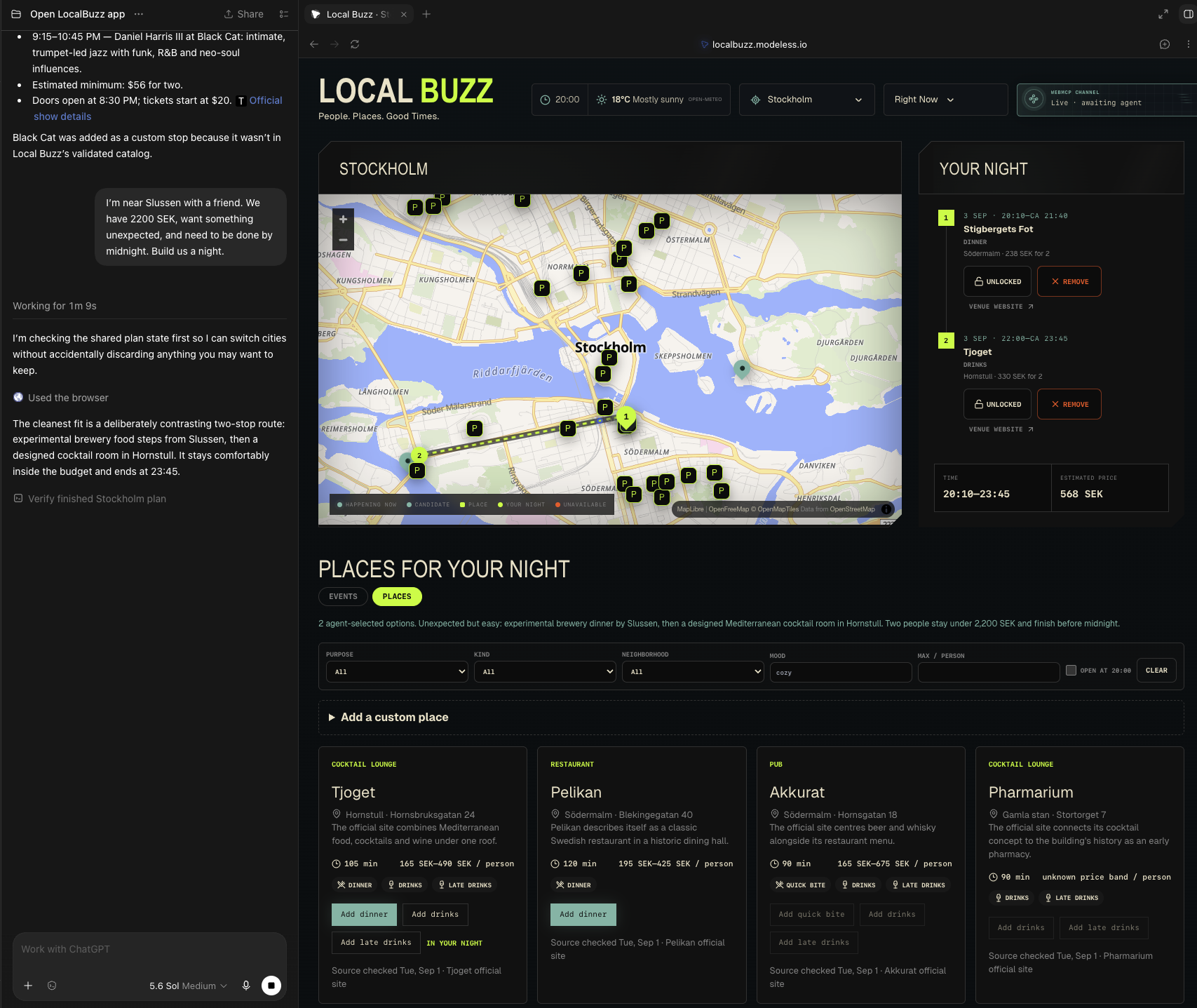
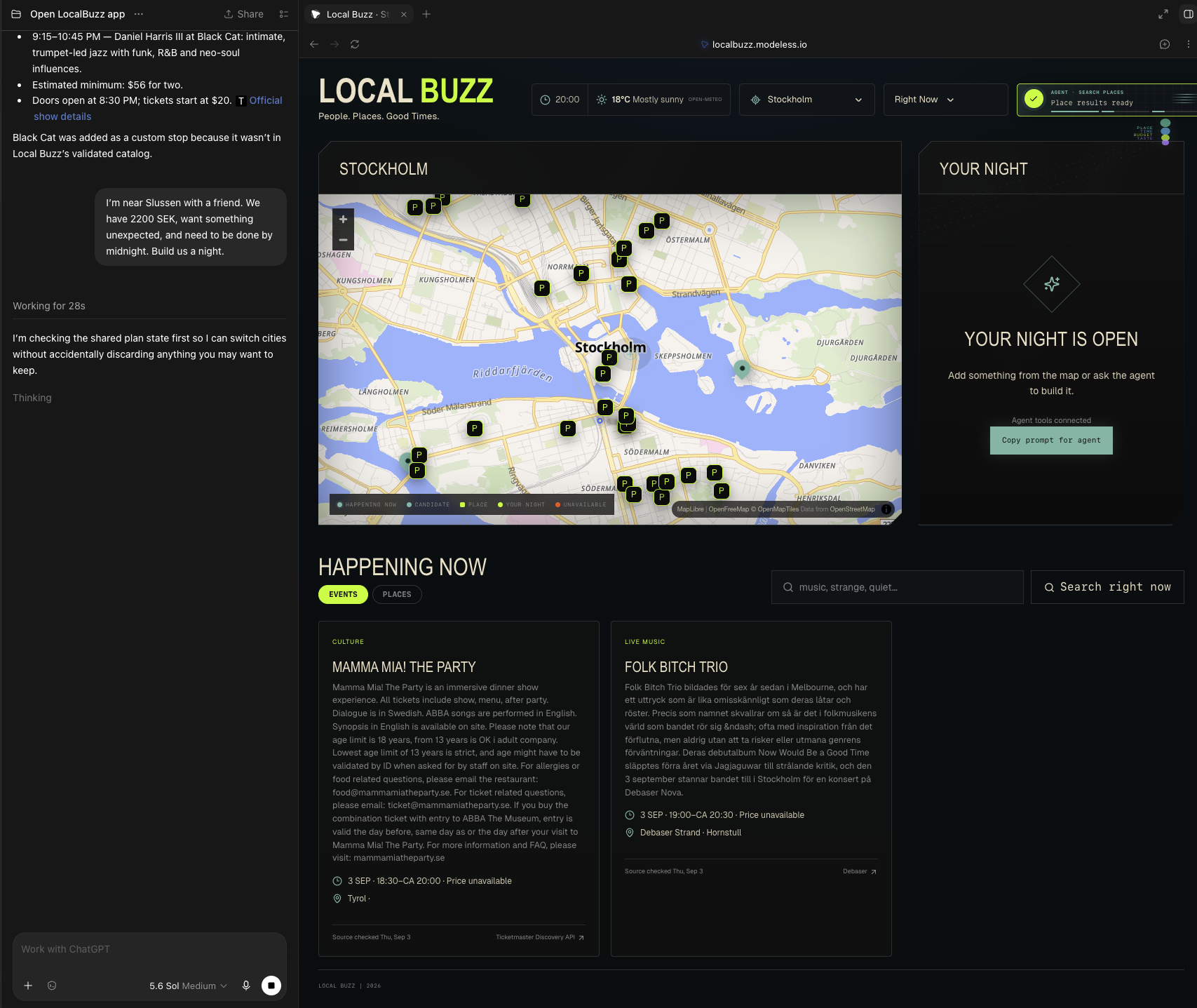
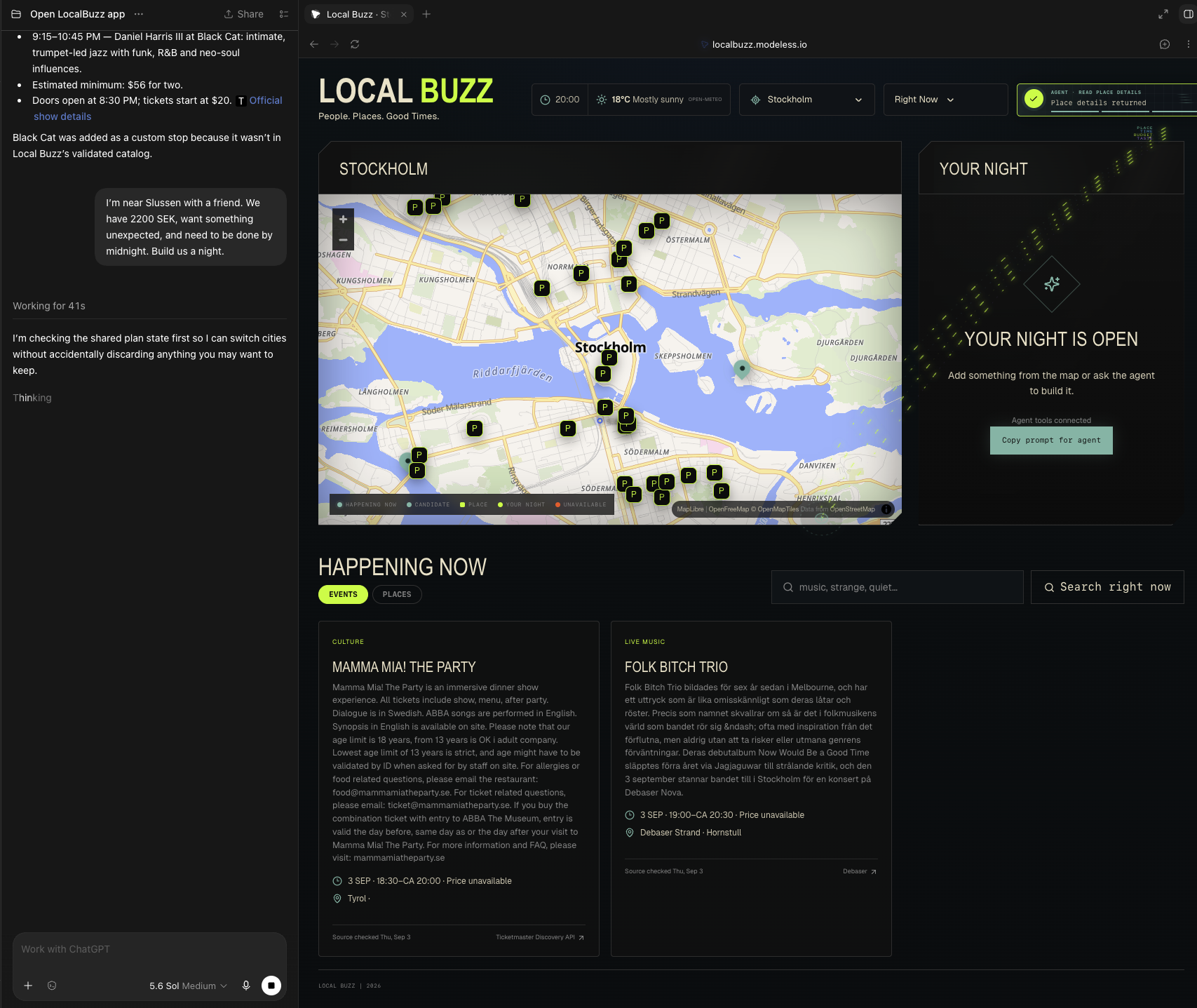
The agent does not click through the UI. Local Buzz exposes structured WebMCP tools, and the results appear directly in the same interface.
-
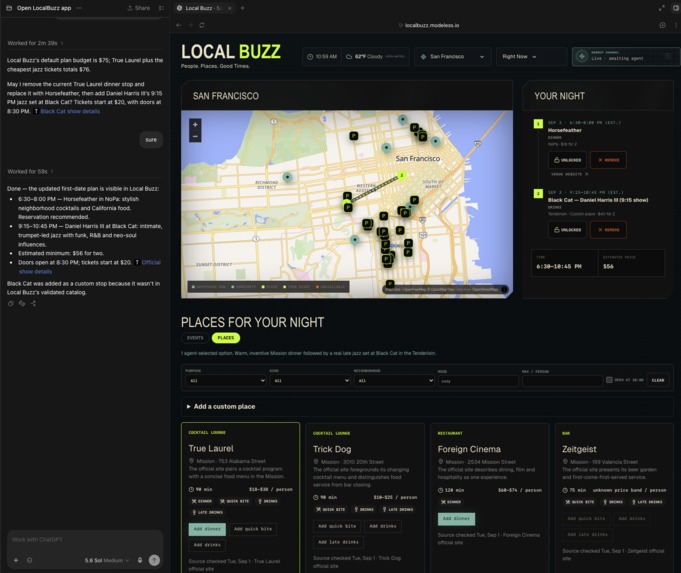
Local Buzz combines a live city interface with WebMCP so a person and their AI agent can plan together.
-
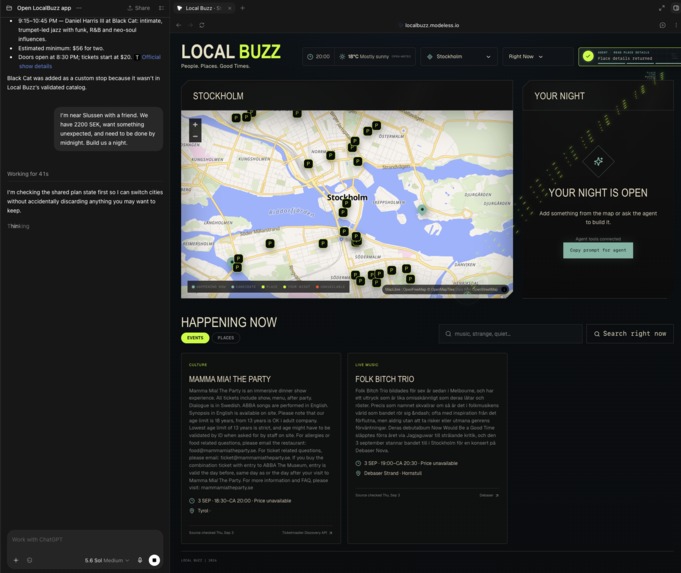
The human brings taste. The agent handles complexity. Local Buzz provides the live city. WebMCP enables one shared experience.
Inspiration
“What should we do tonight?” sounds simple, but the answer is scattered across event sites, venues, ticketing platforms, local calendars, social media, and word of mouth.
AI can already recommend events or generate itineraries, but chat is a poor interface for exploring a city. A map is better for geography. A timeline is better for sequence. Visual browsing is better for taste.
That led to a different question:
What if a person and their personal AI agent could explore and shape a night together, inside the same live web experience?
What it does
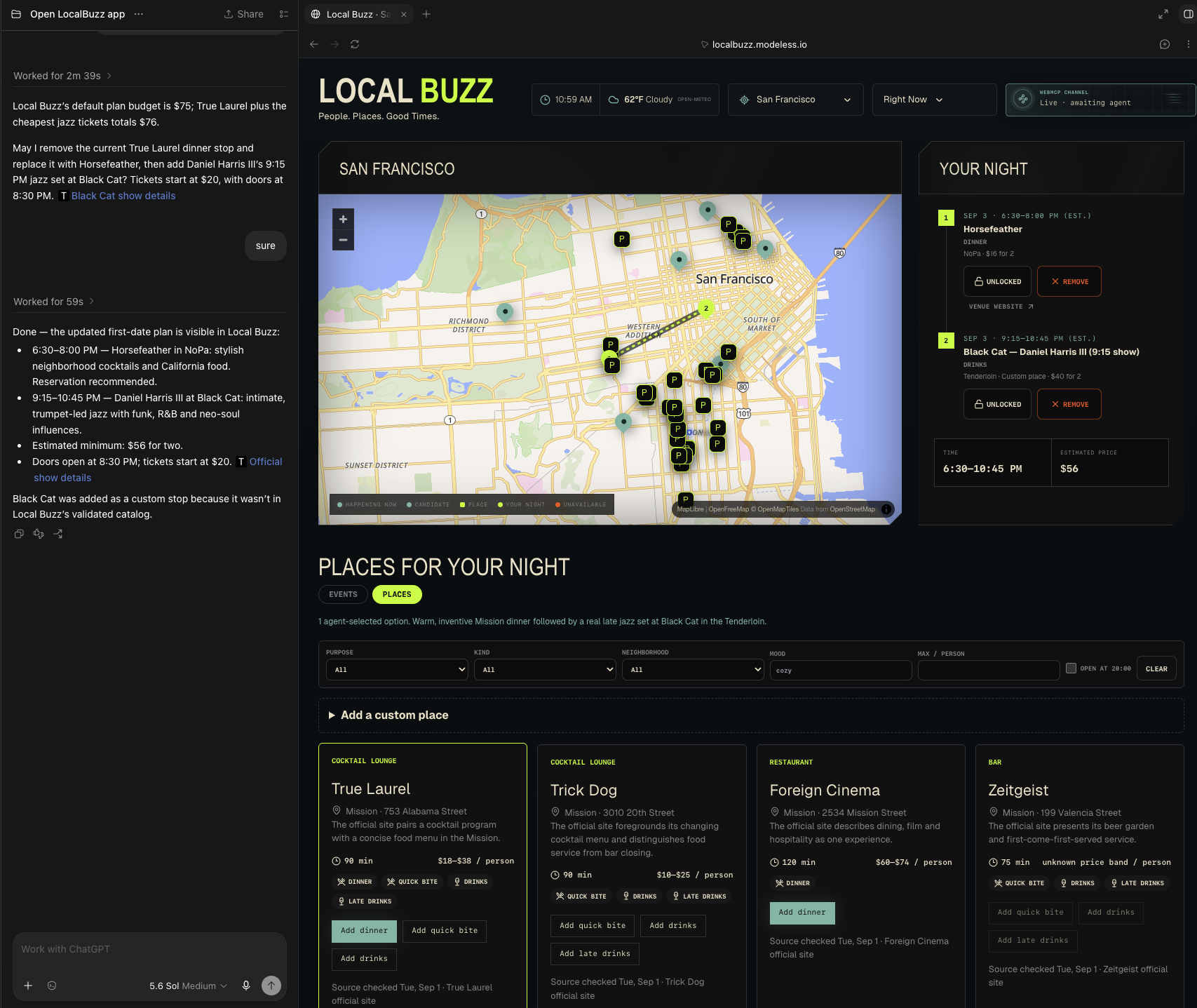
Local Buzz turns your city into a shared real-time workspace for a person and their AI agent (starting with Stockholm and San Francisco).
Local Buzz knows the city: what is happening, where, when, how much it costs, and what is currently available.
The user's agent can bring something Local Buzz does not need to collect: context about the user.
Together they can:
- discover relevant happenings
- surface candidates directly on the city map
- stage an evening on a visual timeline
- let the human lock, reject, or change individual choices
- let the agent read those changes and adapt around them
- repair an existing night when something becomes unavailable
The important idea is that Local Buzz is not an AI itinerary generator.
It is a shared model of a night that stays alive. It answers the age old question: where can I go have fun right now?
Why WebMCP
The human and the agent need different interfaces into the same application. The human works visually through maps, cards, timelines, locks, and direct manipulation.
The agent works through structured WebMCP tools for searching happenings, showing candidates, reading the current plan, staging changes, locking stops, and repairing the plan.
Both operate on the same underlying application state.
For example, when a human locks a stop in the interface, the agent sees that constraint the next time it reads the plan. If another event becomes unavailable, the agent repairs only the affected portion instead of throwing the entire itinerary away and starting over.
This is the interaction we wanted to explore with WebMCP:
Agent acts → interface changes → human intervenes → agent understands the intervention → reality changes → agent repairs the shared state → human approves.
How we built it
Local Buzz is built as a proof-of-concept web application using the Modeless design system.
The application has one shared domain model that powers both the human interface and its WebMCP tools. Human actions and agent actions call the same underlying application functions rather than maintaining separate UI and agent state.
For the challenge prototype, we focus on Stockholm and San Francisco and use a small normalized set of real local event and venue data. Local Buzz adds derived metadata where useful for planning.
A last-minute event availability change used in the demo is intentionally simulated so the repair behavior can be demonstrated deterministically and is clearly labeled as such.
What we learned
The most interesting part of WebMCP is that websites can be designed from the beginning for two collaborators with different strengths. The human brings taste, intuition, and judgment. The agent handles search, constraints, timing, and complexity. The website provides the live domain state they collaborate around.
What I've been exploring is the surface area of how much a web app can be adapted for the end user based on agentic interactions. In some ways, it starts to become reminiscent of push, or streaming, data if the agent is making a lot of updates. I believe there's a lot of use cases for WebMCP around real-time data.
Built With
- codex
- mapbox
- modeless-design-system
- openai
- react
- typescript
- webmcp

Log in or sign up for Devpost to join the conversation.