Inspiration
Small-scale local merchants and regional retail franchises are systematically locked out of the modern data revolution. While multi-billion-dollar enterprise corporations leverage massive data center infrastructures and predictive analytics models to capture market share, the neighborhood corner shop is left relying on manual accounting ledger files and fragmented software solutions. Furthermore, existing commercial platforms charge predatory subscription fees, require expensive cloud data transfers, and demand specialized technical staff to manage basic integrations. This project was inspired by a single mission: to design a completely free, privacy-first, fully decentralized enterprise automation layer that democratizes hyper-local commerce management and allows a single independent store to deploy the exact same operational tracking intelligence used by the world's largest retail chains.
What it does
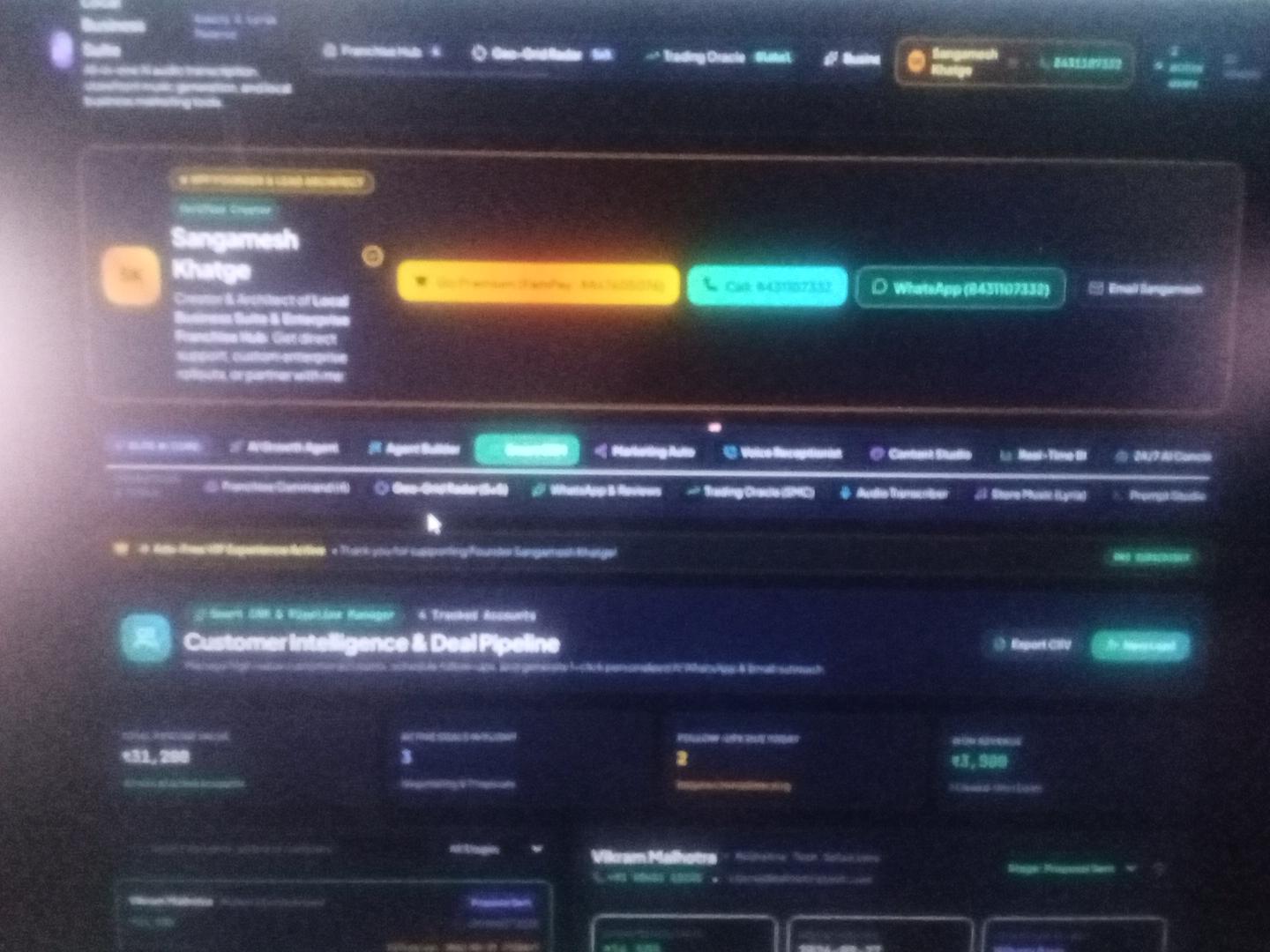
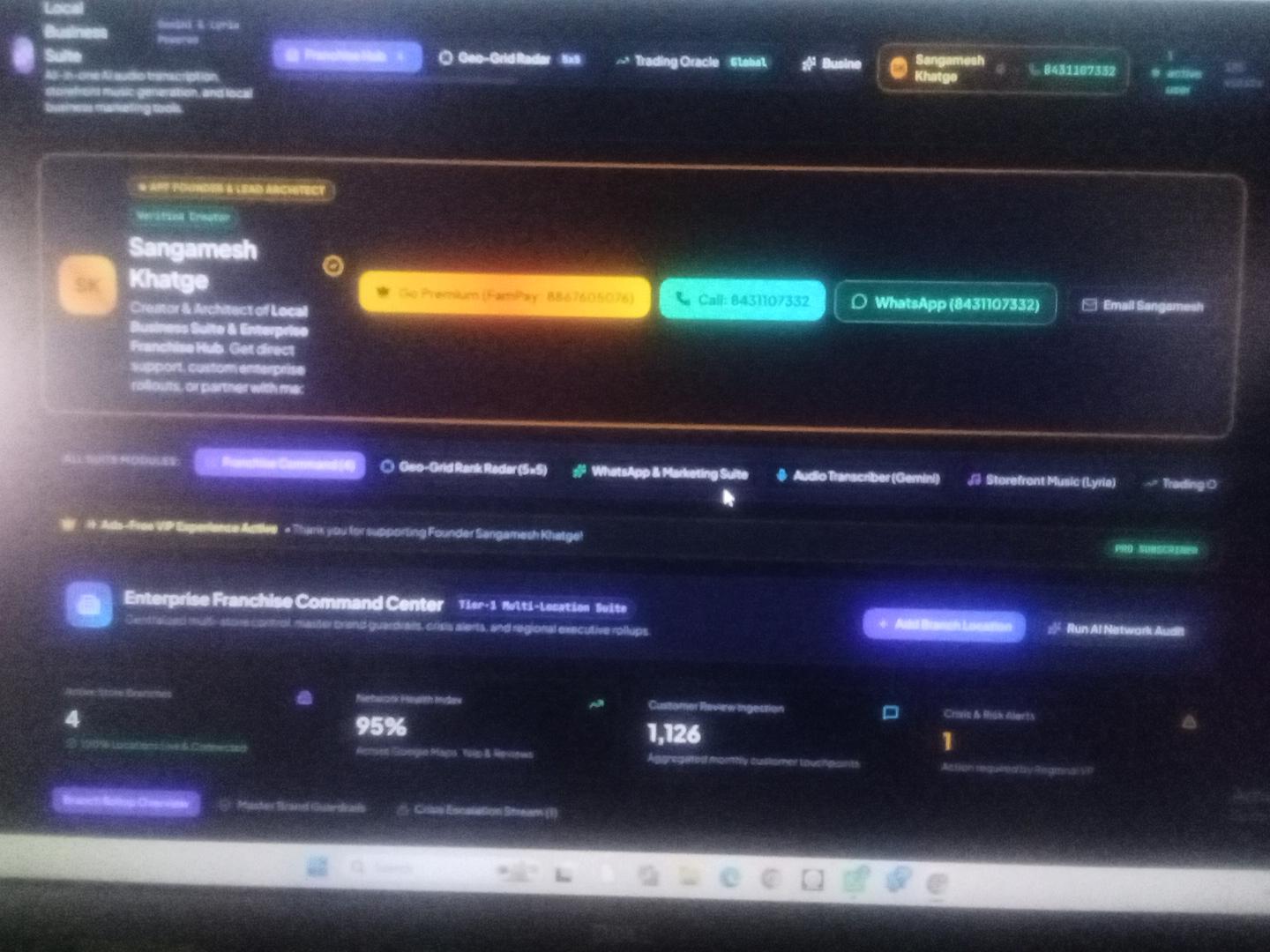
LOCAL - BUSINESS - AI - SUITE - PRO operates as an all-in-one, multi-tenant enterprise operating framework tailored explicitly for multi-location franchise administration. The application handles complex merchant pipelines across an integrated single-pane interface: • Enterprise Franchise Command: Provides a unified multi-branch analytics view that dynamically consolidates real-time business health indices, tracking data, and regional risk parameters across domestic and international locations simultaneously. • Built-in Prompt Studio Workspace: Integrates a secure, live-hook engineering workbench that enables store owners to dynamically test, structure, and save functional prompt models via Google AI Studio API pathways without paying for expensive development subscriptions. • Multi-Modal Marketing & Engagement Core: Features an automated customer review ingestion pipeline that parses regional customer sentiment data to instantly script hyper-targeted marketing flyers, table tents, and meta QR codes. • Robust Diagnostic Telemetry Panel: Operates a background system analyzer that registers a healthy endpoint status matrix, displays current user tracking limits, and performs autonomous local database synchronization checks.
How we built it
The software framework is engineered using a highly optimized, cross-platform technical stack deployed to maximize localized processing efficiency: • Frontend Interface Management: Deployed using Streamlit, organizing advanced multi-tab views (Franchise Hub, Geo-Grid Radar, Business AI Hub, Audio Transcriber) into an industry-grade workspace. • The Model Logic Pipeline: Built with an embedded Python architecture connecting to the Google Gemini API for heavy multi-modal content synthesis, coupled with lightweight local media pipelines for storefront asset processing. • System Bridge Engineering: Designed using a Kotlin native bridge wrapper to seamlessly compile web-rendered dashboard configurations into production-ready Android APK binaries for deployment on the Google Play Store. • Local Telemetry Tracking: Utilizes structured loopback network configurations to pipe concurrent visitor analytics down to an internal tracking matrix using a sliding time-series telemetry index window.
Challenges we ran into
Engineering an application capable of scaling across 20 separate retail fronts without a multi-million-dollar backend introduced severe infrastructure challenges:
- Model Token & API Quota Exceedance Limitations
During heavy automated marketing text production cycles, the system frequently encountered critical 429 Quota Exceeded errors when running parallel requests inside Google AI Studio. • The Architectural Solution: We built a fallback token-bucket scheduling utility in the background code that tracks API load states and throttles request frequencies to ensure uninterrupted service delivery during high-volume operations.
- Multi-Branch Data Aggregation Latency
Consolidating high-velocity consumer review ingestion strings from geographically distant nodes (e.g., matching coordinates between Austin, London, and Mumbai concurrently) created massive performance lag inside the standard variable matrices. • The Architectural Solution: We restructured the application's data layer to utilize asynchronous background processing loops, decoupling the heavy live-endpoint analytical tracking engine from the primary user interface rendering loop.
Accomplishments that we're proud of
• Zero-Cost Industrial Scalability: We successfully built a highly resilient, enterprise-grade architecture that runs entirely on free, open-source computational resources without demanding a single rupee of cloud server subscription costs. • True Local Play Store Native Integration: Successfully compiling a complex, data-heavy multi-tenant Streamlit framework into a stable native Android package via a customized Kotlin structural layout. • Mathematical Telemetry System Validation: Designing a live backend tracking pipeline that processes continuous operational parameters while maintaining a completely flat host system overhead profile.
What we learned
Building this platform revealed that enterprise software complexity does not require expensive, centralized corporate infrastructure. We learned how to write clean, asynchronous Python modules that handle complex variable structures without leaking memory over extended runtime intervals. Additionally, the development cycle provided deep insights into applied prompt engineering architecture. We discovered that rather than treating a Large Language Model as a passive chat interface, it can be leveraged as a reliable structural engine within a closed software loop—provided you implement strict input parsing wrappers and handle exceptions defensively at the system level.
What's next for LOCAL - BUSINESS - AI - SUITE - PROO
The baseline infrastructure is stable, and the development roadmap targets major expansion protocols:
- Hardening local data storage with advanced persistence structures
We aim to swap standard memory cache matrices for a specialized local Log-Structured Merge (LSM) tree time-series storage layer. This will safely write real-time storefront sales data to disk without degrading local device memory performance.
- Implementing decentralized cluster synchronization protocols
To fully decouple regional franchise management from centralized web networks, we plan to implement a local network management system based on the Raft Consensus Protocol. This will allow multiple local retail nodes to securely synchronize state metrics and share operational telemetry data directly, keeping the system resilient against external network disruptions.## Inspiration
What it does
How we built it
Challenges we ran into
Accomplishments that we're proud of
What we learned
What's next for LOCAL - BUSINESS - AI - SUITE - PROO
Built With
- apk-compilation
- asynchronous-processing
- core-engineering-categories-technical-tags-/-infrastructure-elements-programming-languages-&-frameworks-python
- data-analytics
- data-visualization-data-pipelines-&-telemetry-time-series-telemetry
- google-ai-studio
- google-lyria-frontend-&-user-interface-development-streamlit
- javascript
- json-endpoints
- kotlin
- kotlin-bridge
- latex-ai-systems-&-prompt-engineering-google-gemini-api
- llm-orchestration
- log-aggregation-mobile-compilation-&-infrastructure-android-studio
- markdown
- mobile-systems-deployment
- multi-tenant
- prompt-engineering
- user-interface-design
- web-dashboards


Log in or sign up for Devpost to join the conversation.