-
-
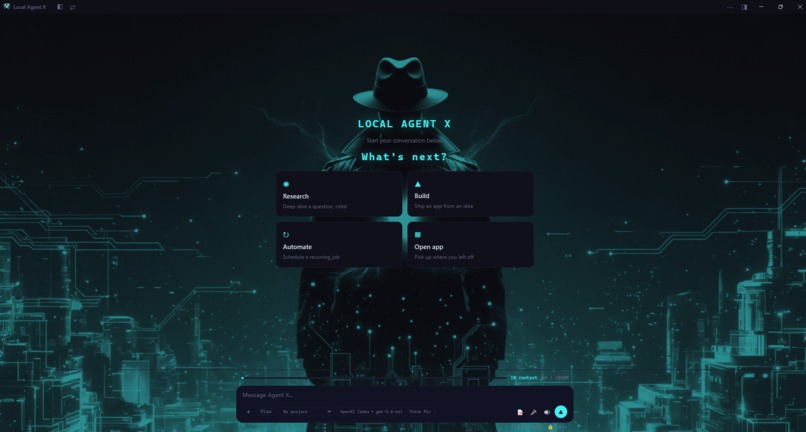
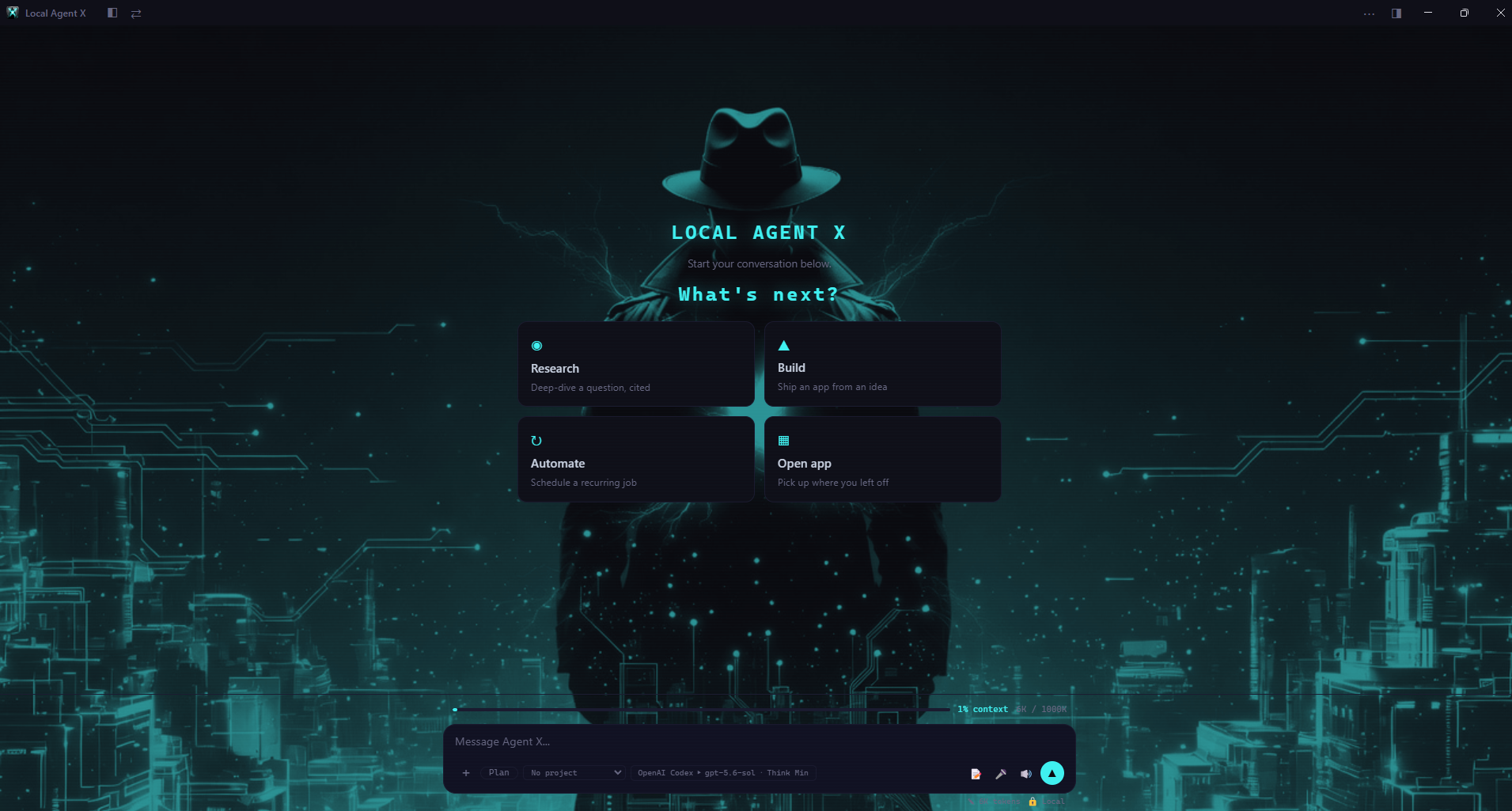
Home screen
-
Loading screen
Inspiration## Inspiration
When I first dove head first into AI coding the first thing I tried to build with no knowledge of anything was an AI coding studio called local AI Studio. It was a big failure but it taught me a lot about AI systems and agentic engineering. I spent 5 months on that and finally retired it in Feb 2026. Then at the very end of March I hear about this thing called open claw. I loved it. It was basically Local AI Studio but with even more tools. I tried it out for 1 night and deleted it the next day. I liked it a lot but the thing kept crashing on me. So the next day I decided to build my own agent system. I didn't want another AI that lives in someone else's cloud, reads my files through an API I don't control, and forgets who I am every session. I run a business, I build products, and a lot of my life sits on my own machine. I wanted an assistant that lives here, on my hardware, that I actually own. So I built Local Agent X. It's a personal AI that runs on local models when I want privacy and cloud models when I want power, and it never makes me pick between the two.
What it does
Local Agent X is a full personal AI layer that runs on your own computer. It can:
- Run on local models (Ollama, LM Studio, anything OpenAI-compatible) or frontier cloud models, and you can switch at runtime.
- Actually do things. It browses the web in a real Chrome window, reads and writes files, runs shell commands, builds and deploys apps, sends email, controls the desktop, and manages a team of smaller sub-agents.
- Remember you. There's a persistent memory system that carries your projects, people, and preferences across every session.
- Edit its own source code to fix bugs and add features it doesn't have yet.
How we built it
The core is a TypeScript runtime that ties together the model providers, a big tool registry, and a memory layer. Every tool call runs through ARI Kernel, an in-process security layer I built and open-sourced. It's default-deny, so the agent can be powerful without being able to wreck your machine. Apps the agent builds live in an isolated workspace and get served back inside the product. Local model concurrency is scheduled with GPU resource locks so two heavy models don't try to load at once.
Challenges we ran into
Power versus safety was the big one. Giving an agent shell, file, and browser access is easy. Doing it without handing over the keys to your whole computer is the hard part, and that's where ARI Kernel came from. Getting local and cloud to behave the same was another one. The same agent has to work whether it's on a 7B local model or a frontier cloud model, and that took a lot of tuning on how tools get routed. And I wanted memory that feels like a friend who remembers you, not a database that just pattern matches.
Accomplishments that we're proud of
A local-first AI that doesn't lose anything by staying on your machine. ARI Kernel shipped as an open-source security framework. And an agent that can extend itself, write new tools, and fix its own bugs while it's running.
What we learned
The hard problem in personal AI isn't intelligence anymore, it's trust. Who owns your data, whether you can see what the agent actually did, and whether the security model is something you can reason about. Capability got cheap. Trust is the part that's worth building.
What's next for Local Agent X
Deeper local model support so 200B class models run on consumer hardware, a mobile layer, and a marketplace for agent skills and apps. The goal is simple. Anyone should be able to have an AI that lives on their machine and works for them, instead of the other way around.

Log in or sign up for Devpost to join the conversation.