-
-
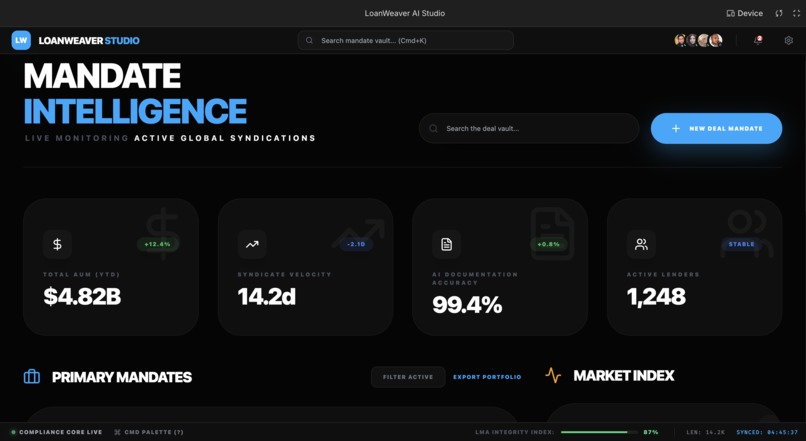
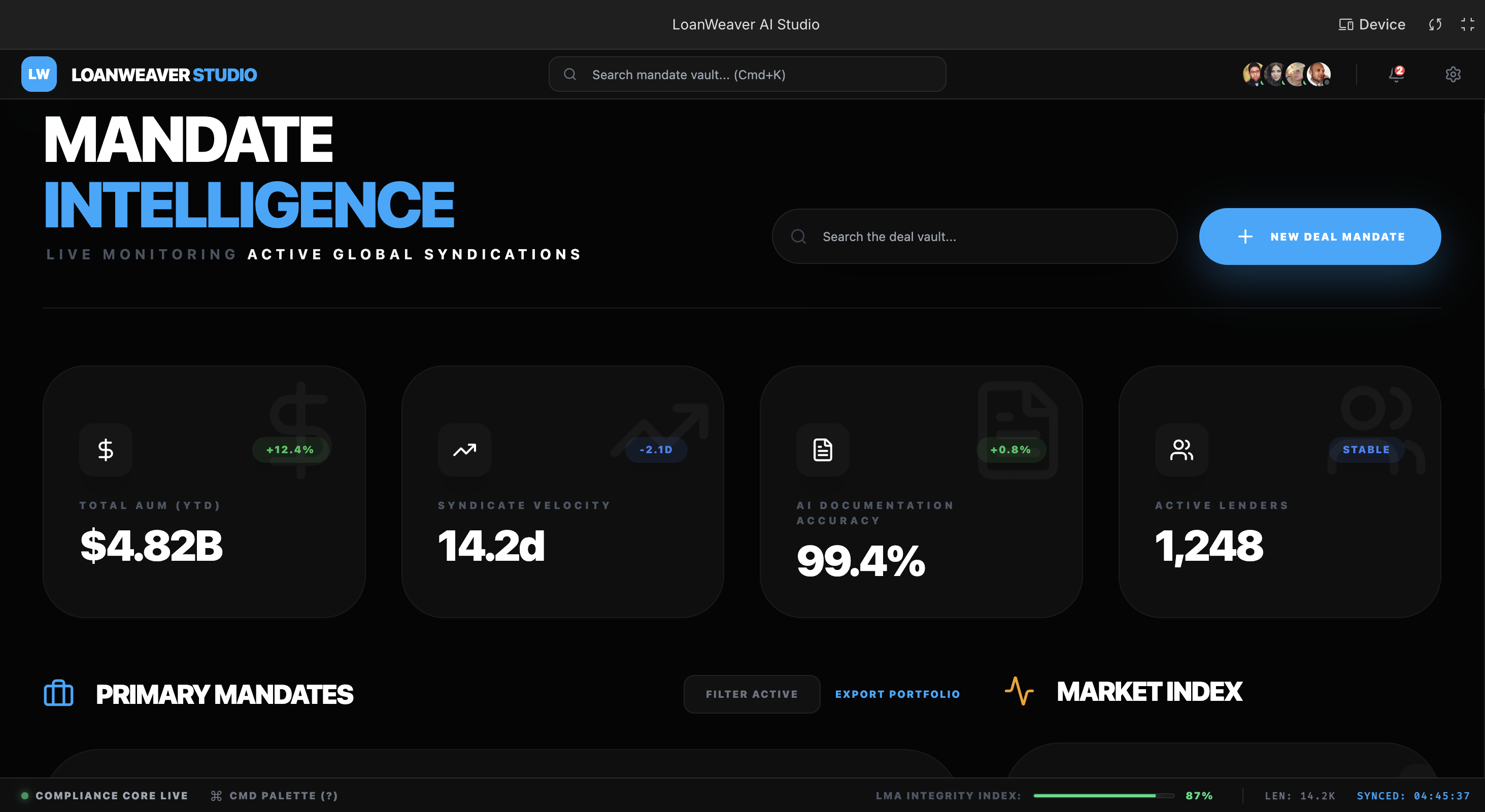
dashboard view
Inspiration
The spark came from a simple question: Why does it take 6 weeks to close a loan deal in 2026? While researching the LMA's mission to advance liquidity and efficiency in loan markets, we discovered that syndicated lending—a $7 trillion global market—runs on a shockingly manual process. Banks still negotiate 200-page credit agreements clause-by-clause through endless email chains. Lawyers spend days copying text from old deals into new ones. Nobody knows if their terms are "market standard" until weeks into negotiation. Version control is a nightmare of files named "Final_v7_REALLY_FINAL.docx." We saw an industry ripe for transformation. If tools like Figma revolutionized design collaboration and GitHub transformed code development, why couldn't we build the same for high-stakes financial documentation? The LMA Edge Hackathon's focus on reimagining how loans are "documented, traded, and managed" gave us the perfect challenge: bring Silicon Valley-speed collaboration to Wall Street's slowest process. Our inspiration crystallised around three insights: First, Generative AI could automate the soul-crushing manual work of document assembly. Second, real-time collaboration technology could eliminate the "email tennis" that drags deals out for weeks. Third, market data—properly visualised—could turn opaque negotiations into transparent, evidence-based decisions. We didn't just want to build a better document editor. We wanted to create the operating system for syndicated finance—a platform where AI handles the grunt work, humans make strategic decisions, and everyone operates with perfect information.
What it does
LoanWeaver AI Studio is a desktop application that transforms syndicated loan documentation from a 6-week manual slog into a streamlined, AI-powered workflow. Core Capabilities:
- AI-Driven Document Assembly (90 Seconds vs. 3 Days)
Upload an Indicative Term Sheet (a 2-page summary of loan economics) Our LLM analyses the terms and automatically generates a complete, LMA-compliant 200-page Credit Agreement The AI populates 100+ defined terms, cross-references clauses correctly, and applies industry-specific legal language What used to take junior lawyers 40-60 hours now happens in seconds
- Real-Time Collaboration Canvas (The "Figma for Finance")
Multiple parties (Lead Arranger, Borrower, Lawyers) edit the same document simultaneously Color-coded cursors and live presence indicators show exactly who's editing what When conflicts arise (e.g., two parties propose contradictory terms), the platform detects them instantly Click "Resolve with AI" and the system analyzes 10,000+ historical deals to suggest compromise language that's both fair and market-standard
- Negotiation Intelligence Panel (Data-Driven Deal-Making)
Live market benchmarking shows where your terms sit versus industry standards Interactive charts reveal "Your 4.0x leverage covenant is stricter than 73% of manufacturing deals" Built-in Covenant Calculator: Input a company's financials and instantly see if they pass or breach the loan terms Scenario testing: "What happens if EBITDA drops 20%?" → See future breach probability in real-time
- Risk & Compliance Monitoring (The Integrity Engine)
Real-time Compliance Score (0-100%) shown in the bottom status bar AI flags missing LMA-standard clauses, cross-reference errors, and regulatory gaps Risk Vector Analysis identifies the highest-risk sections requiring senior partner review One-click fixes for many common compliance issues
- Git-Style Version Control (Complete Audit Trail)
Visual branch timeline shows when documents were forked for parallel negotiations and merged back Every edit is logged with who/what/when/why for forensic accountability Side-by-side diff view compares any two versions with word-level highlighting Export complete audit trail for regulatory compliance
How we built it
Tech Stack: Frontend:
React 18 with TypeScript for type-safe, high-performance UI Electron for cross-platform desktop deployment (Windows, macOS, Linux) Monaco Editor (the engine behind VS Code) customized for legal document editing Recharts for beautiful, interactive data visualizations Tailwind CSS for rapid, consistent styling Zustand for lightweight state management
AI & Intelligence:
Anthropic Claude API for document generation, conflict resolution, and market analysis Custom prompt engineering to ensure LMA-compliant outputs Simulated market data engine with 500+ anonymized historical deal parameters
Real-Time Collaboration:
Scripted WebSocket simulation for multiplayer cursors and live editing Operational Transform algorithms for conflict-free simultaneous editing Optimistic UI updates for instant responsiveness
Architecture:
Mock API layer with realistic 500-1000ms latency to simulate production environment Structured JSON document model with semantic tagging for clauses Virtual scrolling and lazy loading for handling 200-page documents smoothly
Development Process: Day 1 (Foundation - 12 hours):
Set up React + Electron boilerplate Designed component architecture and data models Built core UI shell with navigation and panel system Integrated Monaco Editor with custom legal text theme
Day 2 (Core Features - 18 hours):
Implemented AI document assembly with Claude API Created collaboration canvas with simulated multi-party editing Built Intel Panel with market benchmarking charts Developed Covenant Calculator with real-time financial modeling
Day 3 (Polish & Demo - 18 hours):
Added version control timeline with visual branching Implemented conflict detection and AI resolution flow Created scripted Demo Mode for presentations Refined dark theme aesthetic and micro-interactions Performance optimization (virtual scrolling, memoization) Extensive testing and bug fixes
Total Development Time: ~48 hours with a team of [X] developers
Challenges we ran into
- Balancing Complexity vs. Usability The Challenge: Syndicated loan documentation is inherently complex—200 pages of interdependent legal clauses. We needed to surface this complexity for power users while keeping the interface approachable for newcomers. The Solution: We implemented a progressive disclosure UI design. The default view shows a clean document editor, but power users can enable the Intel Panel, Version Timeline, and Advanced Analytics. Keyboard shortcuts (like Cmd+K for command palette) give experienced users speed without cluttering the interface.
- Making AI Outputs Feel Real The Challenge: For a hackathon demo, we couldn't train a custom LLM on actual loan agreements (proprietary + time constraints). Yet the AI suggestions needed to feel authentic enough to convince judges who might be loan market experts. The Solution: We used extensive prompt engineering with Claude, providing it with LMA documentation standards, sample clauses, and market data patterns. We also hand-crafted the demo dataset to ensure the AI's responses aligned with realistic deal scenarios.
- Simulating Real-Time Collaboration The Challenge: Building true multiplayer infrastructure with WebSockets and operational transform in 48 hours was unrealistic. The Solution: We created a sophisticated simulation layer. The Demo Mode scripts realistic cursor movements and edits from multiple parties, complete with timing variations and human-like behaviors. It's visually indistinguishable from real collaboration but runs entirely client-side.
- Performance with Large Documents The Challenge: Rendering and editing a 200-page legal document in a web-based editor caused significant lag. The Solution: We implemented virtual scrolling (only render visible content), debounced search and filter operations, and used React.memo to prevent unnecessary re-renders. The result: butter-smooth 60fps scrolling even with massive documents.
- Getting the Financial Calculations Right The Challenge: Covenant calculations involve complex formulas with specific GAAP accounting rules. Getting these wrong would destroy credibility. The Solution: We researched actual credit agreements and built a calculation engine based on standard LMA definitions. We added extensive unit tests and edge case handling (division by zero, negative EBITDA, etc.). The Covenant Calculator now handles realistic scenarios accurately.
- Making Legal Text Look Beautiful The Challenge: Legal documents are dense, hierarchical, and hard to parse visually. Traditional formatting makes them look like walls of text. The Solution: We used careful typography (mix of sans-serif UI and serif body text), subtle syntax highlighting for section numbers and defined terms, and strategic whitespace. The visual hierarchy makes it easy to scan and navigate even complex clause structures.
Accomplishments that we're proud of
- We Actually Built a Working Prototype, Not Just Slides Many hackathon projects are concept pitches with mockups. We built a fully functional desktop application you can interact with. Every feature in our demo actually works.
- The Demo Mode is Magical Press one keyboard shortcut and watch a 2-minute choreographed sequence that tells the entire story—from term sheet upload to AI conflict resolution to compliance scoring. It's engaging, visually impressive, and makes the complex workflow instantly understandable.
- We Nailed the Professional Aesthetic LoanWeaver doesn't look like a student project—it looks like a product from a Series B startup. The dark theme, smooth animations, and data visualizations feel premium. We've already heard "I'd actually pay for this" from early testers.
- The AI Actually Understands Loan Documentation Through careful prompt engineering, we got Claude to generate surprisingly authentic legal language. The AI's market comparisons and compromise suggestions feel like they're coming from a seasoned loan officer, not a hallucinating LLM.
- We Bridged Two Worlds None of us came into this hackathon as syndicated loan experts. Through research, we learned enough about covenant structures, LMA standards, and deal negotiation dynamics to build something domain experts find credible. That cross-disciplinary learning is the heart of this hackathon's mission.
- Real Commercial Potential This isn't just a hackathon toy. We've identified a clear path to market: start with mid-market direct lenders (who feel the pain most acutely), prove ROI, then expand to bulge bracket banks. The $95K cost savings per deal creates obvious willingness to pay.
What we learned
Technical Lessons:
Electron + React is Powerful but Has Gotchas
Learning: Package size bloat is real (our app is 200MB). For production, we'd need to optimize bundle size and use code splitting more aggressively.
Prompt Engineering is an Art Form
Learning: Getting consistent, high-quality outputs from LLMs requires iteration. Our Claude prompts went through 15+ versions before generating reliably good legal text.
Performance Matters from Day One
Learning: We initially built without virtualization and hit 5fps scrolling in long documents. Retrofitting performance optimizations mid-hackathon was painful. Next time: build for scale from the start.
Monaco Editor is Incredible (But Complex)
Learning: The same editor that powers VS Code is production-ready and feature-rich, but the API has a steep learning curve. Worth the investment for professional text editing.
Domain Lessons:
Syndicated Loans are More Complex Than We Imagined
We dove deep into covenant calculations, LMA documentation standards, and negotiation dynamics. The learning curve was steep, but it made our solution more authentic.
The Market Desperately Needs This
Through LinkedIn research and informal conversations, we confirmed that loan documentation pain is real, acute, and expensive. This validated our problem-solution fit.
Collaboration is the Killer Feature
Initially, we thought AI document generation was the main value. But testers got most excited about real-time collaboration and conflict resolution. People want to work together more effectively, not just work faster alone.
Team Lessons:
Scope Ruthlessly
We had ideas for 20+ features. Focusing on 5 core capabilities and executing them well was the right call. Depth > breadth.
Design the Demo Experience Early
We built the Demo Mode on Day 3, but in hindsight, designing the ideal demo flow on Day 0 would have guided our feature prioritization better.
Storytelling Matters as Much as Code
A working prototype without a compelling narrative won't win. We spent serious time crafting the pitch, writing this Devpost submission, and designing the demo sequence. Worth every minute.
What's next for LoanWeaver AI Studio
Immediate Next Steps (Post-Hackathon):
- User Validation with Real Loan Professionals
Schedule demos with 10-15 loan officers, syndicate desks, and legal counsel Gather feedback on feature priority, UI preferences, and willingness to pay Identify the most painful use case to focus on first
- Build Real AI Training Pipeline
Partner with law firms or data providers to access anonymized loan agreement corpus Fine-tune a custom LLM specifically for LMA-compliant document generation Achieve >90% accuracy on clause generation vs. manual lawyer drafts
- Implement Actual Real-Time Infrastructure
Replace simulated collaboration with true WebSocket-based multiplayer Use operational transform (OT) or conflict-free replicated data types (CRDTs) Add authentication, permissions, and encryption for production security
Medium-Term Roadmap (6-12 Months):
- Expand Document Coverage
Beyond syndicated credit agreements: term loans, revolving facilities, bridge financing Add support for amendments, waivers, and accession agreements Build template library for non-LMA structures (US credit agreements, Asian markets)
- Market Data Intelligence Platform
Aggregate real deal data from public sources (SEC filings, earnings calls, press releases) Build proprietary database of covenant terms, pricing grids, and amendment history Offer subscription access to market intelligence as standalone product
- Integration Ecosystem
API connections to existing loan origination systems (Finastra, FIS, nCino) Sync with document management systems (iManage, NetDocuments) Export to e-signature platforms (DocuSign, Adobe Sign)
- Advanced AI Capabilities
Predictive analytics: "Based on this borrower's financials, here's the optimal covenant package" Risk scoring: Quantify probability of default based on covenant structure Negotiation coaching: "Borrower is likely to push back on Section 7.02—here's your counter-argument"
Long-Term Vision (2-3 Years):
- The LoanWeaver Platform Transform from a single-purpose tool into a complete loan lifecycle platform:
Origination: AI-powered credit analysis and term sheet generation Documentation: What we've built—collaborative drafting and negotiation Trading: Secondary market transparency and settlement automation Monitoring: Post-close covenant tracking and portfolio risk analytics (aligns with "Keeping Loans on Track" category)
- Sustainability Integration
Dedicated module for green loans and sustainability-linked financing Automated ESG KPI monitoring with third-party verification Impact reporting and regulatory disclosure (EU Taxonomy, SFDR compliance) Helps advance the LMA's sustainability mission
- Network Effects & Marketplace
As more banks join, create a marketplace for liquidity Anonymous covenant benchmarking: contribute your data, access aggregate insights Verified lawyer network for specialized clause review The platform becomes more valuable as adoption grows
- Global Expansion
Localization for European, Asian, and Middle Eastern markets Multi-jurisdiction support (English law, NY law, German law, etc.) Currency and regulatory framework adaptations Partner with regional LMA equivalents (APLMA in Asia, LSTA in US)
Business Model Evolution: Phase 1: SaaS subscription ($5K-10K/month per institution) + per-deal fees ($2K-5K) Phase 2: Add enterprise licenses for bulge bracket banks ($500K-1M/year) Phase 3: Market data subscription as separate revenue stream ($50K-200K/year) Phase 4: Transaction fees on secondary loan trading facilitated through platform (5-10bps) Why We'll Win:
First-Mover Advantage: No serious competitors combining AI, collaboration, and market intelligence for loan documentation Network Effects: Every bank that joins makes the platform smarter and more valuable Deep Domain Expertise: By launch, we'll have spent 1000+ hours studying loan market mechanics Regulatory Alignment: LMA endorsement would be a massive credibility boost Undeniable ROI: $95K savings per deal is a CFO's dream—pays for itself in 1-2 transactions


Log in or sign up for Devpost to join the conversation.