Inspiration
Loan applications often require financial institutions to evaluate multiple factors such as income, employment, credit history, existing loans, and loan amount. We were inspired to create a system that could simplify this process using AI and machine learning. Our goal was to make loan evaluation faster, more consistent, and data-driven while helping identify potential risks early.
What it does
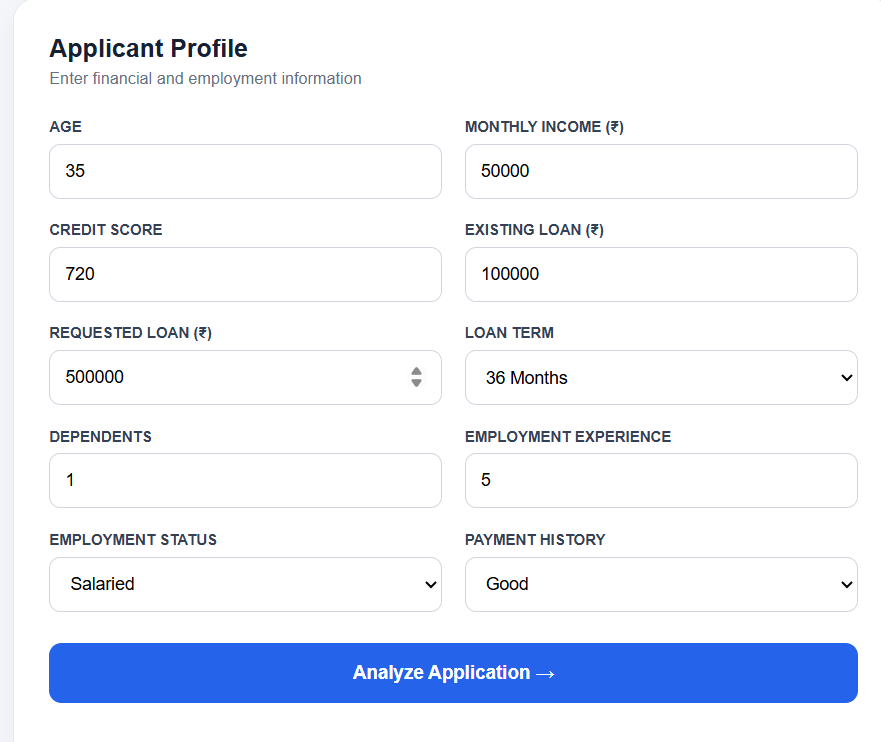
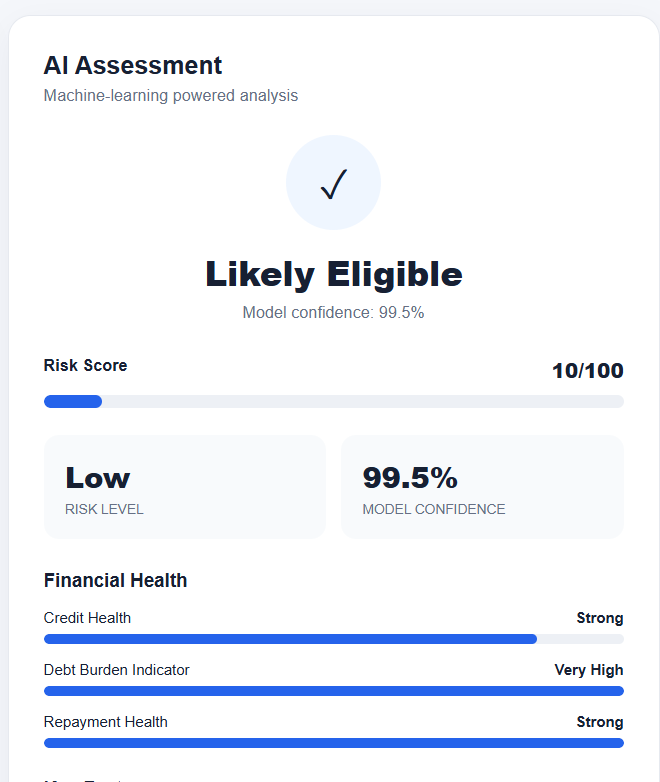
LoanLens AI analyzes an applicant’s financial and personal information to predict their loan eligibility and assess their risk level. It considers factors such as income, employment status, credit history, existing loans, loan amount, loan term, and other relevant information. The system provides a quick prediction that can assist financial institutions in making informed lending decisions.
How we built it
We built LoanLens AI using Python for the core machine-learning workflow. Pandas and NumPy were used for data processing and preprocessing, while Scikit-learn was used to train and evaluate machine-learning models. We used Flask/FastAPI for the backend and HTML, CSS, and JavaScript for the user interface. A MySQL/PostgreSQL database can be used to manage applicant information and prediction records.
Challenges we ran into
One of our biggest challenges was preparing the dataset for machine learning. We had to handle missing values, convert categorical information into numerical form, select relevant features, and compare different algorithms. Ensuring that the model produced reliable predictions while keeping the system simple and user-friendly was another challenge.
Accomplishments that we're proud of
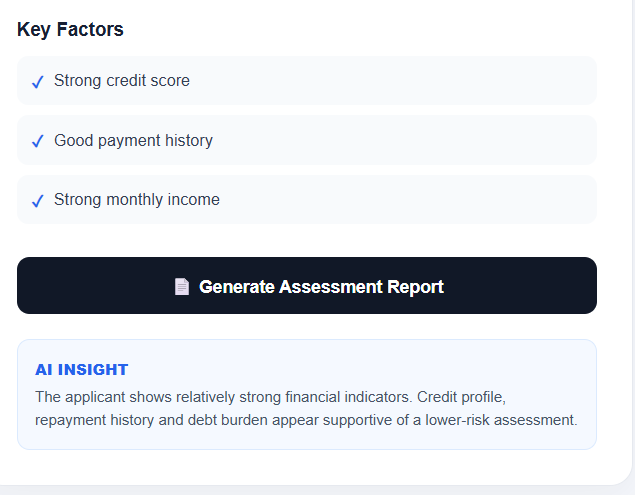
We are proud of building an end-to-end AI-based system that connects data processing, machine learning, backend development, and a user-friendly interface. We successfully transformed raw applicant information into meaningful eligibility and risk predictions, creating a practical solution that could assist in the loan evaluation process.
What we learned
Through this project, we learned that building an ML solution involves much more than simply training a model. Data preprocessing, feature selection, model evaluation, and understanding the problem domain are equally important. We also gained experience in connecting a machine-learning model with a web-based application.
What's next for LoanLens AI
In the future, we want to improve the model with larger and more diverse datasets and explore advanced algorithms such as XGBoost. We also plan to add explainable AI, so users can understand why a particular prediction was made. Additional features could include personalized loan recommendations, fraud-risk detection, real-time credit-data integration, and improved fairness and bias monitoring.
Built With
- css
- flask
- html
- javascript
- learning
- machine
- numpy
- pandas
- python
- scikit-learn
- sqlite


Log in or sign up for Devpost to join the conversation.