Inspiration After working at a bank as a loans officer and seeing how hard it is to keep track of loans, I have built Loanledger to give lenders a modern, accessible tool for tracking loans, payments, and obligations.
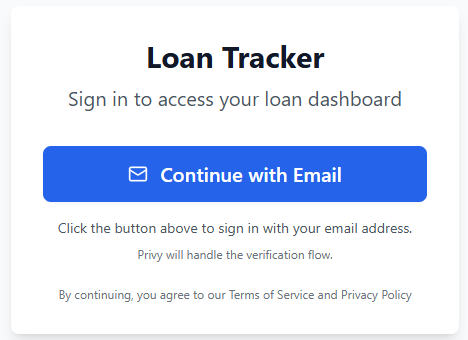
What it does Loanledger is a loan tracking dashboard that: Manages loans with full CRUD operations Generates automatic payment schedules using amortization formulas Calculates risk scores based on payment history and obligations Sends alerts for due payments, overdue items, and high-risk loans Provides analytics with portfolio distribution charts Tracks financial, reporting, and operational obligations Supports multi-user authentication via Privy
How I built it Built with React 19, Vite, Zustand, and Tailwind CSS. Implemented: Amortization calculations for payment schedules Risk scoring algorithm evaluating payment history, obligations, and time to maturity User-specific data isolation using localStorage keys Protected routes with Privy authentication Recharts for data visualization Phases: core loan management → UI components → alert system → authentication → polish.
Challenges I ran into Financial calculations: Ensuring accurate amortization formulas and handling edge cases State management: Managing interconnected loans, payments, and obligations User data isolation: Implementing multi-user support with localStorage Performance: Optimizing alert generation for large portfolios Backend migration: Designing for future API integration without major refactoring
Accomplishments that I am proud of Complete loan management system with automatic calculations Intelligent risk scoring algorithm Automated alert system Clean, responsive UI Multi-user architecture ready for backend migration Comprehensive documentation
What I learned Financial engineering: Amortization formulas, risk assessment, payment scheduling Modern React: Zustand state management, React Router, custom hooks UX design: Dashboard design, data visualization, responsive layouts Authentication: Privy integration and protected routes Architecture: Organizing complex applications with clear separation of concerns
What's next for Loanledger Backend integration: Migrate from localStorage to REST API or Supabase Real-time updates: WebSocket support for live portfolio updates Advanced analytics: Trend analysis and forecasting Document management: Upload and store loan documents Email notifications: Automated alerts via email Export functionality: CSV/PDF reports Payment recording: Interface for recording actual payments Team collaboration: Multi-user access with role-based permissions Rolling into production to ease loan tracking

Log in or sign up for Devpost to join the conversation.