-
-
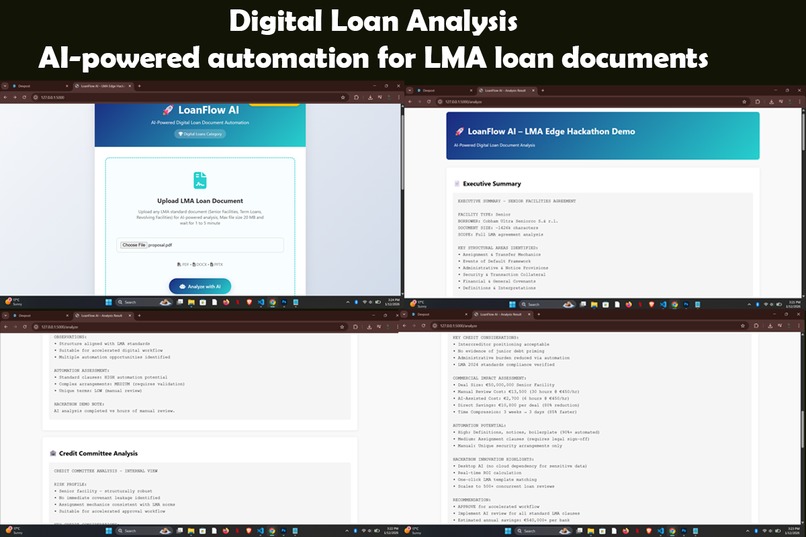
User Interface
Inspiration
I was primarily inspired by the way company annual reports are used in financial analysis. Annual reports often span 100–200 pages, and while reading them in full is important, extracting only the critical insights for valuation, risk assessment, and research reports consumes a significant amount of time and effort.
While reflecting on this, I noticed that digital loan documents—especially LMA-based facility agreements—present the same problem, but at an even higher operational cost. These documents are long, repetitive, and highly standardized, yet banks still rely on manual legal and credit review, which slows down approvals and increases expenses.
This led me to a simple question:
Why can’t we have an AI system that extracts only what actually matters for loan approval—quickly, reliably, and in a structured way?
That idea became the foundation for LoanFlow AI.
What it does
LoanFlow AI allows users to upload LMA-based loan documents (PDF, DOCX, PPTX), and automatically extracts:
Key structural elements of the facility
Credit-relevant insights for fast approval
Automation potential across standard LMA clauses
Commercial impact in terms of time and cost savings
Instead of reading hundreds of pages, decision-makers receive a credit-committee-ready summary in minutes—helping banks save time, reduce costs, and accelerate approvals without compromising control.
How we built it
Due to hardware limitations on my local machine, I leveraged Kaggle’s notebook environment and GPU infrastructure to develop and test the model.
The solution was built using:
A large language model sourced from Hugging Face
Fine-tuned prompting and structured inference inside Kaggle Notebooks
Kaggle notebooks used as a remote inference layer
A Flask backend for application logic
PostgreSQL for storing uploaded documents and analysis results
A lightweight frontend for secure document upload and result visualization
This hybrid architecture allowed me to build an enterprise-grade AI system without requiring high-end local hardware, making the solution both practical and scalable.
Challenges we ran into
Initially, I believed that models trained or tested on Kaggle must be fully exported and run locally, which was not feasible due to their size and compute requirements.
The real challenge—and learning curve—was discovering that:
Kaggle notebooks can effectively be used as an inference endpoint
Models do not always need to run locally to power a production-like demo
Since this was my first time building such a pipeline, integrating Kaggle, APIs, backend services, and deployment required continuous problem-solving. While challenging, the process was extremely rewarding and educational.
Accomplishments that we're proud of
Building a fully working AI system from scratch despite limited hardware
Designing a realistic, commercially viable banking use case
Creating a product that speaks the language of credit committees, not just engineers
Proving that strong understanding and system thinking can compensate for lack of formal credentials
I am not a professional ML engineer or data scientist—but this project reinforced my confidence that deep understanding, curiosity, and practical AI usage can create real value.
What we learned
Kaggle notebooks can be repurposed as powerful inference backends
Large AI systems can be built without expensive local infrastructure
Enterprise AI is less about models and more about workflow integration
Structured prompts and domain framing matter more than raw model size
Most importantly, I learned that this approach can be extended far beyond loans—to any document-heavy financial workflow.
What's next for LoanFlow AI – Digital Loan Analysis
Expand support beyond senior facilities to revolving credit, term loans, and hybrid structures
Add clause-level risk scoring and comparison
Introduce version-to-version document diffing
Enable bank-specific policy overlays on top of LMA standards
Package the solution as a secure desktop or private-cloud product for banks
The long-term vision is to make LoanFlow AI a standard AI layer for institutional credit workflows, reducing friction while maintaining full human oversight.
Built With
- flask
- hugging
- inference
- kaggle-notebook
- language
- large
- model
- pdfplumber
- postgresql
- prompt-based
- python
- python-docx
- python-pptx
- werkzeug

Log in or sign up for Devpost to join the conversation.