Inspiration
According to S&P Global market intelligence, Singapore's leading banks face slower loan growth in 2023, tied down by tight monetary policy and a poorer picture for Asia-Pacific economies as central banks keep their focus on inflation control (2022). Increases in interest rates since late 2021 have boosted Singapore's largest lenders by assets. However, this rise could become a double-edged sword, and hinder borrowing. We mainly target two objectives that also experience constraints in lending, which are individual consumers and small and medium-sized enterprises (SMEs).
Goals
Singapore's current process of assessing and approving loans is not optimized, which creates obstacles for both borrowers and lenders. Given the problem's urgency and its consequences on economic development, our team aims to apply Machine Learning to simplify the loan application process and give users a holistic view of each other's credibility and capability.
What it does
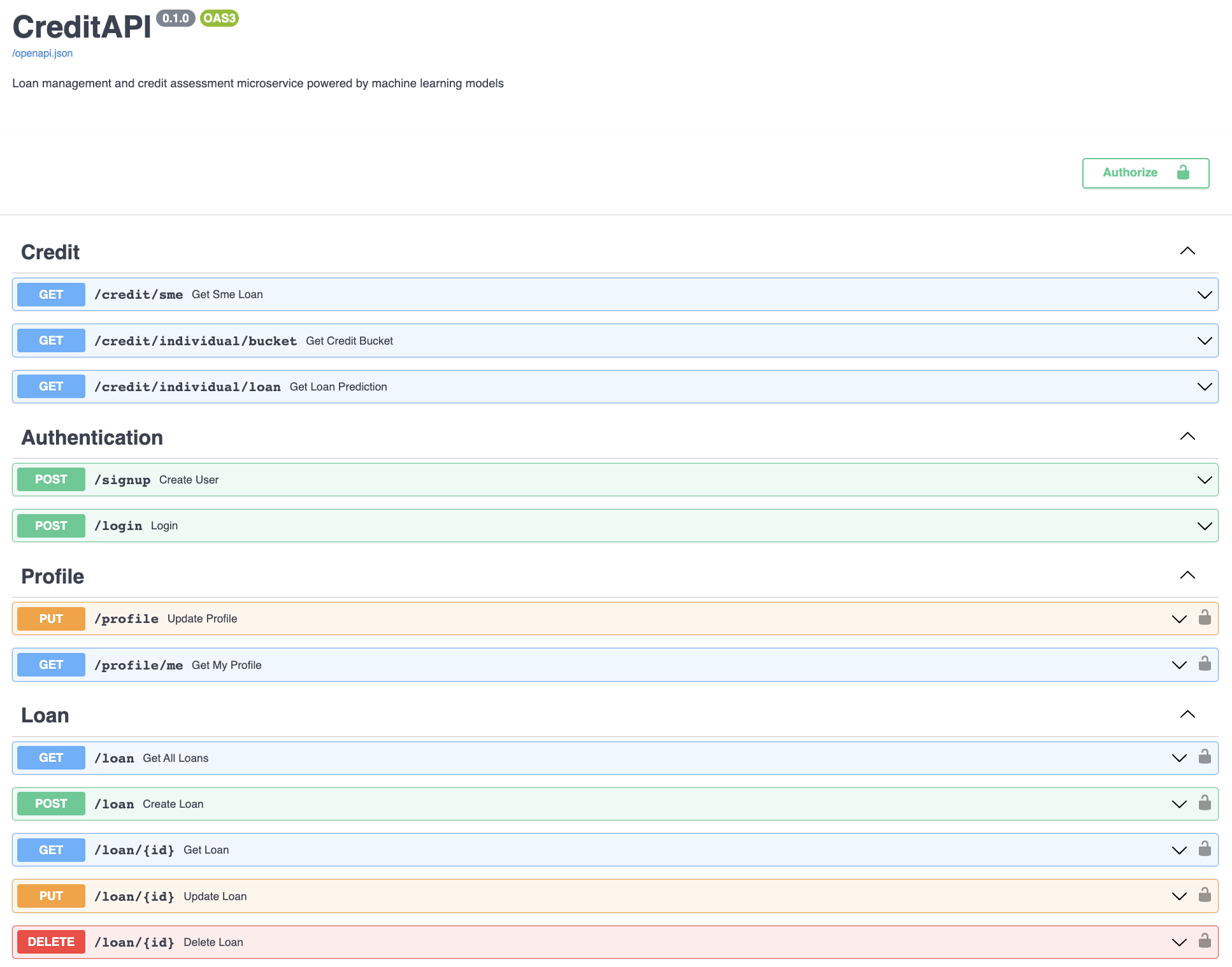
To address the difficulties in lending and borrowing, we proposed a Loan Management and Credit Assessment Microservice. It complies with the OpenAPI standard and contains 2 main components:
Public credit-assessment endpoints that are powered by machine learning models. First, clients can use the API to determine individuals' credit score buckets (Good, Standard, or Poor),. They can also use it to predict whether a personal loan will be accepted or not and the expected loan amount for SMEs by using collateral analysis.
Loan management component serves as the backend for a mobile application. We have also provided a Figma prototype for this application.
How we built it
We use scikit-learn to build our machine learning models and FastAPI to build the microservice. The microservice is hosted on an AWS EC2 machine with an Nginx reverse proxy.
Challenges we ran into
Our main challenge is to find relevant datasets to train our machine learning models. The available public datasets on Kaggle are "not so clean" and do not contain too many data points since financial data is hardly made available to the public.
What's next for Loan Management and Credit Assessment Microservice
As our Loan Management backend gets data from users, that data can be used to enhance our prediction model. For further improvement of our microservice, we can build a data pipeline and add an online learning component to train our models in real-time.

Log in or sign up for Devpost to join the conversation.