Inspiration
Loan management today is largely reactive. In many institutions, risks are addressed only after covenants are breached or payments are missed, leading to higher defaults, rushed human decisions, and operational stress. While AI is often used for credit scoring or alerts, it rarely closes the loop between risk detection and safe action.
We were inspired by this gap between prediction and decision. We asked a simple question: What if loans could manage themselves proactively while still respecting compliance, explainability, and human oversight? This question led to the creation of Loan Autopilot.
What it does
Loan Autopilot is a safe, explainable AI system that proactively keeps loans healthy.
The system:
Detects early risk drift instead of waiting for failures
Estimates time-to-breach for covenants and obligations
Simulates multiple compliant corrective actions
Applies strict guardrails to control AI autonomy
Automatically executes safe actions or escalates to humans
Logs every decision in a transparent loan timeline
Rather than just reporting risk, Loan Autopilot actively manages it responsibly.
How we built it
The project was built as a production-style MVP with realism and safety as first principles:
Loan State Machine Each loan moves through deterministic states: HEALTHY → WATCH → MITIGATION → ESCALATION → RECOVERY
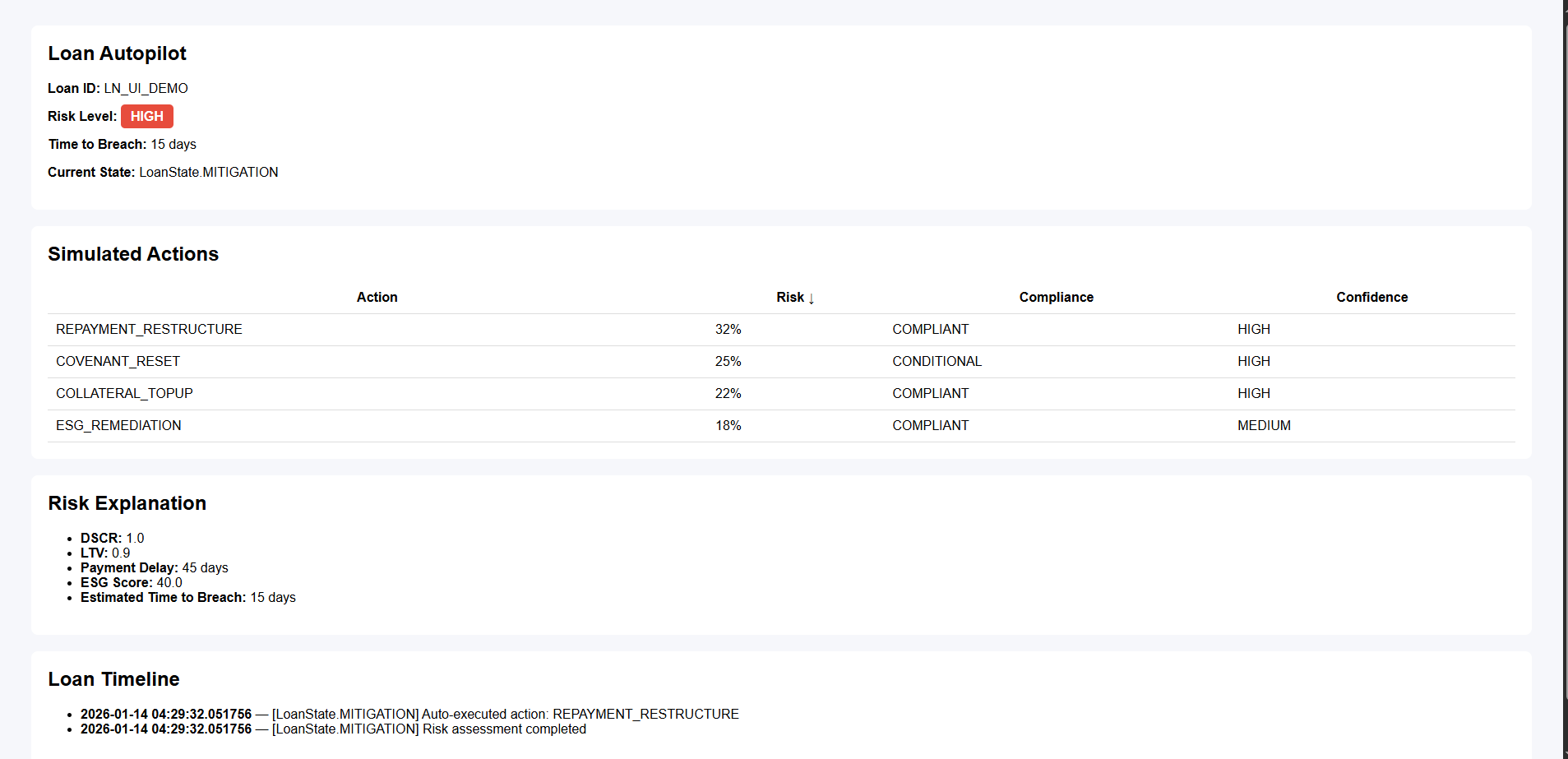
Risk Drift Engine Financial, behavioral, and ESG signals (DSCR, LTV, payment delays, ESG score) are analyzed to predict risk and time-to-breach with explainable reasoning.
Action Simulation Engine The system simulates interventions such as repayment restructuring, covenant resets, collateral top-ups, and ESG remediation ranking them by risk reduction, compliance, and confidence.
Guardrailed Autonomy AI actions are executed only when they are compliant, high-confidence, and appropriate for the loan state. Otherwise, cases are escalated to human review.
Transparent Timeline & UI A minimal, read-only dashboard displays loan state, simulated actions, and a chronological decision timeline, reflecting how real risk teams consume AI outputs.
Challenges we ran into
Balancing autonomy with safety Full automation in finance is risky. Designing meaningful guardrails without making the AI ineffective required careful trade-offs.
Avoiding black-box AI We intentionally avoided opaque models and focused on explainable, deterministic logic that financial professionals can trust.
Scoping discipline It was tempting to add complex UI features and workflows, but restraint was necessary to keep the system clear, realistic, and demo-ready.
Accomplishments that we're proud of-
Built a complete end-to-end decision loop, not just a prediction tool
Designed an AI system that acts responsibly, not recklessly
Delivered explainability, compliance, and autonomy in a single workflow
Created a demo that mirrors real-world financial operations
What we learned
In financial systems, trust and transparency matter more than model complexity
AI is most valuable when it supports decisions, not just insights
Guardrails and escalation paths are essential for real-world autonomy
Clear product scoping can be a competitive advantage in hackathons
What's next for Loan Autopilot - Safe Autonomous Loan Risk Management
Future phases focus on integration, not new intelligence, including:
Connecting to live loan servicing and document systems
Portfolio-level monitoring across thousands of loans
Deeper ESG and regulatory reporting integration
Deployment as an internal risk-management engine for lenders
Loan Autopilot demonstrates that safe, explainable autonomous loan management is achievable today.


Log in or sign up for Devpost to join the conversation.